Contents
What it is
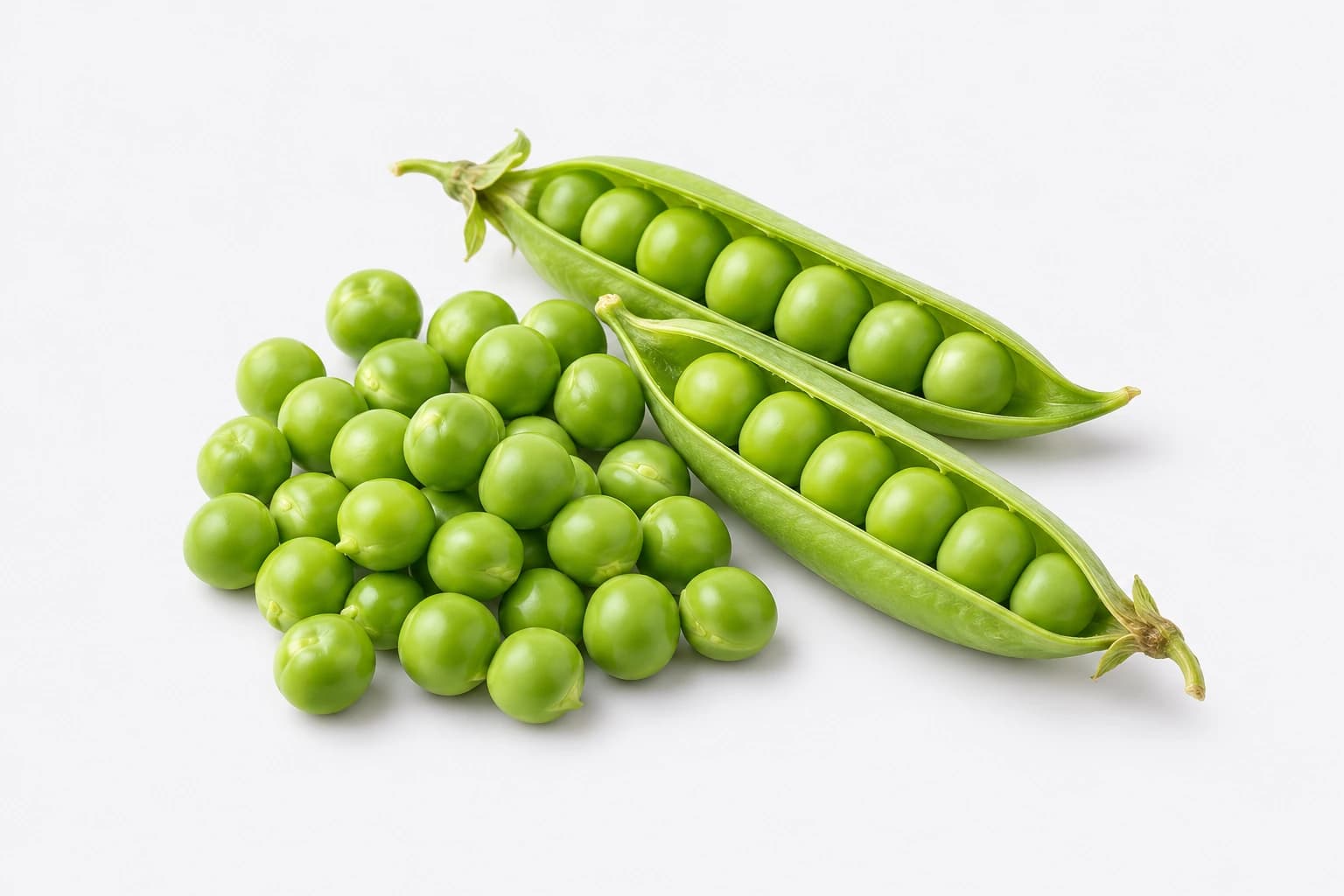
Green peas are the immature seeds of an annual legume native to western Asia and the Mediterranean. Left to ripen and dry on the same plant they become the hard yellow split pea; picked young and green, they are what we call garden peas. That is why, unlike other pulses, they carry more sugar than starch and taste sweet — and why the sugar converts to starch fast after picking, dulling that sweetness. It is exactly this that makes peas frozen within hours of harvest so common.
Scientific name Pisum sativum
Green peas have long been carried along by the claim that pulses are good for cholesterol. But there is a trial that looked at peas on their own, and in it peas failed.
2024, Journal of Nutrition. The same study, the same duration and the same amount compared beans and peas, each against rice.
- Beans: LDL −0.21 mmol/L (95% CI −0.39 to −0.03) — significant
- Peas: LDL −0.11 mmol/L (95% CI −0.29 to 0.07) — the interval crosses zero
The authors' conclusion reads: beans, but not peas, lowered LDL-cholesterol.
This site prints that sentence as it stands. Writing "pulses are good for cholesterol" on a page about green peas, when a trial has already looked at peas separately, would be burying it.
None of which makes green peas a bad food. The composition table stands out among vegetables.
- Protein 5.42 g — high for a vegetable
- Fibre 5.7 g
- Vitamin C 40 mg, thiamin 0.266 mg
- Lutein and zeaxanthin 2,480 µg
The lutein has its own honest caveat, set out below.
Key benefits
- Not established
Peas did not lower LDL — beans, in the same trial, did
[1][2]2024, Journal of Nutrition. Registration NCT01661543.
This trial matters because it did not lump pulses together — it split them by type.
Participants Adults with mild hypercholesterolaemia, 60 per group, three groups Setting Two Canadian cities (Edmonton, Winnipeg) Design Randomised, single-blind, three-arm parallel group Intervention 120 g (about ¾ cup) a day of beans or peas, or identical foods with white parboiled rice The beans A mixture of black, great northern, navy and pinto The peas A mixture of yellow and green peas Duration Six weeks Primary outcome LDL-cholesterol The results, relative to rice, at six weeks:
Change (mmol/L) 95% CI Beans — LDL −0.21 −0.39 to −0.03 significant Peas — LDL −0.11 −0.29 to +0.07 crosses zero Beans — non-HDL −0.20 −0.40 to −0.002 significant Beans — total cholesterol −0.28 −0.49 to −0.06 significant What did not move in either group:
- Triglycerides −0.07 (−0.28 to 0.14)
- Glucose 0.02 (−0.17 to 0.14)
- Insulin 4.94 (−5.51 to 11.38)
- Systolic blood pressure −1.39 (−5.18 to 2.40), diastolic −1.89 (−4.65 to 0.88)
How to read this.
The peas' −0.11 does not mean the effect is zero. The estimate points the same way as the beans', at about half the size. The interval crossing zero means this trial, at this size, could not tell whether there was an effect.
But in the same trial, the beans could be told apart. Same design, same 60 people, same six weeks, same 120 g. When one arm clears the bar under identical conditions and the other does not, that difference is not something to wave away.
The pulse meta-analysis had already flagged this.
The 2026 Journal of the American Heart Association meta-analysis cited in this site's lentil and chickpea entries pooled 38 randomised trials and 2,095 people and reported that a median 130 g a day of pulses lowered LDL by 0.14 mmol/L (95% CI −0.19 to −0.08).
Those authors wrote something into the text: that more research is needed on chickpeas, peas and lentils. This 2024 trial set out to fill exactly that gap, and for peas the gap did not close.
And the authors found something interesting along the way.
In the bean group there was no correlation between fibre intake and LDL (grams per day, r²=0.209, p=0.142). So the authors wrote that fibre may not be responsible for the effect of beans, and that other phytochemicals may be the active components.
That could also explain the pea result. If peas are no worse than beans for fibre and yet LDL did not move, the difference lies somewhere other than fibre.
One distinction must be stated last.
This trial used dry peas — yellow and green peas dried, the split-pea form. The composition table on this page is for fresh green peas, the immature seed taken out of the pod.
They are the same plant but different foods. Dry peas are far higher in protein and fibre; fresh green peas are higher in vitamin C and sugar. So carrying this trial's result straight across to fresh green peas is not accurate either.
The honest conclusion:
- In a trial that looked at peas on their own, LDL did not fall significantly
- In the same trial, beans did
- Glucose, insulin, triglycerides and blood pressure did not move in either group
- What was used was dry peas; this page's table is fresh green peas
- The grade is "not established"
- If cholesterol is the goal, the pulse with the evidence behind it is beans
- Nutrition data
Protein 5.42 g — a rare figure on a vegetable's table
The previous section was a null result, so this one deals only in what is certain: the composition.
Per 100 g of raw green peas:
- 81 kcal, protein 5.42 g, carbohydrate 14.4 g, fibre 5.7 g, sugar 5.67 g, fat 0.4 g
- Vitamin C 40 mg, thiamin (B1) 0.266 mg, folate 65 µg, vitamin A 38 µg
- Lutein and zeaxanthin 2,480 µg
- Potassium 244 mg, phosphorus 108 mg, magnesium 33 mg, iron 1.47 mg, zinc 1.24 mg, calcium 25 mg, manganese 0.41 mg
- Sodium 5 mg
Why the 5.42 g of protein stands out.
Vegetables rarely carry more than 5 g of protein per 100 g. On this site cucumber is 0.65 g, cabbage 1.3 g, spinach 2.9 g. It is because peas are a legume — a seed inside a pod, and seeds store protein.
But set the comparison on the right scale. Lentils, in the same family, carry 9.0 g of protein and 7.9 g of fibre per 100 g boiled. Green peas are high in protein for a vegetable, not high among pulses. Fresh green peas are still an immature seed, full of water.
The 40 mg of vitamin C is worth noting too.
Against an adult recommendation of 100 mg, that is 40% in 100 g. You almost never see that figure in a pulse — dried beans have essentially no vitamin C. Peas have it because they are eaten immature. Vitamin C disappears as the seed ripens and dries.
But vitamin C is heat-sensitive. Long boiling leaches or destroys much of it. A short blanch is better.
Thiamin at 0.266 mg is also on the high side. Against an adult recommendation of 1.1 to 1.2 mg, that is a little over 20% in 100 g. Thiamin is a coenzyme in turning carbohydrate into energy.
The 5.7 g of fibre can be taken at face value. Unlike this site's chicory root entry, the fibre in peas is the kind traditional assays capture normally.
Now the most practical part — frozen against canned.
Fresh and frozen Canned Sodium around 5 mg hundreds of mg, depending on the product Vitamin C retained substantially reduced by heat and storage Texture kept softened Frozen peas are a good choice. They are blanched and flash-frozen right after harvest, so losses are small and they sit close to fresh. They work regardless of season.
With canned peas, watch the sodium. Fresh green peas carry 5 mg; canned products are far higher because salt goes into the packing liquid. If you use them, tip them into a sieve and rinse. A good share washes off.
Lastly, FODMAPs. Peas contain oligosaccharides (GOS), and low-FODMAP diets restrict the portion size. With irritable bowel syndrome, large amounts may bring gas and bloating.
- Not established
Lutein 2,480 µg — but the largest trial's primary analysis failed
[3]Green peas carry 2,480 µg of lutein and zeaxanthin per 100 g. That is the figure you would expect from a deep green vegetable.
Food (100 g) Lutein + zeaxanthin Kale 6,260 µg Green peas 2,480 µg Sweetcorn 644 µg These two pigments accumulate selectively in the macula of the eye. They filter blue light and act as antioxidants. The body cannot make them, so they come only from food. That much is established.
Which is where "peas are good for your eyes" comes from. Here is where honesty is required.
2013, JAMA, AREDS2.
Participants 4,203 adults at high risk of progression to advanced macular degeneration Duration Five years Intervention Lutein 10 mg plus zeaxanthin 2 mg Primary outcome Progression to advanced macular degeneration Primary analysis: no significant reduction.
Hazard ratio 0.90, 95% CI 0.76 to 1.07, p=.12.
The interval crosses 1. It could not rule out there being no effect.
This does not mean lutein is useless. A subgroup analysis in AREDS2 showed benefit in participants with the lowest dietary lutein intake, and a formulation substituting lutein for beta-carotene subsequently entered recommendations. But a primary analysis is a primary analysis. Subgroup analyses are for generating hypotheses, not for drawing conclusions.
And look at the dose.
The trial used 10 mg of lutein. The lutein and zeaxanthin in 100 g of green peas is 2.48 mg — a quarter of the trial dose.
Matching the AREDS2 dose from green peas would take more than 400 g a day. And that trial still failed its primary analysis.
One practical point about absorption.
Lutein is fat-soluble. Eating it with fat improves absorption. Sautéing peas in olive oil, or pairing them with egg or avocado, is the better move. That is a statement about absorption, and it does not change the trial result above.
The honest conclusion:
- Green peas contain 2,480 µg of lutein and zeaxanthin — a fact of composition
- That these pigments accumulate in the macula is established — a fact of mechanism
- The largest trial's primary analysis did not significantly reduce progression of macular degeneration
- That trial's dose was four times what 100 g of peas provides
- The grade is "not established"
- If you are worried about your eyes, an eye examination comes before food
How to eat it well
- Use frozen peas. Blanched and flash-frozen after harvest, they sit close to fresh in composition and work in any season.
- Blanch briefly. Long boiling leaches much of the 40 mg of vitamin C into the water.
- Eat them with fat. Lutein is fat-soluble, so absorption improves.
- Rinse canned peas in a sieve. Fresh green peas carry 5 mg of sodium; canned is far higher.
- If cholesterol is the goal, beans are the better pulse. They are the arm that produced evidence in the same trial.
- Dry peas and fresh green peas are different foods. The figures on this page are fresh.
- With irritable bowel syndrome, watch the portion. Peas contain oligosaccharides.
- They pair well with egg, avocado and olive oil. Fat alongside helps the lutein.
How to read the grades
Each benefit carries a label showing how far research on people supports it. Grades differ between items even within the same ingredient.
- Nutrition data
- A fact verifiable from food composition databases or health authorities. This is a different kind of statement from a clinical effect.
- Strong evidence
- Consistently confirmed across randomised controlled trials or meta-analyses.
- Moderate evidence
- Human studies exist, but effect sizes are small or results are mixed.
- Early research
- Cell or animal work, or small preliminary studies.
- Not established
- Commonly claimed, but not confirmed in studies on people.
What to watch out for
- In a randomised trial of peas alone, LDL did not fall significantly (−0.11 mmol/L, 95% CI −0.29 to 0.07). In the same trial, beans did.
- Glucose, insulin, triglycerides and blood pressure did not move in either the bean or the pea group.
- That trial used dry peas, while the table on this page is fresh green peas.
- The primary analysis of the largest lutein trial (AREDS2) was not significant (hazard ratio 0.90, 95% CI 0.76 to 1.07).
- The AREDS2 lutein dose was 10 mg, four times what 100 g of green peas provides (2.48 mg).
- Canned peas are far higher in sodium. Rinse them before use.
- Peas contain oligosaccharides. Large amounts can cause gas and bloating, and low-FODMAP diets restrict them.
- Pea allergy is reported, though rarely, and cross-reaction with peanut allergy has been described.
Nutrition
Per 100 g of raw green peas. Frozen peas are close to this; canned peas differ sharply in sodium.
- Calories
- 81 kcal4%
- Protein
- 5.42 g11%
- Carbohydrates
- 14.4 g5%
- Fiber
- 5.7 g20%
- Sugars
- 5.67 g
- Fat
- 0.4 g<1%
- Vitamin C
- 40 mg44%
- Vitamin B1
- 0.266 mg22%
- Folate
- 65 µg16%
- Vitamin A
- 38 µg4%
- Lutein
- 2480 µg
- Potassium
- 244 mg5%
- Phosphorus
- 108 mg9%
- Magnesium
- 33 mg8%
- Iron
- 1.47 mg8%
- Zinc
- 1.24 mg11%
- Calcium
- 25 mg2%
- Manganese
- 0.41 mg18%
- Sodium
- 5 mg<1%
Percentages are of the US FDA Daily Value for adults and children 4 and over. National reference intakes differ by sex and age.
Calculate this alongside other ingredients →
Key nutrients
By health concern
Dishes with this ingredient
Sources
The databases and health authorities this article's nutrition figures and health statements draw on.
- 1A Comparison of Dry Bean and Pea Consumption on Serum Cholesterol: A Randomized Controlled Trial in Adults with Mild HypercholesterolemiaClinical trialBell RC, et al. J Nutr 2024PMID 39357673
- 2Effect of Different Types of Whole Dietary Pulses on Established Therapeutic Lipid Targets for Cardiovascular Risk Reduction: An Updated Systematic Review and Dose-Response Meta-Analysis of Randomized Controlled TrialsMeta-analysisBack S, et al. J Am Heart Assoc 2026PMID 42132198
- 3Lutein + zeaxanthin and omega-3 fatty acids for age-related macular degeneration: the Age-Related Eye Disease Study 2 (AREDS2) randomized clinical trialClinical trialAge-Related Eye Disease Study 2 Research Group JAMA 2013PMID 23644932
- 4USDA FoodData CentralFood composition database
- 5NIH Office of Dietary SupplementsHealth authority
- 6PubMedResearch literature