Contents
What it is
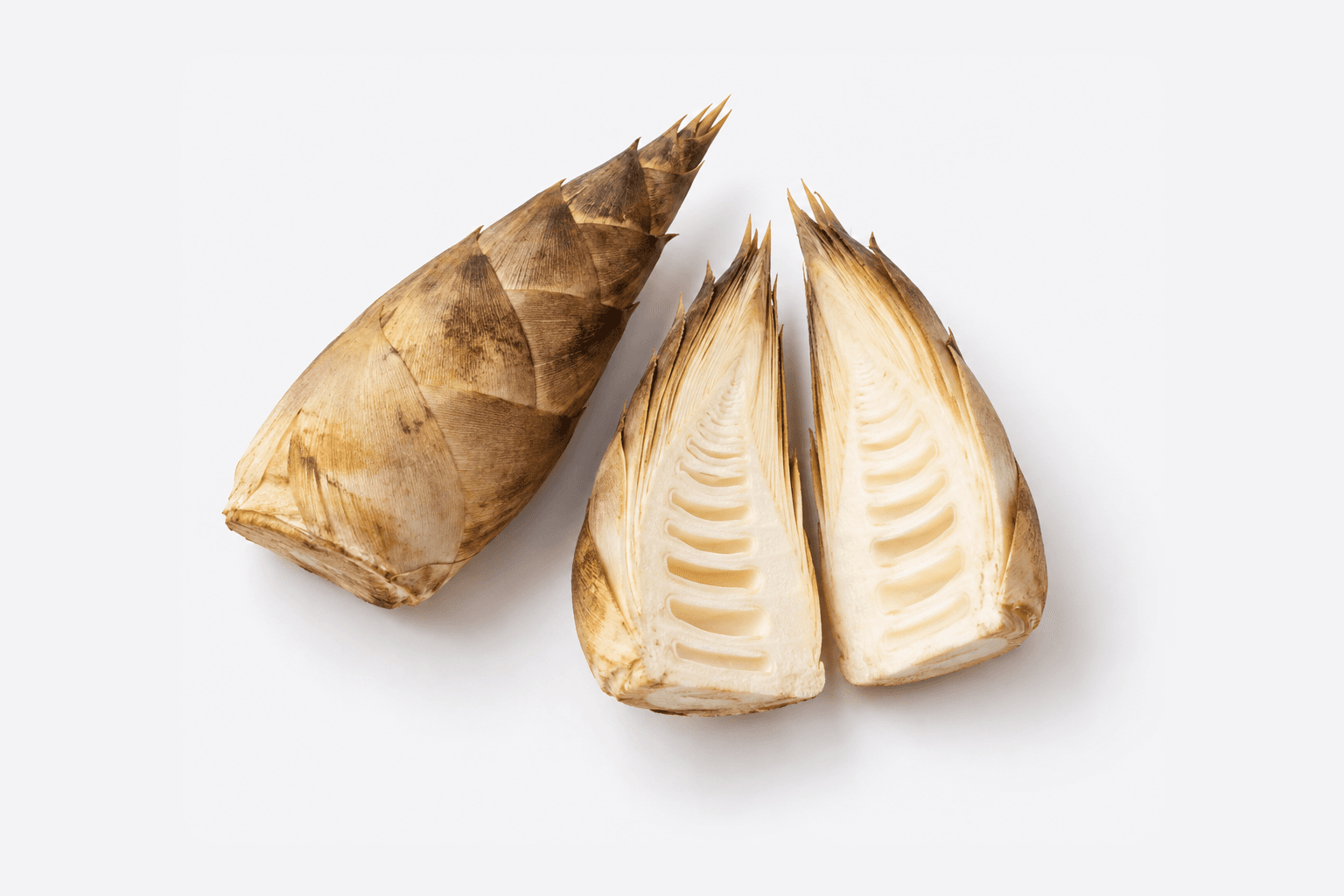
A bamboo shoot is the young sprout that pushes up from a bamboo's underground stem in spring. Left alone it becomes a bamboo stalk, so it is dug while still sheathed in husk and before it hardens. It is eaten in Korea, China and Japan, and the fresh season lasts only a few weeks. Harshness builds quickly after harvest, so the key step is boiling it with rice-washing water or rice bran to draw that out. The appeal is its crisp snap; pre-boiled vacuum packs and cans are widely sold year-round.
Scientific name Phyllostachys edulis
On a bamboo shoot page, preparation has to come before benefits.
Bamboo shoots contain cyanogenic glycosides, principally taxiphyllin. To quote a 2025 review in Food Chemistry directly: bamboo shoots are a staple of Asian diets and valued for their nutrients, but "they contain cyanogenic glycosides, primarily Taxiphyllin, posing toxicity risks if improperly consumed."
Cyanogenic glycosides release hydrogen cyanide when the tissue is damaged and they meet an enzyme. They belong to the same family of compounds found in bitter almonds, cassava and apricot kernels.
Fortunately, processing reduces them substantially. That same review examined the role of traditional and industrial methods — boiling, fermentation and steaming — in lowering taxiphyllin. The custom in Korea, Japan and China of always boiling bamboo shoots comes from safety, not flavour.
The composition itself is ordinary — 27 kcal, 533 mg of potassium and 2.2 g of fibre per 100 g. The value of bamboo shoots lies in texture and low energy, not in any standout nutrient.
Key benefits
- Not established
They contain cyanogenic glycosides — boiling is not optional
[1]This entry is about safety, not benefit, and it is the most important item on this page.
A 2025 review in Food Chemistry examined bamboo shoots' nutritional profile, geographical consumption patterns and the role of taxiphyllin.
What the review covered:
- Bamboo shoots are a staple in Asian diets, particularly in India, China, Japan and Southeast Asia, and are valued for their rich nutrients
- However, they contain cyanogenic glycosides, primarily taxiphyllin, posing toxicity risks if improperly consumed
- It explores the impact of traditional and industrial processing methods — boiling, fermentation and steaming — in reducing taxiphyllin levels to ensure food safety
- Detection technologies in food processing matter for preventing cyanide poisoning
The mechanism behind the risk. Taxiphyllin itself has low toxicity. The problem arises when the tissue is damaged: cutting or chewing lets the plant's own enzyme (β-glucosidase) break the glycoside down and release hydrogen cyanide, which blocks cells from using oxygen.
Symptoms begin with headache, dizziness and nausea, and in severe cases reach breathing difficulty and reduced consciousness.
So the preparation is not optional.
- Peel them and cut away the tough base.
- Boil in plenty of water with the lid off. The lid must be off so the volatile hydrogen cyanide can escape.
- Always discard the boiling water.
- Thinner slices clear faster. Boiling them whole does not treat the middle.
Shop-bought pre-boiled and tinned shoots have already been processed and can be used as they are. The risk lies with shoots you dig yourself or buy raw.
Stated honestly: this review examined analytical techniques and processing methods; it does not give a single figure of the form "N minutes of boiling removes X%" that this site could cite. So no time in minutes is printed here — only the principles: plenty of water, lid off, water discarded.
- Nutrition data
533 mg of potassium on 27 kcal — high even among vegetables
Per 100 g of raw bamboo shoots:
- 27 kcal, protein 2.6 g, fat 0.3 g
- Of 5.2 g of carbohydrate, 2.2 g is fibre
- Potassium 533 mg — high even among vegetables
- Phosphorus 59 mg, zinc 1.1 mg
- Thiamine 0.15 mg, vitamin B6 0.24 mg
- Manganese 0.262 mg, copper 0.19 mg
- Sodium 4 mg
The 533 mg of potassium stands out. More than a banana's 358 mg and close to spinach's 558 mg — near the top among vegetables.
But boiling cuts it. Potassium is a water-soluble mineral, and the boiling that safety requires sends a good share of it into the water. The figures above are for raw shoots, and the boiled shoots you actually eat hold less.
This is the structural limit of a bamboo shoot page: eating them safely requires boiling, and boiling reduces the water-soluble nutrients. You cannot have both.
Zinc at 1.1 mg is high for a vegetable. Thiamine at 0.15 mg and vitamin B6 at 0.24 mg are not low either.
With 2.6 g of protein on 27 kcal, the protein share of the calories is high. Add 2.2 g of fibre and it becomes a food that fills more than it costs.
Sodium is effectively absent at 4 mg. Tinned products add salt, so check the label.
- Nutrition data
Where the crunch comes from, and what the white powder is
People eat bamboo shoots mostly for the texture, not for any exceptional nutrient.
That crunch comes from cellulose and lignin in the cell walls. A shoot is the tissue that will become bamboo, so lignification proceeds fast as it grows. That is why they toughen within a day of being dug — lignin synthesis continues after harvest.
Hence the saying "boil them the moment you dig them." It is a well-founded piece of advice: boiling inactivates the enzymes and stops the lignification.
You may have seen a white powder between the layers of boiled bamboo shoots. It is not mould or spoilage — it is tyrosine, an amino acid that crystallises as the shoots cool. It is safe to eat. Rinse it off if it bothers you.
The bitterness and astringency are not only about cyanogenic glycosides. Homogentisic acid and oxalate are involved too. The traditional method of boiling them with rice-washing water or rice bran is explained as adsorbing these compounds and reducing the astringency.
The season is spring. Shoots from April and May are the most tender; they toughen as the season passes.
Store them boiled and submerged in water in the fridge. Change the water daily and they keep about a week. Left raw, they only get tougher.
How to eat it well
- Raw shoots must be boiled. Peel them, boil in plenty of water with the lid off, and discard the water.
- Slicing them thin clears them faster. Boiling whole does not treat the middle.
- Shop-bought pre-boiled and tinned shoots are already processed and can be used as they are.
- Boiling them with rice-washing water or rice bran reduces the astringency.
- Boil them as soon as they are dug. They lignify and toughen with time.
- The white powder is tyrosine. Eat it or rinse it off, as you prefer.
- Keep them boiled and submerged in water in the fridge, changing the water daily.
- If potassium is what you are after, bamboo shoots are a poor choice — the boiling takes it out.
How to read the grades
Each benefit carries a label showing how far research on people supports it. Grades differ between items even within the same ingredient.
- Nutrition data
- A fact verifiable from food composition databases or health authorities. This is a different kind of statement from a clinical effect.
- Strong evidence
- Consistently confirmed across randomised controlled trials or meta-analyses.
- Moderate evidence
- Human studies exist, but effect sizes are small or results are mixed.
- Early research
- Cell or animal work, or small preliminary studies.
- Not established
- Commonly claimed, but not confirmed in studies on people.
What to watch out for
- Do not eat raw bamboo shoots. They contain cyanogenic glycosides (taxiphyllin) and carry a toxicity risk. Boiling, fermentation and steaming lower it.
- Boil with the lid off and discard the water. The volatile hydrogen cyanide has to escape.
- If headache, dizziness or nausea appear, stop immediately and seek medical care.
- Shoots you dig yourself are the greater risk. Content varies by species, and they have not been processed like commercial stock.
- If you restrict potassium for kidney disease, raw shoots hold 533 mg per 100 g. Boiling reduces it, but check.
- With thyroid disease, thiocyanate — a metabolite of cyanogenic glycosides — can interfere with iodine use.
- Tinned products add sodium. Check the label and rinse them.
- No randomised human evidence for health benefits of bamboo shoots was identified.
Nutrition
Per 100 g of raw bamboo shoots. Raw shoots are not eaten as they are — read the safety section first. Boiling leaches some of the nutrients into the water.
- Calories
- 27 kcal1%
- Protein
- 2.6 g5%
- Carbohydrates
- 5.2 g2%
- Fiber
- 2.2 g8%
- Potassium
- 533 mg11%
- Phosphorus
- 59 mg5%
- Zinc
- 1.1 mg10%
- Vitamin B1
- 0.15 mg13%
- Vitamin B6
- 0.24 mg14%
- Manganese
- 0.262 mg11%
- Copper
- 0.19 mg21%
- Sodium
- 4 mg<1%
Percentages are of the US FDA Daily Value for adults and children 4 and over. National reference intakes differ by sex and age.
Calculate this alongside other ingredients →
Key nutrients
Sources
The databases and health authorities this article's nutrition figures and health statements draw on.
- 1Uncovering taxiphyllin in bamboo shoots: an analytical perspectiveSystematic reviewsNiyogi A, et al. Food Chemistry 2025PMID 40179559
- 2USDA FoodData CentralFood composition database
- 3NIH Office of Dietary SupplementsHealth authority
- 4World Health Organization · Healthy dietHealth authority
- 5PubMedResearch literature