Contents
What it is
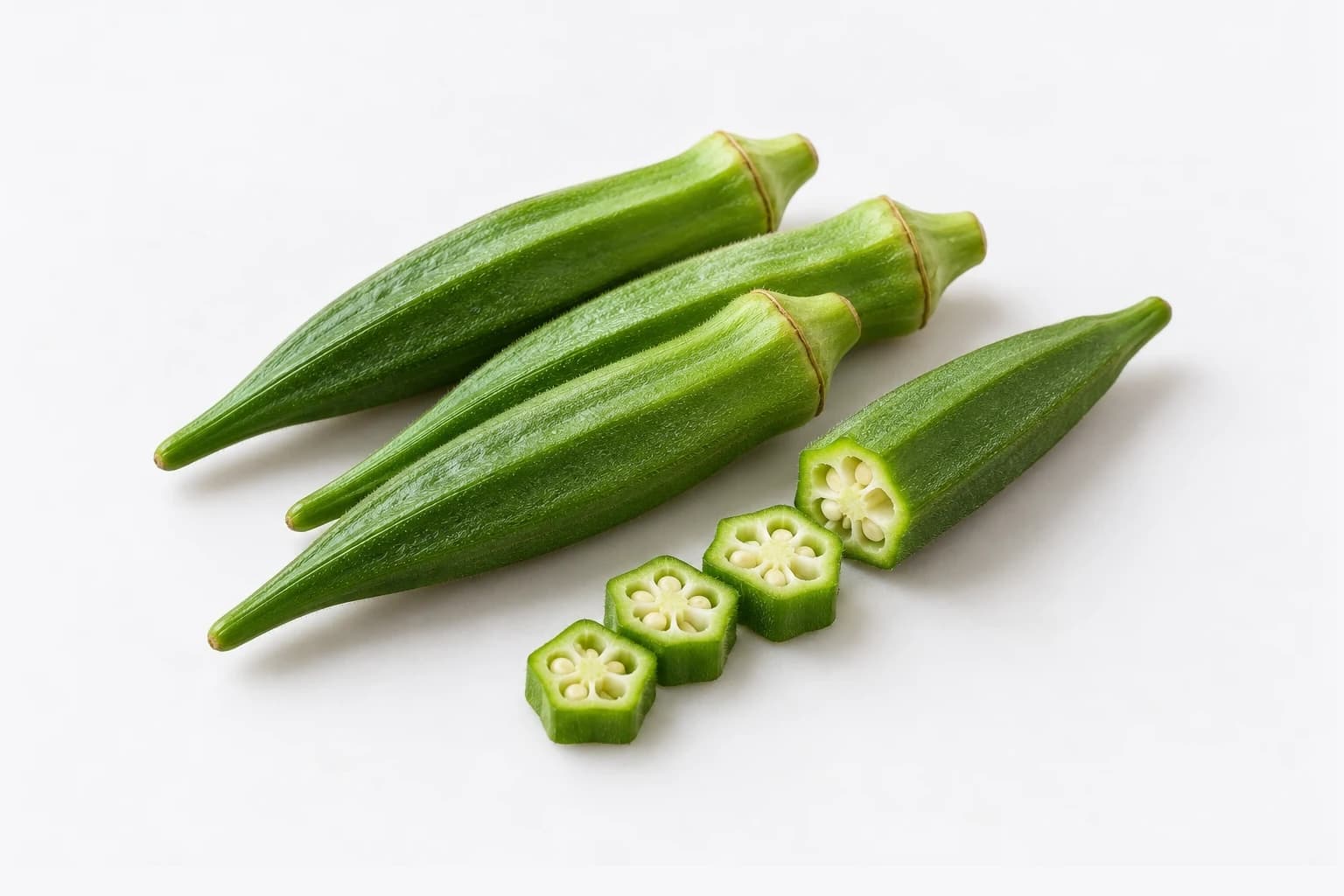
Okra is an annual plant in the mallow family, eaten as the whole unripe seed pod. It originated in West Africa and grows in hot climates. Its defining trait is the sticky mucilage released when the pod is cut. The flavour itself is mild and grassy, close to a green bean or aubergine. It is in season in summer and is blanched, stir-fried, or stirred into soups and stews.
Scientific name Abelmoschus esculentus
Cut okra and it releases a slippery mucilage. That mucilage is soluble fibre, and the claims about blood sugar and cholesterol start there.
The evidence is thicker than you might expect.
The British Journal of Nutrition, 2025, carried a GRADE-assessed systematic review and dose-response meta-analysis. Twelve randomised controlled trials, 770 participants.
| Outcome | Standardised mean difference | 95% CI |
|---|---|---|
| Fasting plasma glucose | −1.07 | −1.75 to −0.38 |
| Fat mass | −0.74 | −1.13 to −0.36 |
| Insulin resistance (HOMA-IR) | −0.56 | −0.84 to −0.29 |
| Total cholesterol | −0.45 | −0.74 to −0.16 |
| HbA1c | −0.38 | −0.71 to −0.05 |
| LDL-cholesterol | −0.32 | −0.52 to −0.11 |
All significant. That is a broader sweep than most ingredients on this site manage.
But two things have to be read before turning this into "eat okra". They are set out below.
Key benefits
- Moderate evidence
Broadly significant — and the doses span 320-fold
[1][2]2025, British Journal of Nutrition, a GRADE-assessed systematic review and dose-response meta-analysis.
Studies pooled 12 randomised controlled trials Participants 770 Duration 2 to 12 weeks Dose 125 mg to 40,000 mg a day Databases PubMed, Scopus, Web of Science, CENTRAL, EMBASE, to January 2025 The results were broadly significant, as the table above shows. Body mass index, fat mass, hip circumference, weight, fasting insulin, fasting plasma glucose, HbA1c, insulin resistance, LDL, total cholesterol and the liver enzyme AST all fell.
A second meta-analysis the same year, in Phytotherapy Research, reported improvements in diabetes and obesity markers in people with type 2 diabetes.
Now the two things that belong alongside it.
First, the dose range is abnormally wide.
From 125 mg to 40,000 mg a day. That is a 320-fold spread. The low end is about one capsule of concentrated extract; the high end is 40 g of powder. The numbers above are an average taken across both.
The paper reports a dose-response analysis, but an average drawn from a range this wide cannot answer "how much should I take". Whether the effect appeared at 125 mg or needed 40 g is not settled by this result.
Second, what the trials used was mostly not okra but okra products.
The word "supplementation" says so. Extracts, powders, capsules. Okra on a plate and a concentrated extract are different things — the same gap this site keeps writing about across other ingredients.
Third, the scale is small. Twelve trials and 770 people averages 64 per trial. The durations, 2 to 12 weeks, are short. HbA1c reflects red blood cell lifespan and needs at least 8 to 12 weeks before a change means much, and two-week trials are in the mix.
The honest conclusion:
- Two meta-analyses report significant improvement across a wide range of markers
- GRADE assessment is a methodological strength
- But a 320-fold dose range leaves the practical amount unknown
- What was used was mostly extract and powder, not okra as a vegetable
- The grade is "moderate"
- If you take diabetes medication, talk to your clinician — the directions of effect overlap
- Nutrition data
The mucilage is soluble fibre
The slippery substance released when you cut okra defines what this vegetable is.
Per 100 g of raw okra:
- 33 kcal, carbohydrate 7.45 g, fibre 3.2 g, sugar 1.48 g, protein 1.93 g, fat 0.19 g
- Vitamin C 23 mg, folate 60 µg, vitamin K 31.3 µg, vitamin B6 0.215 mg, thiamin 0.2 mg
- Magnesium 57 mg, potassium 299 mg, calcium 82 mg, phosphorus 61 mg, manganese 0.788 mg
- Beta-carotene 416 µg, lutein 280 µg, iron 0.62 mg, zinc 0.58 mg, sodium 7 mg
That is 3.2 g of fibre in 33 kcal. Per calorie it is high, and a substantial share is the soluble fibre — pectin and mucilage — that makes up the slipperiness.
How soluble fibre acts on blood sugar and cholesterol is established. It builds viscosity in the gut, slowing sugar absorption, and it traps bile acids and carries them out. The body rebuilds bile acids from cholesterol, so cholesterol gets used. This site's psyllium and oats work by the same mechanism.
But the quantities differ. Psyllium carries 77.8 g of fibre per 100 g and its trials used 10 g a day. Okra carries 3.2 g per 100 g, so matching that fibre would take more than 300 g of okra. That is why the trials used extracts and powders.
Magnesium at 57 mg is high for a vegetable — 14% of the 420 mg adult recommendation in 100 g.
Folate at 60 µg and vitamin K at 31.3 µg are worth noting too. Vitamin K is the one to keep steady if you take warfarin.
Practical notes on cooking.
- If you dislike the slime, cook the pods whole and do not cut them. It comes from the cut surface
- Acid reduces it. Lemon juice or vinegar leaves it less viscous
- A short sear over high heat releases less of it
- To use the mucilage instead, slice it into a soup or stew; it thickens
- Vitamin C is heat-sensitive. Long boiling costs much of the 23 mg
- Not established
On "okra water" — and the cautions
Slicing okra, soaking it in water overnight and drinking the liquid — "okra water" — has spread widely, usually with a claim about blood sugar.
This site found no human trial of okra water.
The twelve trials in the meta-analysis above used extracts and powders, not an infusion. Soaking would release some of the soluble fibre, but how much, and how that relates to the doses the trials used, has not been measured by anyone.
So the accurate statement is not "okra water does not work" but "it has not been tested". Eating the okra at least brings the fibre and the vitamins with it.
Now the cautions.
It overlaps with diabetes medication. If okra pushes blood glucose down, taking it alongside glucose-lowering drugs could push too far. If you are on medication, talk to your clinician. If you monitor your glucose, keep a record of any change.
An interaction with metformin has been reported in animal studies — that okra may reduce metformin absorption. It has not been confirmed in humans. Still, not taking them at the same time is the safe default.
Take care if you have had kidney stones. Okra is among the higher-oxalate foods, and calcium oxalate stones are the most common kind.
With 31.3 µg of vitamin K, keep your intake steady if you take warfarin — that is not an instruction to avoid it.
It is a high-fibre food, so a sudden large increase can bring gas and bloating if your usual fibre intake is low. Drink water as you increase the amount.
How to eat it well
- One pod is 10 to 12 g. Five pods is about half the table above.
- Cook them whole if you dislike the slime. It comes from the cut surface.
- Lemon juice or vinegar cuts the viscosity.
- A short sear over high heat keeps the texture and releases less mucilage.
- To thicken a soup, do the opposite and slice them in.
- The 23 mg of vitamin C is heat-sensitive. Do not boil them long.
- If you take diabetes medication, talk to your clinician. The directions of effect overlap.
- "Okra water" has no confirmed evidence. Eating the okra is the better bet.
How to read the grades
Each benefit carries a label showing how far research on people supports it. Grades differ between items even within the same ingredient.
- Nutrition data
- A fact verifiable from food composition databases or health authorities. This is a different kind of statement from a clinical effect.
- Strong evidence
- Consistently confirmed across randomised controlled trials or meta-analyses.
- Moderate evidence
- Human studies exist, but effect sizes are small or results are mixed.
- Early research
- Cell or animal work, or small preliminary studies.
- Not established
- Commonly claimed, but not confirmed in studies on people.
What to watch out for
- The meta-analysis pooled doses from 125 mg to 40,000 mg a day, a 320-fold range. It cannot tell you how much to take.
- What the trials used was mostly extract and powder, not okra as a vegetable.
- Twelve trials, 770 people, 2 to 12 weeks. HbA1c is hard to interpret over short periods.
- The direction of effect overlaps with diabetes medication. Taken together, glucose could fall too far; talk to your clinician.
- Animal studies report reduced metformin absorption. Unconfirmed in humans, but not taking them at the same time is the safe default.
- Okra is a high-oxalate food. Take care if you have had kidney stones.
- It carries 31.3 µg of vitamin K, so keep intake steady if you take warfarin.
- No human trial of "okra water" was found.
Nutrition
Per 100 g of raw okra. One pod is usually 10 to 12 g, so about five pods is half the table below.
- Calories
- 33 kcal2%
- Carbohydrates
- 7.45 g3%
- Fiber
- 3.2 g11%
- Sugars
- 1.48 g
- Protein
- 1.93 g4%
- Fat
- 0.19 g<1%
- Vitamin C
- 23 mg26%
- Folate
- 60 µg15%
- Vitamin K
- 31.3 µg26%
- Magnesium
- 57 mg14%
- Potassium
- 299 mg6%
- Calcium
- 82 mg6%
- Phosphorus
- 61 mg5%
- Manganese
- 0.788 mg34%
- Vitamin B6
- 0.215 mg13%
- Vitamin B1
- 0.2 mg17%
- Beta-carotene
- 416 µg
- Lutein
- 280 µg
- Iron
- 0.62 mg3%
- Zinc
- 0.58 mg5%
- Sodium
- 7 mg<1%
Percentages are of the US FDA Daily Value for adults and children 4 and over. National reference intakes differ by sex and age.
Calculate this alongside other ingredients →
Key nutrients
By health concern
Dishes with this ingredient
Sources
The databases and health authorities this article's nutrition figures and health statements draw on.
- 1Beneficial effects of okra (Abelmoschus esculentus L.) consumption on anthropometric measures, blood pressure, glycaemic control, lipid profile and liver function tests in randomised controlled trials: a GRADE-assessed systematic review and dose-response meta-analysisMeta-analysisJafari A, et al. Br J Nutr 2025PMID 40007206
- 2The Impact of Okra (Abelmoschus esculentus) Supplementation on Diabetes and Obesity Biomarkers in Type 2 Diabetes Patients: A Systematic Review and Meta-Analysis of Randomized Controlled TrialsMeta-analysiset al. Phytother Res 2025PMID 40867089
- 3USDA FoodData CentralFood composition database
- 4NIH Office of Dietary SupplementsHealth authority
- 5PubMedResearch literature