Contents
What it is
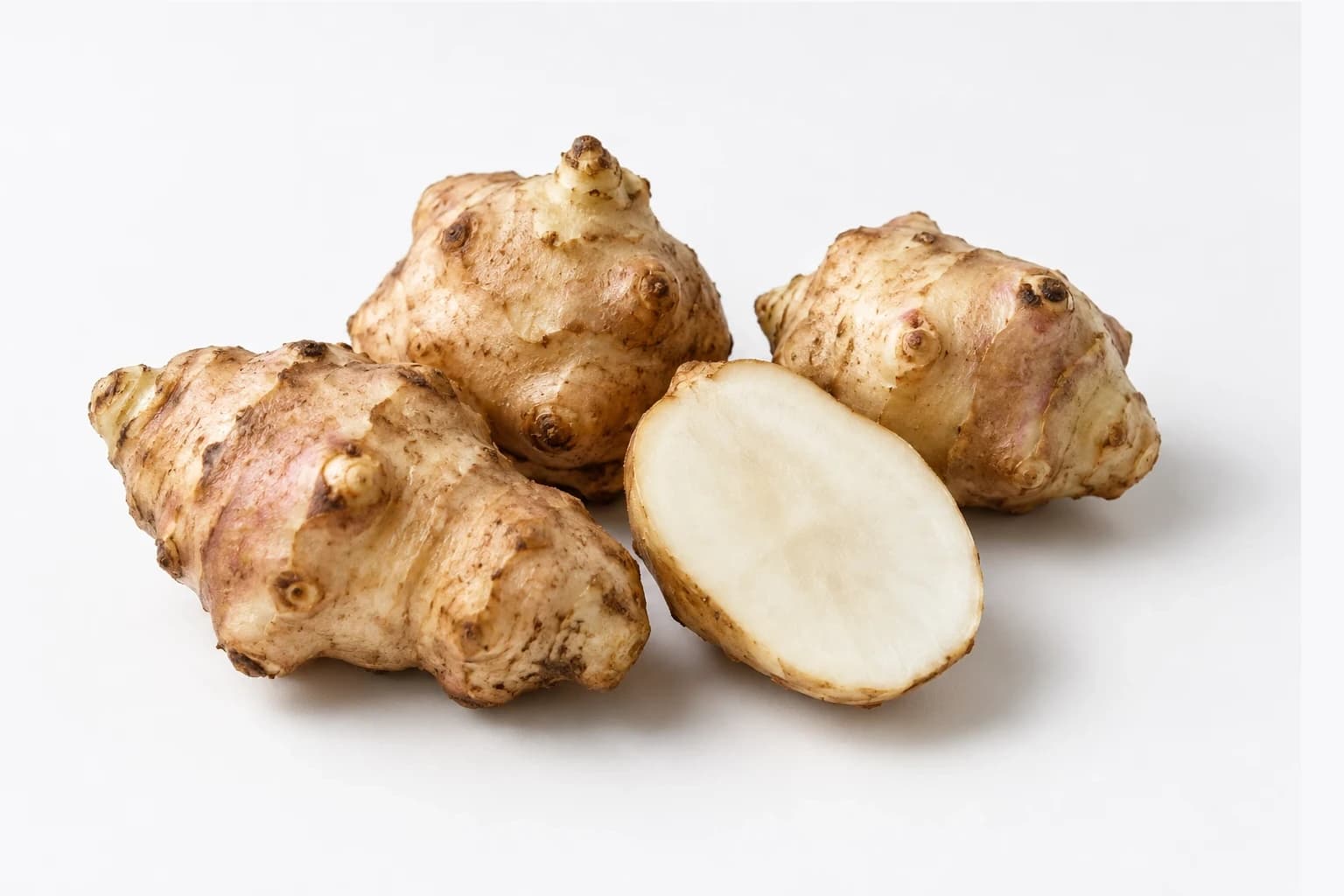
The Jerusalem artichoke is the tuber of a sunflower relative in the daisy family, native to North America. Despite the name it is neither an artichoke nor related to the potato, and it has nothing to do with Jerusalem. Sliced raw it is crisp and faintly sweet, closer to a water chestnut or a pear. What sets it apart from a potato is that it stores inulin rather than starch. It is eaten raw in salads, braised, roasted, or brewed as a tea.
Scientific name Helianthus tuberosus
The Jerusalem artichoke is the tuber of a sunflower relative. It looks like a potato, is unrelated to one, and stores inulin instead of starch.
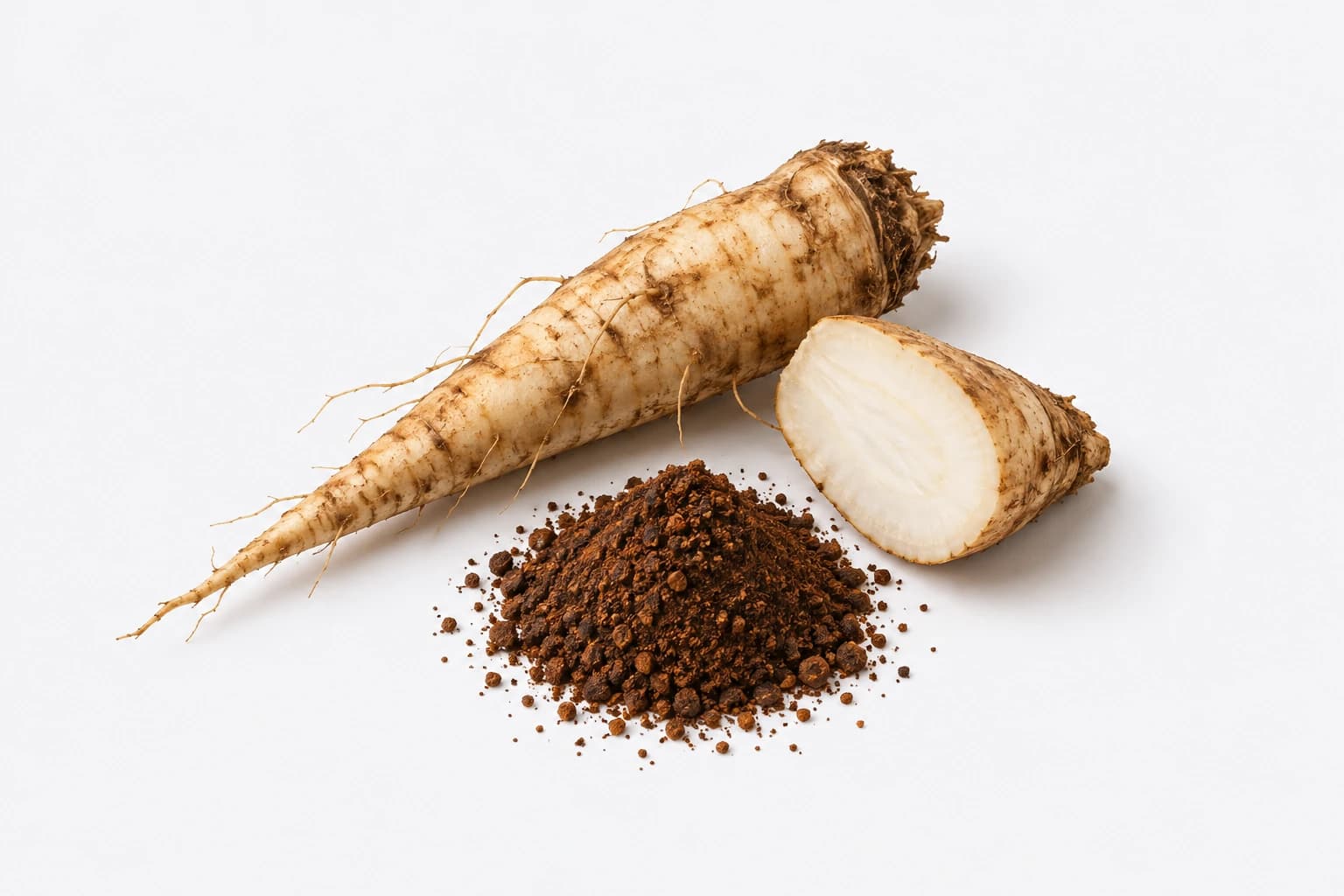
That makes it close kin to this site's chicory root. The researchers who ran the trial below reported finding no structural difference between chicory inulin and Jerusalem artichoke inulin, before or after processing. It is the same molecule.
2007, British Journal of Nutrition.
- 45 volunteers, double-blind, randomised, placebo-controlled, parallel-group
- Three groups of 15 — snack bars with chicory inulin, with Jerusalem artichoke inulin, or without fructans
- A 7-day adaptation at 7.7 g of fructan a day, then 14 days at two bars a day (15.4 g)
- Faecal microbiota composition, faecal short-chain fatty acids, bowel habit and gastrointestinal symptoms were measured
The results as reported:
- Bifidobacteria rose 1.2 log10 over 21 days (p<0.05)
- Bacteroides/Prevotella fell in number, and the Clostridium histolyticum/lituseburense group fell in frequency
- No change in faecal short-chain fatty acid concentration
- Stool frequency rose slightly and consistency shifted slightly
- Mild and sometimes moderate flatulence occurred in some participants, significantly more than placebo (p<0.05)
The third line and the fifth line have to be read together.
Key benefits
- Early research
The bacteria changed; the substance that would carry that change did not
[1]2007, British Journal of Nutrition, design as above.
Outcome Result Bifidobacteria +1.2 log10 over 21 days (p<0.05) Bacteroides/Prevotella fell in number Clostridium histolyticum/lituseburense fell in frequency Faecal short-chain fatty acids no change Stool frequency slight increase Flatulence significantly more than placebo (p<0.05) A rise of 1.2 log10 in bifidobacteria is roughly sixteen-fold. As a prebiotic it clearly worked, and the design — double-blind, placebo-controlled — is sound.
But the short-chain fatty acids did not move. Here is why that matters.
When gut bacteria are said to affect health, much of the proposed route runs through the short-chain fatty acids they make by fermenting fibre — acetate, propionate and butyrate. Butyrate is fuel for the cells lining the colon and is implicated in inflammation and barrier function.
In other words, short-chain fatty acids are the bridge between "the bacteria changed" and "this is good for you". In this trial the bacteria changed and the bridge did not move.
That is not the same as "it does not work". Faecal short-chain fatty acid concentration measures what was left after absorption, not what was produced, so production could rise while absorption rises with it and nothing shows in stool. It is a limit of the measurement.
But what this trial demonstrated stops at the composition of the microbiota. Weight, blood glucose, blood lipids and inflammatory markers were not measured. So "Jerusalem artichoke is good for gut health" runs one step ahead of what this trial showed.
The scale is small too: fifteen people per group.
The honest conclusion:
- That Jerusalem artichoke inulin raises bifidobacteria is confirmed by a double-blind trial
- In the same trial, short-chain fatty acids did not change
- No clinical outcome was measured
- Flatulence rose significantly
- The grade is "early"
- Since no structural difference from chicory inulin was found, this site's chicory root entry applies here too
- Nutrition data
Do not believe the 1.6 g of fibre — and the 3.4 mg of iron is real
Per 100 g of raw Jerusalem artichoke:
- 73 kcal, carbohydrate 17.4 g, sugar 9.6 g, fibre 1.6 g, protein 2.0 g, fat 0.01 g
- Potassium 429 mg, iron 3.4 mg, phosphorus 78 mg, choline 30 mg, magnesium 17 mg, calcium 14 mg
- Thiamin 0.2 mg, niacin 1.3 mg, vitamin C 4 mg, folate 13 µg, sodium 4 mg
Start with that 1.6 g of fibre. It does not contain the inulin.
This is the same problem set out in this site's chicory root entry. The assay long used as the standard treats the sample with enzymes and then precipitates fibre with alcohol — and inulin dissolves in alcohol and passes straight through. So it is not counted as fibre and instead sits inside the 17.4 g of carbohydrate and the 9.6 g of sugar.
Seeing 9.6 g of sugar and concluding it must be sweet is half right. Jerusalem artichoke does taste sweet, but a substantial part of that figure is not simple sugar that raises blood glucose — it is inulin, which is not absorbed in the small intestine. The energy actually absorbed is also lower than 73 kcal.
Iron at 3.4 mg is very high for a tuber. Potato runs 0.8 mg. Against an adult reference of 18 mg, that is 19% in 100 g.
But it is non-haem iron. Plant iron absorbs poorly and does better alongside vitamin C. Jerusalem artichoke's own vitamin C, at 4 mg, is negligible, so pairing it with lemon juice or raw vegetables works in its favour. Keep tea and coffee away from the meal instead.
Potassium at 429 mg is also high. If your kidney function is reduced you may be restricting potassium; talk to your clinician.
Choline at 30 mg is an uncommon row for a tuber.
- Not established
Gas — the most practical thing to know about this tuber
In the trial above, flatulence was significantly more common than on placebo (p<0.05). It was mild and sometimes moderate, in some participants.
This is not a side effect so much as a consequence of the mechanism. Inulin is not digested in the small intestine; it reaches the colon, where bacteria ferment it. Fermentation makes gas. A sixteen-fold rise in bifidobacteria and more flatulence are two faces of the same process.
Jerusalem artichokes are notorious for this, enough that English has a joking nickname for them.
On how to set the amount.
The trial used 7.7 g of fructan a day for a 7-day adaptation period first, and only then raised it to 15.4 g a day for 14 days. Not starting high is the point of that design.
- Begin with 50 g of raw tuber or less
- Increase at weekly intervals
- A large amount at one sitting can bring bloating and cramping
Take particular care with irritable bowel syndrome.
Inulin is a FODMAP — the "O", the oligosaccharides. It is one of the classic restrictions on a low-FODMAP diet, and Jerusalem artichoke is among the higher-content foods within it. Symptoms can worsen; talk to your clinician.
Watch for daisy-family allergy. The Jerusalem artichoke is in that family, and cross-reaction is reported in people allergic to ragweed, mugwort and chrysanthemum. Chicory, globe artichoke, lettuce and sunflower seed share it.
Notes on cooking.
- The skin is fine to leave on. It is thin; just wash the soil off well
- Cooking breaks down some of the inulin, raising the sweetness and leaving slightly less gas
- Sliced raw into a salad it has a good crisp texture, but produces more gas
- Cut surfaces brown. Keep them in lemon water — which also helps the iron
How to eat it well
- Start at 50 g or less and increase weekly. The trial itself went from 7.7 g to 15.4 g.
- Leave the skin on. Just wash the soil off properly.
- Cooking leaves slightly less gas. Raw is crisper but ferments more.
- Keep cut pieces in lemon water. It stops browning and helps absorb the 3.4 mg of iron.
- Keep tea and coffee away from the meal. Tannins lower non-haem iron absorption.
- With irritable bowel syndrome, talk to your clinician. Inulin is a FODMAP.
- Take care with daisy-family allergy.
- With reduced kidney function, note the 429 mg of potassium.
How to read the grades
Each benefit carries a label showing how far research on people supports it. Grades differ between items even within the same ingredient.
- Nutrition data
- A fact verifiable from food composition databases or health authorities. This is a different kind of statement from a clinical effect.
- Strong evidence
- Consistently confirmed across randomised controlled trials or meta-analyses.
- Moderate evidence
- Human studies exist, but effect sizes are small or results are mixed.
- Early research
- Cell or animal work, or small preliminary studies.
- Not established
- Commonly claimed, but not confirmed in studies on people.
What to watch out for
- What the trial demonstrated stops at the composition of the microbiota. Weight, glucose, lipids and inflammation were not measured.
- In the same trial, faecal short-chain fatty acids did not change — the bridge from a change in bacteria to an effect on the body did not move.
- Fifteen people per group, 45 in total.
- Flatulence was significantly more common than placebo (p<0.05), mild and sometimes moderate.
- Inulin is a FODMAP. It can worsen symptoms in irritable bowel syndrome.
- The 1.6 g of fibre in the table does not include the inulin. It sits inside the carbohydrate and sugar figures.
- The Jerusalem artichoke is in the daisy family. Cross-reaction is reported with ragweed, mugwort and chrysanthemum allergy.
- Potassium is 429 mg, so talk to your clinician if you have kidney disease.
Nutrition
Per 100 g of raw Jerusalem artichoke. Do not take the 1.6 g of fibre below at face value — inulin, this tuber's main component, is not captured by traditional assays and ends up inside the carbohydrate and sugar figures. The same problem as chicory root.
- Calories
- 73 kcal4%
- Carbohydrates
- 17.4 g6%
- Sugars
- 9.6 g
- Fiber
- 1.6 g6%
- Protein
- 2.0 g4%
- Fat
- 0.01 g<1%
- Potassium
- 429 mg9%
- Iron
- 3.4 mg19%
- Phosphorus
- 78 mg6%
- Choline
- 30 mg5%
- Magnesium
- 17 mg4%
- Calcium
- 14 mg1%
- Vitamin B1
- 0.2 mg17%
- Vitamin B3
- 1.3 mg8%
- Vitamin C
- 4 mg4%
- Folate
- 13 µg3%
- Sodium
- 4 mg<1%
Percentages are of the US FDA Daily Value for adults and children 4 and over. National reference intakes differ by sex and age.
Calculate this alongside other ingredients →
Key nutrients
By health concern
Dishes with this ingredient
Sources
The databases and health authorities this article's nutrition figures and health statements draw on.