Contents
What it is
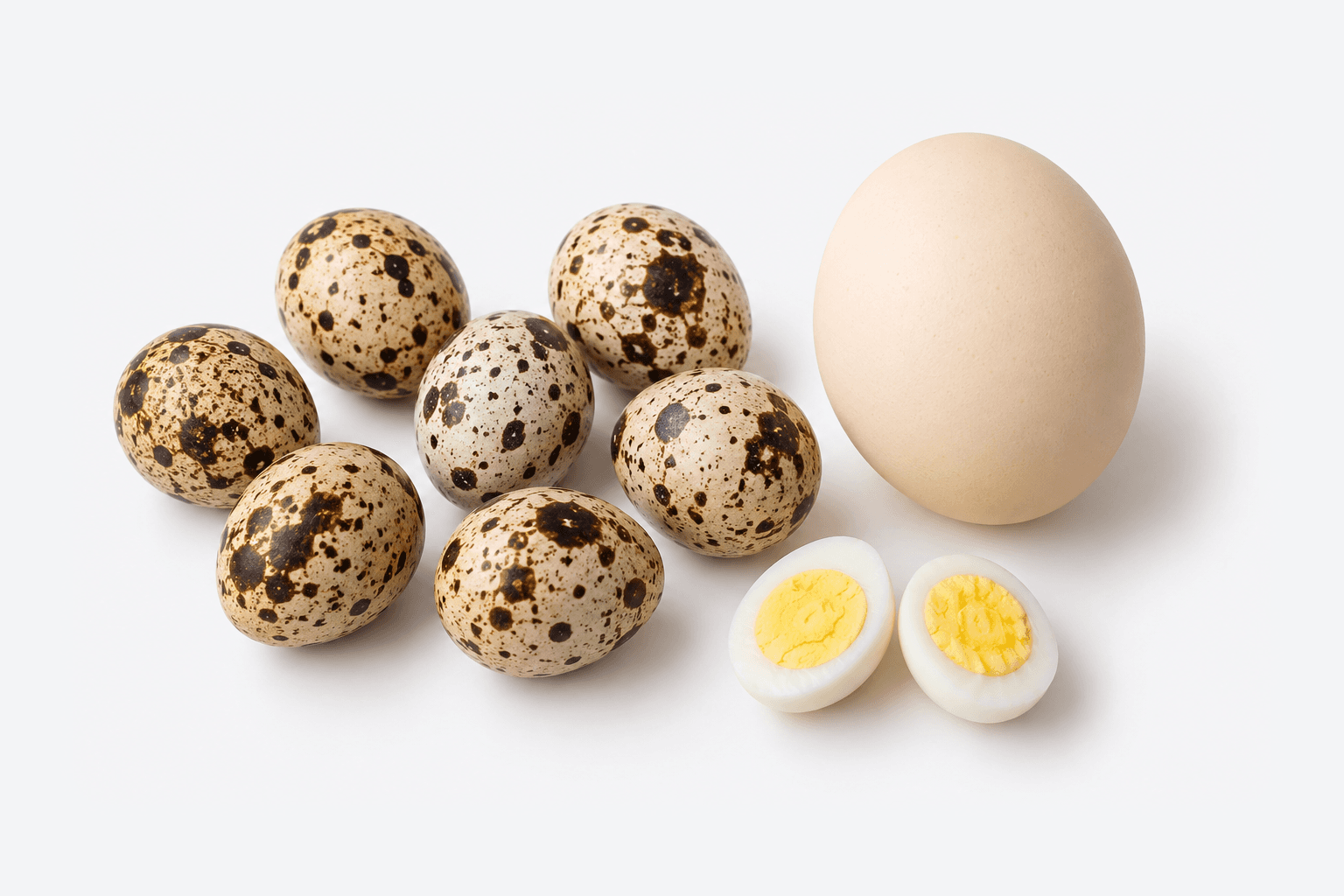
A quail egg is laid by the quail. It is far smaller than a hen's egg — about 10 grams apiece — with brown mottling on the shell. The structure is the same as a chicken egg, but the yolk makes up a larger share of the whole, so weight for weight more of what sits in a yolk — fat, fat-soluble vitamins, choline — comes with it. The shell is thin but the membrane beneath is tough, which makes peeling a boiled one fiddly, so they suit dishes that use them whole, braised in soy sauce or threaded onto skewers.
People say quail eggs are "more nutrient-dense than hen's eggs". That is true only per 100 g.
By 100 g, quail eggs hold more than twice the iron (3.65 vs 1.67 mg), nearly twice the riboflavin (0.79 vs 0.419 mg), and twice the cholesterol (844 vs 411 mg).
By the egg, it reverses. One quail egg gives about 9 g of edible egg; a hen's egg about 50 g. More than a fivefold difference in mass, so per egg the hen's egg carries more iron, more choline, more riboflavin and more protein.
And the common line "twelve quail eggs equal one hen's egg" does not hold by weight. Twelve is about 108 g, which is 912 mg of cholesterol — 4.4 times a hen's egg (about 206 mg).
What about clinical evidence? On quail eggs themselves there is one randomised trial in seasonal allergic rhinitis with 40 people — and what it gave was not eggs but quail egg and zinc tablets, against a steroid-only comparator. Meanwhile a meta-analysis of 17 randomised trials of increased egg intake found LDL rose by 8.14 mg/dL.
Key benefits
- Moderate evidence
Eating more egg raised LDL by 8.14 mg/dL — across 17 randomised trials
[1]2020, Nutrients: a meta-analysis of 17 randomised controlled trials in healthy people. Trials with combination therapy were excluded, and results were pooled with a random-effects model.
The results:
- LDL cholesterol was higher — mean difference +8.14 mg/dL (p < 0.0001, I² = 18%).
- The LDL/HDL ratio was higher too — mean difference +0.14 (p = 0.001, I² = 25%).
- Longer meant larger — trials running over two months showed a bigger effect size than those under two months.
- Heterogeneity at 18% and 25% is low, meaning the trials agreed reasonably well.
- The authors declared no financial or non-financial conflicts of interest.
This was done with hen's eggs. No randomised trial has repeated it with quail eggs. But quail eggs carry twice the cholesterol per 100 g, so there is no reason to set the finding aside either.
Now work out how much you actually eat.
- One quail egg (9 g edible): about 76 mg cholesterol
- One hen's egg (50 g edible): about 206 mg
- Five quail eggs still come in under two hen's eggs
- Eleven quail eggs (100 g): about 844 mg
Eaten one at a time, a quail egg delivers less than a hen's egg. The problem is that quail eggs are not usually eaten one at a time. Ten of them in a braise or on skewers is 760 mg of cholesterol — close to four hen's eggs.
The honest summary: what matters is not the species of bird but the number of eggs. The authors closed by saying randomised trials with long-term follow-up are still needed.
- Early research
One allergic rhinitis trial: 40 people, and a tablet added to a steroid
[2]2023, The Journal of Laryngology & Otology: a randomised controlled trial in patients with seasonal allergic rhinitis, conducted within a CONSORT-compliant framework.
The design:
- 40 patients randomised
- Control — mometasone nasal spray for four weeks
- Intervention — the same topical steroid plus commercially available oral quail egg and zinc tablets
The results:
- The intervention group showed greater reductions in nasal itching, sneezing and total nasal symptom score.
- A higher proportion had good rhinitis control, with no need for rescue medication.
The authors' conclusion is cautious: despite the need for a further larger study, quail egg "preliminarily appears" to be an effective adjunct to topical steroid therapy.
Four things must be read alongside it.
First, 40 people. A result at this size points a direction and no more.
Second, what was given was not an egg. It was a commercial quail egg and zinc tablet. That is not the same as boiled quail eggs on a plate.
Third, zinc is mixed in. Zinc alone may act on nasal symptoms, and this design cannot separate quail egg's share from zinc's.
Fourth, there was no placebo arm. The comparator was steroid alone while the intervention added tablets on top. Participants could therefore likely tell which arm they were in, and nasal symptom scores are self-reported.
That is why this site grades the evidence as early. A 2014 Food Science & Nutrition study also tested a quail egg preparation under nasal provocation, but it used a branded proprietary blend.
The conclusion: there is as yet no evidence that quail eggs as a side dish improve rhinitis.
- Nutrition data
The composition: dense by the 100 g, small by the egg
Per 100 g of raw quail egg (about eleven eggs):
- 158 kcal, protein 13.0 g, fat 11.1 g
- Cholesterol 844 mg
- Choline 263 mg
- Iron 3.65 mg, riboflavin 0.79 mg
- Folate 66 µg, vitamin A 156 µg, vitamin B12 1.58 µg
Side by side with hen's eggs, per 100 g:
Quail Hen Iron 3.65 mg 1.67 mg Riboflavin 0.79 mg 0.419 mg Choline 263 mg 335 mg Cholesterol 844 mg 411 mg Iron and riboflavin roughly double, choline is actually lower, and cholesterol doubles.
Convert to one egg and all of it inverts.
1 quail egg (9 g) 1 hen's egg (50 g) Protein 1.17 g about 6.3 g Iron 0.33 mg 0.84 mg Riboflavin 0.071 mg 0.21 mg Choline 23.7 mg 168 mg Cholesterol 76 mg 206 mg Per egg the hen's egg is higher on everything — the good and the cholesterol alike.
"Quail eggs are more nutritious" is an artefact of the unit. A 100 g basis favours the smaller egg, because it has a higher yolk-to-shell ratio, which raises the concentration of everything the yolk holds.
That yolk ratio is also why the cholesterol is high. All of it sits in the yolk. The same reason makes the choline and vitamin A concentrated.
How to eat it well
- Counting them one by one is the most honest way to handle this food — 76 mg each, 760 mg for ten.
- Boil for three to four minutes, half of a hen's egg. Longer and the yolk goes chalky.
- The shells are thin and crack easily. Chill in cold water after boiling, then roll to craze the shell before peeling.
- Soaking in water with a little vinegar weakens the shell membrane and makes peeling easier.
- Soy-braising raises the sodium. Dilute the soy sauce and do not drink the braising liquid.
- They suit lunchboxes and salad toppings because the size already fits — no cutting needed.
- Eating them for allergic rhinitis is not worth doing: the trial used tablets, not eggs.
How to read the grades
Each benefit carries a label showing how far research on people supports it. Grades differ between items even within the same ingredient.
- Nutrition data
- A fact verifiable from food composition databases or health authorities. This is a different kind of statement from a clinical effect.
- Strong evidence
- Consistently confirmed across randomised controlled trials or meta-analyses.
- Moderate evidence
- Human studies exist, but effect sizes are small or results are mixed.
- Early research
- Cell or animal work, or small preliminary studies.
- Not established
- Commonly claimed, but not confirmed in studies on people.
What to watch out for
- Cholesterol is 844 mg per 100 g, double a hen's egg. Per egg it is 76 mg, but bear in mind this is a food people eat ten of at a time.
- Across 17 randomised trials of increased egg intake, LDL rose by 8.14 mg/dL, with a larger effect in trials longer than two months.
- With familial hypercholesterolaemia or cardiovascular disease, set a daily number with your clinician.
- If you are allergic to hen's eggs, avoid quail eggs too. Ovalbumin and ovomucoid cross-react commonly between bird eggs.
- They are a choking hazard for small children — one egg is exactly the size that blocks an airway. Cut them in half.
- Raw or soft-set carries a Salmonella risk, as with hen's eggs.
- The rhinitis trial had no placebo arm, and zinc was included, so quail egg's own contribution cannot be separated.
Nutrition
Per 100 g of raw quail egg. One quail egg gives about 9 g of edible egg, so 100 g is about eleven of them. Per-egg figures are given in the text.
- Calories
- 158 kcal8%
- Protein
- 13.0 g26%
- Fat
- 11.1 g14%
- Choline
- 263 mg48%
- Iron
- 3.65 mg20%
- Vitamin B2
- 0.79 mg61%
- Folate
- 66 µg17%
- Vitamin A
- 156 µg17%
- Vitamin B12
- 1.58 µg66%
Percentages are of the US FDA Daily Value for adults and children 4 and over. National reference intakes differ by sex and age.
Calculate this alongside other ingredients →
Key nutrients
By health concern
Dishes with this ingredient
Compare with
Sources
The databases and health authorities this article's nutrition figures and health statements draw on.
- 1Association between egg consumption and cholesterol concentration: a systematic review and meta-analysis of randomized controlled trialsMeta-analysisLi MY, Chen JH, Chen C, Kang YN Nutrients 2020PMID 32635569
- 2Quail egg homogenate with zinc as adjunctive therapy in seasonal allergic rhinitis: a randomised, controlled trialClinical trialAndaloro C, Saibene AM, La Mantia I The Journal of Laryngology & Otology 2023PMID 35582999
- 3USDA FoodData CentralFood composition database
- 4NIH Office of Dietary SupplementsHealth authority
- 5PubMedResearch literature