Contents
What it is
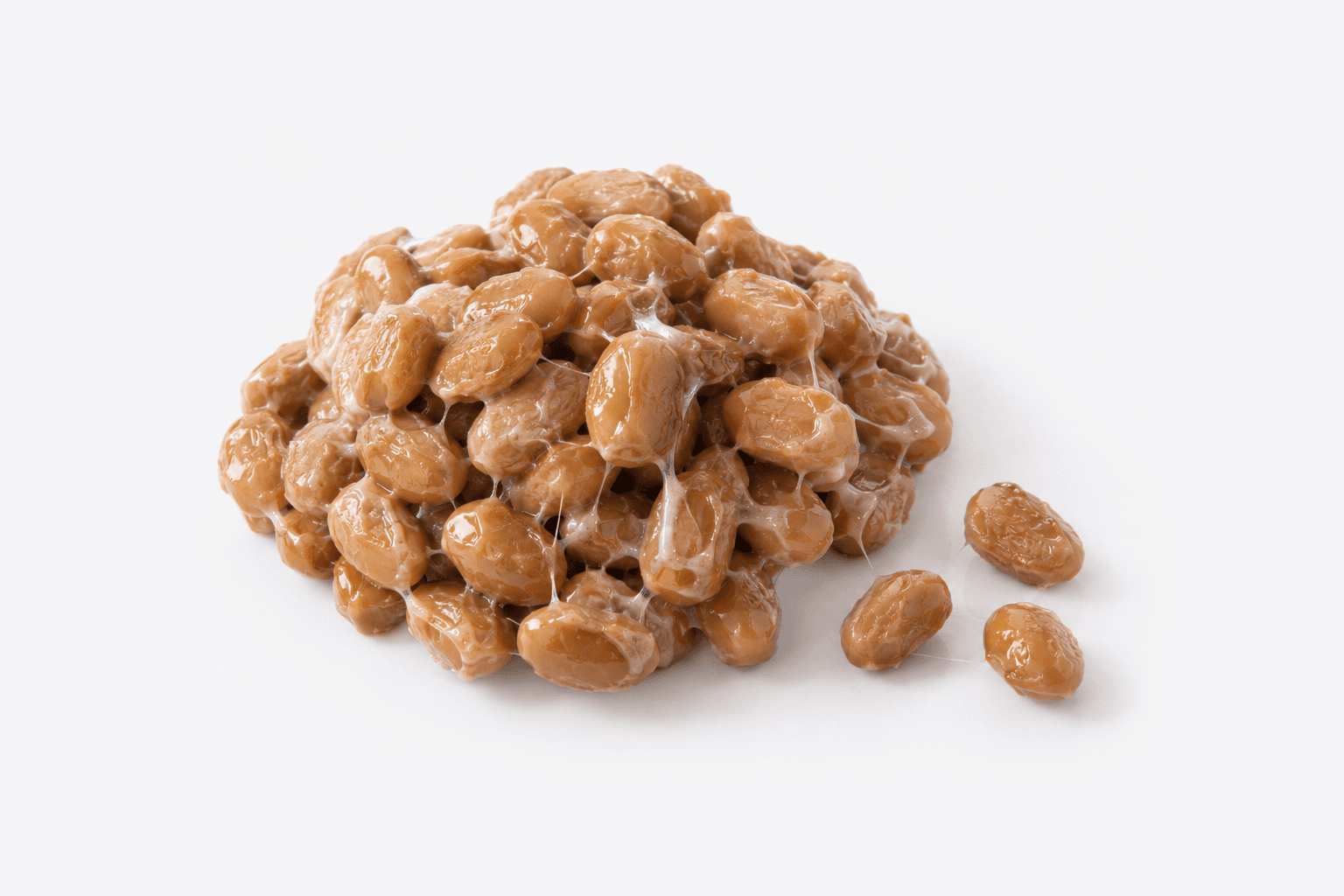
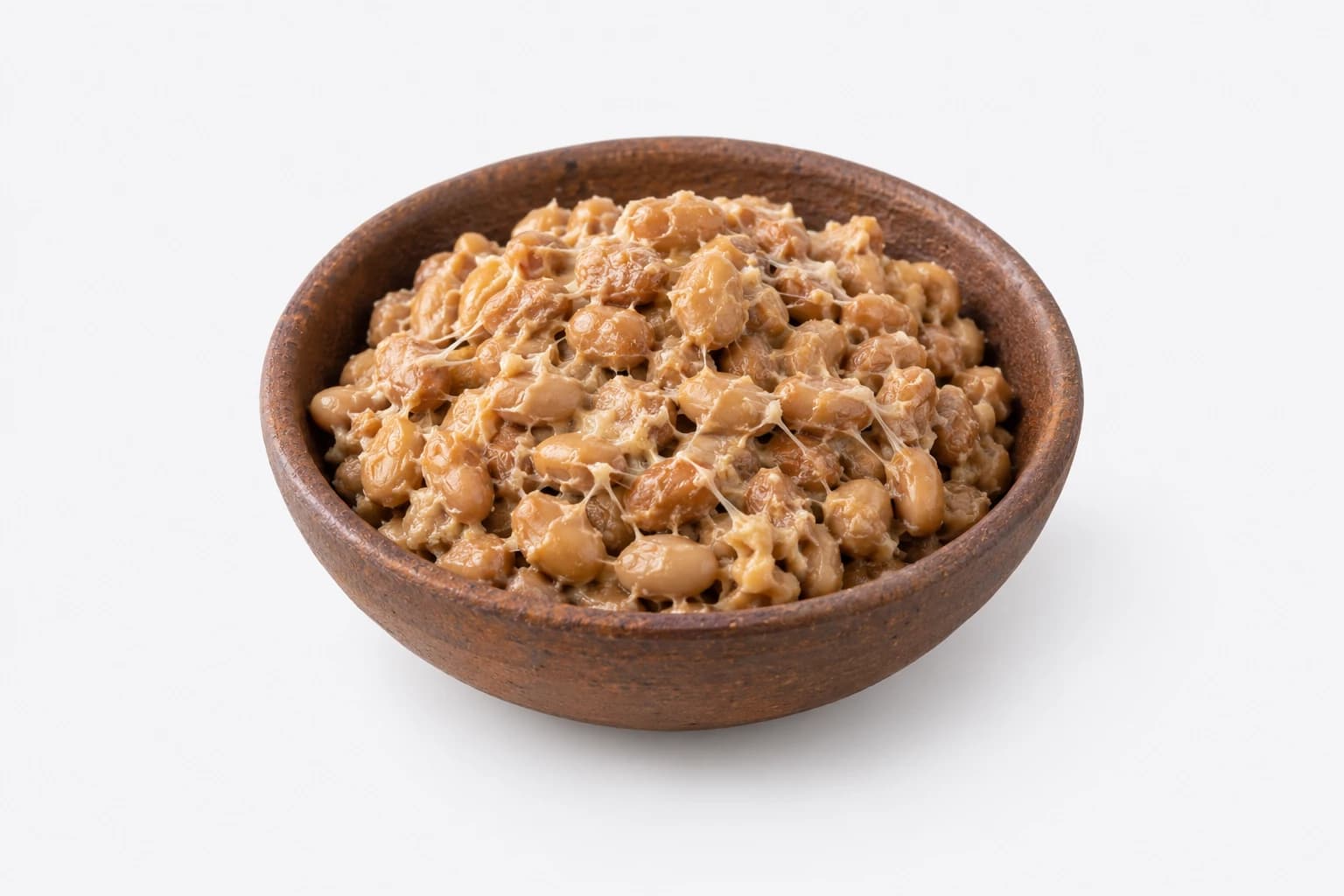
Cheonggukjang is a Korean ferment made by inoculating boiled soybeans with the hay bacillus carried on rice straw and leaving them just two or three days. It starts from the same bean as doenjang but is a different thing: doenjang goes through dried blocks and months or years in brine, while cheonggukjang is finished in days and without salt. That is why the beans keep their shape and why it draws long sticky threads. It uses the same bacterium as Japanese natto, but natto is eaten as it is while cheonggukjang is simmered into a stew. A powerful smell is part of what it is.
Cheonggukjang is cooked soybeans fermented with Bacillus subtilis for two or three days. Unlike doenjang the ferment is short and lightly salted, so the beans keep their shape.
Three clinical trials exist. Korean trials on a Korean food are rare enough to be worth noting. But they need reading carefully.
2025, Nutrients — menopause. Sixty postmenopausal women took 3.3 g of cheonggukjang tablets daily for eight weeks. The Kupperman index, a menopausal symptom score, fell significantly in all three groups, most in the group taking the product richest in beneficial microorganisms.
Do not stop there. The three groups were high-microorganism cheonggukjang, low-microorganism cheonggukjang, and commercial cheonggukjang. All three were cheonggukjang. No group went without.
2023, Foods — obesity. Same structure. All three groups took cheonggukjang pills, and the result was this:
No changes in obesity and inflammation-related indicators were observed before and after consumption.
2011, Journal of Medicinal Food — lipids and glucose. This one did have a control (starch). Total and LDL cholesterol fell. But what the abstract compares them to is not the control group — it is "the initial value".
Key benefits
- Early research
All three groups improved — because all three groups ate cheonggukjang
[1][2][3]2025, Nutrients — 60 postmenopausal women, eight weeks.
- Three groups: high-microorganism (HTC), low-microorganism (LTC), commercial (CC) cheonggukjang
- 3.3 g of cheonggukjang tablets daily
- Kupperman index, metabolic parameters, stool microbiome analysis
Outcome Result Kupperman index (menopausal symptoms) significantly decreased in all three groups, greatest in HTC BMI, weight no significant change Lipid profile no significant change Fasting glucose decreased significantly only in HTC Beneficial bacteria increased in HTC and CC Firmicutes/Bacteroidetes ratio decreased in HTC and CC, not significant Look at the design. All three arms were cheonggukjang. The comparison was not cheonggukjang versus none but cheonggukjang A versus B versus C.
That limits what "symptoms improved in all three groups" can mean. Menopausal symptom scores are a questionnaire, and taking something diligently for eight weeks while recording symptoms commonly lowers such scores. Some improvement happens simply with time. A placebo arm is what separates those out, and this trial has none.
The between-group difference survives. That HTC fell most is a comparison among the three products, so it holds. But that says a cheonggukjang richer in microorganisms beat a poorer one, not cheonggukjang beat not eating it.
The 2023 Foods trial has the same structure. All three groups (19, 20, 20) took cheonggukjang pills, and the abstract concludes:
No changes in obesity and inflammation-related indicators were observed before and after Cheonggukjang consumption. The Firmicutes/Bacteroidetes ratio decreased in all three groups, but no statistical significance was indicated.
What that trial actually achieved lies elsewhere. It confirmed that the biogenic amines present in cheonggukjang did not produce adverse effects in participants. It is closer to a safety study than an efficacy one.
2011, Journal of Medicinal Food — this one has a control.
- 45 people with impaired fasting glucose, three groups: control (starch 2 g/day), cheonggukjang 20 g/day, red ginseng cheonggukjang 20 g/day, eight weeks
- Total cholesterol fell about 30 mg/dL in the cheonggukjang group
- LDL cholesterol fell 29.66%
- The apolipoprotein B to A-1 ratio fell from 3.0 to 2.5
- Fasting glucose was lower in both active groups
But look at what these were compared against. The abstract repeatedly says "compared to the initial value". Not compared to the control group. A within-group before-and-after comparison and a between-group comparison are different claims.
One note on the abstract's units. The fall in total cholesterol is printed as "30.0 mg/mL", which would be 3,000 mg/dL — impossible in a person. It appears to be a misprint for mg/dL.
The honest conclusion:
- Three Korean trials on a Korean food is rare and welcome in itself
- But the two recent ones have no placebo arm. All three groups ate cheonggukjang
- The 2023 trial found no change at all in obesity or inflammation markers
- The 2011 improvements are measured against baseline, not against the control
- The grade here is "early research"
- Nutrition data
19.4 g of protein, 217 mg of calcium, 8.6 mg of iron — but this table is natto's
First, what this table is. The figures below are the USDA entry for natto. Cheonggukjang is hard to find as a separate entry in the public composition databases.
The two are close. Both are whole cooked soybeans fermented with Bacillus subtilis, unlike doenjang or miso, where the beans are crushed and held in brine for a long time.
They are not the same, though. Cheonggukjang ferments for two or three days and is usually salted and simmered into a stew; natto is eaten as it is with soy sauce. Read the numbers as indicative, not exact.
Per 100 g of natto:
- 211 kcal, protein 19.4 g, fat 11.0 g, carbohydrate 12.7 g, fibre 5.4 g
- Calcium 217 mg, iron 8.6 mg, potassium 729 mg, magnesium 115 mg
- Zinc 3.03 mg, manganese 1.53 mg, copper 0.667 mg, selenium 8.8 µg
- Vitamin K 23.1 µg, vitamin C 13.0 mg
- Sodium 7 mg
Per tablespoon (15 g):
100 g A tablespoon (15 g) Energy 211 kcal 32 kcal Protein 19.4 g 2.9 g Calcium 217 mg 33 mg Iron 8.6 mg 1.3 mg The 19.4 g of protein is the centre of this food, high among fermented soy products because the whole bean is used.
Iron at 8.6 mg also stands out, a rare figure for a plant food. But plant iron (non-haem) is absorbed less readily than animal iron. Vitamin C helps, and this table happens to carry 13 mg of it.
Calcium at 217 mg is above milk's 123 mg per 100 g.
Do not take the 7 mg of sodium at face value. That is unseasoned natto. Cheonggukjang stew is another food entirely — salt, soy sauce and doenjang go in, sometimes kimchi or salted seafood. What you actually eat is decided by the cooking.
One qualification on the 23.1 µg of vitamin K. That figure counts phylloquinone (vitamin K1) only. The menaquinones (vitamin K2) that the fermenting bacteria produce are not in that number. That soybean foods fermented with B. subtilis contain vitamin K2 is known; how much cannot be read from this table.
There is a case where this genuinely matters — warfarin. The next section continues.
- Not established
The trials fed tablets, not stew — and a word about warfarin
This entry is about actually eating it.
First, the form. Look again at what the trials gave:
- 2025 — 3.3 g of cheonggukjang tablets a day
- 2023 — cheonggukjang pills
- 2011 — cheonggukjang 20 g/day
3.3 g a day is less than a quarter of a tablespoon. That is a different scale from what goes into a bowl of stew. When carrying these results across to the stew, carry the difference in form and amount with them.
And stew comes with salt. Cheonggukjang itself is low in sodium, but simmering it into a stew adds salt, soy sauce and doenjang. If you eat it often as a health food, the thing to count is not the paste but the broth. This site's low-sodium doenjang stew recipe makes the same point.
Now warfarin.
Soybean foods fermented with Bacillus subtilis contain vitamin K2 (menaquinone). Vitamin K is involved in blood clotting, and warfarin works by blocking that action. A sudden rise in vitamin K intake can blunt the drug.
In Japan it is standard to advise patients on warfarin to avoid natto. Cheonggukjang is fermented with the same organism, so if you take warfarin, speak to your doctor before eating it. This site does not hold data on how much vitamin K2 cheonggukjang contains, and not knowing an amount is not the same as it being safe.
One common claim, handled plainly.
The enzyme the bacteria produce, nattokinase, is widely said to dissolve blood clots. This site has not published a trial feeding cheonggukjang or natto and measuring clot-related clinical outcomes. That an enzyme breaks down fibrin in a test tube and that eating the food reduces clots in people are different claims. It will be added as its own entry once the evidence is checked.
With a soy allergy, cheonggukjang counts.
The smell is what fermentation does. Ammonia-family compounds cause it, and it is not the smell of spoilage. But prolonged boiling kills the bacteria. If you want them alive, take the pan off the heat and stir it in at the end — though, as above, what that buys you is not yet clear.
How to eat it well
- A tablespoon is about 15 g and 32 kcal.
- The trials gave 3.3 g of tablets a day. That differs from a bowl of stew in both form and amount.
- What to count is the salt in the broth, not the paste.
- To keep the bacteria alive, stir it in off the heat at the end. Long boiling kills them.
- Eaten with vegetables carrying vitamin C, the plant iron is absorbed better.
- If you take warfarin, speak to your doctor before eating it.
- Not for anyone with a soy allergy.
- The smell is fermentation, not spoilage. Still, discard it if the colour has changed or the strands have dried out.
How to read the grades
Each benefit carries a label showing how far research on people supports it. Grades differ between items even within the same ingredient.
- Nutrition data
- A fact verifiable from food composition databases or health authorities. This is a different kind of statement from a clinical effect.
- Strong evidence
- Consistently confirmed across randomised controlled trials or meta-analyses.
- Moderate evidence
- Human studies exist, but effect sizes are small or results are mixed.
- Early research
- Cell or animal work, or small preliminary studies.
- Not established
- Commonly claimed, but not confirmed in studies on people.
What to watch out for
- The 2025 and 2023 trials had no placebo arm. All three groups ate cheonggukjang. Do not read "all three improved" as an effect.
- The 2023 trial found no change at all in obesity or inflammation markers.
- The 2011 improvements are measured against baseline, not against the control group.
- The nutrition table above is the USDA entry for natto, close to cheonggukjang but not the same.
- The 7 mg of sodium is unseasoned. Stew is another matter.
- The 23.1 µg of vitamin K counts K1 only, not the K2 the bacteria produce.
- On warfarin, ask your doctor first. Vitamin K can blunt the drug.
- This site has not verified the nattokinase and blood clot claims.
- Contraindicated with soy allergy.
Nutrition
The figures below are the USDA entry for natto. Cheonggukjang and natto are both whole cooked soybeans fermented with Bacillus subtilis, but cheonggukjang ferments for a shorter time and is usually salted and eaten as a stew. Treat these as indicative rather than exact — and sodium depends entirely on the product and the cooking. A tablespoon is about 15 g.
- Calories
- 211 kcal11%
- Protein
- 19.4 g39%
- Calcium
- 217 mg17%
- Iron
- 8.6 mg48%
- Potassium
- 729 mg16%
- Magnesium
- 115 mg27%
- Fiber
- 5.4 g19%
- Fat
- 11.0 g14%
- Carbohydrates
- 12.7 g5%
- Zinc
- 3.03 mg28%
- Manganese
- 1.53 mg67%
- Vitamin K
- 23.1 µg19%
- Vitamin C
- 13.0 mg14%
- Sodium
- 7 mg<1%
Percentages are of the US FDA Daily Value for adults and children 4 and over. National reference intakes differ by sex and age.
Calculate this alongside other ingredients →
Key nutrients
Dishes with this ingredient
Sources
The databases and health authorities this article's nutrition figures and health statements draw on.
- 1The Efficacy of Cheonggukjang in Alleviating Menopausal Syndrome and Its Effects on the Gut Microbiome: A Randomized, Double-Blind TrialClinical trialHan AL, et al. Nutrients 2025PMID 39940363
- 2Evaluation of Body Changes and the Anti-Obesity Effect after Consumption of Korean Fermented Food, Cheonggukjang: Randomized, Double-Blind Clinical TrialClinical trialHan AL, et al. Foods 2023PMID 37297435
- 3Supplementation of cheonggukjang and red ginseng cheonggukjang can improve plasma lipid profile and fasting blood glucose concentration in subjects with impaired fasting glucoseClinical trialShin SK, et al. Journal of Medicinal Food 2011PMID 21128827
- 4USDA FoodData CentralFood composition database
- 5PubMedResearch literature
- 6MFDS Food Composition Database · 식품안전나라Food composition database