Contents
What it is
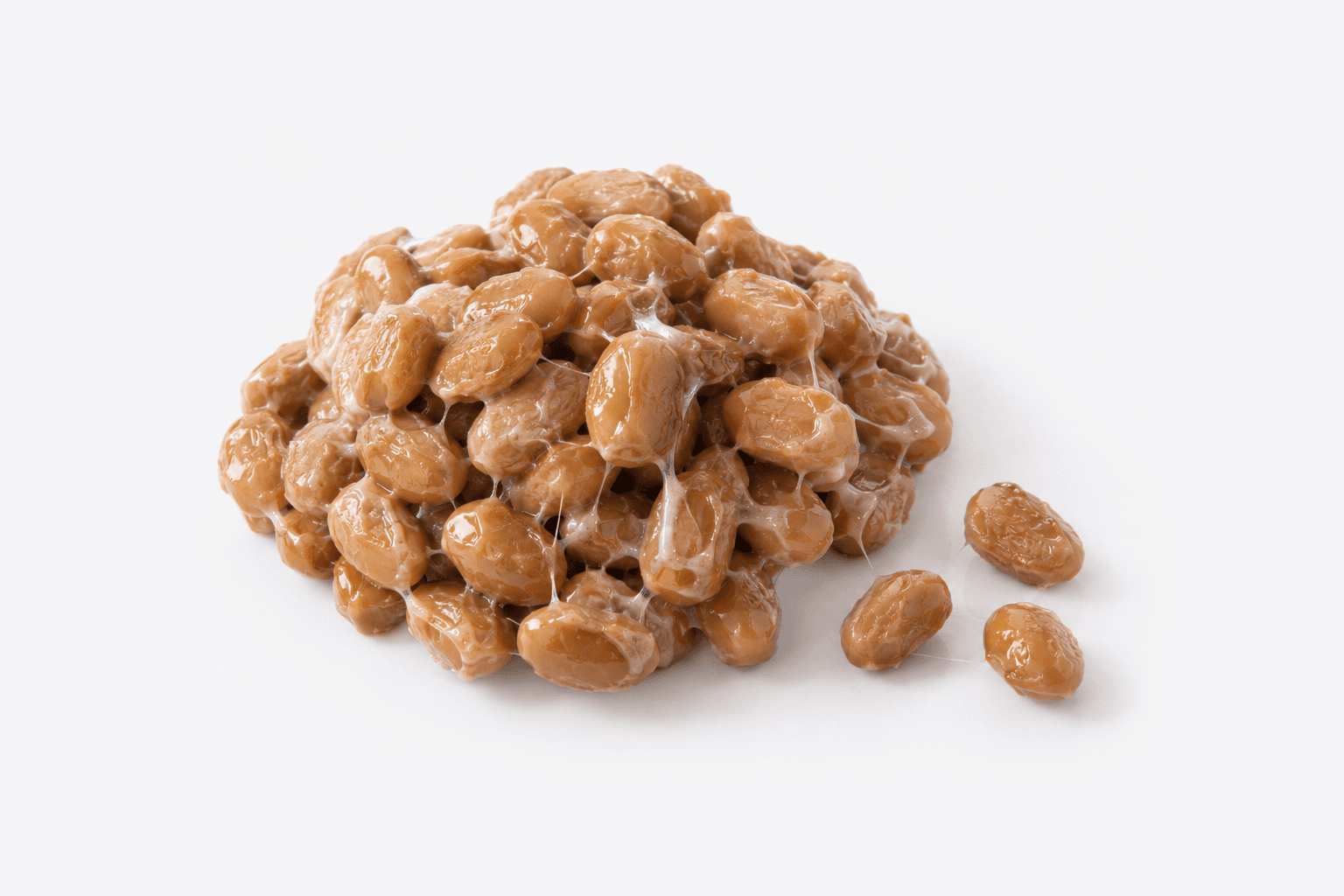
Natto is a Japanese food of boiled soybeans fermented with the hay bacillus. It uses the same bacterium as Korean cheonggukjang and is made on the same principle, but it is used differently: natto is stirred with soy sauce and mustard and spooned over rice, while cheonggukjang is simmered into a stew. The more it is stirred the longer the threads stretch, and those threads are polyglutamic acid. An enzyme produced during the ferment, nattokinase, is what most of the research on this food concerns. Its smell and stickiness divide people sharply.
Natto's evidence only reads correctly when you put two trials from the same journal side by side. Both ran in Osteoporosis International, and they conclude opposite things.
2013 — 244 healthy postmenopausal women took 180 µg of MK-7 for three years. The age-related decline in bone density slowed significantly at the lumbar spine and femoral neck. But not at the total hip.
2010 — 334 early-menopausal Norwegian women took 360 µg of MK-7 as natto capsules for one year. There was no difference in bone loss rate at the total hip or at any other site measured.
One common assumption needs clearing up. The trial that failed was not the low-dose one — 360 µg failed and 180 µg worked. What differed was duration (one year against three) and population (1–5 years past menopause against postmenopausal).
The two trials agreed on one thing. Both clearly moved the vitamin K status marker — undercarboxylated osteocalcin fell (p < 0.001 in the 2010 trial). So the MK-7 was absorbed and was acting. It simply did not translate into bone density within a year.
Moving a marker and changing a bone are different events.
Key benefits
- Early research
MK-7 over three years: spine and femoral neck improved, total hip did not. Over one year: nothing did
[1][2]These two have to be read together.
The positive one — 2013, Osteoporosis International
244 healthy postmenopausal women received placebo or 180 µg of MK-7 daily for three years. Bone mineral density of the lumbar spine, total hip and femoral neck was measured by DXA, bone strength indices of the femoral neck were calculated, and vertebral fracture was assessed by DXA.
- Vitamin K status improved significantly.
- The age-related decline in bone mineral content and density slowed significantly at the lumbar spine and femoral neck.
- It did not at the total hip.
- Bone strength moved favourably, and the loss of vertebral height at the mid-site of the lower thoracic vertebrae fell significantly.
The authors' own conclusion is careful: MK-7 supplements may help postmenopausal women prevent bone loss — and whether this extrapolates to other populations is a separate question.
The null one — 2010, Osteoporosis International
334 healthy Norwegian women aged 50–60, one to five years past menopause, were randomised double-blind to 360 µg of MK-7 as natto capsules or identical-looking placebo capsules containing olive oil, for one year.
- There were no statistical differences in bone loss rates at the total hip or at any other measurement site.
- Yet carboxylated osteocalcin rose and undercarboxylated osteocalcin fell (p < 0.001).
The authors' conclusion: MK-7 taken as natto over one year reduced undercarboxylated osteocalcin but did not influence bone loss rates in early menopausal women.
The honest tally:
2013 2010 People 244 334 Dose MK-7 180 µg MK-7 360 µg (natto capsules) Duration 3 years 1 year Population Postmenopausal 1–5 years past menopause Vitamin K marker Improved Improved Bone density Spine and femoral neck improved; total hip did not No change anywhere The higher dose is the one that failed — that contrast is the point. What is left to explain it is duration and population. Neither trial settles the question, and that is why this site grades it early.
- Early research
Nattokinase capsules for eight weeks: systolic −5.55 mmHg, with an interval that nearly touches zero
[3]2008, Hypertension Research. A randomised, double-blind, placebo-controlled trial from Yonsei University and Mizmedi Hospital in Seoul.
The design:
- 86 adults aged 20–80 with untreated systolic blood pressure of 130–159 mmHg — prehypertension or stage 1 hypertension
- Nattokinase 2,000 FU capsules or placebo for eight weeks
- 73 completed the protocol — thirteen did not
The results:
- Net change in systolic pressure −5.55 mmHg (95% CI −10.5 to −0.57), p < 0.05
- Net change in diastolic pressure −2.84 mmHg (95% CI −5.33 to −0.33), p < 0.05
- Renin activity −1.17 ng/mL/h, p < 0.05
Look at the confidence interval. The systolic upper bound is −0.57. Significant, yes, but pressed right up against zero — meaning this data is compatible with a true effect near −0.57 mmHg, which would be clinically meaningless.
Four things to read alongside it.
First, what was given was not natto. It was a 2,000 FU nattokinase capsule. Nothing here shows that eating natto delivers a comparable amount of active nattokinase.
Second, 13 of 86 dropped out — 15%.
Third, eight weeks. Shorter than the window used to judge blood pressure drugs, and no hard outcomes such as cardiovascular events were measured.
Fourth, it is a single trial. No large meta-analysis has yet reproduced it.
Nattokinase is an enzyme with reported fibrinolytic activity. That is why it becomes a caution for anyone on anticoagulants, noted below.
- Nutrition data
The composition: 8.6 mg of iron, and how to read the vitamin K figure
Per 100 g of natto (about two shop packs):
- 211 kcal, protein 19.4 g, fat 11.0 g, carbohydrate 12.7 g
- Fibre 5.4 g
- Iron 8.6 mg — above the 8 mg requirement for adult men
- Calcium 217 mg, magnesium 115 mg, potassium 729 mg
- Manganese 1.53 mg, zinc 3.03 mg, copper 0.667 mg
- Sodium 7 mg — very low. The sachet of soy sauce supplies nearly all the sodium
- Vitamin K (phylloquinone) 23.1 µg
The 8.6 mg of iron stands out. But plant iron is non-haem and poorly absorbed; eating it alongside something with vitamin C raises the uptake.
The vitamin K figure has to be read precisely. The 23.1 µg above is phylloquinone, K1. The menaquinone-7 that natto is famous for does not appear in the USDA record. So this site does not print a number for natto's MK-7 content — there is no source to print. And the trial doses above (180 µg, 360 µg) are, again, supplement doses.
That natto is a fermented food does not show up well in a composition table. Bacillus subtilis fermenting soybeans produces the sticky threads (poly-gamma-glutamic acid) and nattokinase. The process is said to break down some of the soy's phytate and so favour mineral absorption, but that has not been confirmed in randomised human trials.
Against plain soybeans, the protein is similar and the fibre is lower. The real difference between boiled soybeans and natto is not in the composition table but in what the fermentation makes.
How to eat it well
- Let it sit out of the fridge for 5–10 minutes before stirring. Cold natto does not string well.
- Stir before adding the soy sauce. Twenty to thirty strokes to develop the threads, then season: the flavour is softer that way.
- Do not put it straight onto steaming rice. Nattokinase is heat-sensitive; let the rice cool a little first.
- The sachet is nearly all of the sodium. Natto itself holds 7 mg per 100 g. Using half the sauce cuts it sharply.
- If the smell is difficult, eat it with gim, spring onion, mustard and sesame oil.
- One pack a day (40–50 g) is the usual Japanese serving.
- If you are eating it for bone or blood pressure, remember the trials used supplements, not natto.
How to read the grades
Each benefit carries a label showing how far research on people supports it. Grades differ between items even within the same ingredient.
- Nutrition data
- A fact verifiable from food composition databases or health authorities. This is a different kind of statement from a clinical effect.
- Strong evidence
- Consistently confirmed across randomised controlled trials or meta-analyses.
- Moderate evidence
- Human studies exist, but effect sizes are small or results are mixed.
- Early research
- Cell or animal work, or small preliminary studies.
- Not established
- Commonly claimed, but not confirmed in studies on people.
What to watch out for
- If you take warfarin, avoid natto. This is the most important caution on this page. Its vitamin K directly opposes warfarin, and because the natto bacteria go on producing vitamin K in the gut, the effect persists for days. It is a bigger problem than other vitamin K foods. Speak to your clinician.
- On anticoagulants or antiplatelet drugs, or before surgery, avoid supplement forms because of nattokinase's fibrinolytic activity, and tell your clinician.
- The bone results split. The three-year trial improved some sites; the one-year trial changed nothing anywhere.
- The blood pressure trial was a single eight-week study in which 73 of 86 completed, with a systolic upper bound of −0.57, close to zero.
- Avoid it with a soy allergy.
- With gout, fermented soy foods are moderate in purines. Keep the portion in check.
- Everything the trials above tested was a supplement, not natto itself.
Nutrition
Per 100 g of natto — a shop pack is 40–50 g, so 100 g is about two. The USDA record carries no menaquinone-7 (MK-7) figure for natto, so the doses below are the supplement doses used in the trials.
- Calories
- 211 kcal11%
- Protein
- 19.4 g39%
- Fat
- 11.0 g14%
- Carbohydrates
- 12.7 g5%
- Fiber
- 5.4 g19%
- Iron
- 8.6 mg48%
- Calcium
- 217 mg17%
- Magnesium
- 115 mg27%
- Potassium
- 729 mg16%
- Manganese
- 1.53 mg67%
- Zinc
- 3.03 mg28%
- Vitamin K
- 23.1 µg19%
Percentages are of the US FDA Daily Value for adults and children 4 and over. National reference intakes differ by sex and age.
Calculate this alongside other ingredients →
Key nutrients
Dishes with this ingredient
Sources
The databases and health authorities this article's nutrition figures and health statements draw on.
- 1Three-year low-dose menaquinone-7 supplementation helps decrease bone loss in healthy postmenopausal womenClinical trialKnapen MH, et al. Osteoporosis International 2013PMID 23525894
- 2Vitamin K2 supplementation does not influence bone loss in early menopausal women: a randomised double-blind placebo-controlled trialClinical trialEmaus N, et al. Osteoporosis International 2010PMID 19937427
- 3Effects of nattokinase on blood pressure: a randomized, controlled trialClinical trialKim JY, et al. Hypertension Research 2008PMID 18971533
- 4USDA FoodData CentralFood composition database
- 5NIH Office of Dietary SupplementsHealth authority
- 6European Food Safety Authority (EFSA)Health authority
- 7PubMedResearch literature