Contents
What it is
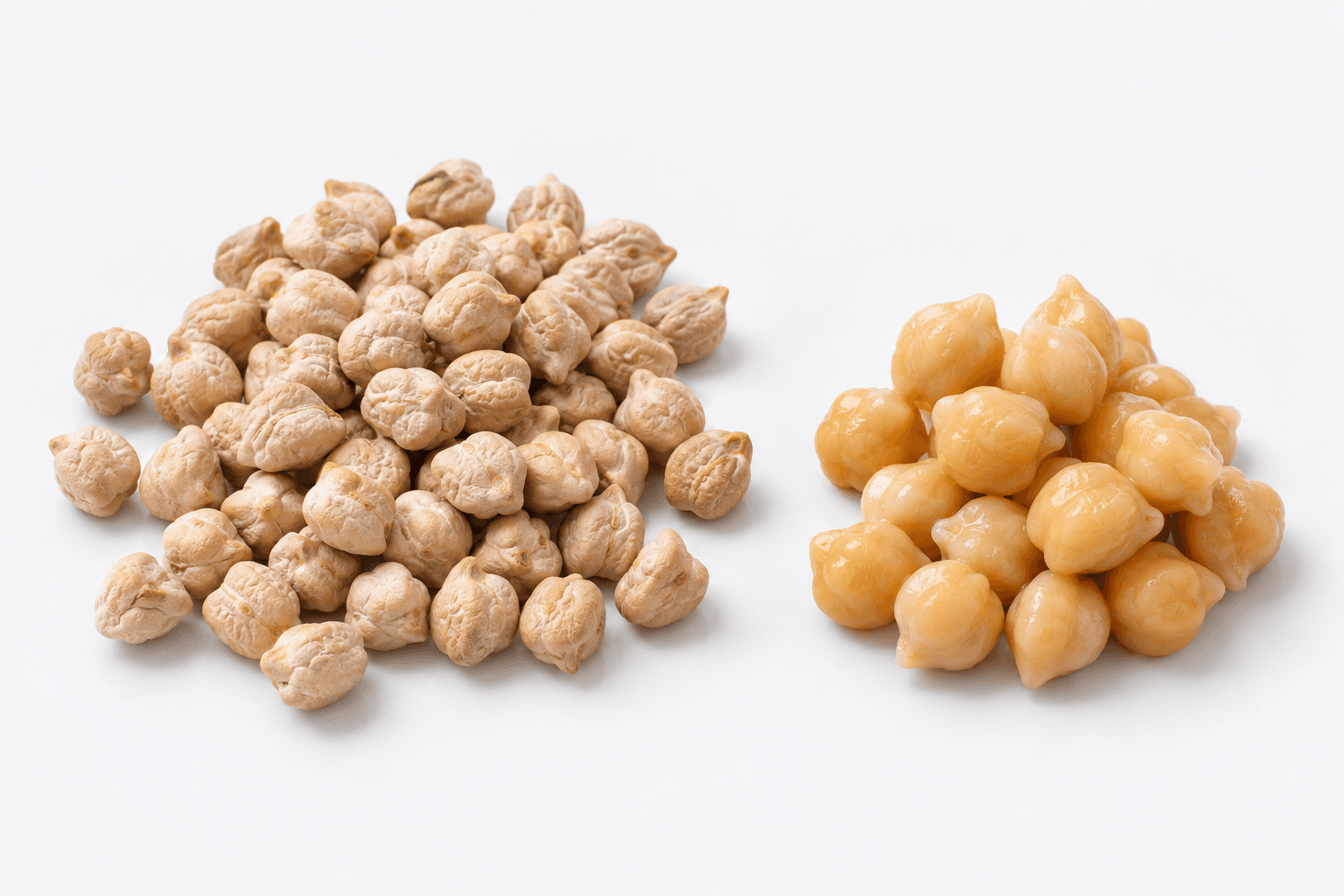
The chickpea is an annual legume named for the small beak-like point on one side of the seed. It is native to western Asia and underpins the cooking of the Middle East, India and the Mediterranean. Boiled, it is mealy and faintly chestnut-sweet. Mashed with sesame paste it becomes hummus; ground, bound and fried it becomes falafel. Even the cooking liquid has a use — known as aquafaba, it whips like egg white. The dried bean is hard and wants an overnight soak.
Scientific name Cicer arietinum
Chickpeas — garbanzos — arrived in Korean kitchens through hummus and curry. Like any pulse, they are dense in fibre and folate.
One thing needs care here. The 2025 chickpea meta-analysis did find lower post-meal glucose, but graded its own evidence 'very low certainty'. Variation between trials was large, and several authors work for a food company.
The claim that pulses as a class lower LDL is far firmer. The reason to eat chickpeas rests more on the pulse literature than on chickpea trials.
Key benefits
- Moderate evidence
They flatten the post-meal glucose curve — at low certainty
[1]A 2025 meta-analysis pooled 28 controlled crossover trials (40 comparisons). Against carbohydrate-matched controls, chickpeas lowered the incremental area under the glucose curve by 47.89 (95 % CI −64.20 to −31.58, p < 0.0001).
Yet in the same analysis peak glucose (Cmax) and insulin iAUC showed no significant difference. And the authors' own GRADE rating of the glucose result was 'very low certainty', because of heterogeneity.
Several of the authors are employees of a food company (PepsiCo), as the paper discloses. That does not make the result wrong, but it is part of what you should know while reading a low-certainty finding.
The direction agrees with the wider pulse literature. 'Chickpeas lower blood sugar' is not yet a settled statement.
- Strong evidence
As a pulse, they lower LDL cholesterol
[2][3]This part is much firmer. A meta-analysis of 38 randomised trials (2,095 people) found that a median 130 g of pulses a day for about 6 weeks lowered LDL by 0.14 mmol/L — roughly 5.4 mg/dL (95 % CI −0.19 to −0.08). Non-HDL fell 0.22 mmol/L, with most outcomes graded moderate-to-high.
An earlier 26-trial meta-analysis put it at 0.17 mmol/L.
Those authors also noted that chickpeas, dried peas and lentils need study in their own right. For now, 'pulses do this' is the accurate phrasing.
- Nutrition data
172 µg of folate — a cup passes the daily requirement
Cooked chickpeas carry 172 µg of folate per 100 g, 43 % of the 400 µg adult requirement. A cup (about 240 g) goes past it.
Fibre is 7.6 g, essentially level with lentils (7.9 g), alongside 2.9 mg of iron, 1.03 mg of manganese and 48 mg of magnesium.
Protein is 8.9 g. Unlike grains, chickpeas are generous in lysine, so eating them with rice or bread lets the two amino-acid profiles fill each other's gaps.
How to eat it well
- Soak dried chickpeas overnight (8 hours). Throw out the soaking water and boil in fresh — some of the gas-forming oligosaccharides leave with it.
- Pair the iron with vitamin C. Non-haem iron absorbs poorly alone, but lemon, tomato or peppers raise it sharply.
- Rinse canned chickpeas. A good share of the sodium washes off.
- Hummus is chickpeas plus tahini plus olive oil. The oil changes the calorie picture, so counting it as 'boiled chickpeas' will be wrong.
- The cooking liquid (aquafaba) foams and stands in for egg white. That is a physical property, not a nutritional one.
How to read the grades
Each benefit carries a label showing how far research on people supports it. Grades differ between items even within the same ingredient.
- Nutrition data
- A fact verifiable from food composition databases or health authorities. This is a different kind of statement from a clinical effect.
- Strong evidence
- Consistently confirmed across randomised controlled trials or meta-analyses.
- Moderate evidence
- Human studies exist, but effect sizes are small or results are mixed.
- Early research
- Cell or animal work, or small preliminary studies.
- Not established
- Commonly claimed, but not confirmed in studies on people.
What to watch out for
- Expect gas and bloating at first. Gut bacteria ferment the raffinose-family oligosaccharides. Increasing slowly usually settles it.
- With IBS, chickpeas are restricted on a low-FODMAP diet. Rinsed canned ones are a little easier.
- On a potassium- or phosphorus-restricted renal diet, count 291 mg potassium and 168 mg phosphorus per 100 g.
- Legume allergy is uncommon but real. If another pulse has ever caused a reaction, start small.
- Undercooked pulses digest badly. Cook until one crushes between your fingers.
Nutrition
Per 100 g of cooked chickpeas. Soaked and boiled, dried chickpeas gain about two and a half times their weight, so 100 g dry yields roughly 250 g cooked. Dry chickpeas run around 380 kcal per 100 g.
- Calories
- 164 kcal8%
- Protein
- 8.9 g18%
- Carbohydrates
- 27.4 g10%
- Fiber
- 7.6 g27%
- Folate
- 172 µg43%
- Iron
- 2.9 mg16%
- Magnesium
- 48 mg11%
- Manganese
- 1.03 mg45%
- Potassium
- 291 mg6%
- Zinc
- 1.5 mg14%
Percentages are of the US FDA Daily Value for adults and children 4 and over. National reference intakes differ by sex and age.
Calculate this alongside other ingredients →
Key nutrients
By health concern
Dishes with this ingredient
Compare with
Sources
The databases and health authorities this article's nutrition figures and health statements draw on.
- 1Chickpea attenuates postprandial blood glucose responses: a systematic review and meta-analysisMeta-analysisMah E, et al. Nutr J 2025PMID 40660242
- 2Effect of Different Types of Whole Dietary Pulses on Established Therapeutic Lipid Targets for Cardiovascular Risk Reduction: An Updated Systematic Review and Dose-Response Meta-Analysis of Randomized Controlled TrialsMeta-analysisBack S, et al. J Am Heart Assoc 2026PMID 42132198
- 3Effect of dietary pulse intake on established therapeutic lipid targets for cardiovascular risk reduction: a systematic review and meta-analysis of randomized controlled trialsMeta-analysisHa V, et al. CMAJ 2014PMID 24710915
- 4USDA FoodData CentralFood composition database
- 5NIH Office of Dietary SupplementsHealth authority
- 6World Health Organization · Healthy dietHealth authority
- 7PubMedResearch literature