Contents
What it is
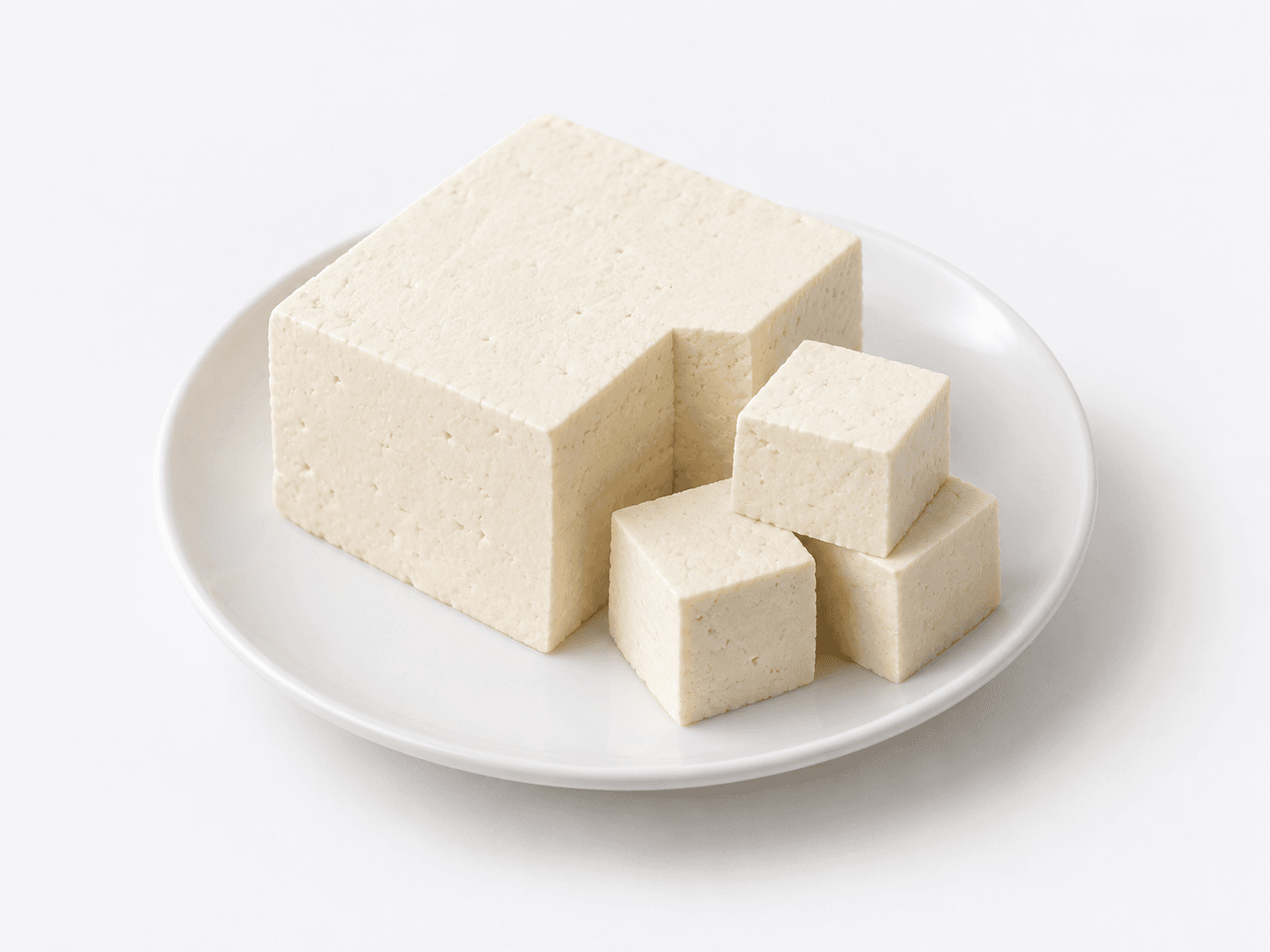
Tofu is made by grinding soybeans, boiling them, straining out the pulp to get soy milk, and setting that milk with a coagulant. The principle is much like cheesemaking, except it starts from a bean rather than from an animal's milk. The coagulant is either nigari, which is magnesium chloride, or calcium sulphate, and which one is used changes the calcium content — that is why calcium figures vary so widely between tofu products. How hard it is pressed gives everything from the softest curd to firm tofu for frying. It is kept refrigerated under water, with the water changed.
Two stories follow tofu around. One says it lowers cholesterol. The other says its oestrogen-like compounds are bad for breast cancer.
The first is true but smaller than people assume. The second points the opposite way in the research.
Tofu is soybeans ground and coagulated into a curd. Most of the bean's fibre is lost in the process, while protein and minerals concentrate. It is worth knowing that the calcium content swings widely depending on which coagulant was used.
Key benefits
- Strong evidence
It lowers LDL cholesterol — by about 3–4 %
[1]When the US FDA considered revoking soy protein's heart health claim, it identified 46 randomised trials. A meta-analysis re-examined them; 43 provided usable data. At a median 25 g of soy protein a day over a median 6 weeks, LDL fell by 4.76 mg/dL (95 % CI −6.71 to −2.80, P < 0.0001, I² = 55 %), and total cholesterol by 6.41 mg/dL.
In proportional terms that is roughly 3–4 %. About 75 % of individual trials pointed downward, though only a minority reached significance on their own. Consistent in direction, small in size — that is the accurate summary. It is not in the same league as a statin, and it does not replace anything.
- Moderate evidence
In breast cancer research, survival was better, not worse
[2]The claim that soy is bad for breast cancer rests on isoflavones resembling oestrogen structurally. What has been observed in people goes the other way.
Pooling 12 studies covering 37,275 women with breast cancer, higher pre-diagnosis soy intake came with better overall survival (hazard ratio 0.84, 95 % CI 0.71–0.98), and lower recurrence. But breast-cancer-specific survival (0.89, 0.74–1.07) and post-diagnosis intake (0.80, 0.62–1.04) were not statistically significant.
The authors called it limited evidence themselves. Do not read it as soy preventing breast cancer. But nothing in this data gives a reason to avoid it.
- Moderate evidence
It modestly reduces menopausal hot flashes
[3]A JAMA meta-analysis of 62 randomised trials covering 6,653 women. Phytoestrogens overall cut daily hot flashes by 1.31 (95 % CI −2.02 to −0.61); soy isoflavones specifically by 0.79 (−1.35 to −0.23).
Night sweats did not improve (−2.14, −5.57 to 1.29 — the interval runs well past zero). And 74 % of the included trials were judged at high risk of bias in three or more domains. Real but small, on evidence of uneven quality.
- Nutrition data
10 g of protein per 100 g, at 83 kcal
Soy protein is complete: it carries all the essential amino acids. Getting the same 10 g from pork belly costs several times the energy.
Calcium runs 282 mg per 100 g, but that number moves a great deal with the coagulant. Tofu set with calcium sulphate is high in calcium; set with nigari (magnesium chloride), the magnesium rises instead. The ingredient list on the package tells you which.
How to eat it well
- Pressing out water raises the protein density. Thirty minutes under paper towel loses weight and improves the texture after cooking.
- Pair the iron with vitamin C. Tofu's iron is non-haem and poorly absorbed. Peppers or broccoli alongside help.
- Freezing and thawing turns it spongy — it soaks up sauce, which suits braises and stir-fries.
- Silken and firm are not interchangeable. Silken holds more water, so the same weight carries less protein.
- If cholesterol is the goal, the studied dose is 25 g of soy protein a day — about 250 g of tofu. A standard block runs around 300 g.
How to read the grades
Each benefit carries a label showing how far research on people supports it. Grades differ between items even within the same ingredient.
- Nutrition data
- A fact verifiable from food composition databases or health authorities. This is a different kind of statement from a clinical effect.
- Strong evidence
- Consistently confirmed across randomised controlled trials or meta-analyses.
- Moderate evidence
- Human studies exist, but effect sizes are small or results are mixed.
- Early research
- Cell or animal work, or small preliminary studies.
- Not established
- Commonly claimed, but not confirmed in studies on people.
What to watch out for
- The thyroid worry is largely unfounded when iodine is adequate. A review of studies in healthy adults and in people with hypothyroidism found no evidence that soy worsens thyroid function. But if you take levothyroxine, soy can interfere with absorption — leave at least four hours between them.
- Soy allergy is relatively common in children.
- On a potassium- or phosphorus-restricted renal diet, count tofu in. Phosphorus is 111 mg per 100 g.
- Gout is not a strong reason to avoid soy. The current understanding is that plant purines do not raise urate the way meat and seafood purines do.
Nutrition
Per 100 g of firm tofu. A standard block is usually around 300 g. Silken and soft tofu hold more water, so the same weight carries less energy and protein than this, and calcium varies a great deal with the coagulant used.
- Calories
- 83 kcal4%
- Protein
- 10.0 g20%
- Fat
- 5.3 g7%
- Carbohydrates
- 1.2 g<1%
- Calcium
- 282 mg22%
- Iron
- 2.0 mg11%
- Magnesium
- 35 mg8%
- Manganese
- 0.67 mg29%
- Selenium
- 13 µg24%
Percentages are of the US FDA Daily Value for adults and children 4 and over. National reference intakes differ by sex and age.
Calculate this alongside other ingredients →
Key nutrients
By health concern
Dishes with this ingredient
Compare with
Sources
The databases and health authorities this article's nutrition figures and health statements draw on.
- 1A Meta-Analysis of 46 Studies Identified by the FDA Demonstrates that Soy Protein Decreases Circulating LDL and Total Cholesterol Concentrations in AdultsMeta-analysisBlanco Mejia S, et al. J Nutr 2019PMID 31006811
- 2Soy and isoflavones consumption and breast cancer survival and recurrence: a systematic review and meta-analysisMeta-analysisQiu S, et al. Eur J Nutr 2019PMID 30382332
- 3Use of Plant-Based Therapies and Menopausal Symptoms: A Systematic Review and Meta-analysisMeta-analysisFranco OH, et al. JAMA 2016PMID 27327802
- 4USDA FoodData CentralFood composition database
- 5MFDS Food Composition Database · 식품안전나라Food composition database
- 6NIH Office of Dietary SupplementsHealth authority
- 7Effects of soy protein and soybean isoflavones on thyroid function in healthy adults and hypothyroid patients: a review of the relevant literatureSystematic reviewsMessina M, et al. Thyroid 2006PMID 16571087
- 8PubMedResearch literature