Contents
What it is
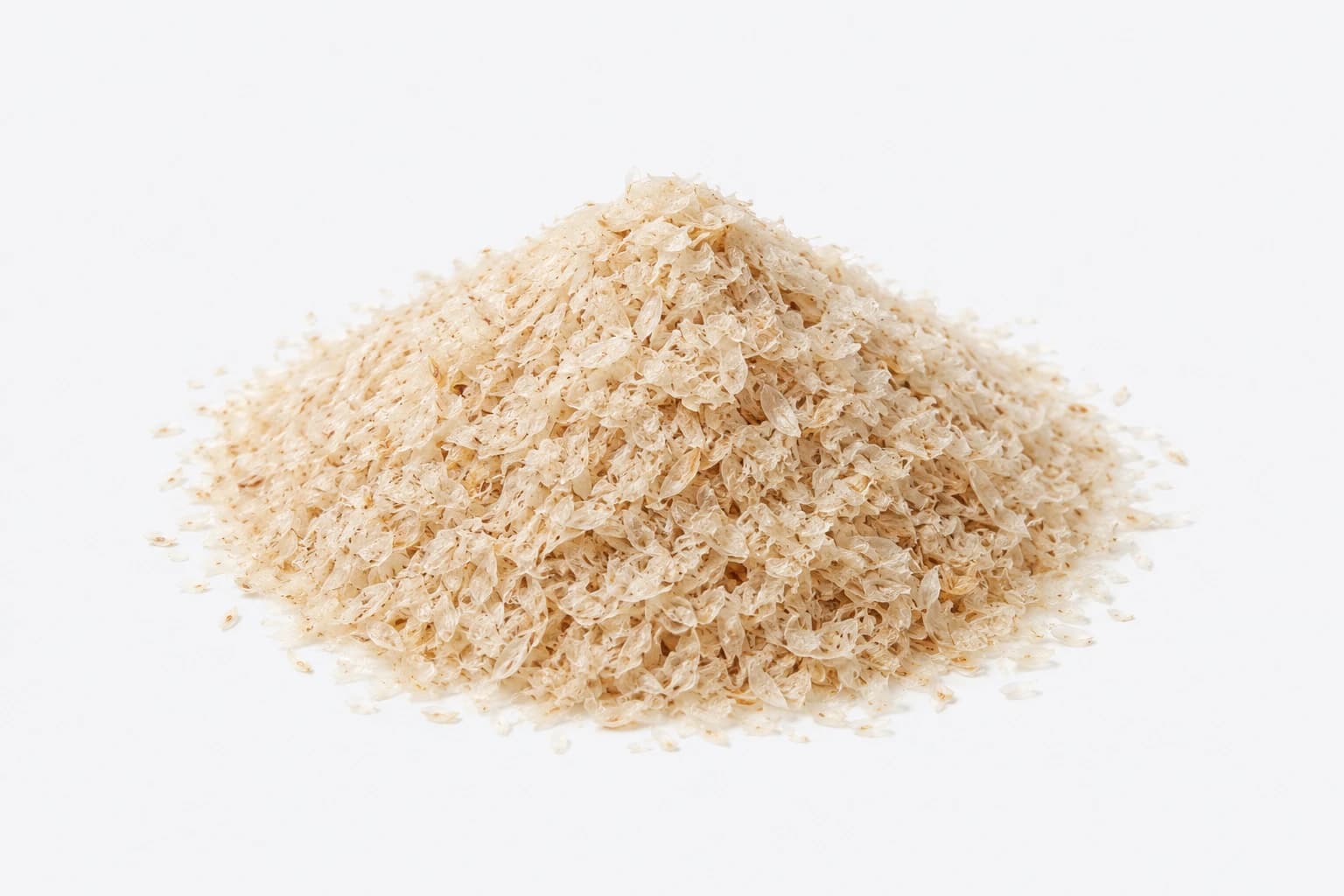
Psyllium husk is the outer coat of the seed of a plantain-family plant, stripped away from the seed itself; India and Pakistan grow most of it. Almost all of it is soluble fibre, and it takes up many times its weight in water, swelling into a gel — that single property is essentially the whole ingredient. It must be taken with plenty of water, because without enough it can lodge in the throat or oesophagus. It has almost no taste or smell, so it is simply stirred into water or a drink.
Scientific name Plantago ovata
Psyllium is the seed husk of Plantago ovata. Almost all of it is dietary fibre, and most of that is water-soluble viscous fibre.
Most entries on this site rest on early or unconfirmed evidence. Psyllium is different.
2018 meta-analysis, The American Journal of Clinical Nutrition.
- 28 randomised controlled trials, 1,924 participants
- Only trials lasting three weeks or more
- Median dose 10.2 g a day
- LDL cholesterol fell by 0.33 mmol/L on average (95% CI −0.38 to −0.27, p<0.00001)
- Non-HDL cholesterol and apolipoprotein B fell too
- The quality of the evidence was graded with GRADE
0.33 mmol/L is about 12.8 mg/dL. It sounds small, but a single food moving it this consistently is rare.
A 2024 meta-analysis in Nutrition Research also found total cholesterol and LDL significantly reduced.
Two things to be clear about, though.
- Psyllium is closer to a fibre supplement than an ordinary food. The trials used powder or capsules
- It must be taken with water, and taking it without can be dangerous. That is set out below
Key benefits
- Strong evidence
LDL cholesterol falls — a meta-analysis of 28 trials and 1,924 people
[1][2]2018, The American Journal of Clinical Nutrition.
- Medline, EMBASE, CINAHL and the Cochrane register searched through October 2017
- Only randomised controlled trials lasting three weeks or more
- People with and without hypercholesterolemia
- 28 trials, 1,924 participants
- Median dose 10.2 g a day
- Random-effects models; evidence quality assessed with GRADE
Outcome Result LDL cholesterol −0.33 mmol/L (95% CI −0.38 to −0.27, p<0.00001) Non-HDL cholesterol significantly reduced Apolipoprotein B significantly reduced In the units used on many lab reports, 0.33 mmol/L is about 12.8 mg/dL.
Why it matters that non-HDL and apoB fell too. An LDL number alone misses some particles. Non-HDL bundles every atherogenic lipoprotein together, and apoB is close to a count of those particles. All three moving the same way means it was not one measure wobbling by chance.
How it works. Psyllium dissolves into a highly viscous gel. That gel traps bile acids in the gut and carries them out. The body has to replace what it lost, and the raw material for bile acids is cholesterol — so blood cholesterol gets used up.
This is the same mechanism as oat beta-glucan, except psyllium forms a more viscous gel.
The limits, stated plainly.
- The effect is not on the scale of a drug. Statins lower LDL by 30 to 50%. Ten grams of psyllium is around 10%
- It cannot replace a prescription. If you are being treated, this is something to add in discussion with your clinician, not something to swap in
- The median 10.2 g is not a small amount. A typical serving is 5 g, so that is twice a day
- The 28 trials differ in design and duration. A meta-analysis is their pooled average
Even so, set against the rest of this site, the evidence here is thick. This site marks something as established only when several human trials exist and agree. Psyllium meets that bar.
- Moderate evidence
Chronic constipation — confirmed in a meta-analysis of fibre supplementation
[3]2022 meta-analysis, The American Journal of Clinical Nutrition.
A systematic review pooling randomised controlled trials of fibre supplementation for chronic constipation in adults. Psyllium is the most studied fibre among them.
How it works. Psyllium holds water, which increases stool bulk and softens it. And most of it passes through the gut without being fermented.
That sets it apart from other fibres. Inulin and fructo-oligosaccharides are fermented quickly by gut bacteria, producing gas. Psyllium ferments less, so it causes comparatively less gas and bloating. That is why it is the fibre usually suggested for irritable bowel syndrome.
The grade here is "moderate", for three reasons.
- That meta-analysis covered fibre supplementation generally, not psyllium alone
- Constipation trials are hard to blind. Psyllium thickens visibly in water, so it is distinguishable from a placebo
- The outcomes are often subjective. Stool frequency can be counted; a feeling of relief cannot
In practice.
- Start small. Three to five grams a day, increasing weekly
- A sudden large dose makes things worse — gas, bloating, cramping
- It takes several days to work. Do not judge it after one
- You must drink enough water. This matters most, and is set out separately below
It is also used for diarrhoea. The same gel holds water, so it firms loose stool. Using one thing for both constipation and diarrhoea sounds odd, but it is two directions of the same action on water.
- Nutrition data
The composition table is almost entirely fibre — and where the numbers come from
The source of this table has to be declared first.
The USDA standard composition database has no entry for psyllium. Every other ingredient on this site uses that database. Psyllium appears to be classified as a supplement rather than a food.
So three pure psyllium husk powders in the branded database were compared, and only the figures on which all three agree are printed here. One product listed iron as 16,700 where the other two said 16.7, so that was judged a unit error.
Energy is blank. None of the three carried a figure. Guesses do not go in this table.
Per 100 g of psyllium husk powder:
- Dietary fibre 77.8 g — soluble 67 g, insoluble 11 g
- Carbohydrate 88.9 g
- Potassium 967 mg
- Iron 16.7 mg
- Sodium 111 mg
There is effectively one thing to read here: 77.8 g of fibre.
Sixty-seven grams of it is soluble. That ratio is what separates psyllium from other fibres. Soluble fibre holds water into a viscous gel, and that viscosity is the mechanism behind both the cholesterol and the stool effects.
Converting to a serving is what makes it meaningful.
100 g One serving, 5 g 10 g a day Fibre 77.8 g 3.9 g 7.8 g Soluble fibre 67 g 3.4 g 6.7 g Potassium 967 mg 48 mg 97 mg Sodium 111 mg 6 mg 11 mg Ten grams a day gives 7.8 g of fibre, which against an adult daily value of 28 g is 28%. The lipid meta-analysis used a median of 10.2 g.
The 16.7 mg of iron looks high, but a 5 g serving is 0.8 mg. It is plant iron, and psyllium's gel may itself interfere with mineral absorption.
Against other fibre sources:
Fibre (100 g) Soluble share Psyllium 77.8 g about 86% Flaxseed 27.3 g low Oats 10.6 g medium Barley 17.3 g medium But psyllium is not a meal. Flaxseed and oats are eaten as food; psyllium is closer to something stirred into water. If you can get fibre from food, that is better — vegetables and whole grains bring much besides fibre.
- Not established
Weight loss and blood sugar — and the rules you must follow
Start with the weight-loss claim.
The story is that psyllium fills you up and so you lose weight. It is true that the viscous gel takes up space in the stomach and slows gastric emptying.
But this site did not find consistent evidence from trials that fed psyllium, measured weight and compared against a control. There is nothing on weight to match the lipid meta-analyses. Feeling full and losing weight are separate claims.
Blood sugar.
That viscous fibre slows the postprandial glucose rise is explicable by mechanism, and there is research pointing that way for psyllium. But this site did not find evidence to mark it as firm as the lipid finding.
If you take diabetes medication, the timing matters — see below.
From here is the most important part of this entry.
Always take it with enough water.
Psyllium absorbs water and swells many times over. Swallowed without enough liquid, it can swell and obstruct the oesophagus or the gut. Cases of choking and bowel obstruction are documented, and the US Food and Drug Administration requires a warning label about it.
- At least 240 ml of water per serving
- Drink it immediately after mixing. Left standing, it sets in the glass
- Drink more water afterwards
- Do not take it lying down
- Do not take it immediately before bed
Do not take it if you have difficulty swallowing, a narrowed oesophagus, or a history of bowel obstruction.
Space it away from medication.
Psyllium's gel can slow or reduce the absorption of drugs taken at the same time.
- Take other medicines two hours before or two hours after psyllium
- Particular care: diabetes medication (hypoglycaemia risk), thyroid hormone, lithium, carbamazepine, digoxin, warfarin
- If you take prescription medication, talk to your clinician before starting psyllium
Allergy. Rarely, asthma and anaphylaxis from inhaling psyllium dust have been reported. Do not breathe in the powder while handling it.
In pregnancy it is used for constipation, but talk to your clinician before starting.
How to eat it well
- A serving is 5 g; around 10 g a day. The lipid meta-analysis used a median of 10.2 g.
- Always take at least 240 ml of water with it, and drink more afterwards.
- Drink it straight after mixing. Left standing, it sets in the glass.
- Start small and increase weekly. A sudden jump brings gas and bloating.
- Space it two hours or more from other medication.
- Do not take it lying down or right before bed.
- Do not inhale the powder. Inhalation allergy has been reported.
- If you can get fibre from vegetables and whole grains, do. Psyllium adds to that; it does not replace it.
How to read the grades
Each benefit carries a label showing how far research on people supports it. Grades differ between items even within the same ingredient.
- Nutrition data
- A fact verifiable from food composition databases or health authorities. This is a different kind of statement from a clinical effect.
- Strong evidence
- Consistently confirmed across randomised controlled trials or meta-analyses.
- Moderate evidence
- Human studies exist, but effect sizes are small or results are mixed.
- Early research
- Cell or animal work, or small preliminary studies.
- Not established
- Commonly claimed, but not confirmed in studies on people.
What to watch out for
- Taken without water it can swell and obstruct the oesophagus or gut. Choking and bowel obstruction have been reported.
- Do not take it with difficulty swallowing, a narrowed oesophagus, or a history of bowel obstruction.
- It can slow or reduce the absorption of other drugs. Leave two hours or more.
- Talk to your clinician if you take diabetes medication, thyroid hormone, lithium, carbamazepine, digoxin or warfarin.
- The LDL effect is not on the scale of a drug. Against statins at 30 to 50%, 10 g of psyllium is around 10%, and it cannot replace a prescription.
- This site could not confirm an effect on weight loss.
- Asthma and anaphylaxis from inhaled psyllium dust have been reported.
- The composition table is not from the USDA standard database but from three branded products that agree. Energy is blank because none carried a figure.
Nutrition
Per 100 g of psyllium husk powder. The USDA standard composition database has no entry for psyllium, so these are the figures on which three pure psyllium husk powders in the branded database agree. Energy is blank because none of the three carried a figure. A serving is 5 to 10 g, so these numbers are more than ten times that.
- Fiber
- 77.8 g278%
- Carbohydrates
- 88.9 g32%
- Potassium
- 967 mg21%
- Iron
- 16.7 mg93%
- Sodium
- 111 mg5%
Percentages are of the US FDA Daily Value for adults and children 4 and over. National reference intakes differ by sex and age.
Calculate this alongside other ingredients →
Key nutrients
By health concern
Dishes with this ingredient
Sources
The databases and health authorities this article's nutrition figures and health statements draw on.
- 1Effect of psyllium (Plantago ovata) fiber on LDL cholesterol and alternative lipid targets, non-HDL cholesterol and apolipoprotein B: a systematic review and meta-analysis of randomized controlled trialsMeta-analysisJovanovski E, et al. The American Journal of Clinical Nutrition 2018PMID 30239559
- 2Plantago consumption significantly reduces total cholesterol and low-density lipoprotein cholesterol in adults: A systematic review and meta-analysisMeta-analysisZhu R, et al. Nutrition Research 2024PMID 38688104
- 3The Effect of Fiber Supplementation on Chronic Constipation in Adults: An Updated Systematic Review and Meta-Analysis of Randomized Controlled TrialsMeta-analysisvan der Schoot A, et al. The American Journal of Clinical Nutrition 2022PMID 35816465
- 4USDA FoodData CentralFood composition database
- 5PubMedResearch literature