Contents
What it is
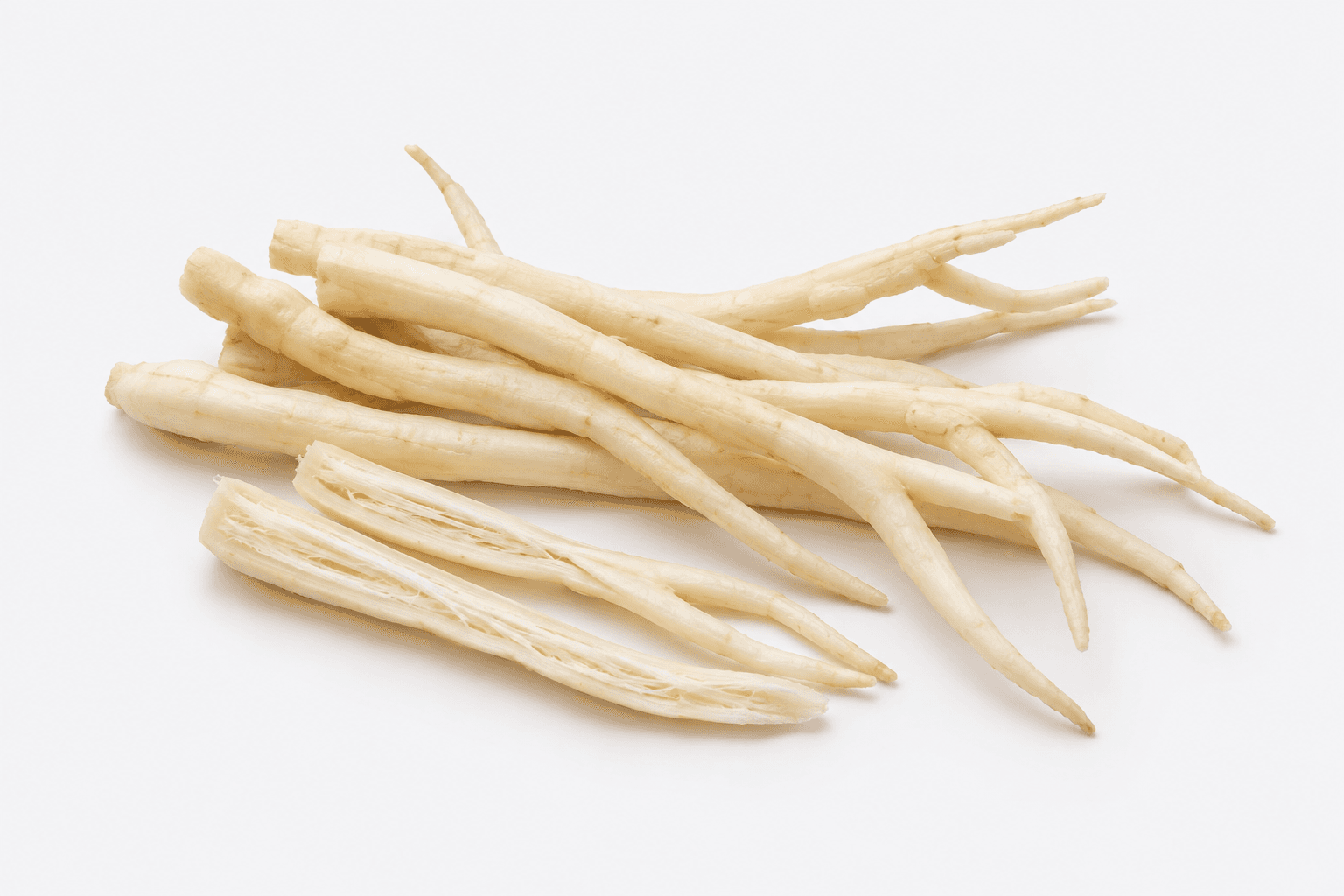
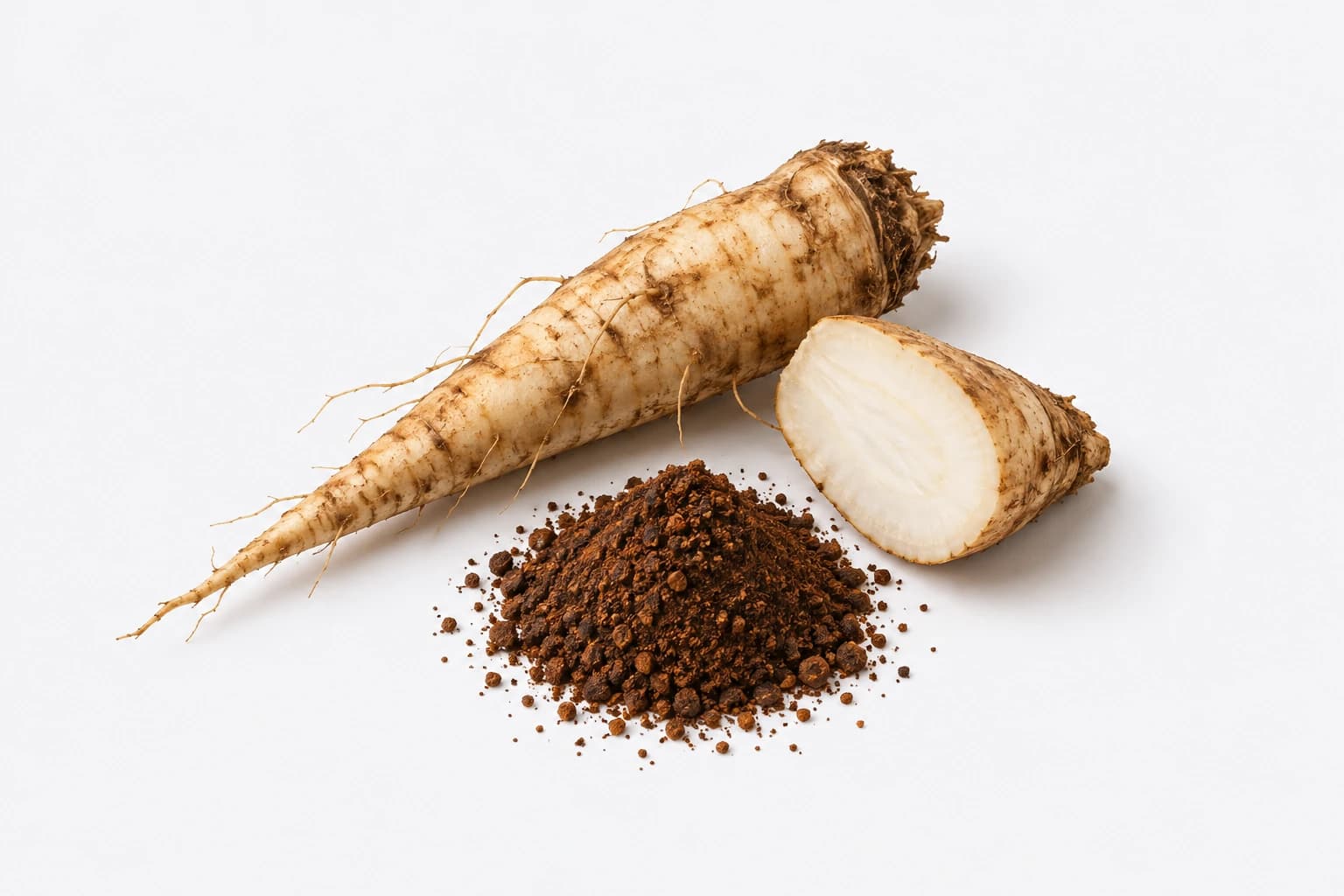
Chicory root is the taproot of the chicory plant, a member of the daisy family. It is the same species as the salad leaf, but a different part of it, and it is native to Europe and western Asia. Cut, dried and roasted, it takes on a colour and aroma close to coffee, and Europe has long used it as a coffee substitute or blender. It contains no caffeine and tastes bitter with a roasted, nutty edge. The inulin extracted from the root is also a common fibre ingredient in processed foods.
Scientific name Cichorium intybus
Chicory root is roasted as a coffee substitute, or used as the raw material for extracting inulin. A large share of the "prebiotic" fibre products on sale comes from this root.
Inulin is a fibre with the opposite properties to this site's psyllium.
- Psyllium — holds water into a viscous gel and is barely fermented in the gut
- Inulin — almost no viscosity, and gut bacteria ferment it quickly
That difference explains both the effect and the side effects.
2017, International Journal of Food Sciences and Nutrition.
- 44 healthy volunteers with constipation
- Randomised, double-blind, placebo-controlled, crossover, with a two-week washout
- Each period: 12 g of chicory inulin a day in three 4 g doses, or maltodextrin placebo, for four weeks
- Stool frequency and consistency, gastrointestinal characteristics and quality of life recorded
The results:
- Stool frequency rose significantly — median 4.0 a week (IQR 2.5-4.5) against placebo 3.0 (2.5-4.0), p=0.038
- Stools softened
- Satisfaction trended higher than placebo but was not significant (p=0.059)
Two things have to be read alongside this — the size of the change, and who the researchers work for.
Key benefits
- Moderate evidence
One more stool a week — and the researchers worked for the manufacturer
[1]2017, International Journal of Food Sciences and Nutrition.
Participants 44 healthy volunteers with constipation Design Randomised, double-blind, placebo-controlled, crossover (two-week washout) Intervention 12 g a day of chicory inulin (3 × 4 g) or maltodextrin Duration four weeks per period, after a run-in Primary outcome stool frequency The results:
Outcome Inulin Placebo Stools per week median 4.0 (IQR 2.5-4.5) 3.0 (2.5-4.0) p=0.038 Consistency softened Satisfaction trended higher p=0.059 — not significant Start with the design's strengths. It was double-blind, and crossover, so the same people experienced both conditions. There was a washout, and the paper states it followed recent guidance for investigating bowel function. That is better than the standard commonly seen in this field.
But two things belong alongside it.
First, the change is one stool a week.
The median went from 3.0 to 4.0. That means going once more per week. Look at the interquartile ranges — placebo 2.5-4.0, inulin 2.5-4.5 — and they overlap substantially.
That does not make it meaningless. For someone with constipation, one more a week can be a felt difference. But it is a different size of thing from "constipation solved".
And satisfaction was not significant (p=0.059). Frequency rose, but satisfaction did not clear the statistical threshold — both belong in the reading.
Second, who the researchers work for.
Some authors of this paper are affiliated with the BENEO-Institute, the research arm of the company that makes the Orafti® Inulin used in the trial.
That does not mean the result is wrong. Manufacturers testing their own products is common and does not by itself invalidate a study. The double-blind placebo-controlled crossover design stands.
But this site writes it down. That industry-funded nutrition research reports positive results more often is a pattern confirmed repeatedly across fields. Replication by an independent group would make this sturdier.
Look at the dose too. Twelve grams a day.
That is not an amount you get by eating chicory root. It is extracted, concentrated inulin powder, split into three doses a day.
The honest conclusion:
- Twelve grams a day of chicory inulin raised stool frequency by one a week in people with constipation
- Satisfaction was not significant
- Some of the researchers work for the maker of the product tested
- What was used is extracted inulin, not the root
- The grade is "moderate"
- Nutrition data
Do not believe the 1.5 g of fibre in the table — it is a limit of the assay
This section is about how to read a composition table.
Per 100 g of raw chicory root:
- 72 kcal, carbohydrate 17.5 g, sugar 8.73 g, fibre 1.5 g
- Potassium 290 mg, phosphorus 61 mg, calcium 41 mg, magnesium 22 mg
- Protein 1.4 g, fat 0.2 g, sodium 50 mg
- Vitamin C 5.0 mg, iron 0.8 mg, manganese 0.233 mg, zinc 0.33 mg
Looking at that "fibre 1.5 g" and concluding there is not much fibre here would be wrong.
The main component of chicory root is inulin. It makes up a substantial share of the fresh root's weight, and this root is the main commercial source from which inulin is extracted.
So why does the fibre read 1.5 g?
Because traditional fibre assays do not capture inulin.
The method long used as the standard treats the sample with enzymes and then precipitates the fibre with alcohol and filters it out. Fibre is caught; sugars dissolve and pass through.
But inulin dissolves in alcohol. So it is not caught, it passes through, and it is not counted as "dietary fibre". It ends up instead inside "carbohydrate", and in some cases "sugars".
So look again at the 17.5 g of carbohydrate and 8.73 g of sugar above. There is a good chance the inulin is in there.
This is also why this site does not rewrite composition tables. It prints the USDA figure as given and explains in the article what that figure fails to hold. Pulling an inulin content from another source and adding it to the fibre cell would mix the table's provenance and make it incomparable with every other ingredient here.
In practice, read it this way.
- You will rarely eat chicory root as it is. It is roasted as a coffee substitute, or used as raw material for extracting inulin
- Products labelled "chicory fibre", "inulin" or "prebiotic fibre" generally come from this root
- Read the product label. Inulin products usually state the content in grams, and that is the figure you can actually use
Note the 50 mg of sodium too. That is high for a root vegetable — cucumber is 2 mg, carrot about 69 mg.
At 72 kcal it is also high for a root vegetable. That follows from 17.5 g of carbohydrate, and if much of that is inulin, the energy actually absorbed is lower than the figure. Inulin is not digested in the small intestine but fermented in the colon, so only part of it is recovered as fermentation products.
- Not established
Gut bacteria, weight, blood sugar — and the side effect you must know about
Several claims attach to inulin. One at a time.
"It increases gut bacteria."
Inulin is classified as a prebiotic. Humans cannot digest it, so it reaches the colon and feeds bacteria such as bifidobacteria. That is well established as a mechanism.
But "the composition of gut bacteria changes" and "therefore health improves" are different claims. This site treats the first as a fact of composition and mechanism, and for the second found no confirmed outcome beyond constipation.
"It helps with weight loss."
There is research on inulin producing fullness or acting on appetite hormones. But this site found no consistent evidence from trials that fed chicory inulin, measured weight and compared against a control.
"It is good for blood sugar."
Inulin barely raises blood glucose, because it is not absorbed in the small intestine. That is true, but it is a different statement from "it lowers blood sugar".
Now the side effects. This is the most practical part of this entry.
Inulin ferments quickly. So it produces a lot of gas.
As set out in this site's psyllium entry, psyllium ferments barely at all and produces little gas. Inulin is the opposite.
- Bloating, gas, cramping and rumbling are common
- It is dose-related. Twelve grams a day is not a small amount
- Start small and build up. Three to five grams a day, increasing weekly
Take particular care if you have irritable bowel syndrome.
Inulin is a FODMAP — specifically the "O", the oligosaccharides. It is one of the classic symptom triggers in irritable bowel syndrome and one of the things a low-FODMAP diet restricts.
So the same compound helps one person's constipation and worsens another's symptoms. With constipation-predominant irritable bowel syndrome it is more confusing still. Talking to your clinician is the better course.
Allergy is reported, rarely. Chicory is in the daisy family, and cross-reaction is reported in people allergic to ragweed, mugwort and chrysanthemum. Artichoke, lettuce and sunflower seed are in the same family.
To summarise:
- Confirmed: 12 g a day raised stool frequency by one a week (44 people, double-blind crossover, with manufacturer-affiliated researchers)
- Established as mechanism: inulin ferments in the colon and feeds particular bacteria
- Not confirmed: weight loss, lowering blood sugar
- What you must know: gas and bloating are common, and in irritable bowel syndrome it can worsen symptoms
How to eat it well
- The trial used 12 g a day, split into three 4 g doses.
- Start at 3 to 5 g a day and increase weekly. Twelve grams straight away brings heavy gas and bloating.
- Split the dose. Three lots of 4 g beats 12 g at once.
- With irritable bowel syndrome, talk to your clinician. Inulin is a FODMAP.
- Read the declared inulin content on the product. That is the usable figure.
- Do not take the 1.5 g of fibre in the table at face value. The assay does not capture inulin.
- Roasted chicory root as a coffee substitute contains no caffeine. But the inulin you take in that way is small.
- Take care with daisy-family allergy.
How to read the grades
Each benefit carries a label showing how far research on people supports it. Grades differ between items even within the same ingredient.
- Nutrition data
- A fact verifiable from food composition databases or health authorities. This is a different kind of statement from a clinical effect.
- Strong evidence
- Consistently confirmed across randomised controlled trials or meta-analyses.
- Moderate evidence
- Human studies exist, but effect sizes are small or results are mixed.
- Early research
- Cell or animal work, or small preliminary studies.
- Not established
- Commonly claimed, but not confirmed in studies on people.
What to watch out for
- The effect size was 3 to 4 stools a week. Satisfaction was not significant at p=0.059.
- Some of the researchers were affiliated with the maker of the inulin used.
- What was used was extracted inulin powder at 12 g a day, not the root.
- Gas, bloating and cramping are common, because this is a rapidly fermented fibre.
- Inulin is a FODMAP. It can worsen symptoms in irritable bowel syndrome, so talk to your clinician.
- The 1.5 g of fibre in the table does not include the inulin. Traditional assays do not retain it.
- Chicory is in the daisy family. Cross-reaction is reported with ragweed, mugwort and chrysanthemum allergy.
- Claims about weight loss and lowering blood sugar are unconfirmed.
Nutrition
Per 100 g of raw chicory root. Do not take the 1.5 g of fibre below at face value — inulin, this root's main component, is not captured by traditional fibre assays. The reason is set out in the article.
- Calories
- 72 kcal4%
- Carbohydrates
- 17.5 g6%
- Sugars
- 8.73 g
- Fiber
- 1.5 g5%
- Potassium
- 290 mg6%
- Phosphorus
- 61 mg5%
- Calcium
- 41 mg3%
- Magnesium
- 22 mg5%
- Protein
- 1.4 g3%
- Fat
- 0.2 g<1%
- Sodium
- 50 mg2%
- Vitamin C
- 5.0 mg6%
- Iron
- 0.8 mg4%
- Manganese
- 0.233 mg10%
- Zinc
- 0.33 mg3%
Percentages are of the US FDA Daily Value for adults and children 4 and over. National reference intakes differ by sex and age.
Calculate this alongside other ingredients →
Key nutrients
By health concern
Dishes with this ingredient
Sources
The databases and health authorities this article's nutrition figures and health statements draw on.
- 1Effect of consumption of chicory inulin on bowel function in healthy subjects with constipation: a randomized, double-blind, placebo-controlled trialClinical trialMicka A, et al. International Journal of Food Sciences and Nutrition 2017PMID 27492975
- 2USDA FoodData CentralFood composition database
- 3PubMedResearch literature