Contents
What it is
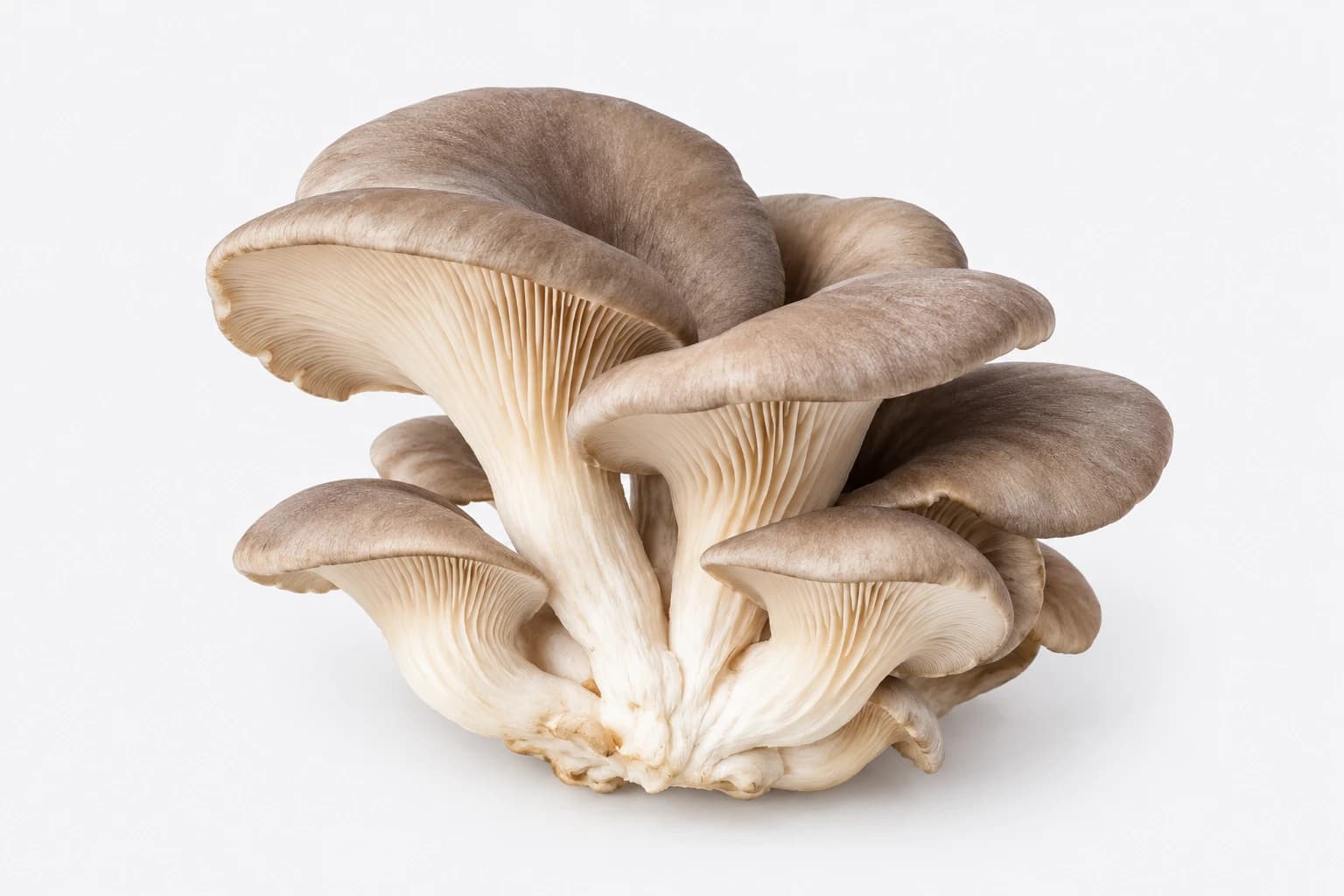
The oyster mushroom grows on wood, with the cap set off to one side like a fan or an oyster shell — which is where its English name comes from. It is not a plant but a fungus, so it does not photosynthesise; it grows by breaking down dead wood. It is among the most commonly cultivated mushrooms in Korea. It tears cleanly along the grain, so it is often pulled apart by hand rather than cut, and it holds a lot of water, so a hot fast pan keeps it from stewing in its own liquid.
Scientific name Pleurotus ostreatus
Oyster mushrooms are 33 kcal per 100 g and rich in beta-glucans. That is why claims about cholesterol and blood glucose attach to them.
Two trials have tested those claims. Both were double-blind, and both missed their primary endpoint.
2022, European Journal of Nutrition. Twenty-two adults with impaired glucose tolerance ate a meal fortified with 20 g of dried oyster mushroom powder (8.1 g of beta-glucans).
- The primary endpoint was the postprandial glucose area under the curve. It did not differ.
- Insulin, triglycerides, GIP and ghrelin did not differ either
- What moved: GLP-1 was 17% higher (p=0.001), free fatty acids 14% lower (p=0.026), hunger 22% lower (p=0.031)
2026, Nutrition & Metabolism. Forty-six adults with LDL between 116 and 190 mg/dL drank a beverage with 8.4 g of oyster mushroom powder (3 g of beta-glucans) every day for four weeks.
- The primary endpoint was LDL cholesterol. It did not differ.
- Total cholesterol, HDL, triglycerides, apolipoproteins A1 and B, gene expression — none of them differed (p≥0.05)
Both trials were honestly designed, and both failed to hit what they aimed at. That is where this entry starts.
Key benefits
- Early research
GLP-1 and hunger moved — glucose did not
[1]2022, European Journal of Nutrition.
- 22 adults with impaired glucose tolerance, double-blind randomised crossover
- One meal fortified with 20 g of oven-dried oyster mushroom powder (8.1 g beta-glucans), against the same meal without it
- Repeated blood draws before and across four hours after the meal
- Primary endpoint: glucose area under the curve
Outcome Result Glucose AUC (primary) no difference Insulin no difference Triglycerides no difference GIP no difference Ghrelin no difference GLP-1 AUC 17% higher (p=0.001) Free fatty acid AUC 14% lower (p=0.026) Hunger AUC 22% lower (p=0.031) Satiety, fullness, desire to eat no difference Read the primary endpoint first. What this trial declared in advance that it was after was postprandial glucose, and glucose did not move. Neither did insulin or triglycerides.
So what did move? GLP-1 — a gut hormone that helps insulin release and slows gastric emptying. The same hormone today's obesity and diabetes drugs imitate.
But do not walk past the fact that GLP-1 rose 17% and glucose still did not move. A hormone level is an intermediate marker; glucose is what we want to know about. When the middle moves and the end does not, one reading is that the movement was not large enough to matter.
And the 22% hunger figure? It is a subjective rating on a visual analogue scale, and the three companions measured alongside it — satiety, fullness and desire to eat — showed no difference. One of four measures moving is hard to separate from chance. The trial also never measured how much anyone actually ate. Feeling less hungry and eating less are different claims.
Look at the dose too. Twenty grams of dried powder is roughly 200 g of fresh mushroom — more than a pack, in a single meal.
The honest conclusion:
- Loading one meal with beta-glucans can raise postprandial GLP-1 and lower hunger — that is as far as this trial reaches
- Glucose did not move. It was the primary endpoint
- This was a single-meal acute trial, and nothing here shows the change persists
- The grade is "early research"
- Nutrition data
33 kcal per 100 g, 4.96 mg of niacin — and the vitamin D question
Per 100 g of raw oyster mushrooms:
- 33 kcal, carbohydrate 6.09 g, fibre 2.3 g, fat 0.41 g
- Protein 3.31 g — high for a vegetable
- Niacin (B3) 4.96 mg, riboflavin (B2) 0.349 mg, thiamin (B1) 0.125 mg
- Potassium 420 mg, phosphorus 120 mg, iron 1.33 mg, copper 0.244 mg, zinc 0.77 mg
- Selenium 2.6 µg, folate 38 µg, sodium 18 mg
- Vitamin D 0.7 µg (29 IU)
The low energy is this mushroom's most practical feature. At 33 kcal per 100 g you can be generous with it in a stir-fry or a hot pot. Halving the meat and filling the gap with mushrooms genuinely changes the arithmetic.
Niacin at 4.96 mg is 31% of the daily value. Mushrooms are generally good for B vitamins and this one is no exception; riboflavin at 0.349 mg covers 27%.
Vitamin D needs its own explanation.
You will often hear that mushrooms supply vitamin D. The figure above is 0.7 µg — 4% of the daily value. Cultivated mushrooms are grown indoors in the dark.
Mushrooms make vitamin D only under ultraviolet light, the same way human skin does in sunlight, and what they make is D2 (ergocalciferol). Sun-drying or UV treatment raises that figure substantially. Products treated this way say so on the label.
Whether D2 works as well as D3 in the body is still argued over, so filling your vitamin D from mushrooms alone is not a plan worth making.
Choosing and keeping. Look for caps that are moist and slightly thick. Edges curled upward mean it has been sitting. Avoid anything slimy or with wide brown patches.
Do not wash them. Mushrooms drink water, and washed ones release it in the pan — you end up braising rather than frying. Wiping with a damp cloth is enough.
Store them in a paper bag in the fridge. Left in the plastic they came in, the trapped moisture turns them slimy fast.
- Not established
The cholesterol claim — the best-designed trial found nothing
[2][3]Cholesterol is the claim most often attached to oyster mushrooms. They are rich in beta-glucans, so the expectation is that they will lower LDL the way oats do.
That expectation was tested head-on in 2026.
2026, Nutrition & Metabolism.
- 46 adults with LDL between 116 and 190 mg/dL (37 women, 9 men)
- Double-blind randomised controlled, four weeks
- A daily beverage containing 8.4 g of oyster mushroom powder (3 g beta-glucans), or the same beverage without it
- Primary endpoint: LDL cholesterol
The results:
Outcome Result LDL cholesterol (primary) no change Total cholesterol, HDL, triglycerides no change Apolipoproteins A1 and B no change Gene expression in cholesterol metabolism no change Markers of cholesterol and bile-acid synthesis no change The abstract's own phrasing is "p ≥ 0.05 for all".
So what did the paper report in its conclusion? That a linear model adjusted for sex showed reduced markers of cholesterol absorption, especially in women (p<0.05).
How to read that matters. The paper itself calls this analysis "post-hoc" — not planned in advance but split out after seeing the results. Post-hoc analysis generates hypotheses; it does not settle them.
And absorption markers are not blood cholesterol. An intermediate marker moved while LDL itself did not.
There is a trial that reported the opposite, though.
2022, International Journal of Medicinal Mushrooms. Thirty residents of a rural Mexican community were split two ways for three months. One group followed a healthy regional diet; the other followed it and added 1 kg of oyster mushrooms a week (four 250 g portions). Visceral fat and hyperlipidemia were reported to fall.
Set the two side by side.
2022, Mexico 2026, Germany Participants 30 46 Blinding none double-blind Control healthy diet alone identical beverage without mushroom Result visceral fat and lipids improved primary endpoint null When a trial is unblinded and both arms receive a "healthy diet" intervention, you cannot rule out that the arm also given mushrooms followed the rest of it more closely.
The honest conclusion:
- The best-designed trial does not support the claim that oyster mushrooms lower cholesterol
- That is not proof of no effect. Forty-six people over four weeks is a small trial
- But the best evidence available is null. The grade here is "not established"
- If beta-glucans for LDL is the goal, oats and barley carry far thicker evidence
How to eat it well
- Do not wash them. Wipe with a damp cloth. Washed mushrooms drink water and braise instead of frying.
- Tear them along the grain by hand. A knife crushes the cut face and costs you texture.
- High heat, short time. Low and slow draws the water out.
- Use them to displace meat. At 33 kcal per 100 g that genuinely changes the arithmetic.
- Niacin covers 31% of the daily value.
- If you want vitamin D from them, check for UV treatment. Ordinary cultivated mushrooms hold 0.7 µg per 100 g.
- Keep them in a paper bag in the fridge. Plastic traps moisture and they turn slimy.
- Caps curled upward at the edge are old.
How to read the grades
Each benefit carries a label showing how far research on people supports it. Grades differ between items even within the same ingredient.
- Nutrition data
- A fact verifiable from food composition databases or health authorities. This is a different kind of statement from a clinical effect.
- Strong evidence
- Consistently confirmed across randomised controlled trials or meta-analyses.
- Moderate evidence
- Human studies exist, but effect sizes are small or results are mixed.
- Early research
- Cell or animal work, or small preliminary studies.
- Not established
- Commonly claimed, but not confirmed in studies on people.
What to watch out for
- The 2022 trial's primary endpoint, postprandial glucose, did not move. What moved were secondary outcomes such as GLP-1 and hunger.
- The 20 g of dried powder it used is roughly 200 g of fresh mushroom, and it was a single-meal acute trial.
- The 2026 double-blind trial was null on every lipid measure. Only absorption markers in women moved, in a post-hoc analysis.
- Do not eat large amounts raw. Edible mushrooms are cooked as a rule.
- Do not forage. Poisonous species resemble oyster mushrooms.
- Mushroom allergy is documented. Stop if a first serving brings swelling around the mouth or hives.
- They are too low in vitamin D to rely on, unless UV-treated: 0.7 µg per 100 g otherwise.
Nutrition
Per 100 g of raw oyster mushrooms. A pack is usually around 150 g, and about 80 g goes into one stir-fry or hot pot. What the trials below used was not the fresh mushroom but a dried powder.
- Calories
- 33 kcal2%
- Protein
- 3.31 g7%
- Carbohydrates
- 6.09 g2%
- Fiber
- 2.3 g8%
- Fat
- 0.41 g<1%
- Vitamin B3
- 4.96 mg31%
- Vitamin B2
- 0.349 mg27%
- Vitamin B1
- 0.125 mg10%
- Potassium
- 420 mg9%
- Phosphorus
- 120 mg10%
- Iron
- 1.33 mg7%
- Copper
- 0.244 mg27%
- Zinc
- 0.77 mg7%
- Selenium
- 2.6 µg5%
- Folate
- 38 µg9%
- Vitamin D
- 0.7 µg3%
- Sodium
- 18 mg<1%
Percentages are of the US FDA Daily Value for adults and children 4 and over. National reference intakes differ by sex and age.
Calculate this alongside other ingredients →
Key nutrients
By health concern
Dishes with this ingredient
Sources
The databases and health authorities this article's nutrition figures and health statements draw on.
- 1Fortifying a meal with oyster mushroom powder beneficially affects postprandial glucagon-like peptide-1, non-esterified free fatty acids and hunger sensation in adults with impaired glucose tolerance: a double-blind randomized controlled crossover trialClinical trialDicks L, et al. European Journal of Nutrition 2022PMID 34505919
- 2Effects of regular consumption of a beta-glucan-rich oyster mushroom powder on cholesterol metabolism in adults with moderately elevated LDL-cholesterol concentrations: a double-blind randomized controlled trialClinical trialJohnen J, et al. Nutrition & Metabolism 2026PMID 42071226
- 3Dietary Supplementation with Oyster Culinary-Medicinal Mushroom, Pleurotus ostreatus (Agaricomycetes), Reduces Visceral Fat and Hyperlipidemia in Inhabitants of a Rural Community in MexicoClinical trialGonzalez-Bonilla A, et al. International Journal of Medicinal Mushrooms 2022PMID 36004709
- 4USDA FoodData CentralFood composition database
- 5PubMedResearch literature