Contents
What it is
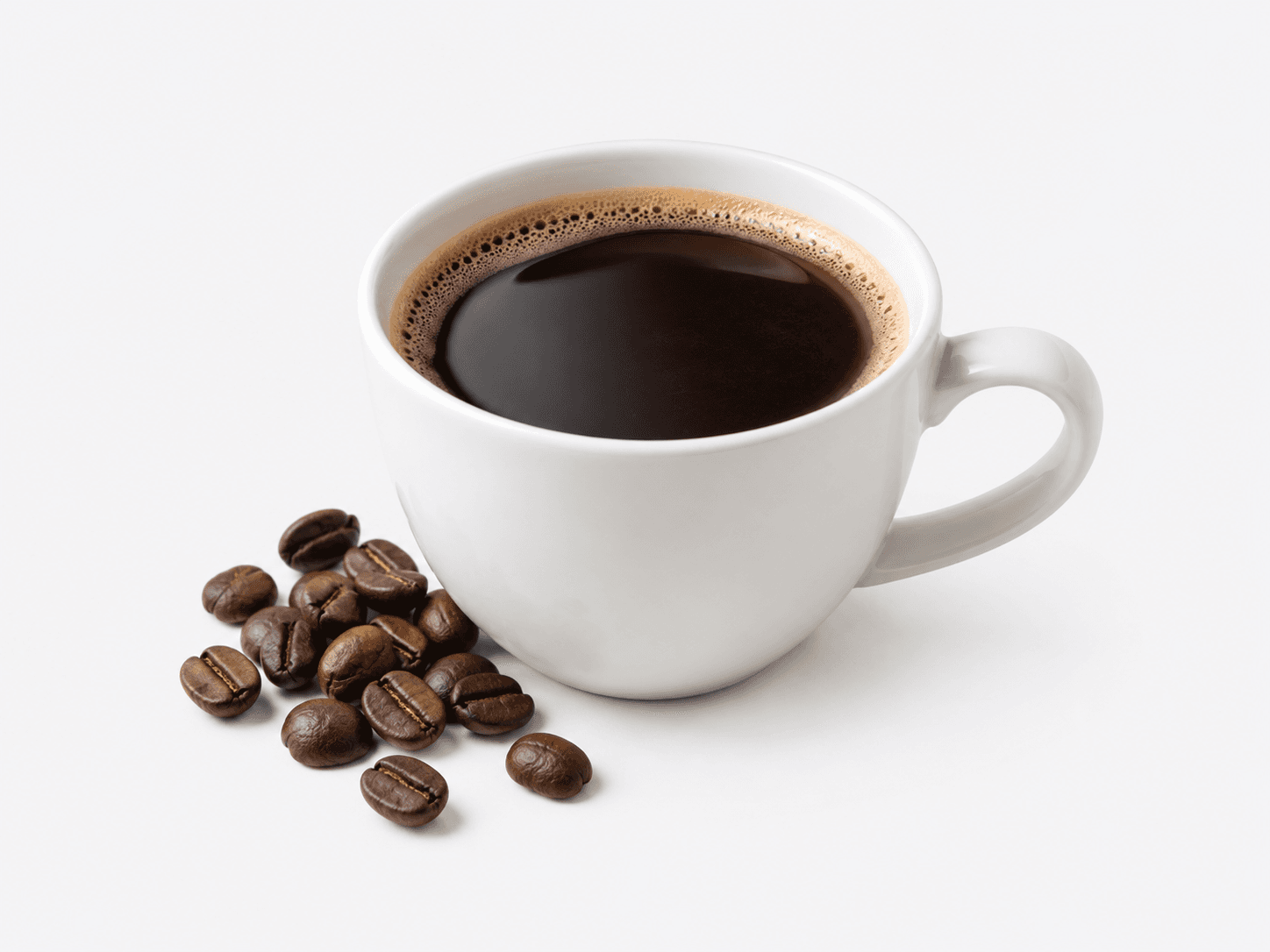
Coffee is a drink made by roasting, grinding and brewing the seeds found inside the fruit of a tree in the madder family, native to Ethiopia. The fruit ripens red and looks like a cherry, hence coffee cherry, and the seeds inside are the green beans. Before roasting they are green and nearly scentless; roasting sets sugars and amino acids reacting and creates hundreds of aroma compounds. The two main species are arabica and robusta, and robusta carries more caffeine and more bitterness.
Scientific name Coffea arabica
Nobody drinks coffee for the nutrients. A cup is 2 kcal and a trace of minerals.
Coffee keeps showing up in health research for a different reason: so many people drink it that it stands out clearly in large cohorts. There are datasets following hundreds of thousands of people for a decade or more.
And one finding keeps recurring in them. Decaf performs almost identically — which suggests caffeine may not be the protagonist.
Key benefits
- Moderate evidence
Lower type 2 diabetes risk — and decaf too
[1]A meta-analysis pooled 30 prospective studies, 1,185,210 participants and 53,018 incident cases of diabetes. The highest-intake group (median 5 cups a day) had 29 % lower risk than non-drinkers (relative risk 0.71, 95 % CI 0.67–0.76). Each additional cup a day lowered risk by 6 % (0.94, 0.93–0.95).
Here is the telling part. Decaffeinated coffee was nearly the same (0.94 per cup, 0.90–0.98); caffeinated was 0.93.
If caffeine were the reason, the effect should disappear in decaf. That it does not suggests another component such as chlorogenic acid is involved — or that something else about coffee drinkers is mixed in. These are observational studies; causation is not established.
- Moderate evidence
Lower risk of liver fibrosis and cirrhosis
[2]Across 16 studies, coffee drinkers had 39 % lower odds of cirrhosis (odds ratio 0.61, 95 % CI 0.45–0.84). Heavy drinkers were lower still at 0.53 (0.42–0.68), and advanced fibrosis came in at 0.73 (0.58–0.92).
The direction held in separate analyses of alcoholic liver disease and hepatitis C patients. That the relationship persists in people who already carry liver risk factors makes the result a little sturdier.
This does not mean coffee offsets drinking.
- Moderate evidence
A review across many diseases pointed the same way
[3]An umbrella review examined 112 meta-analyses covering 59 outcomes. Coffee was linked to a probable decreased risk of breast, colorectal, endometrial and prostate cancer, cardiovascular disease and mortality, Parkinson's disease and type 2 diabetes.
The same review noted the other side. In pooled randomised trials, caffeine raised blood pressure and coffee raised serum lipids — though with considerable heterogeneity. Caffeine on its own was also linked to increased risk of pregnancy loss.
The authors' conclusion was that coffee can be part of a healthful diet. That is its position: not a treatment, but a habit that does not harm.
- Nutrition data
96 mg of caffeine per cup, at 2 kcal
A 240 ml cup of drip coffee holds roughly 96 mg of caffeine. The 400 mg a day commonly given as an adult ceiling is a little over four cups.
That number moves a lot, though. An espresso shot is 60–80 mg; cold brew can run higher because of the long extraction. And the moment you add syrup and milk, the '2 kcal' disappears.
How to eat it well
- Use a paper filter. Unfiltered methods — French press, moka pot, Turkish coffee — let through a compound called cafestol, which raises LDL cholesterol. Paper catches it. If cholesterol is a concern, this single choice is the most practical difference you can make.
- Avoid the hour right after a meal. Coffee's polyphenols block non-haem (plant) iron absorption. That matters on a plant-based diet or while managing anaemia.
- Stop eight hours before bed. Caffeine's half-life runs 3–7 hours depending on the person; a 3 pm cup can still be half present at 11 pm.
- If the health effect is what you want, decaf works too — the diabetes data barely distinguished them.
- Ground coffee loses aroma quickly. Grind just before brewing.
How to read the grades
Each benefit carries a label showing how far research on people supports it. Grades differ between items even within the same ingredient.
- Nutrition data
- A fact verifiable from food composition databases or health authorities. This is a different kind of statement from a clinical effect.
- Strong evidence
- Consistently confirmed across randomised controlled trials or meta-analyses.
- Moderate evidence
- Human studies exist, but effect sizes are small or results are mixed.
- Early research
- Cell or animal work, or small preliminary studies.
- Not established
- Commonly claimed, but not confirmed in studies on people.
What to watch out for
- In pregnancy, stay under 200 mg a day — about two cups. Caffeine is linked to increased risk of pregnancy loss. Count tea, chocolate and energy drinks too.
- With high blood pressure, caffeine raises it temporarily. Habitual drinking blunts that response, but discuss it if your hypertension is uncontrolled.
- With arrhythmia, anxiety or insomnia, sensitivity varies a great deal between people — caffeine metabolism differs genetically.
- With reflux or gastritis, coffee on an empty stomach can worsen symptoms.
- 400 mg a day (about four cups) is the usual ceiling for healthy adults.
Nutrition
Approximate values for one brewed cup (about 240 ml). Caffeine varies widely with the bean and the brewing method.
- Calories
- 2 kcal<1%
- Caffeine
- 96 mg
- Potassium
- 118 mg3%
- Magnesium
- 7 mg2%
- Vitamin B2
- 0.18 mg14%
- Vitamin B3
- 0.5 mg3%
Percentages are of the US FDA Daily Value for adults and children 4 and over. National reference intakes differ by sex and age.
Calculate this alongside other ingredients →
Key nutrients
- Caffeine
- Potassium
- Magnesium
- Vitamin B2
By health concern
Compare with
Sources
The databases and health authorities this article's nutrition figures and health statements draw on.
- 1Coffee consumption and reduced risk of developing type 2 diabetes: a systematic review with meta-analysisMeta-analysisCarlström M, et al. Nutr Rev 2018PMID 29590460
- 2Coffee Consumption Decreases Risks for Hepatic Fibrosis and Cirrhosis: A Meta-AnalysisMeta-analysisLiu F, et al. PLoS One 2015PMID 26556483
- 3Coffee, Caffeine, and Health Outcomes: An Umbrella ReviewSystematic reviewsGrosso G, et al. Annu Rev Nutr 2017PMID 28826374
- 4USDA FoodData CentralFood composition database
- 5European Food Safety Authority (EFSA)Health authority
- 6Caffeine intake during pregnancy and adverse birth outcomes: a systematic review and dose-response meta-analysisMeta-analysisGreenwood DC, et al. Eur J Epidemiol 2014PMID 25179792
- 7PubMedResearch literature