Contents
What it is
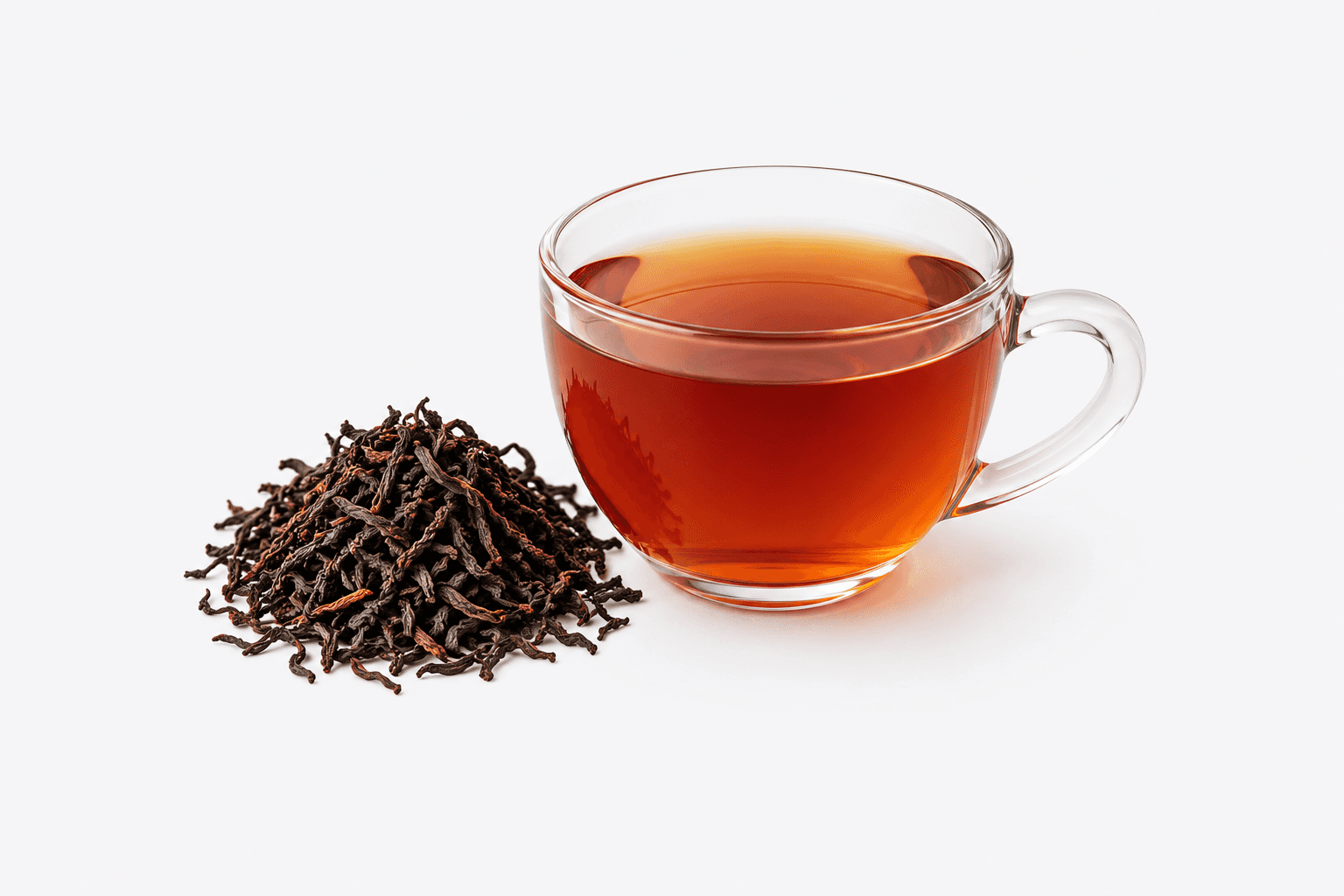
Black tea is made from the leaves of the tea plant, fully oxidised. Green, oolong and white tea come from the very same leaf; only the processing differs — green tea is kept from oxidising, oolong is stopped partway, black tea goes all the way. Along the way the astringent catechins turn into theaflavins and thearubigins, which redden the liquor and give it weight. China names it after the red colour of the brew, while the West names it after the colour of the dry leaf.
Scientific name Camellia sinensis
Black tea and green tea are leaves of the same plant, Camellia sinensis. Oxidation is what separates them. Green tea is halted early, keeping its catechins; black tea is oxidised fully, turning catechins into theaflavins and thearubigins.
Hence the line that black tea is the lesser tea. It is not that simple. The compounds differ, and there are not enough head-to-head trials to declare a winner.
What human trials have confirmed for black tea is blood pressure. A 2021 meta-analysis found systolic pressure 1.04 mmHg lower.
How to read that number is the point of this page. It is statistically significant and clinically small. A single blood pressure tablet usually delivers more than 10 mmHg.
Key benefits
- Moderate evidence
Systolic blood pressure −1.04 mmHg — significant but small
[1]A meta-analysis published in 2021 pooled 13 randomised controlled trials on black tea and blood pressure.
- Systolic blood pressure −1.04 mmHg (95 % CI −2.05 to −0.03)
- Diastolic blood pressure −0.59 mmHg
The upper end of that confidence interval is −0.03 — very nearly zero. Statistical significance was scraped, not won comfortably.
For a sense of scale:
Intervention Change in systolic BP Black tea −1.0 mmHg Cutting sodium (2.3 g → 1.5 g a day) −5 to −6 mmHg Losing 5 kg −4 to −5 mmHg One antihypertensive drug more than −10 mmHg Managing blood pressure with black tea is not a plan. Across a whole population, though, 1 mmHg is not nothing — shift the mean of tens of millions by 1 mmHg and the stroke count visibly changes. Individual choices and population statistics are different arguments.
There is a reason to drink black tea. Not to fix blood pressure, but in place of a sugary drink.
- Nutrition data
Almost no calories — and what it replaces is the point
Black tea holds 1 kcal per 100 g. A cup (240 g) is 2 kcal.
Fill that same cup another way:
- Soft drink, 240 ml — about 100 kcal, 26 g of sugar
- Fruit juice, 240 ml — about 110 kcal
- Latte, 240 ml — about 120 kcal
- Black tea, unsweetened, 240 ml — 2 kcal
This is black tea's most reliable advantage. Not a special compound — it simply occupies the space.
But how you drink it flips the arithmetic. Two spoons of sugar in a milk tea pushes a cup past 100 kcal, and bottled milk teas routinely exceed 30 g of sugar. The blood pressure evidence above does not transfer to those.
There are small amounts of minerals: manganese 0.219 mg (a cup gives 14 % of the adult requirement), potassium 37 mg, folate 5 µg. Not enough to count tea as a mineral source.
Caffeine is 20 mg per 100 g — about 48 mg in a cup, a third to a half of a cup of coffee's 95–200 mg.
- Not established
The health effects of theaflavins are not established
Black tea's characteristic compounds are theaflavins and thearubigins, formed when catechins combine during oxidation. They give black tea its colour and its astringency.
Cell and animal studies report antioxidant and anti-inflammatory activity. But no large randomised trial has looked at disease outcomes in humans.
Observational studies have sometimes found black tea intake inversely associated with cardiovascular disease. People who drink a lot of tea differ in other habits, though, and 'drinking tea' means different things in different countries — a British cup comes with milk and sugar; elsewhere it does not.
Claims about weight loss, cancer prevention and blood glucose are not established at the level of human trials.
What is established stops at the two items above: a small blood pressure effect, and the absence of calories.
How to eat it well
- Brew at 95–100 °C for three to five minutes. Longer draws out more caffeine and more astringent tannin together.
- Drinking it unsweetened is the condition on the advantages above. If it needs lifting, use lemon or cinnamon.
- Leave 30–60 minutes between tea and a meal. Tannins interfere with the absorption of plant (non-haem) iron — which matters most if you are anaemic or eat no meat.
- Adding lemon offsets part of that interference, because vitamin C aids iron absorption.
- Avoid it late in the day. Caffeine's half-life of five to six hours reaches into sleep.
- Most of a tea bag's caffeine comes out in the first brew. A second cup from the same bag carries far less.
How to read the grades
Each benefit carries a label showing how far research on people supports it. Grades differ between items even within the same ingredient.
- Nutrition data
- A fact verifiable from food composition databases or health authorities. This is a different kind of statement from a clinical effect.
- Strong evidence
- Consistently confirmed across randomised controlled trials or meta-analyses.
- Moderate evidence
- Human studies exist, but effect sizes are small or results are mixed.
- Early research
- Cell or animal work, or small preliminary studies.
- Not established
- Commonly claimed, but not confirmed in studies on people.
What to watch out for
- The blood pressure effect above is 1 mmHg. Do not replace medication with tea.
- It interferes with iron absorption. With anaemia, in pregnancy or on a plant-based diet, separate tea from meals.
- The caffeine ceiling is 400 mg a day for adults, 200 mg in pregnancy. A cup of black tea is about 48 mg — add it to your coffee.
- With insomnia, anxiety or palpitations, caffeine can make things worse.
- Bottled milk tea and iced tea are sugary drinks. The evidence on this page does not apply to them.
- Black tea contains some fluoride (373 µg per 100 g). Several cups a day are not a problem, but cases have been reported with very high intakes sustained over years.
Nutrition
Per 100 g of black tea brewed with tap water — about half a cup. A cup is 240 g, 2.4 times this table, with around 48 mg of caffeine.
Percentages are of the US FDA Daily Value for adults and children 4 and over. National reference intakes differ by sex and age.
Calculate this alongside other ingredients →
Key nutrients
By health concern
Dishes with this ingredient
Sources
The databases and health authorities this article's nutrition figures and health statements draw on.
- 1The effect of black tea supplementation on blood pressure: a systematic review and dose-response meta-analysis of randomized controlled trialsMeta-analysisMa C, et al. Food Funct 2021PMID 33237083
- 2USDA FoodData CentralFood composition database
- 3European Food Safety Authority (EFSA)Health authority
- 4NIH Office of Dietary SupplementsHealth authority
- 5PubMedResearch literature