Contents
What it is
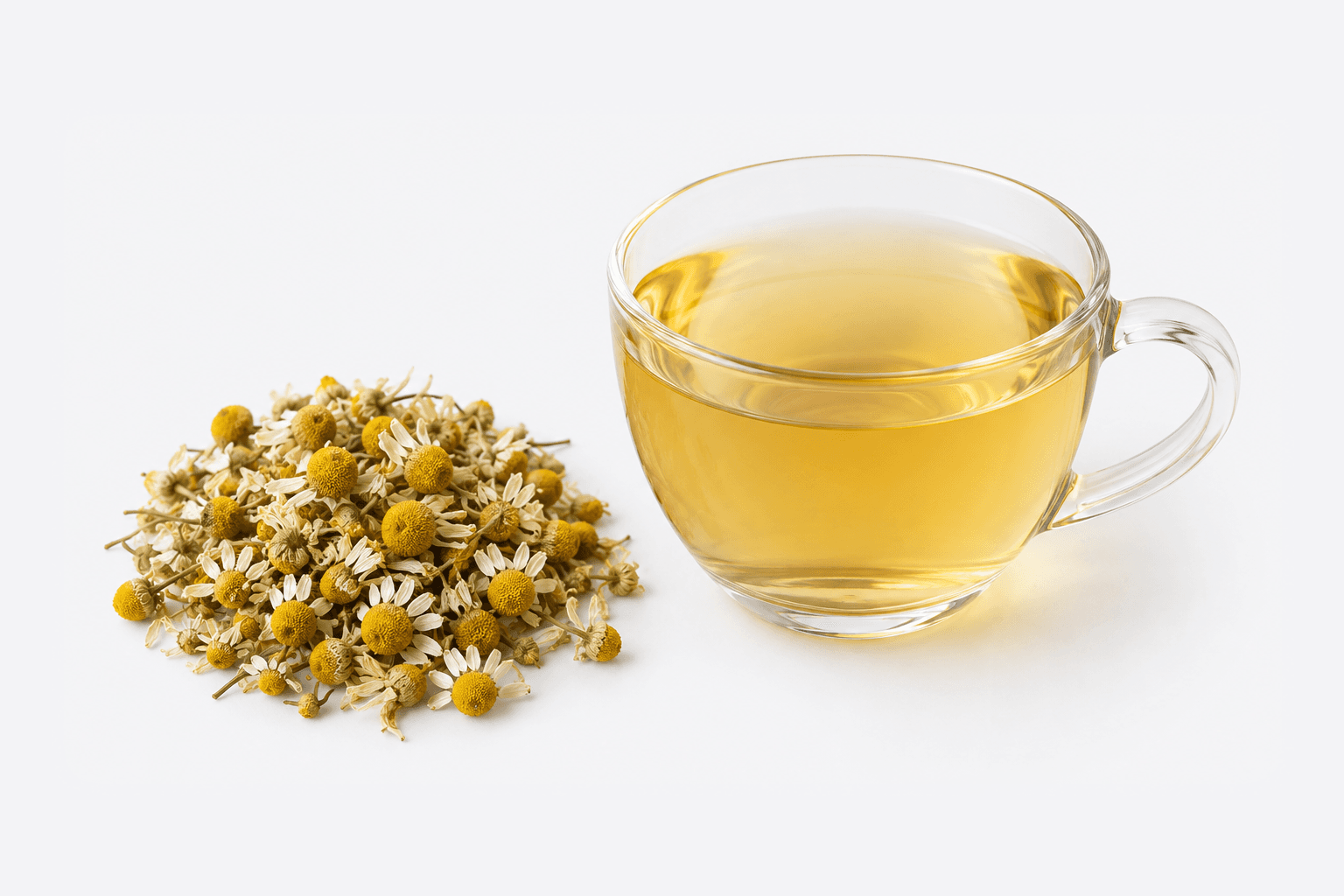
Chamomile tea is an infusion of the dried flowers of an annual in the daisy family, native to Europe and western Asia. It is not made from the tea plant at all, so it contains no caffeine. The flowers look like small daisies — white petals around a yellow centre — and carry a sweet, apple-like scent; the Greek root of the name means earth-apple. Three to five minutes in hot water is enough, and steeping longer turns it bitter. Anyone allergic to plants in the daisy family should be careful with it.
Scientific name Matricaria chamomilla
Chamomile has settled into its place as the tea you drink before bed. Whether evidence supports that place is this page's question.
In 2019, Phytotherapy Research searched eleven databases and pooled 12 randomised and quasi-randomised trials, looking at four things separately.
- Sleep quality — improved. Standardised mean difference −0.73 (95% CI −1.23 to −0.23), P < 0.005
- Generalised anxiety disorder — improved, though by a small amount
- Anxiety — no difference (3 trials, P = 0.4214)
- Insomnia — one trial only, and no significant change
That sleep quality and insomnia came apart is the finding. How people rated their sleep improved; the severity of insomnia as a condition did not move.
The authors summarise it the same way: chamomile appears efficacious for sleep quality and GAD, with little evidence for anxiety and insomnia.
Key benefits
- Moderate evidence
Sleep quality improved — insomnia did not
[1]A 2019 systematic review and meta-analysis in Phytotherapy Research. Eleven databases including PubMed, Science Direct, Cochrane Central and Scopus were searched, and 12 randomised controlled trials were included.
Sleep quality
- Standardised mean difference −0.73 (95% CI −1.23 to −0.23), P < 0.005
An SMD of 0.73 is a moderate-to-large effect. That the interval runs from −1.23 to −0.23 also tells you the participant numbers were not generous.
Insomnia
- Only one trial. In it, the Insomnia Severity Index did not change significantly (P > 0.05).
Reading those two side by side is the honest way. Sleep quality is usually a self-reported questionnaire — the Pittsburgh Sleep Quality Index and similar: how you felt falling asleep, how rested you felt, how satisfied you were. Insomnia is a clinical scale covering how long it took to fall asleep, how often you woke, and the daytime impairment that follows.
The first moved and the second did not. And for the second there was one trial, so even the absence rests on thin ground.
Tea and extract are not the same thing. This analysis covered "chamomile", and standardised extracts are among what the trials used. A cup of tea does not deliver the same amount. That gap matters when carrying these results into a teacup.
- Moderate evidence
Generalised anxiety improved — by 1.4 points
[1]In the same analysis, generalised anxiety disorder was measured with the Hamilton Anxiety Rating Scale (HAM-A).
- At two weeks — mean difference −1.43 (95% CI −2.47 to −0.39), P = 0.007
- At four weeks — mean difference −1.79 (95% CI −3.14 to −0.43), P = 0.0097
Statistically significant. To know how large that is, you need the scale.
HAM-A runs from 0 to 56. The common threshold in trials for calling someone a responder is a halving of the score. Someone with moderate GAD typically starts around 20, so responding means dropping about 10 points.
1.43 points is nowhere near that. Neither is 1.79 at four weeks.
And for ordinary state anxiety there was no difference at all.
- Standardised mean difference −0.15 (95% CI −0.46 to 0.16), P = 0.4214, three trials
The interval crosses zero. There is no effect to report.
So: in diagnosed generalised anxiety disorder there was a small but consistent shift; for everyday tension and nervousness there is no evidence. The authors put it as "little evidence" for anxiety and insomnia.
Adverse effects were mild. Three of the 12 trials reported any.
- Nutrition data
Zero caffeine and zero calories
Of every 100 g of brewed chamomile, 99.7 g is water. There is almost nothing else.
- 1 kcal
- 0 mg caffeine
- Carbohydrate 0.2 g, potassium 9 mg, calcium 2 mg, manganese 0.044 mg
This is not a tea you drink for nutrients. Two numbers in the table matter, and both are zero.
Those two zeros are the use.
- You can drink it in the evening without touching your sleep. Caffeine's five-to-six-hour half-life reaches into the night; a late cup of black tea (about 48 mg) or coffee (95–200 mg) does not. Chamomile has no such problem.
- It replaces a sweet drink. A soft drink is about 100 kcal and 26 g of sugar. Drunk unsweetened, that substitution is the most certain benefit on this page.
Note that chamomile is not a tea leaf. Green, black and oolong all come from Camellia sinensis; chamomile is a flower in the daisy family. That is why the caffeine is zero — and why the allergy warning below matters.
How to eat it well
- Five minutes in boiling water, covered. Covering it keeps the aromatic compounds from leaving with the steam.
- Thirty to sixty minutes before bed is the usual timing. A large cup right before lying down wakes you for the bathroom instead.
- No sugar. Some bottled chamomile blends are sweetened.
- Whole flower heads smell better than bagged dust, though no difference in compounds has been shown.
- Do not drink more because sleep is not coming. The evidence above does not show a dose-response.
- If insomnia has run for more than a month, that is a clinical question, not a tea question. In the analysis above, the insomnia measure did not move.
- The evidence for sleep habits — fixed bed and wake times, a dark room, limiting caffeine — is far stronger.
How to read the grades
Each benefit carries a label showing how far research on people supports it. Grades differ between items even within the same ingredient.
- Nutrition data
- A fact verifiable from food composition databases or health authorities. This is a different kind of statement from a clinical effect.
- Strong evidence
- Consistently confirmed across randomised controlled trials or meta-analyses.
- Moderate evidence
- Human studies exist, but effect sizes are small or results are mixed.
- Early research
- Cell or animal work, or small preliminary studies.
- Not established
- Commonly claimed, but not confirmed in studies on people.
What to watch out for
- Avoid it if you are allergic to the daisy family. People who react to ragweed, chrysanthemum, daisy or mugwort can cross-react to chamomile. Anaphylaxis has been reported, rarely.
- On warfarin or other anticoagulants, check with your clinician. Bleeding cases have been reported in connection with chamomile's coumarin content.
- Not recommended in pregnancy. Uterine stimulation has been raised as a concern and safety is not established.
- Stop it before surgery — it may compound sedatives and anaesthetics.
- If you take sedatives or sleeping pills, the effects may overlap; check.
- It does not replace insomnia treatment. In the analysis above, insomnia severity did not change significantly.
- The evidence base is 12 trials, and the authors themselves call for larger randomised trials.
Nutrition
Per 100 g of brewed chamomile, about half a cup. A cup is 240 g, and 99.7 g of every 100 is water.
- Calories
- 1 kcal<1%
- Caffeine
- 0 mg
- Carbohydrates
- 0.2 g<1%
- Potassium
- 9 mg<1%
- Manganese
- 0.044 mg2%
- Calcium
- 2 mg<1%
- Sodium
- 1 mg<1%
Percentages are of the US FDA Daily Value for adults and children 4 and over. National reference intakes differ by sex and age.
Calculate this alongside other ingredients →
Key nutrients
By health concern
Sources
The databases and health authorities this article's nutrition figures and health statements draw on.
- 1Therapeutic efficacy and safety of chamomile for state anxiety, generalized anxiety disorder, insomnia, and sleep quality: A systematic review and meta-analysis of randomized trials and quasi-randomized trialsMeta-analysisHieu TH, et al. Phytother Res 2019PMID 31006899
- 2USDA FoodData CentralFood composition database
- 3European Food Safety Authority (EFSA)Health authority
- 4NIH Office of Dietary SupplementsHealth authority
- 5PubMedResearch literature