Contents
What it is
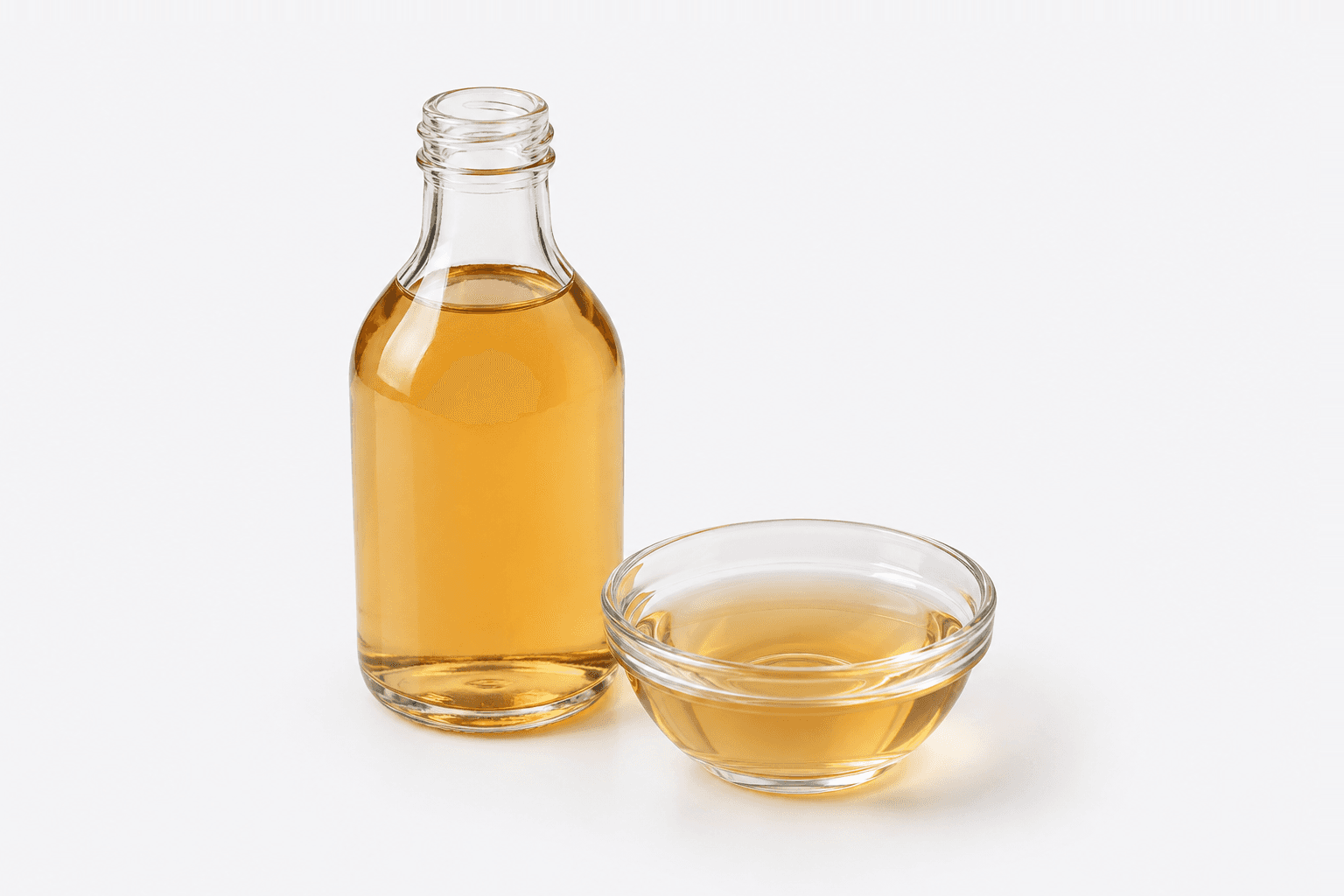
Vinegar is a sour liquid made when acetic acid bacteria oxidise alcohol. Something must first be fermented into alcohol, so vinegar's raw material is really the raw material of a drink — cider gives cider vinegar, wine gives wine vinegar and balsamic, rice wine gives rice vinegar. The sourness is acetic acid, usually 4 to 7 percent in culinary vinegar. Its acidity makes it hostile to microbes, which is why it preserves, and because it can erode tooth enamel the standard advice is not to drink it undiluted.
Vinegar has an almost empty composition table. 21 kcal per 100 ml, 0.4 g of sugar, no protein or fat, minerals at trace level.
And yet there is a fair amount of clinical evidence. The subject of this page is that the size of that evidence looks wrong.
A 2025 GRADE-assessed dose-response meta-analysis in Frontiers in Nutrition pooled seven controlled trials in people with type 2 diabetes:
- Fasting blood glucose −21.9 mg/dL (95% CI −29.19 to −14.67, p<0.001)
- HbA1c −1.53% (95% CI −2.65 to −0.41, p=0.008)
- Insulin +2.06 μU/ml (p=0.025)
- HOMA-IR (insulin resistance) unchanged
Stop there. An HbA1c reduction of 1.53% is what metformin monotherapy typically delivers. When a result saying a few spoonfuls of vinegar match a first-line diabetes drug comes out of seven small trials, that is less a signal of a large effect than a signal of what happens when small studies are pooled.
The other meta-analysis raised the same concern. A 2020 review in the Journal of Advanced Nursing pooled six trials in 317 people and reported better fasting glucose and HbA1c — while stating in its conclusion that "vinegar content varied across the studies, and the sample sizes were relatively small. Therefore, caution should be exercised when trying to extrapolate the results to a larger population."
Key benefits
- Early research
Two meta-analyses point the same way, but the size is hard to believe
[1][2]First, 2025, Frontiers in Nutrition. Searching Scopus, PubMed and Web of Science to November 2024, the authors pooled seven controlled trials of apple cider vinegar on glycaemic markers. Random-effects model, publication bias, sensitivity and meta-regression analyses, Cochrane risk-of-bias assessment and GRADE certainty, registered on PROSPERO.
- Fasting blood glucose −21.929 mg/dL (95% CI −29.19 to −14.67, p<0.001)
- HbA1c −1.53% (95% CI −2.65 to −0.41, p=0.008)
- Insulin +2.059 μU/ml (p=0.025)
- HOMA-IR — no effect
- Dose-response: each 1 ml/day was associated with −1.255 mg/dL of fasting glucose, with greater effects above 10 ml
Second, 2020, Journal of Advanced Nursing. Six trials in 317 adults with type 2 diabetes. Fasting glucose and HbA1c significantly better, and in secondary analyses total cholesterol and LDL fell too. GRADE was also applied.
So far the direction is consistent — both analyses point downward on fasting glucose and HbA1c.
The problem is the size.
It helps to picture what an HbA1c drop of 1.53% means.
- Metformin monotherapy typically lowers HbA1c by around 1.0–1.5%
- That would mean a few spoonfuls of vinegar a day matching the first-line drug for type 2 diabetes
Why that is suspect.
First, seven trials is few, and the individual trials are small. The more small studies there are, the more publication bias — only positive results getting published — can inflate a pooled estimate.
Second, the confidence interval is wide. For HbA1c it runs from −2.65 to −0.41. The lower end, 0.41%, is clinically small. The analysis is itself saying the truth could be 0.4% or 2.65%.
Third, something inside the result does not fit. Insulin went up while HOMA-IR did not change. If glucose fell substantially while insulin rose, you would expect the insulin-resistance index to move in some direction.
Fourth, the other meta-analysis's authors warned about exactly this, writing that vinegar content varied across studies and sample sizes were relatively small, so caution is needed in extrapolating.
Does that mean vinegar does nothing? There is no basis for saying that either.
The mechanism — vinegar's acetic acid slowing gastric emptying and inhibiting disaccharidases in the small intestine, flattening the post-meal glucose rise — has been proposed across a number of studies. As a claim about flattening the post-meal curve, it is plausible.
This site's honest conclusion:
- The direction is consistent — both meta-analyses point to lower glucose
- The size cannot be taken as printed — an HbA1c drop of 1.53% is too large to come from seven small trials
- So the grade here is "early research"
- It does not replace diabetes medication. It is not a basis for reducing or stopping a prescription
- A spoonful with a meal is harmless and mechanistically plausible. That is a different claim from "HbA1c falls by 1.5%"
- Nutrition data
21 kcal per 100 ml — the composition table is almost empty
Per 100 g (about 100 ml) of cider vinegar:
- 21 kcal, carbohydrate 0.93 g, sugar 0.4 g
- Protein 0 g, fat 0 g, fibre 0 g
- Potassium 73 mg, manganese 0.249 mg, calcium 7 mg
- Magnesium 5 mg, phosphorus 8 mg, iron 0.2 mg
- Sodium 5 mg
- Vitamins effectively zero
One tablespoon (15 ml) is 3 kcal. Eleven milligrams of potassium; the rest is not worth counting.
Nobody eats vinegar for its nutrients, and that is as it should be — vinegar is a 4–6% solution of acetic acid in water.
"Apple cider vinegar contains the goodness of apples" does not hold. In fermentation, sugar becomes alcohol and then acetic acid. The apple's vitamin C and fibre do not survive.
About "the mother". The cloudy strands floating in unfiltered vinegar are a mass of acetic acid bacteria and cellulose. It is often described as a probiotic, but this site did not identify randomised evidence that the mother changes gut flora or a health outcome in people.
Acidity differs by type.
- Brewed and cider vinegars — generally 4–6%
- Balsamic — lower acidity, more sugar. Some products carry around 15 g of sugar per 100 ml
- Black and brown-rice vinegars — slightly more amino acids, with no evidence that the difference changes outcomes
Apple cider vinegar gummies and tablets sell heavily. Their content varies widely, the trials above used liquid vinegar, and gummies bring sugar with them.
- Not established
Do not drink it neat — teeth and oesophagus
This entry is about safety rather than benefit.
Vinegar's pH is typically 2 to 3 — around or below cola (about 2.5). Drinking it neat every day for blood sugar means passing that acidity through your mouth and oesophagus every day.
First, dental erosion.
Tooth enamel begins to demineralise below pH 5.5. Vinegar sits far below that. Acid erosion is irreversible — unlike a cavity it is not filled; the surface is worn away.
There are ways to reduce it:
- Always dilute. One tablespoon in a glass of water (200 ml) is the usual ratio
- Use a straw to reduce contact with the teeth
- Rinse with water afterwards
- Do not brush straight away. Brushing acid-softened enamel abrades it. Wait 30 minutes
Second, the oesophagus. Cases of oesophageal burn from swallowing neat vinegar have been reported, as have injuries from vinegar tablets lodging in the oesophagus.
Third, the stomach. With reflux or peptic ulcer, acid can worsen symptoms. Taking it on an empty stomach is particularly not advised.
Fourth, drug interactions.
- On insulin or a sulfonylurea, glucose may fall further, risking hypoglycaemia. Speak to your doctor first
- With diuretics, potassium loss can compound. Hypokalaemia has been reported with long-term high vinegar intake
- On digoxin, hypokalaemia is dangerous
Fifth, with gastroparesis, vinegar may slow gastric emptying further. For someone with diabetic gastroparesis that is a problem, not a benefit.
In short — vinegar in salads and cooking poses no issue. The problem is the "drink it neat every day for your health" version.
How to eat it well
- Always dilute it. A tablespoon in 200 ml of water is the usual ratio.
- Never drink it neat. It damages teeth and oesophagus.
- Rinse afterwards and wait 30 minutes to brush. Brushing immediately abrades softened enamel.
- With a meal rather than on an empty stomach. The mechanism is about the post-meal curve anyway.
- Using it in cooking is the safest form — dressings, dipping sauces, pickles.
- Balsamic carries sugar. Check the label.
- Gummies and tablets vary widely in content and are not what the trials used.
- If you take diabetes medication, speak to your doctor before adding vinegar.
How to read the grades
Each benefit carries a label showing how far research on people supports it. Grades differ between items even within the same ingredient.
- Nutrition data
- A fact verifiable from food composition databases or health authorities. This is a different kind of statement from a clinical effect.
- Strong evidence
- Consistently confirmed across randomised controlled trials or meta-analyses.
- Moderate evidence
- Human studies exist, but effect sizes are small or results are mixed.
- Early research
- Cell or animal work, or small preliminary studies.
- Not established
- Commonly claimed, but not confirmed in studies on people.
What to watch out for
- The meta-analysis effect sizes are implausibly large. An HbA1c drop of 1.53% is metformin territory, from seven small trials, with a lower confidence bound of 0.41%.
- It does not replace diabetes medication and is not a basis for reducing or stopping a prescription.
- On insulin or a sulfonylurea, there is a hypoglycaemia risk. Speak to your doctor.
- Dental erosion is irreversible. Always dilute, and do not brush for 30 minutes afterwards.
- Oesophageal injury from neat vinegar has been reported, as has injury from vinegar tablets.
- With reflux or peptic ulcer, symptoms can worsen.
- On diuretics or digoxin, consider the risk of hypokalaemia.
- With gastroparesis, gastric emptying may slow further.
- No randomised evidence was identified that "the mother" benefits health.
Nutrition
Per 100 g (about 100 ml) of cider vinegar. One tablespoon is about 15 ml, so a real serving is roughly a fifteenth of the figures below.
- Calories
- 21 kcal1%
- Carbohydrates
- 0.93 g<1%
- Sugars
- 0.4 g
- Protein
- 0 g0%
- Fat
- 0 g0%
- Potassium
- 73 mg2%
- Manganese
- 0.249 mg11%
- Calcium
- 7 mg<1%
- Magnesium
- 5 mg1%
- Phosphorus
- 8 mg<1%
- Iron
- 0.2 mg1%
- Sodium
- 5 mg<1%
Percentages are of the US FDA Daily Value for adults and children 4 and over. National reference intakes differ by sex and age.
Calculate this alongside other ingredients →
Key nutrients
By health concern
Dishes with this ingredient
Sources
The databases and health authorities this article's nutrition figures and health statements draw on.
- 1Effects of apple cider vinegar on glycemic control and insulin sensitivity in patients with type 2 diabetes: A GRADE-assessed systematic review and dose-response meta-analysis of controlled clinical trialsMeta-analysisArjmandfard D, Behzadi M, Sohrabi Z, Mohammadi Sartang M Frontiers in Nutrition 2025PMID 39949546
- 2A systematic review and meta-analysis: Vinegar consumption on glycaemic control in adults with type 2 diabetes mellitusMeta-analysisCheng LJ, Jiang Y, Wu VX, Wang W Journal of Advanced Nursing 2020PMID 31667860
- 3USDA FoodData CentralFood composition database
- 4PubMedResearch literature
- 5NIH Office of Dietary SupplementsHealth authority