Contents
What it is
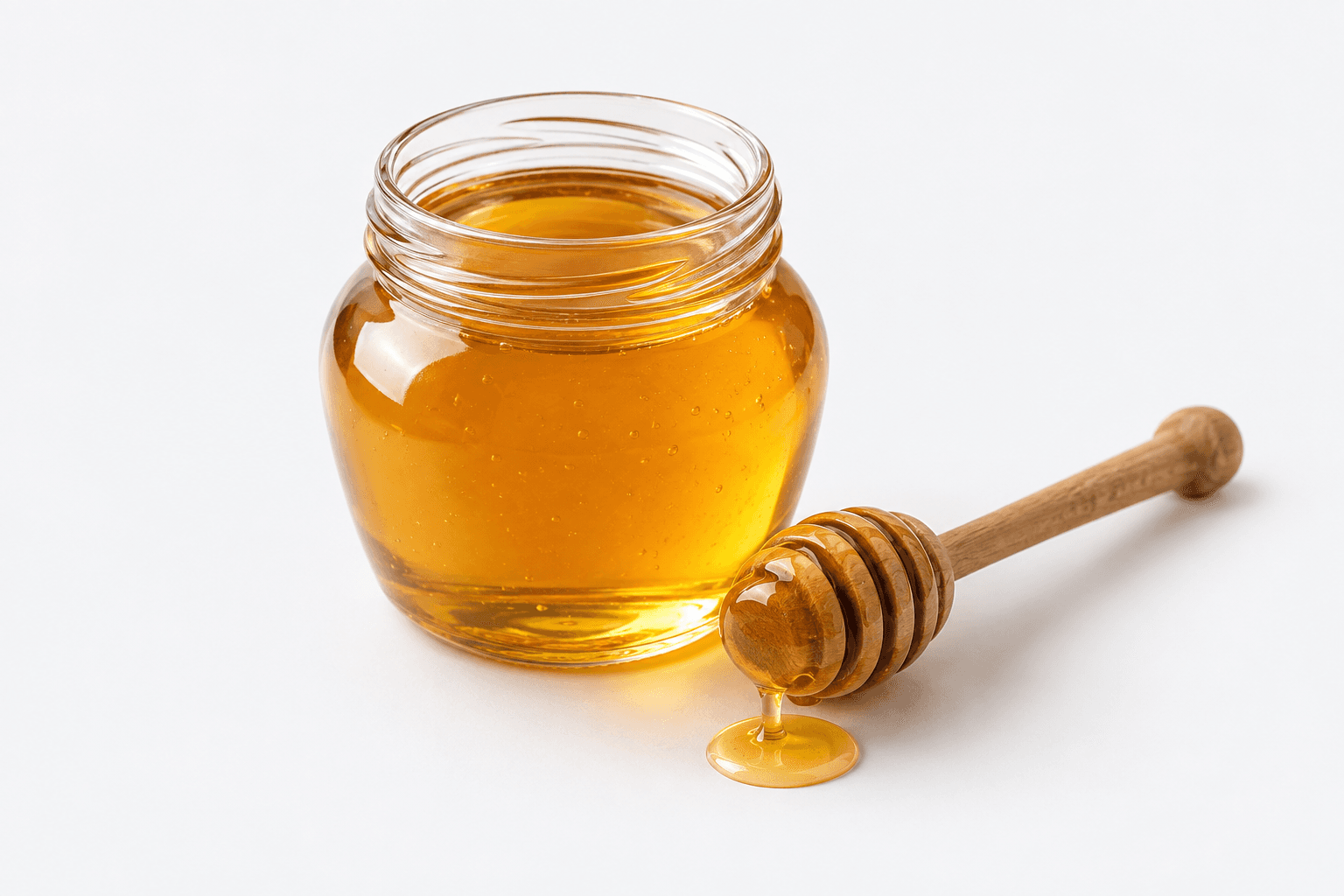
Honey is flower nectar that bees have concentrated and enzymatically transformed in the hive. Nectar starts out watery; the bees pass it mouth to mouth, mixing in enzymes, and fan it down to under 20 percent water. That low moisture, together with its acidity, makes it hostile to microbes, which is why it keeps at room temperature for years. Most of its sugar is fructose and glucose, which is why it tastes sweeter than table sugar. It can contain botulinum spores, so it is not given to infants under one year old.
Honey is a rare case on this site — it is essentially sugar, and it has clinical evidence.
The composition first. 82.1 g of every 100 g is sugar. 304 kcal, 0.3 g of protein, no fat, and vitamins and minerals at trace level. Nutritionally, honey is sugar.
And yet there is evidence. A 2018 Cochrane review pooled six randomised trials in 899 children on honey for acute cough:
- Reduced cough frequency versus no treatment — MD −1.05 (95% CI −1.48 to −0.62), moderate certainty
- And versus placebo — MD −1.62 (95% CI −3.02 to −0.22), moderate certainty
- No different from dextromethorphan, an over-the-counter cough medicine — low certainty
Two things must be flagged.
First, three days is the limit. Up to three days honey beat placebo and salbutamol; beyond that there was no advantage.
Second, the review covers ages 12 months to 18 years. Infants under one year were never included, because of botulinum spores. That is treated separately below.
Key benefits
- Moderate evidence
Acute cough in children — the Cochrane numbers as they stand
[1][2]2018, Cochrane Database of Systematic Reviews, updating earlier versions from 2010, 2012 and 2014.
Inclusion criteria: randomised controlled trials comparing honey with no treatment, placebo, honey-based cough syrup or over-the-counter cough medicines, for acute cough in children aged 12 months to 18 years. Six trials, 899 children were included.
Measurement was mostly on a 7-point Likert scale, where a lower score meant better relief.
The results:
Comparator Mean difference 95% CI Studies / children Certainty No treatment −1.05 −1.48 to −0.62 2 / 154 Moderate Placebo −1.62 −3.02 to −0.22 2 / 402 Moderate Dextromethorphan −0.07 −1.07 to 0.94 2 / 149 Low Diphenhydramine −0.57 −0.90 to −0.24 1 / 80 Low I² was 0% for both the no-treatment and placebo comparisons, meaning the included trials agreed with each other.
How to read those numbers.
First, it is about one point on a seven-point scale. −1.05 is roughly one point out of seven. Not nothing, but not the cough going away either.
Second, it was no different from an over-the-counter cough medicine. Against dextromethorphan the difference was −0.07, with an interval well across zero. That can be read as "honey is as good as the medicine" or as "neither does much" — the evidence for over-the-counter cough medicines themselves is not strong.
Third, past three days there is no advantage. The review states that up to three days honey was probably better than placebo or salbutamol at relieving cough, but beyond three days there was no advantage in cough severity, bothersome cough, or the impact of cough on sleep for children and parents (moderate certainty).
And adults? A 2021 systematic review and meta-analysis in BMJ Evidence-Based Medicine looked at honey for symptomatic relief in upper respiratory tract infections, reporting better symptom scores and cough frequency than usual care. Here too the included trials are limited in size and quality.
The honest summary: a spoonful of honey at bedtime for a child with a cold cough is an evidence-based choice. The effect is about a point, it does not persist past three days, and a cough that drags on is a reason to see a doctor.
- Nutrition data
82.1 g of sugar in 100 g — nutritionally, honey is sugar
Per 100 g of honey:
- 304 kcal, sugar 82.1 g, carbohydrate 82.4 g
- Protein 0.3 g, fat 0 g, fibre 0.2 g
- Potassium 52 mg, calcium 6 mg, iron 0.42 mg
- Vitamin C 0.5 mg, riboflavin 0.038 mg, selenium 0.8 µg
- Sodium 4 mg
82.1 g of it is sugar. Table sugar is 100 g of sugar per 100 g, so honey is about 82% of the way there. The rest is mostly water.
Honey's sugars are fructose and glucose. Table sugar (sucrose) is the two bonded together; in honey they are already separate. That is why honey tastes sweeter — fructose is sweeter than sucrose.
Per tablespoon (21 g):
100 g 1 tbsp (21 g) Energy 304 kcal 64 kcal Sugar 82.1 g 17.2 g Potassium 52 mg 11 mg Iron 0.42 mg 0.09 mg One tablespoon is 17.2 g of sugar. The WHO recommends free sugars below 10% of total energy, and ideally below 5%. On 2,000 kcal that is 50 g and 25 g. A tablespoon of honey spends two-thirds of the 5% allowance.
How far does "honey is better than sugar" hold?
- It has minerals — it does. Per tablespoon, 11 mg of potassium and 0.09 mg of iron. Not meaningful amounts
- It has a lower glycaemic index — honey's GI varies by type but generally sits similar to or slightly below sugar. Not a large difference
- It has antioxidants — darker honeys carry more polyphenols. But no evidence was identified that this changes a health outcome in people
The honest conclusion: honey is a slightly better sugar. Swapping sugar for honey is not a substitute for using less sugar.
On heating. Boiling honey drives off the aroma and inactivates its enzymes. But there is no evidence those enzymes do anything in the body, so the reason to avoid heat is flavour, not health.
Crystallisation is not spoilage. It is glucose separating out, and a jar stood in water at around 40°C will clear it. Avoid the microwave — it overheats in spots.
- Not established
Never give honey to an infant under 12 months — infant botulism
This entry is about safety rather than benefit. It is the most important thing on this page.
Honey must not be given to a child under 12 months of age — not a small amount, and not cooked into food.
The reason is spores of Clostridium botulinum.
Honey can carry spores of this bacterium. Spores are its dormant form and ordinary cooking does not kill them. In adults and older children, the established gut flora prevents them from germinating, so nothing happens.
An infant under one year has not yet established that gut flora. The spores can germinate in the intestine and produce toxin, which is infant botulism.
How it presents:
- Constipation, usually the first sign
- Weak feeding and a poor suck
- A weaker cry
- Loss of head control, floppiness
- Drooping eyelids
- In severe cases, paralysis of the muscles of breathing
This is an emergency. If you see these signs, seek medical care immediately.
Common questions:
"Isn't it fine if it's cooked?" — No. Botulinum spores are heat-resistant and are not destroyed at domestic cooking temperatures.
"Even a tiny amount?" — Yes. There is no established safe amount.
"What about biscuits or cereal containing honey?" — Processed foods containing honey should also be avoided under one year. Check the label.
"When is it safe?" — After 12 months. That is also where the Cochrane review's age range begins.
And one more thing. If you are reaching for honey because of a cough, a cough in an infant under one year is itself a reason to see a doctor. Look for the paediatrician rather than for a substitute for honey.
How to eat it well
- Never give it to an infant under 12 months. That is the most important line on this page.
- For a child's cough, a spoonful at bedtime. That use has evidence — though there is no advantage past three days.
- A tablespoon (21 g) is 17.2 g of sugar, two-thirds of the WHO's 5% daily figure of 25 g.
- Do not stir it into boiling tea. The aroma goes. Let the drink cool first.
- Crystallisation is normal. Stand the jar in water at around 40°C. Avoid the microwave.
- Darker honeys carry more polyphenols — though no effect has been confirmed in people.
- Swapping sugar for honey is not a substitute for using less sugar.
- With diabetes, count honey the way you count sugar.
How to read the grades
Each benefit carries a label showing how far research on people supports it. Grades differ between items even within the same ingredient.
- Nutrition data
- A fact verifiable from food composition databases or health authorities. This is a different kind of statement from a clinical effect.
- Strong evidence
- Consistently confirmed across randomised controlled trials or meta-analyses.
- Moderate evidence
- Human studies exist, but effect sizes are small or results are mixed.
- Early research
- Cell or animal work, or small preliminary studies.
- Not established
- Commonly claimed, but not confirmed in studies on people.
What to watch out for
- Contraindicated under 12 months of age. Botulinum spores are not destroyed by heat and can cause infant botulism. There is no safe amount.
- The benefit for cough runs to three days. The Cochrane review found no advantage beyond that.
- See a doctor if a cough persists or breathing is difficult. Honey does not replace a diagnosis.
- 82.1 g of every 100 g is sugar. Nutritionally, honey is sugar.
- With diabetes, it acts on blood sugar much as sugar does.
- With bee or pollen allergy, reactions are rarely reported.
- No evidence was identified for the claim that raw honey is better. If anything, unprocessed honey may be less controlled for spores.
- Honey containing grayanotoxin (so-called mad honey, from rhododendron nectar) rarely causes bradycardia and hypotension. Avoid imported honey of unclear origin.
Nutrition
Per 100 g of honey. One tablespoon is about 21 g, so most of the figures below should be divided by roughly five.
- Calories
- 304 kcal15%
- Carbohydrates
- 82.4 g30%
- Sugars
- 82.1 g
- Protein
- 0.3 g<1%
- Fat
- 0 g0%
- Potassium
- 52 mg1%
- Calcium
- 6 mg<1%
- Iron
- 0.42 mg2%
- Vitamin C
- 0.5 mg<1%
- Vitamin B2
- 0.038 mg3%
- Sodium
- 4 mg<1%
- Selenium
- 0.8 µg1%
Percentages are of the US FDA Daily Value for adults and children 4 and over. National reference intakes differ by sex and age.
Calculate this alongside other ingredients →
Key nutrients
Dishes with this ingredient
Sources
The databases and health authorities this article's nutrition figures and health statements draw on.
- 1Honey for acute cough in childrenSystematic reviewsOduwole O, Udoh EE, Oyo-Ita A, Meremikwu MM Cochrane Database of Systematic Reviews 2018PMID 29633783
- 2Effectiveness of honey for symptomatic relief in upper respiratory tract infections: a systematic review and meta-analysisMeta-analysisAbuelgasim H, Albury C, Lee J BMJ Evidence-Based Medicine 2021PMID 32817011
- 3USDA FoodData CentralFood composition database
- 4PubMedResearch literature
- 5World Health Organization · Healthy dietHealth authority
- 6NIH Office of Dietary SupplementsHealth authority