Contents
What it is
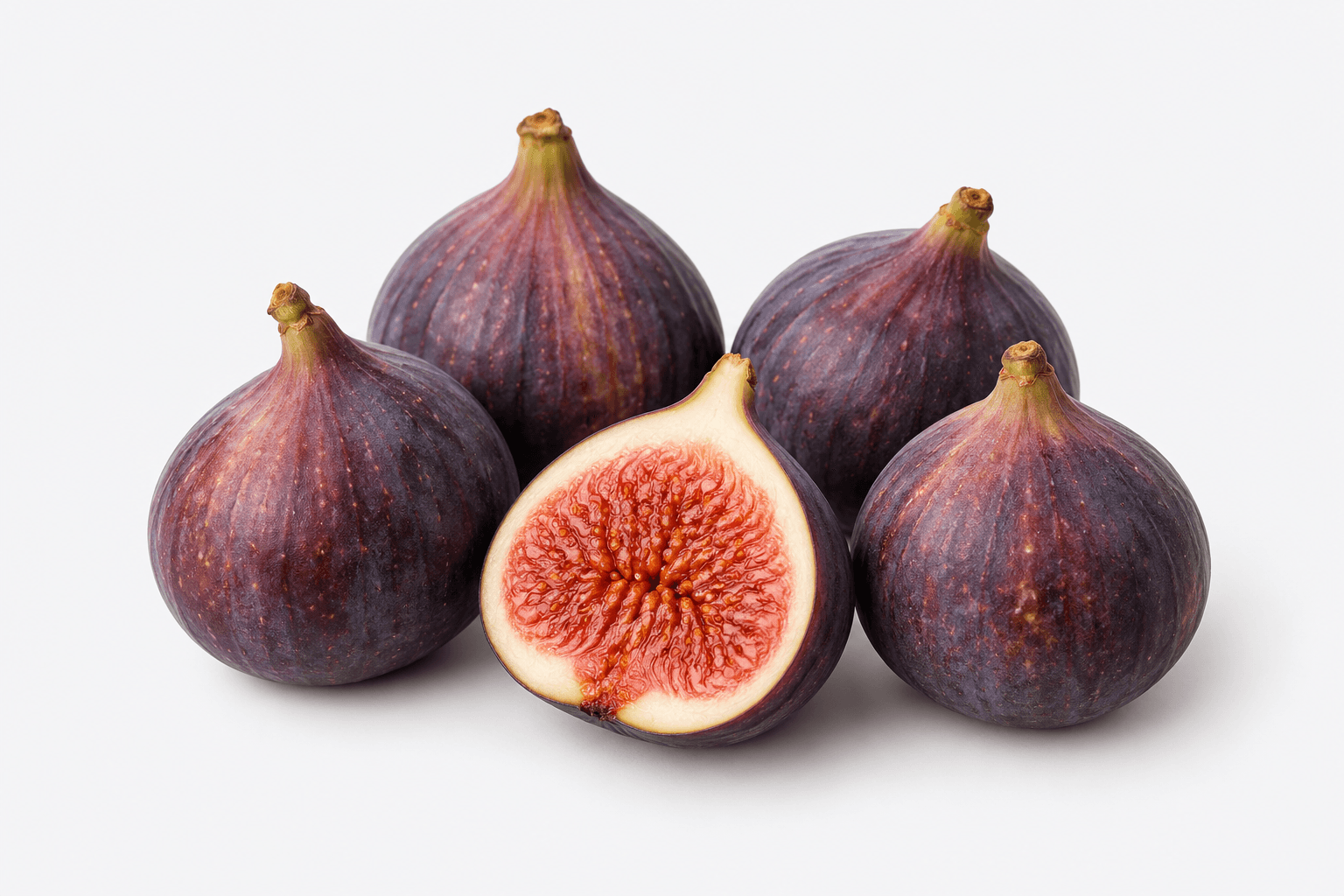
The fig is the fruit of a tree in the mulberry family. Its Korean and Chinese name means flowerless fruit, but it is not flowerless at all: hundreds of tiny flowers bloom inside the hollow, pouch-like receptacle where nobody can see them. The small crunchy specks you feel when eating one are the fruits those flowers set. The tree is native to western Asia and the Mediterranean. The skin is thin and the flesh wet, so fresh figs bruise and spoil quickly — which is why so much of the crop is sold dried.
Scientific name Ficus carica
Figs appear briefly in Korea from late summer into early autumn. And they have long been used for constipation.
This time there are real trials attached to the folklore. How they attach is the interesting part.
First, 2019 in Explore. 150 patients with constipation-predominant irritable bowel syndrome (IBS-C), followed for four months. In the fig group, stool frequency, hard stool, distension, the frequency of pain and quality of life all improved.
But the same paper states:
No significant effect on the severity of abdominal pain or on CRP.
How often it hurt went down; how much it hurt did not. And CRP, the inflammation marker, did not move.
Second, 2025 in Nutrition & Metabolism. Ninety pregnant women with constipation were split three ways: fig-walnut syrup, fig syrup, placebo. Both active arms beat placebo on the number of bowel movements.
Watch the walnut here. There was no significant difference between the fig-walnut combination and fig alone. On quality of life, the figure for fig alone was in fact the larger one (−5.8 against −3.4).
Adding walnut bought nothing over fig by itself.
Key benefits
- Early research
Bowel measures improved; pain severity and the inflammation marker did not
[1][2]Two randomised trials that fed figs to people.
2019, Explore — constipation-predominant IBS.
- 150 patients with IBS-C, three groups (flixweed / fig / control), four months
- Single-blind, not double
- Assessed with the IBS severity score system and quality-of-life questionnaires
Outcome Result Frequency of pain improved Distension improved Stool frequency improved Hard stool improved Quality of life improved Satisfaction with bowel habits improved Severity of abdominal pain no significant difference CRP (inflammation) no significant difference The bottom two rows matter.
First, the frequency of pain and its severity are different measures. Figs cut how often it hurt without changing how much it hurt. When stool softens, the number of painful episodes falls naturally. That is not the same as addressing the pain itself.
Second, CRP did not move. Figs are widely introduced as an anti-inflammatory food. This trial does not support that. Four months of intake left the inflammation marker where it was.
2025, Nutrition & Metabolism — constipation in pregnancy.
- Ninety pregnant women with constipation, 30 per arm, double-blind
- 15 ml of syrup daily, half an hour before bed, for 14 days, with two weeks of follow-up
- Fig-walnut syrup / fig syrup / placebo
Comparison Result Fig-walnut vs placebo significantly more bowel movements Fig alone vs placebo significantly more bowel movements Fig-walnut vs fig alone no significant difference Quality of life, fig-walnut vs placebo mean difference −3.4 (p=0.008) Quality of life, fig alone vs placebo mean difference −5.8 (p<0.001) Quality of life, between the two active arms no significant difference (p=0.104) The walnut earned nothing. The expectation that a combination beats the single ingredient is not borne out by this data.
The limits of these trials:
- Both used a syrup or processed form, not whole fresh figs. The abstract does not say how many figs 15 ml of syrup represents
- The 2019 trial was single-blind. When participants know what they are taking, questionnaire scores move easily — and every primary outcome here was a questionnaire
- The 2025 trial ran 14 days with 30 people per arm
- The authors close with "further studies are needed to reach a conclusive determination"
- Both trials were conducted in Iran
This site's conclusion:
- For constipation there may be something here. Two trials point the same way
- But do not read it as pain relief or as an anti-inflammatory effect. Pain severity and CRP did not move
- The grade here is "early research"
- Nutrition data
16.3 g of sugar and 2.9 g of fibre per 100 g fresh — dried figs are another food
Per 100 g of fresh figs:
- 74 kcal, sugar 16.3 g, carbohydrate 19.2 g
- Fibre 2.9 g
- Potassium 232 mg, calcium 35 mg, magnesium 17 mg
- Vitamin B6 0.113 mg, vitamin C 2.0 mg, manganese 0.128 mg
- Protein 0.75 g, fat 0.3 g, sodium 1 mg
Per medium fig (50 g):
100 g One fig (50 g) Three figs (150 g) Energy 74 kcal 37 kcal 111 kcal Sugar 16.3 g 8.2 g 24.5 g Fibre 2.9 g 1.5 g 4.4 g Potassium 232 mg 116 mg 348 mg 2.9 g of fibre is high for a fruit, above an apple's 2.4 g. It is the first thing to reach for when explaining the trial results — not an exotic compound, just fibre.
But sugar is 16.3 g. Three figs is 24.5 g, and the WHO recommends free sugars under 25 g a day on 2,000 kcal. Sugars held within whole fruit are not free sugars by that definition. Even so, if you manage blood glucose, know the number.
Dried figs are not the same food. Drying concentrates the sugar and the energy. Do not apply the fresh-fig table above to them. A handful of dried figs is nothing like one fresh fig.
The crunch of the seeds really is seeds. The edible part of a fig is an inverted cluster of flowers, and each small grain inside corresponds to a fruit.
Choosing them. Figs do not ripen after picking. They have to ripen on the tree, which is why the season is short and they bruise easily. A ripe one wrinkles slightly at the skin and yields to a fingertip. A firm one will never sweeten.
Refrigerate, two to three days. Store unwashed and rinse just before eating.
- Not established
"Fig enzymes aid digestion" — tenderising meat is a different claim
This entry sorts through a common misunderstanding.
Figs contain a protein-digesting enzyme called ficin. That much is true. It is concentrated in the milky sap and is genuinely used to tenderise meat, in the same family as pineapple's bromelain and papaya's papain.
Then the story skips a step. "It contains a protein-digesting enzyme, therefore it aids digestion" tends to follow.
Several things to check.
First, this site has not found a clinical trial that fed figs and measured digestive function. The two trials above are about bowel movements, not about enzyme activity.
Second, a swallowed enzyme has to survive the stomach, which runs at pH 1–2 and contains pepsin — an enzyme that digests proteins, including other enzymes. That an ingested protein-digesting enzyme stays active as far as the small intestine is a claim requiring its own evidence, not a free assumption.
Third, the kitchen situation is not the same. Fig sap tenderising meat on a worktop means concentrated enzyme in direct contact for tens of minutes at room temperature. Eating a fig or two is not those conditions.
So this site draws no conclusion in either direction here. That ficin exists is a fact; that it improves digestion when a person eats a fig is a separate claim that has not been confirmed.
There is, however, something definite to say about ficin — the skin.
The milky sap from fig stems and unripe fruit irritates skin. Handling a lot of figs can leave your hands stinging or reddened. Fig leaves and sap also contain furocoumarins, so skin carrying the sap can develop phototoxic dermatitis on exposure to sunlight. Wear gloves on a day of heavy fig handling, and wash the sap off.
With a latex allergy, cross-reactivity to figs has been reported. Stop and seek care if your mouth itches or swells.
How to eat it well
- One fresh fig is 37 kcal and 8.2 g of sugar. Three brings the sugar to 24.5 g.
- If you want the constipation effect, think fibre and water together. Fibre without fluid makes things worse, not better.
- They do not ripen after picking. Choose slightly wrinkled ones that yield to a fingertip.
- Refrigerate unwashed and eat within two or three days, rinsing just before.
- Eat the skin. Much of the fibre is in it.
- Dried figs have concentrated sugar. Do not carry the fresh figures across.
- Wear gloves on a heavy prep day. The milky sap irritates skin.
- With yoghurt or cheese the sweetness is tempered and the fullness lasts longer.
How to read the grades
Each benefit carries a label showing how far research on people supports it. Grades differ between items even within the same ingredient.
- Nutrition data
- A fact verifiable from food composition databases or health authorities. This is a different kind of statement from a clinical effect.
- Strong evidence
- Consistently confirmed across randomised controlled trials or meta-analyses.
- Moderate evidence
- Human studies exist, but effect sizes are small or results are mixed.
- Early research
- Cell or animal work, or small preliminary studies.
- Not established
- Commonly claimed, but not confirmed in studies on people.
What to watch out for
- Pain severity and CRP did not move in the trials. Do not read this as pain relief or an anti-inflammatory effect.
- Both trials used a syrup or processed form, not whole fresh figs.
- The 2019 trial was single-blind with questionnaires as every primary outcome.
- If constipation troubles you in pregnancy, do not copy the syrup dose on your own — speak to your care team.
- With diabetes, one fresh fig carries 8.2 g of sugar, and dried figs far more.
- With IBS, figs move into the high-FODMAP range as the portion grows. Some people improved in the trial, but this varies a great deal.
- The milky sap irritates skin, and sap-covered skin exposed to sunlight can develop phototoxic dermatitis.
- With a latex allergy, cross-reactivity has been reported.
Nutrition
Per 100 g of fresh figs. A medium fig is about 50 g, so the figures below are roughly two. Dried figs have lost their water, so the same weight carries far more sugar and energy.
- Calories
- 74 kcal4%
- Carbohydrates
- 19.2 g7%
- Sugars
- 16.3 g
- Fiber
- 2.9 g10%
- Potassium
- 232 mg5%
- Calcium
- 35 mg3%
- Magnesium
- 17 mg4%
- Vitamin B6
- 0.113 mg7%
- Vitamin C
- 2.0 mg2%
- Manganese
- 0.128 mg6%
- Protein
- 0.75 g2%
- Fat
- 0.3 g<1%
- Sodium
- 1 mg<1%
Percentages are of the US FDA Daily Value for adults and children 4 and over. National reference intakes differ by sex and age.
Calculate this alongside other ingredients →
Key nutrients
By health concern
Dishes with this ingredient
Sources
The databases and health authorities this article's nutrition figures and health statements draw on.
- 1Comparison and Assessment of Flixweed and Fig Effects on Irritable Bowel Syndrome with Predominant Constipation: A Single-Blind Randomized Clinical TrialClinical trialPourmasoumi M, et al. Explore 2019PMID 30318190
- 2The effect of combined fig-Walnut syrup on functional constipation in pregnant women: a randomized controlled trialClinical trialValizadeh R, et al. Nutrition & Metabolism 2025PMID 39825362
- 3USDA FoodData CentralFood composition database
- 4PubMedResearch literature
- 5World Health Organization · Healthy dietHealth authority