Contents
What it is
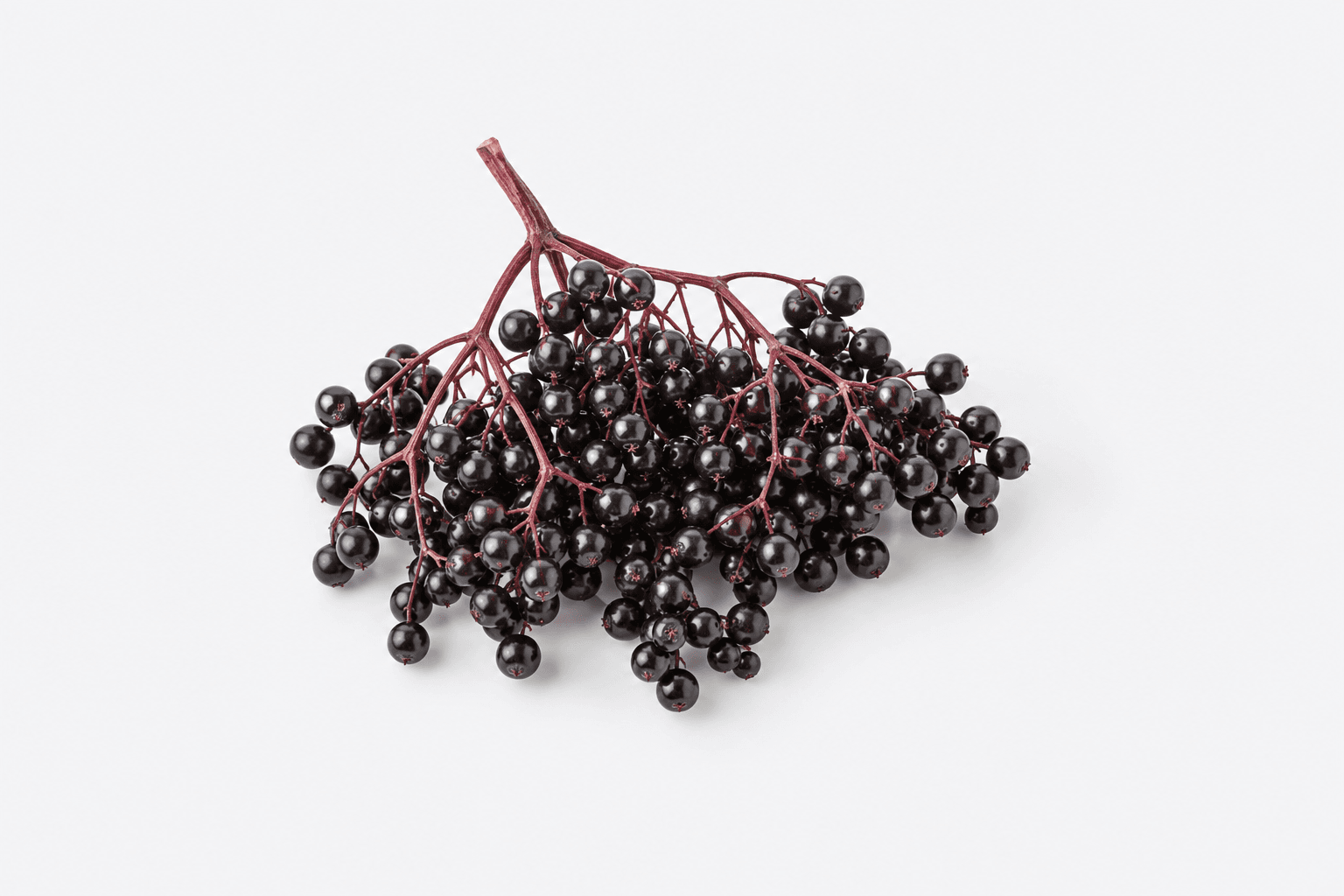
The elderberry is the fruit of a shrub growing across Europe, North Africa and western Asia, borne in clusters of small black berries about 5mm across. Europe has used it in folk remedies and drinks for centuries. Unripe berries, along with the leaves, stems and seeds, contain cyanogenic glycosides and can cause nausea and vomiting if eaten raw in quantity, so the fruit is always cooked and turned into syrup, jam or juice. Unlike the other berries on this site, it is not a fruit to eat fresh.
Scientific name Sambucus nigra
Elderberry shows up every change of season as syrup and jelly, with "good for colds" attached almost automatically.
So the evidence first. A 2021 systematic review in BMC Complementary Medicine and Therapies pooled five randomised trials, assessed bias with Cochrane tools and rated certainty with GRADE. The conclusion does not reduce to one line.
- It may not reduce the risk of developing a cold — this is not prevention
- It may reduce duration and severity, but the evidence is uncertain
- It may reduce the duration of influenza — also uncertain
"Uncertain" is the authors' own word. This site does not rewrite it.
The composition is not ordinary. 100 g holds 7.0 g of fibre and 36 mg of vitamin C. But a spoonful of syrup does not carry those numbers, and the arithmetic is below.
And one thing to say first — elderberries must not be eaten raw. The US CDC's weekly report (MMWR) carries a case of poisoning from elderberry juice, published in 1984.
Key benefits
- Early research
Prevention failed, and the shortening stayed "uncertain"
[1][2]2021, BMC Complementary Medicine and Therapies. The authors searched six databases, four trial registers and two preprint servers, screened 1,187 records and included five randomised trials. Two reviewers independently extracted data, assessed risk of bias with Cochrane tools and certainty with GRADE.
The results:
- Risk of developing a cold — it may not reduce it. No preventive effect was established
- Duration and severity of colds — may be reduced, but the evidence is uncertain
- Duration of influenza — may be reduced, also uncertain
- Compared with oseltamivir (Tamiflu), an elderberry-containing product may have carried a lower risk of influenza complications and adverse events
Another study that gets quoted constantly needs to sit next to this one.
A 2019 meta-analysis in Complementary Therapies in Medicine reported that elderberry supplementation "substantially reduced upper respiratory symptoms" with "a large mean effect size". Search for elderberry online and this is almost always what comes back.
That analysis included 180 participants in total.
One hundred and eighty is a small number for a condition as common and as variable as a cold. A cold resolves in about a week whether or not you do anything. Measuring an effect against that background takes a far larger sample. The authors' affiliation is a wellness institute rather than a university or hospital.
The two look like they disagree, but they do not really conflict. One says the effect was large; the other says there may be an effect, but the evidence is not good enough to be confident of it. The one that graded certainty is the second.
The honest summary: elderberry will not keep you from catching a cold. It may shorten one you already have, and the evidence for that possibility is weak.
- Nutrition data
7 g of fibre per 100 g — but how much survives in a spoonful of syrup?
Per 100 g of raw elderberries:
- 73 kcal, protein 0.66 g, fat 0.5 g
- Of 18.4 g of carbohydrate, 7.0 g is fibre
- Vitamin C 36.0 mg — 40% of the requirement
- Potassium 280 mg, calcium 38 mg, iron 1.6 mg
- Vitamin B6 0.23 mg, vitamin A 30 µg, phosphorus 39 mg
7.0 g of fibre is high even among fruit — close to three times blueberry's 2.4 g. The 36 mg of vitamin C is below orange (53 mg) and far above blueberry (9.7 mg).
But almost nobody eats that table.
Elderberry reaches you by three routes.
First, syrup. The berries are boiled, strained, and reduced with sugar or honey. Most of the fibre leaves at the strainer. Vitamin C is heat-sensitive and falls during the boil. What remains is anthocyanin and sugar.
Second, jelly and jam. Same as syrup, with more sugar.
Third, capsules and extracts. This is closest to what the trials above used — though concentration and specification differ by product.
So separate two things:
- If you want the nutrients — syrup will not deliver them. For 7 g of fibre you would need the cooked whole fruit, and other fruit may serve better anyway
- If you want the effect the trials looked at — those trials used standardised extracts, not a spoonful of syrup
One more thing — the colour is intense. That is the anthocyanin, and it stains clothes and cutting boards.
- Not established
"Boosts immunity" — no evidence was found for that sentence
[1]This entry sorts through a claim that is not established.
The phrase attached most often to elderberry products is "boosts immunity", frequently with talk of "modulating cytokines".
The 2021 review took this on directly, because concern had been raised during the COVID pandemic that elderberry might overstimulate immunity and increase the risk of a cytokine storm. The authors searched for evidence in both directions.
What they found:
- No studies linking elderberry to clinical inflammatory outcomes. No clinical evidence either for benefit or for harm
- Three studies measured cytokine production ex vivo. There was some effect on inflammatory markers, but that effect may decline with ongoing supplementation
- In one small study comparing it with diclofenac (an anti-inflammatory drug), elderberry was as effective or less effective than diclofenac at reducing cytokines over time
Three points follow.
First, "immunity" has no unit of measurement. Human immunity is not a dial you turn up. It can only be judged by outcomes — did you get infected less, were you less ill — and the evidence on those outcomes is entry one above, where prevention failed.
Second, an ex vivo marker is not a human outcome. Cytokines moving in cells is a different order of claim from a person being less ill.
Third, anyone with an autoimmune condition or on immunosuppressants should be especially careful. If the "stimulates immunity" claim were true, that would be a risk rather than a benefit for them. And there is no clinical evidence in that direction either.
How to eat it well
- Do not eat them raw. Cooking the berries thoroughly is the rule. Leaves, stems and unripe berries are worse.
- Strain out seeds and stems. Stems left in make illness more likely.
- If you make syrup, boil, strain, cool, then add honey. Added hot, the aroma flashes off.
- Count the sugar. Commercial syrups carry a lot per spoonful. You can end up adding sugar daily to shorten a cold.
- If fibre is the point, you need the cooked whole fruit, not the syrup.
- For capsules, read the specification. The trials used standardised extracts.
- Taking it once you have a cold is closer to the evidence than taking it to prevent one. Prevention was not established.
- The colour is strong. Keep it off white clothes and wooden boards.
How to read the grades
Each benefit carries a label showing how far research on people supports it. Grades differ between items even within the same ingredient.
- Nutrition data
- A fact verifiable from food composition databases or health authorities. This is a different kind of statement from a clinical effect.
- Strong evidence
- Consistently confirmed across randomised controlled trials or meta-analyses.
- Moderate evidence
- Human studies exist, but effect sizes are small or results are mixed.
- Early research
- Cell or animal work, or small preliminary studies.
- Not established
- Commonly claimed, but not confirmed in studies on people.
What to watch out for
- Raw elderberries, leaves, stems and unripe fruit must not be eaten. The US CDC's MMWR reported poisoning from elderberry juice in 1984. Nausea, vomiting, abdominal pain and diarrhoea are the reported symptoms.
- No preventive effect was established. The GRADE-assessed review states it may not reduce the risk of developing a cold.
- The authors themselves called the evidence for shortening illness "uncertain".
- The widely quoted 2019 meta-analysis totalled 180 participants.
- With an autoimmune condition or on immunosuppressants, speak to your doctor first. There is no clinical evidence for the "immune stimulation" claim, but absence of evidence is not proof of safety.
- Syrups and jellies are sugar-added preparations and differ from the table above.
- Safety in pregnancy and breastfeeding is not established.
- If you suspect influenza, get medical care. The comparison above does not mean elderberry can replace an antiviral.
Nutrition
Per 100 g of raw elderberries. Note that this fruit is meant to be cooked, and what you actually meet is usually syrup, jelly or a supplement.
- Calories
- 73 kcal4%
- Protein
- 0.66 g1%
- Fat
- 0.5 g<1%
- Carbohydrates
- 18.4 g7%
- Fiber
- 7.0 g25%
- Vitamin C
- 36.0 mg40%
- Potassium
- 280 mg6%
- Calcium
- 38 mg3%
- Iron
- 1.6 mg9%
- Vitamin B6
- 0.23 mg14%
- Vitamin A
- 30 µg3%
- Phosphorus
- 39 mg3%
Percentages are of the US FDA Daily Value for adults and children 4 and over. National reference intakes differ by sex and age.
Calculate this alongside other ingredients →
Key nutrients
Dishes with this ingredient
Sources
The databases and health authorities this article's nutrition figures and health statements draw on.
- 1Elderberry for prevention and treatment of viral respiratory illnesses: a systematic reviewSystematic reviewsWieland LS, Piechotta V, Feinberg T, Ludeman E, Hutton B, Kanji S, Seely D, Garritty C BMC Complementary Medicine and Therapies 2021PMID 33827515
- 2Black elderberry (Sambucus nigra) supplementation effectively treats upper respiratory symptoms: A meta-analysis of randomized, controlled clinical trialsMeta-analysisHawkins J, Baker C, Cherry L, Dunne E Complementary Therapies in Medicine 2019PMID 30670267
- 3USDA FoodData CentralFood composition database
- 4PubMedResearch literature
- 5NIH Office of Dietary SupplementsHealth authority
- 6Poisoning from elderberry juice — CaliforniaHealth authorityCenters for Disease Control (CDC) MMWR Morbidity and Mortality Weekly Report 1984PMID 6422238