Contents
What it is
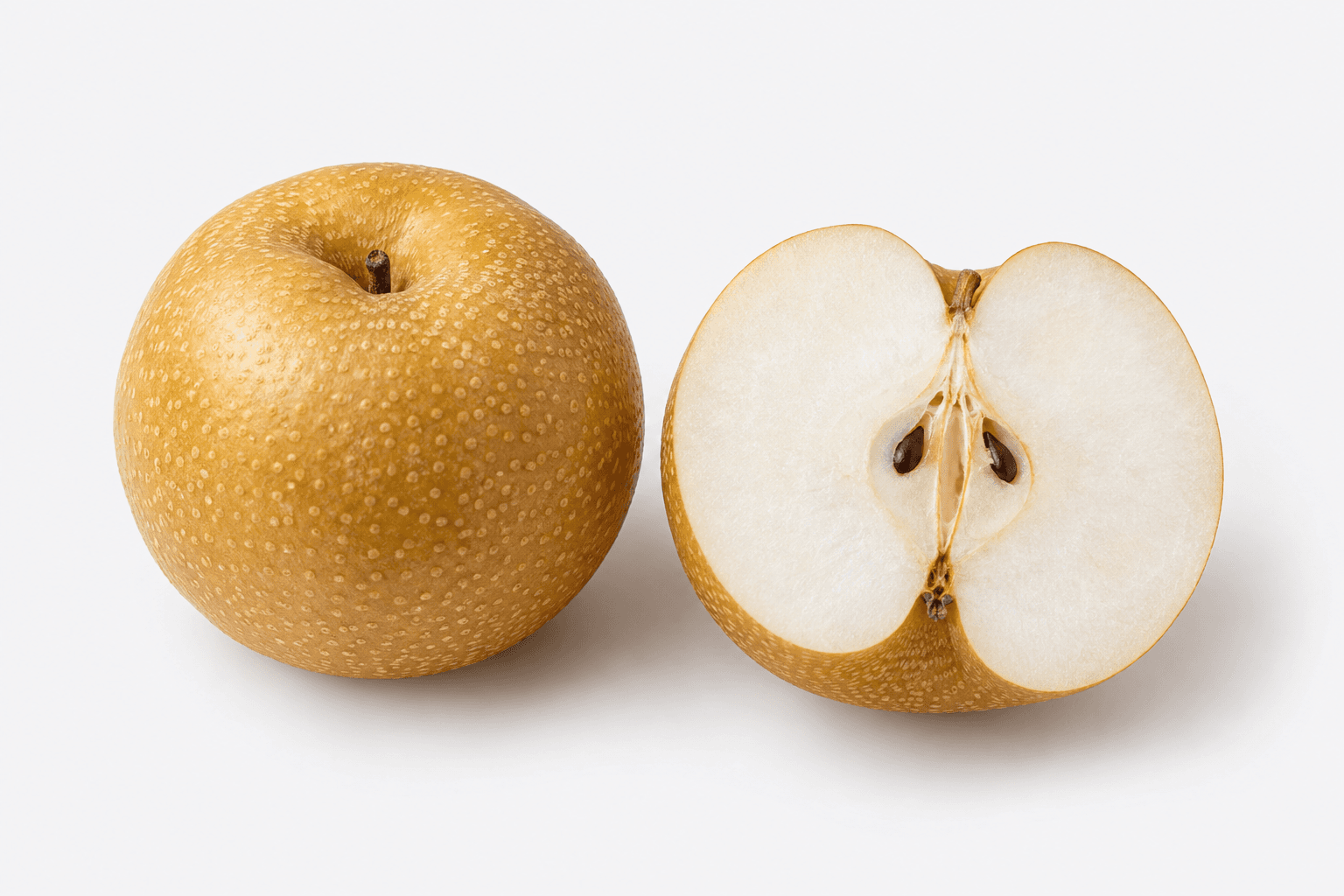
The pear here is the East Asian pear, a fruit in the rose family alongside the apple. The pears eaten in Korea, China and Japan are round, brown-skinned and crisp, while the European pear is bottle-shaped and ripens to a soft, buttery flesh — two fruits so different it is hard to think of them as one. The faint grittiness between the teeth comes from stone cells, clusters of hardened cells in the flesh. It contains enzymes that break down protein, which is why Korean cooking grates it into meat marinades for tenderising and sweetness at once.
Scientific name Pyrus pyrifolia
'Pear juice before drinking' is old folk advice. In this case, unusually, there is an actual human trial.
In 2013 Korean researchers gave 14 healthy young men Shingo pear juice or placebo, then had them drink spirits 30 minutes later, taking blood and urine at nine time points over 15 hours. The design was randomised, single-blind and crossover.
Hangover scores came out 16–21 % lower than placebo. But that is 14 participants, single-blind. Turning it into 'pears cure hangovers' overstates it.
Nutritionally, a pear is close to water with fibre in it. 42 kcal and 3.6 g of fibre per 100 g — more fibre than an apple's 2.4 g.
Key benefits
- Early research
Hangover — a real trial, but a small one
[1]A randomised single-blind crossover trial in 14 healthy young men. They drank Shingo pear (Pyrus pyrifolia) juice or placebo and, 30 minutes later, 540 ml of spirits at 20.1 % alcohol. Blood and urine were collected at nine points over 15 hours.
At 15 hours, total hangover severity was 16 % lower and average severity 21 % lower (both p < 0.05). 'Trouble concentrating' improved significantly in particular.
Blood alcohol was also lower (p < 0.01).
The interesting part is that results split by genotype. In ALDH2*1/*1 and *1/*2 carriers, impaired memory and sensitivity to light and sound improved — but in ALDH2*2/*2 carriers, who barely clear acetaldehyde, they did not. That is the group whose faces flush hard on a small drink.
Limits: 14 people, single-blind, self-reported scores at one time point. That is why the grade here is 'early'. And in every case, the measure that works on hangovers is drinking less.
- Nutrition data
3.6 g of fibre — more than an apple
Raw Asian pear is 3.6 g of fibre and 42 kcal per 100 g.
Compare: apple 2.4 g, European pear 3.1 g, peach 1.5 g, watermelon 0.4 g. Among fruits, a pear sits on the high side.
Much of that fibre is lignin and cellulose — the stone cells in the skin and flesh. That faintly grainy texture when you bite a pear is the fibre. Peeling removes part of it.
Water content is 88 %, potassium 121 mg, vitamin C 3.8 mg. The vitamin C is not much.
Weight for weight, Asian pears are lower in energy than European pears (42 vs 57 kcal) and higher in fibre (3.6 vs 3.1 g).
- Moderate evidence
The cohort evidence for apples and pears
[2]A dose–response meta-analysis pooled 95 prospective studies (142 publications). For every extra 200 g a day of fruit and vegetables, relative risks were 0.92 for coronary heart disease, 0.84 for stroke, 0.92 for cardiovascular disease and 0.90 for all-cause mortality.
The analysis broke fruit down by type, and apples and pears appear together among the items inversely associated with cardiovascular disease and all-cause mortality.
This is pooled observational data, and the accurate reading is 'because you ate more fruit', not 'because it was a pear'.
A pear usually weighs 250–400 g, so one covers that extra 200 g on its own.
How to eat it well
- Eat the skin. Fibre and polyphenols concentrate there. Washed well and sliced thin, it is not hard to eat.
- Pear juice is a different food. Juicing strips out most of the fibre and leaves the sugar. The trial above did use juice — but that was a hangover study, not a nutrition argument.
- Grated into a meat marinade it tenderises. Pear proteases do the work, and the sweetness means less sugar.
- Left out for a few days it gets sweeter. Refrigeration holds it where it is.
- If cut pear browns, a brief dip in lemon or salt water handles it.
How to read the grades
Each benefit carries a label showing how far research on people supports it. Grades differ between items even within the same ingredient.
- Nutrition data
- A fact verifiable from food composition databases or health authorities. This is a different kind of statement from a clinical effect.
- Strong evidence
- Consistently confirmed across randomised controlled trials or meta-analyses.
- Moderate evidence
- Human studies exist, but effect sizes are small or results are mixed.
- Early research
- Cell or animal work, or small preliminary studies.
- Not established
- Commonly claimed, but not confirmed in studies on people.
What to watch out for
- Do not read the hangover trial as permission. Fourteen people, and no effect in ALDH2*2/*2 carriers. Alcohol is an IARC Group 1 carcinogen.
- With IBS, pears are a classic high-FODMAP fruit. High in both fructose and sorbitol, they readily cause cramping and diarrhoea.
- There is sugar here — 10.6 g of carbohydrate per 100 g. A large pear (400 g) is over 40 g. If you manage blood glucose, a whole one at a sitting is a lot.
- Pear juice and pear drinks are close to sugar concentrate. Check the sugars on the label.
- The figures are USDA's 'pears, asian, raw'. Sweetness varies with cultivar and ripeness.
Nutrition
Approximate values per 100 g edible portion.
- Calories
- 42 kcal2%
- Carbohydrates
- 10.6 g4%
- Fiber
- 3.6 g13%
- Potassium
- 121 mg3%
- Vitamin C
- 3.8 mg4%
- Copper
- 0.05 mg6%
- Vitamin K
- 4.5 µg4%
- Magnesium
- 8 mg2%
Percentages are of the US FDA Daily Value for adults and children 4 and over. National reference intakes differ by sex and age.
Calculate this alongside other ingredients →
Key nutrients
Dishes with this ingredient
Sources
The databases and health authorities this article's nutrition figures and health statements draw on.
- 1Effect of Korean pear (Pyruspyrifolia cv. Shingo) juice on hangover severity following alcohol consumptionClinical trialLee HS, et al. Food Chem Toxicol 2013PMID 23587660
- 2Fruit and vegetable intake and the risk of cardiovascular disease, total cancer and all-cause mortality-a systematic review and dose-response meta-analysis of prospective studiesMeta-analysisAune D, et al. Int J Epidemiol 2017PMID 28338764
- 3USDA FoodData CentralFood composition database
- 4NIH Office of Dietary SupplementsHealth authority
- 5PubMedResearch literature