Contents
What it is
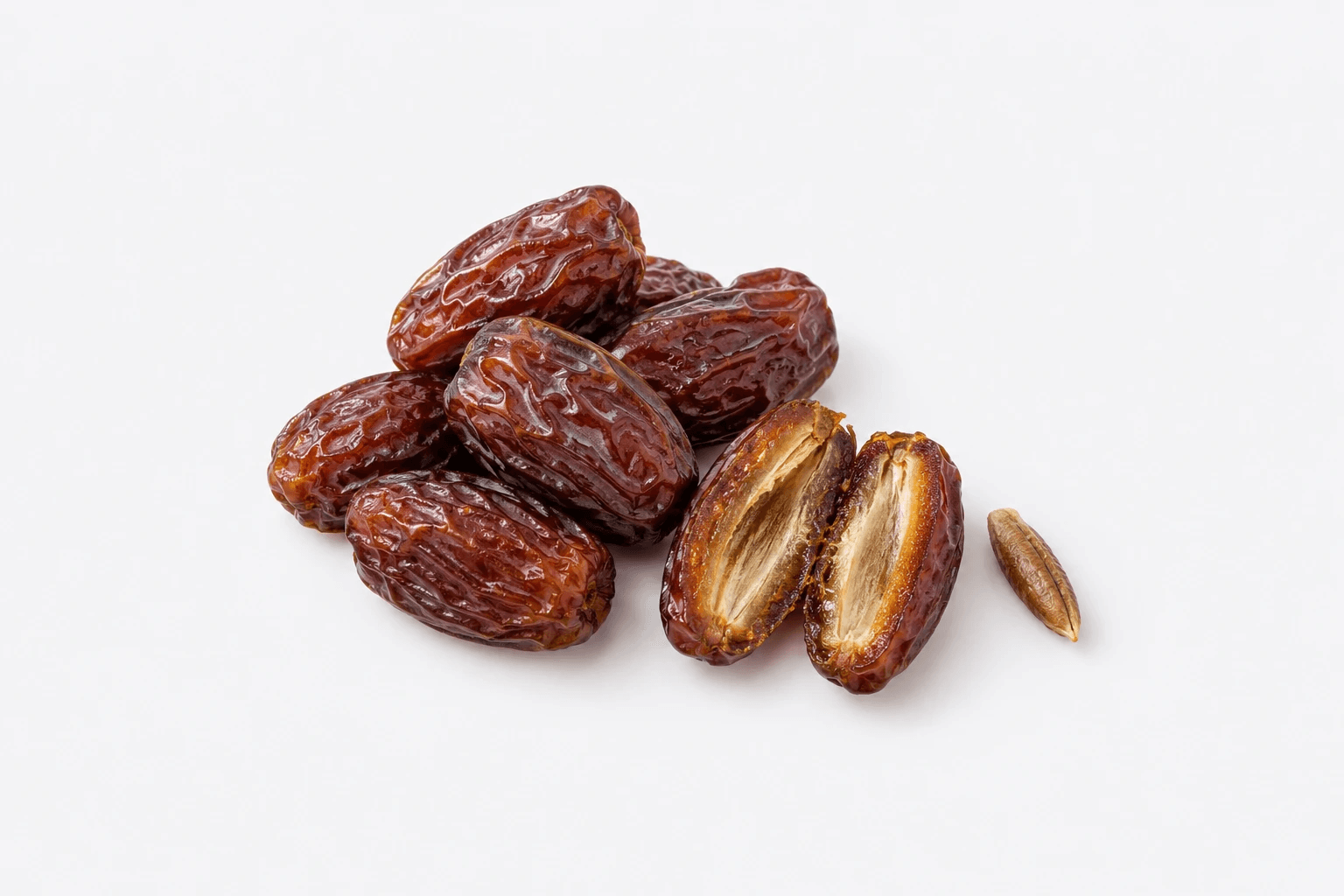
The date is the fruit of the date palm. It is an entirely different plant from the jujube, which is also called a date in Korean; the shared name is just a matter of looks. The palm is native to the Middle East and North Africa, where the fruit has long held a place close to a staple food. Dates lose moisture on the tree and arrive semi-dried without any processing, which is why they are intensely sweet with no sugar added — 60 to 70 percent of their weight is sugar. Texture varies a great deal by variety, from the soft Medjool to the firmer Deglet Nour.
Scientific name Phoenix dactylifera
Dates break the fast during Ramadan across the Middle East, and in Korea they sit on the health-food shelf.
The composition first. 100 g holds 66.5 g of sugar and 277 kcal. The 6.7 g of fibre and 696 mg of potassium are high. Fat, at 0.15 g, is effectively absent.
The clinical evidence sits in an unusual place — childbirth.
A 2024 systematic review and dose-response meta-analysis in BMC Pregnancy and Childbirth searched eight databases and included 48 studies reported in 55 publications, covering dates given in the third trimester, in late pregnancy, during labour and postpartum.
The positive findings run long.
- Consumption in late pregnancy shortened gestation and labour (except the second stage)
- Reduced the need for induction
- Accelerated spontaneous delivery, raised cervical dilatation on admission and Bishop score
- Intake during labour shortened labour (except the third stage)
- Postpartum intake increased breast milk quantity and reduced post-delivery haemorrhage
- Third-trimester intake raised maternal haemoglobin
But you cannot stop there. The next sentence of the same abstract reads:
"The overall evidence quality was also unacceptable, and RoB was high in most studies. Furthermore, the intervention's safety was recorded only in four trials."
And the conclusion is that better-designed studies are required.
Key benefits
- Early research
A long list of positive findings, and authors who called the evidence unacceptable
[1]2024, BMC Pregnancy and Childbirth. A systematic review and dose-response meta-analysis, registered on PROSPERO.
Methods.
- Eight databases searched from inception to 30 April 2023
- Randomised and non-randomised controlled trials in any language, conducted in the peripartum period (third trimester, late pregnancy, labour or postpartum)
- Standard care plus oral dates versus standard care alone or combined with other alternatives
- Assessed with the Cochrane Risk of Bias tools and GRADE
- 2,460 records screened, 48 studies (55 publications) included
What was reported.
Period Reported findings Late pregnancy Shorter gestation and labour (except second stage), less need for induction, faster spontaneous delivery, higher cervical dilatation on admission and Bishop score, more spontaneous vaginal deliveries During labour Shorter labour (except third stage), greater cervical dilatation two hours after the intervention Postpartum More breast milk, less post-delivery haemorrhage Third trimester Higher maternal haemoglobin Fetal, neonatal, infant Data insufficient for meta-analysis; most outcomes not substantially different between groups And the same abstract states:
- "The overall evidence quality was also unacceptable"
- "RoB was high in most studies"
- "The intervention's safety was recorded only in four trials"
- Conclusion: "More well-designed investigations are required to robustly support consuming dates during peripartum as effective and safe integrated care"
How to read this.
First, the number of findings is not the strength of the evidence. That many outcomes reached significance across 48 studies is a different matter from whether those 48 studies can be trusted. The authors themselves denied the second.
Second, non-randomised trials are included. Without randomisation, allocation itself can be entangled with the outcome — if the mothers who ate dates were better prepared overall, that difference shows up as effect.
Third, safety data are almost absent. Only four of the 48 recorded safety. To recommend something in pregnancy, safety comes before efficacy, and that data is missing.
Fourth, the outcomes for the baby had too little data. Fetal, neonatal and infant outcomes could not be pooled, and most of what was reported showed no substantial difference between groups.
Fifth, count the sugar alongside. A common dose in these trials is around six dates a day — roughly 144 g, carrying about 96 g of sugar. That is not an amount to recommend unexamined to a mother with, or at risk of, gestational diabetes.
This site's honest conclusion:
- There may be something here. Multiple studies point the same way
- But the authors themselves rated the evidence "unacceptable". This site does not rewrite that rating
- Any dietary change in pregnancy belongs with your care team, especially with gestational diabetes
- The grade here is "early research"
- Nutrition data
66.5 g of sugar per 100 g — that is 16 g in a single date
Per 100 g of Medjool dates:
- 277 kcal, sugar 66.5 g, carbohydrate 75.0 g
- Fibre 6.7 g
- Potassium 696 mg — 15% of the requirement
- Magnesium 54 mg, calcium 64 mg, copper 0.362 mg
- Vitamin B6 0.249 mg, protein 1.81 g
- Fat 0.15 g, sodium 1 mg
66.5 g of it is sugar. That is what this fruit is: drying removed the water and concentrated the sugar.
Per date (24 g):
100 g One date (24 g) Three dates (72 g) Energy 277 kcal 66 kcal 199 kcal Sugar 66.5 g 16.0 g 47.9 g Fibre 6.7 g 1.6 g 4.8 g Potassium 696 mg 167 mg 501 mg One date carries 16 g of sugar. The WHO recommends free sugars below 5% of energy — under 25 g on 2,000 kcal. Two dates reach that line.
But an important qualification. The WHO's definition of free sugars covers added sugars and those in honey, syrups and fruit juice, and sugars present within whole or dried fruit are not counted as free sugars. So dates' sugar cannot be counted identically to table sugar.
That is not permission to eat freely. Dried fruit shrinks in volume and is easy to overeat, and three dates is already 199 kcal.
The 6.7 g of fibre is high — 1.6 g per date. Fibre arriving with the sugar is what distinguishes this from table sugar, and it changes the rate of absorption.
696 mg of potassium is also high, close to twice a banana's 358 mg. But if you restrict potassium for kidney disease, that is a caution rather than a benefit.
Varieties differ.
- Medjool — large and soft. The table above
- Deglet Noor — smaller, firmer, slightly less sugar
The white bloom on the surface is not mould. It is sugar crystallising out, and it appears with storage.
Store them sealed and cool, refrigerated for longer keeping.
- Not established
"It's natural sugar, so it's fine" — with diabetes that is a different conversation
This entry sorts through a common misunderstanding.
Dates are often recommended as a natural sweetener to replace sugar, and blending them into desserts in place of sugar is a common technique.
Part of that is right.
- Fibre comes with it — 1.6 g per date, against zero in table sugar
- There are minerals: potassium, magnesium, copper
- It is sugar within fruit rather than added sugar, so it does not fall under the WHO's free-sugar figure in the same way
But there are parts you cannot skip.
First, sugar is sugar. Dates' sugars are mainly glucose and fructose — the same sugars table sugar breaks down into. Their effect on blood glucose does not disappear.
Second, the low-GI claim is conditional. Reported glycaemic index values for dates vary widely by variety and ripeness. And GI is defined on 50 g of carbohydrate, which is not the one or two dates you actually eat. A low GI is also not permission to eat more.
Third, with diabetes the situation changes. Sixteen grams of sugar per date. If you are managing blood glucose, that number belongs in your count. "It's natural" does not exempt it.
Fourth, gestational diabetes especially. The childbirth studies above used around six dates a day, reaching about 96 g of sugar. With gestational diabetes or at risk of it, do not copy that dose on your own. Speak to your care team.
Fifth, dried fruit is easy to overeat. Fresh fruit creates fullness through water and volume; dried fruit has lost that brake. Three dates is 199 kcal, and eaten absent-mindedly it goes past that fast.
The honest conclusion: dates are a better sweetener than sugar. But they are not "not sugar". And with diabetes or gestational diabetes, the word natural exempts nothing.
How to eat it well
- One date is 16 g of sugar and 66 kcal. Count them.
- With diabetes, put them in your count. "Natural" does not exempt the arithmetic.
- In pregnancy, do not copy the trial dose (around six a day) on your own — speak to your care team.
- Eaten with nuts the sweetness is tempered and the fullness lasts longer.
- Blended in place of sugar they bring fibre and minerals with them. The sugar is still there.
- The white bloom is crystallised sugar, not mould.
- Store sealed and cool, refrigerated for longer keeping.
- Remove the stone. It is hard enough to damage a tooth.
How to read the grades
Each benefit carries a label showing how far research on people supports it. Grades differ between items even within the same ingredient.
- Nutrition data
- A fact verifiable from food composition databases or health authorities. This is a different kind of statement from a clinical effect.
- Strong evidence
- Consistently confirmed across randomised controlled trials or meta-analyses.
- Moderate evidence
- Human studies exist, but effect sizes are small or results are mixed.
- Early research
- Cell or animal work, or small preliminary studies.
- Not established
- Commonly claimed, but not confirmed in studies on people.
What to watch out for
- The authors of the childbirth meta-analysis rated the evidence quality "unacceptable", with high risk of bias in most studies.
- Only four of the 48 studies recorded safety.
- Fetal, neonatal and infant outcomes had too little data to pool, and most reported outcomes showed no substantial difference between groups.
- Any dietary change in pregnancy belongs with your care team, especially with or at risk of gestational diabetes.
- Each date carries 16 g of sugar. With diabetes it has to enter the count.
- If you restrict potassium for kidney disease, 100 g holds 696 mg.
- Dried fruit sticks to teeth. Rinse with water afterwards.
- With IBS, dates are classed as high FODMAP.
Nutrition
Per 100 g of Medjool dates. One date is about 24 g without the stone, so the figures below are roughly four dates.
- Calories
- 277 kcal14%
- Sugars
- 66.5 g
- Carbohydrates
- 75.0 g27%
- Fiber
- 6.7 g24%
- Potassium
- 696 mg15%
- Magnesium
- 54 mg13%
- Calcium
- 64 mg5%
- Copper
- 0.362 mg40%
- Vitamin B6
- 0.249 mg15%
- Protein
- 1.81 g4%
- Fat
- 0.15 g<1%
- Sodium
- 1 mg<1%
Percentages are of the US FDA Daily Value for adults and children 4 and over. National reference intakes differ by sex and age.
Calculate this alongside other ingredients →
Key nutrients
Dishes with this ingredient
Sources
The databases and health authorities this article's nutrition figures and health statements draw on.
- 1Is oral consumption of dates (Phoenix dactylifera L. fruit) in the peripartum period effective and safe integrative care to facilitate childbirth and improve perinatal outcomes: a comprehensive revised systematic review and dose-response meta-analysisMeta-analysisSalajegheh Z, et al. BMC Pregnancy and Childbirth 2024PMID 38166785
- 2USDA FoodData CentralFood composition database
- 3PubMedResearch literature
- 4World Health Organization · Healthy dietHealth authority
- 5NIH Office of Dietary SupplementsHealth authority