Contents
What it is
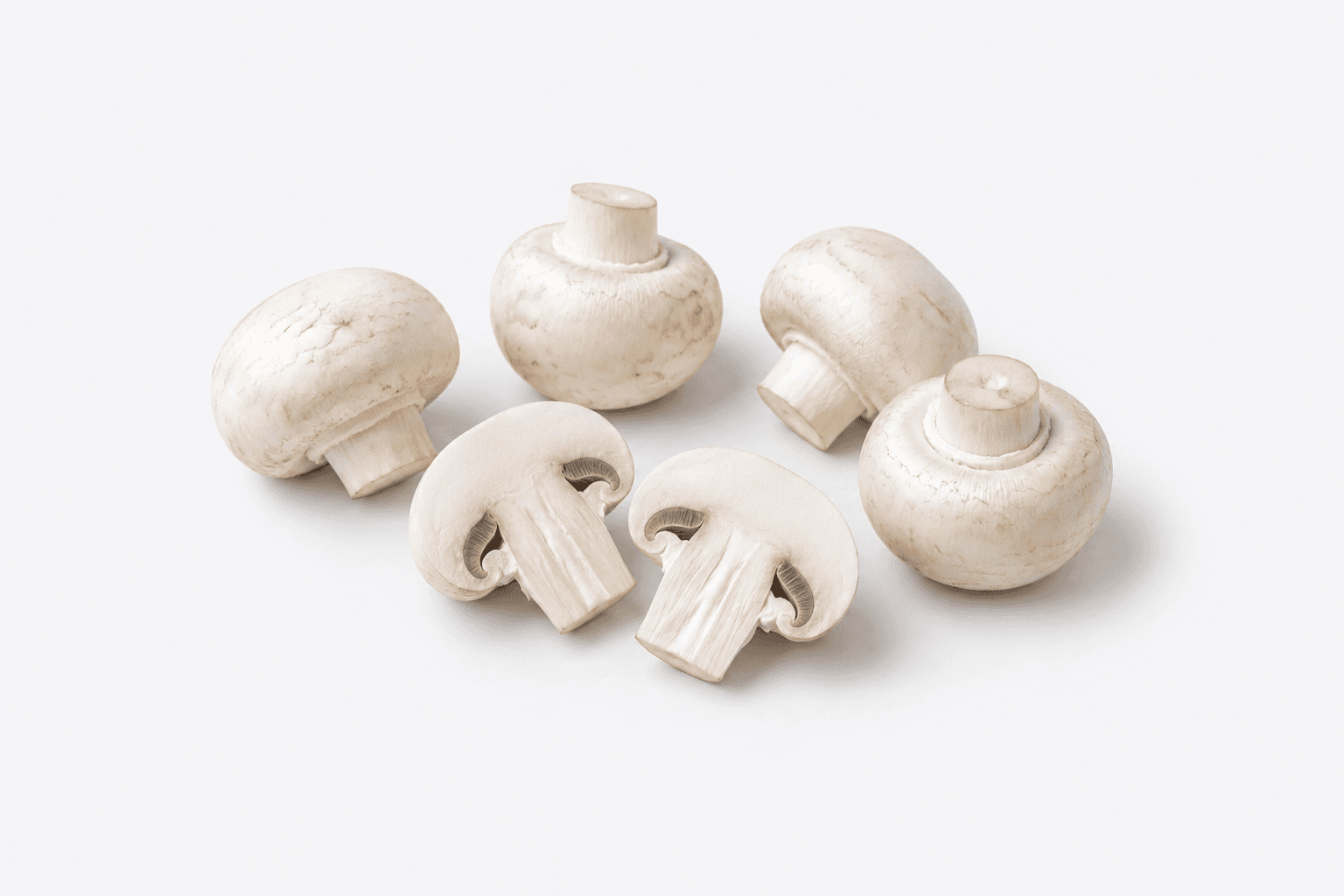
The button mushroom is the most widely cultivated mushroom in the world. The familiar white button, the brown cremini and the large portobello are all the same species — only the strain and the stage of growth differ, and a portobello is simply a cremini whose cap has opened fully. It is native to Europe. It holds a lot of water and soaks up more if washed, so brushing it or wiping it with a damp cloth is better, and a hot fast pan keeps it from stewing. Cut surfaces brown.
Scientific name Agaricus bisporus
Mushrooms are fungi, not plants. And like human skin, they make vitamin D when exposed to ultraviolet light. Where we make D3 from cholesterol, mushrooms make D2 from ergosterol.
The USDA record shows the difference plainly.
- Ordinary white mushrooms, 100 g: vitamin D 0.2 µg
- UV-exposed white mushrooms, 100 g: vitamin D 26.2 µg
A 131-fold difference. Every other value in the two entries is identical — the UV changes only the vitamin D.
So does eating them raise your blood level? Here the story splits.
A 2016 meta-analysis in the Journal of Nutrition pooled six randomised trials. The result was not significant (p = 0.12), with very high heterogeneity (I² = 87%).
But splitting them revealed a pattern. In the three European trials, where baseline blood levels were low, it rose significantly. In the three US trials, where baselines were already adequate, nothing moved at all.
It rose only in the people who were short of it.
Key benefits
- Early research
Not significant across all six trials; significant only in the three that started low
[1]2016, Journal of Nutrition. A systematic review and meta-analysis of randomised controlled trials measuring serum total 25-hydroxyvitamin D after eating UV light-exposed edible mushrooms. Biobanked sera from one trial, originally run by immunoassay, were reanalysed by LC-MS/MS to separate 25(OH)D2 from 25(OH)D3.
Ovid MEDLINE, EMBASE and Cochrane CENTRAL yielded six eligible trials.
The overall result:
- Pooling all six, serum 25(OH)D was not significantly increased (P = 0.12).
- Heterogeneity was very high — I² = 87%, meaning the trials disagreed sharply.
The subgroup analysis shows where that disagreement came from.
- Three European trials — mean baseline 25(OH)D 38.6 nmol/L. Weighted mean difference +15.2 nmol/L (95% CI 1.5 to 28.8), P = 0.03, I² = 88%
- Three US trials — mean baseline 25(OH)D 81.5 nmol/L. P = 0.83 — no effect at all
It rose only where baselines were less than half as high. Vitamin D goes up when you supplement someone who is short of it and barely moves in someone who is replete. This meta-analysis demonstrates that principle again, with mushrooms.
So how should this be read?
First, the headline is "not significant". The pre-specified primary analysis gave p = 0.12. A significant subgroup result should not be treated as the main finding.
Second, the subgroup split is close to post hoc. Dividing by Europe and the US matters not because of geography but because of baseline levels — and such a division is easy to choose after seeing the results.
Third, six trials is few and I² of 87% is very high.
Fourth, what mushrooms make is D2. Research indicates D2 raises serum 25(OH)D less effectively than D3, and rising D2 has been reported to lower D3 somewhat.
The honest summary: UV-exposed mushrooms contain vitamin D — the 26.2 µg is a measured USDA value. Whether eating them raises your blood level was seen only in people who were deficient, and was not significant overall.
- Nutrition data
0.2 µg against 26.2 µg — the same mushroom, two entries
The USDA records white mushrooms as two separate entries. Everything else is identical; only the vitamin D differs.
Ordinary UV-exposed Vitamin D 0.2 µg 26.2 µg Energy 22 kcal 22 kcal Protein 3.09 g 3.09 g Potassium 318 mg 318 mg Riboflavin 0.402 mg 0.402 mg 26.2 µg is 175% of the 15 µg adult requirement. A hundred grams — five mushrooms — clears a day.
But one distinction matters: the mushrooms in the shop have usually not been UV-exposed. They are typically grown in dark rooms. Only packs labelled "vitamin D enriched" or "UV treated" carry that 26.2 µg.
What about drying them in the sun at home? That mushroom ergosterol converts to D2 under UVB is an established reaction. But how much it rises depends on the UV intensity, the duration and how much surface is exposed. This site does not print a figure for "leave them out for N hours and you get X µg" — the conditions vary and you cannot control them at home.
Only the direction is certain: gills facing up, exposed to UV, the level rises. Behind window glass it barely works, because glass blocks most UVB.
- Nutrition data
0.402 mg of riboflavin and 1.5 mg of pantothenic acid, inside 22 kcal
Per 100 g of raw white mushrooms:
- 22 kcal, protein 3.09 g, fat 0.34 g, fibre 1.0 g
- Riboflavin (B2) 0.402 mg — 31% of the requirement
- Niacin 3.61 mg, pantothenic acid 1.5 mg
- Selenium 9.3 µg, copper 0.318 mg
- Potassium 318 mg, phosphorus 86 mg
- Sodium 5 mg
The 22 kcal is the first thing to notice. Eating 100 g costs almost nothing, and there is still 3.09 g of protein in it — a higher protein share of the calories than most vegetables.
Riboflavin at 0.402 mg is the real strength. A third of the requirement in 100 g. Riboflavin usually comes from dairy and meat, which makes mushrooms a meaningful source for people eating mostly plants.
Pantothenic acid at 1.5 mg is also high — 30% of the 5 mg adequate intake.
The savoury taste comes from glutamate and guanylate. Drying raises the guanylate, which is why dried mushrooms taste more savoury than fresh. Using them with shiitake compounds the effect — glutamate and guanylate together are perceived as several times more savoury than either alone.
The browning is tyrosinase. Cut surfaces oxidise and turn brown. It has nothing to do with flavour.
You can wash them. Despite the claim that mushrooms must never touch water, a brief rinse takes up only around 2% of their weight. Just do not leave them soaking.
How to eat it well
- If vitamin D is the point, look for "UV treated" or "vitamin D enriched" on the pack. Ordinary mushrooms hold 0.2 µg.
- Cook them in a single layer over high heat. Crowded, they release water and steam.
- Salt at the end. Salting early draws out moisture and stops them browning.
- Washing is fine. Rinse briefly and pat dry; do not soak.
- Browned cut surfaces are harmless. If it bothers you, dip them briefly in lemon water.
- Mixing with shiitake raises the savouriness sharply.
- Drying deepens the flavour. Sun-drying also raises the vitamin D, though by how much depends on conditions.
- Do not store them in the sealed bag. A paper bag keeps them from going slimy.
How to read the grades
Each benefit carries a label showing how far research on people supports it. Grades differ between items even within the same ingredient.
- Nutrition data
- A fact verifiable from food composition databases or health authorities. This is a different kind of statement from a clinical effect.
- Strong evidence
- Consistently confirmed across randomised controlled trials or meta-analyses.
- Moderate evidence
- Human studies exist, but effect sizes are small or results are mixed.
- Early research
- Cell or animal work, or small preliminary studies.
- Not established
- Commonly claimed, but not confirmed in studies on people.
What to watch out for
- The primary result of the meta-analysis was "not significant" (p = 0.12, six trials). Only the three with low baselines rose.
- What mushrooms make is D2, which research suggests raises serum 25(OH)D less effectively than D3.
- Shop mushrooms are usually not UV-exposed. The 26.2 µg belongs to UV-treated products.
- How much home sun-drying adds varies by condition. This site does not print a number for it.
- Do not forage wild mushrooms. Toxic and edible species are hard to tell apart, and some are lethal.
- If you restrict potassium for kidney disease, 100 g holds 318 mg.
- With gout, mushrooms are moderate in purines.
- If you need vitamin D, a blood test and your clinician's judgement come first.
Nutrition
Per 100 g of raw white mushrooms — about five medium caps. USDA lists UV-exposed white mushrooms as a separate entry: only the vitamin D differs.
- Calories
- 22 kcal1%
- Protein
- 3.09 g6%
- Carbohydrates
- 3.26 g1%
- Fiber
- 1.0 g4%
- Vitamin B2
- 0.402 mg31%
- Vitamin B3
- 3.61 mg23%
- Selenium
- 9.3 µg17%
- Potassium
- 318 mg7%
- Phosphorus
- 86 mg7%
- Copper
- 0.318 mg35%
- Vitamin D
- 0.2 µg1%
- Sodium
- 5 mg<1%
Percentages are of the US FDA Daily Value for adults and children 4 and over. National reference intakes differ by sex and age.
Calculate this alongside other ingredients →
Key nutrients
Dishes with this ingredient
Sources
The databases and health authorities this article's nutrition figures and health statements draw on.
- 1Effect of ultraviolet light-exposed mushrooms on vitamin D status: LC-MS/MS reanalysis of biobanked sera from a randomized controlled trial and a systematic review plus meta-analysisMeta-analysisCashman KD, et al. The Journal of Nutrition 2016PMID 26865648
- 2USDA FoodData CentralFood composition database
- 3NIH Office of Dietary SupplementsHealth authority
- 4European Food Safety Authority (EFSA)Health authority
- 5PubMedResearch literature