Contents
What it is
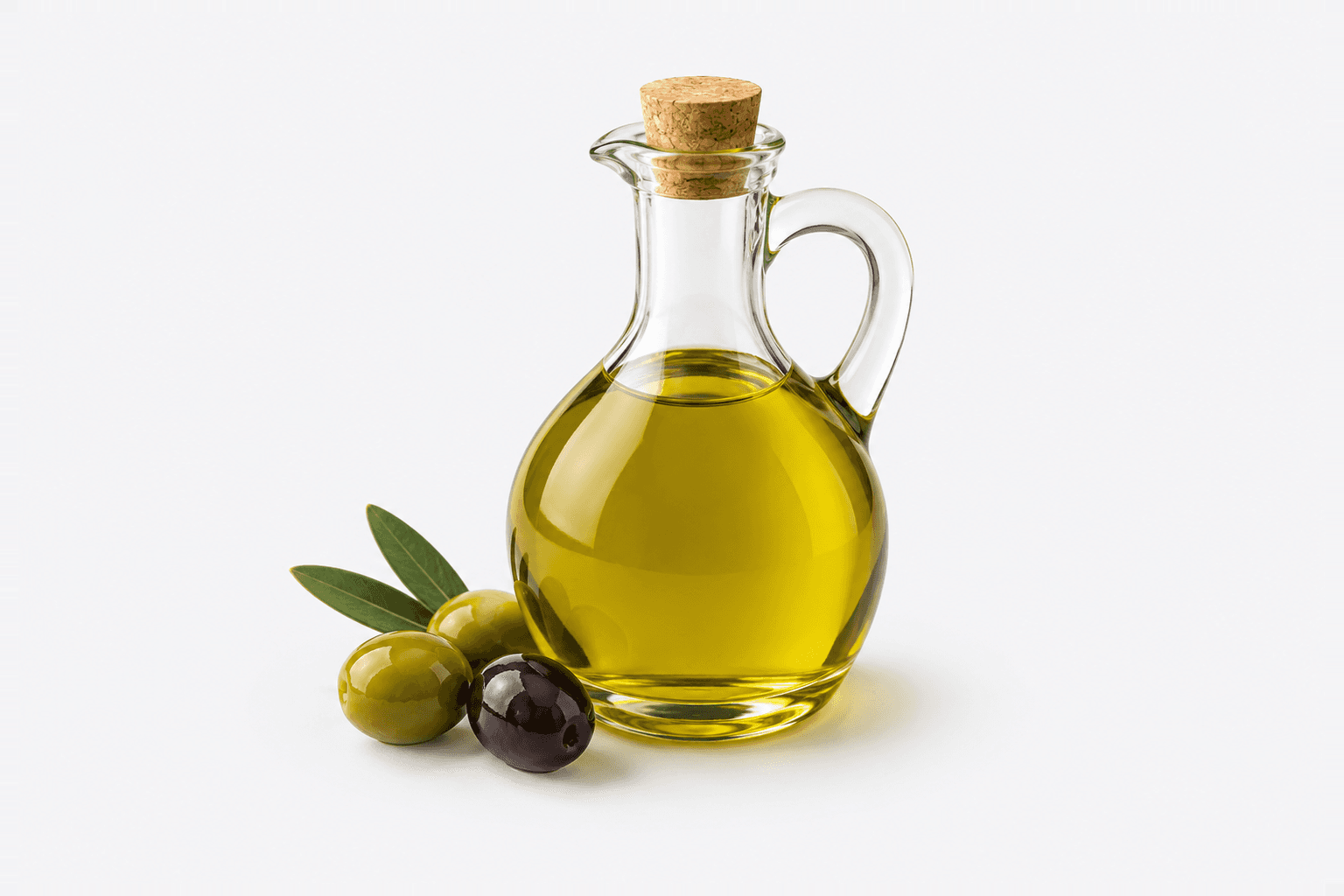
Olive oil is pressed from the flesh of the olive, not from a seed — which is what separates it from most vegetable oils, since the oil can be won by pressure alone, without heat or chemical solvents. Extra virgin is first-press oil obtained that way which also passes limits on acidity and a sensory panel; refined olive oil is made by refining oil that failed those tests. Its smoke point is not especially high, but it is comfortably high enough for everyday pan cooking.
Scientific name Olea europaea
Olive oil is one of the very few foods with randomised trial evidence on cardiovascular outcomes. Most 'healthy foods' stop at observation.
Spain's PREDIMED trial randomised 7,447 people at high cardiovascular risk to three diets and followed them a median of 4.8 years. The arm given free extra-virgin olive oil on a Mediterranean diet had significantly fewer heart attacks, strokes and cardiovascular deaths.
One qualifier has to travel with that sentence. The comparison was a low-fat diet — not another vegetable oil. That distinction runs through this whole article.
Key benefits
- Strong evidence
31 % fewer cardiovascular events — against a low-fat diet
[1]PREDIMED randomised 7,447 people aged 55–80, at high cardiovascular risk but without disease, into three groups: ① a Mediterranean diet with free extra-virgin olive oil ② a Mediterranean diet with free nuts ③ a control group advised to reduce dietary fat.
After a median 4.8 years, the primary endpoint (myocardial infarction, stroke or cardiovascular death) occurred in 3.8 % of the olive oil group, 3.4 % of the nut group and 4.4 % of controls. Hazard ratios were 0.69 (95 % CI 0.53–0.91) for olive oil and 0.72 (0.54–0.95) for nuts.
This trial has a correction history. After the 2013 publication, protocol deviations were found — randomisation was not followed at some sites — and the paper was withdrawn. A revised analysis excluding the 1,588 affected participants was republished in 2018. The figures above are that reanalysis, and results were similar with and without the exclusions.
And the control group was people told to eat less fat. This is not a trial of olive oil against other oils.
- Moderate evidence
Swapping butter and margarine for olive oil tracked with lower mortality
[2]A cohort of US adults followed for 28 years, analysing 36,856 deaths.
Those consuming the most olive oil (more than 7 g a day, about half a tablespoon) had a total-mortality hazard ratio of 0.81 (95 % CI 0.78–0.84) against those who rarely or never used it. Cardiovascular mortality was 0.81, cancer 0.83, neurodegenerative disease 0.71.
The substitution analysis is the heart of it. Replacing 10 g a day of margarine, butter, mayonnaise or dairy fat with olive oil was associated with 8–34 % lower total and cause-specific mortality.
But against other vegetable oils combined, no significant association appeared. The authors say so directly.
So what the evidence supports is not 'olive oil is special' but 'replacing animal fat with plant oil is better' — and olive oil is the best-studied option in that slot.
- Nutrition data
14.4 mg of vitamin E and 60.2 µg of vitamin K — per 100 g
Olive oil carries 14.4 mg of vitamin E and 60.2 µg of vitamin K per 100 g. The adult vitamin E requirement is 15 mg, so that is nearly a full day.
But 100 g is about seven tablespoons and 884 kcal. The tablespoon you actually use (14 g) gives 2 mg of vitamin E — 13 % of the daily requirement.
The fat is mostly monounsaturated (oleic acid) at 73 g, with 13.8 g saturated and 10.5 g polyunsaturated.
Extra-virgin carries polyphenols that refined oil does not — hydroxytyrosol and oleocanthal. That peppery catch at the back of the throat when you swallow fresh oil is oleocanthal. EFSA permits a claim that olive oil polyphenols protect LDL from oxidation, but the threshold is 5 mg per 20 g, and products vary widely.
How to eat it well
- Use it to replace something. Putting olive oil where butter or margarine was is the use the evidence points to — not adding it on top of the oil you already use.
- Extra-virgin smokes at roughly 190–210 °C, higher than commonly claimed, so sautéing and roasting are fine. For deep-frying, where high heat is held for a long time, refined oil is the better tool.
- Polyphenols are sensitive to heat and light, and survive best uncooked. Extra-virgin for salads and finishing, plain olive oil for cooking, is a sensible split.
- Buy it in a dark bottle and keep it capped somewhere cool. In a clear bottle, shop lighting alone speeds up rancidity.
- Use it within two or three months of opening. If it smells stale, throw it out.
How to read the grades
Each benefit carries a label showing how far research on people supports it. Grades differ between items even within the same ingredient.
- Nutrition data
- A fact verifiable from food composition databases or health authorities. This is a different kind of statement from a clinical effect.
- Strong evidence
- Consistently confirmed across randomised controlled trials or meta-analyses.
- Moderate evidence
- Human studies exist, but effect sizes are small or results are mixed.
- Early research
- Cell or animal work, or small preliminary studies.
- Not established
- Commonly claimed, but not confirmed in studies on people.
What to watch out for
- A tablespoon is 124 kcal. Pouring more because it is 'healthy' adds calories and nothing else. The studied intakes were around a tablespoon a day.
- There is no evidence it beats other vegetable oils. Compared with canola or sunflower oil, no significant difference appeared.
- Claims that olive oil causes weight loss, or should be drunk on an empty stomach, have no human evidence behind them.
- 'Extra-virgin' covers a wide quality range. Acidity and polyphenol content differ between products, and the label alone will not tell you.
- PREDIMED studied Spanish adults at high cardiovascular risk. You cannot claim the same effect size in a healthy young person.
Nutrition
Per 100 g, about seven tablespoons. One tablespoon is 14 g — a seventh of this table, and 124 kcal on its own.
Percentages are of the US FDA Daily Value for adults and children 4 and over. National reference intakes differ by sex and age.
Calculate this alongside other ingredients →
Key nutrients
Dishes with this ingredient
- Potato and kale soup35 min
- Boiled soybean and tomato salad25 min
- Asparagus and prawn stir-fry15 min
- Watermelon and cottage cheese salad10 min
- Saffron chicken rice40 min
- Turkey and pepper stir-fry20 min
- Quail egg and spinach salad15 min
- Mussels in tomato25 min
- Roast Brussels sprouts with walnuts30 min
- Artichoke and chickpea salad20 min
- Mushrooms sautéed with garlic15 min
- Octopus and potato salad60 min
- Mint yoghurt sauce10 min
- Olive and tomato salad10 min
- Mango and avocado salad15 min
- Watercress salad with a poached egg15 min
- Green pea and egg scramble12 min
- Black bean and green pea salad15 min
- Okra, tomato and egg stir-fry12 min
- Roasted Jerusalem artichokes35 min
Compare with
Sources
The databases and health authorities this article's nutrition figures and health statements draw on.
- 1Primary Prevention of Cardiovascular Disease with a Mediterranean Diet Supplemented with Extra-Virgin Olive Oil or NutsClinical trialEstruch R, et al. N Engl J Med 2018PMID 29897866
- 2Consumption of Olive Oil and Risk of Total and Cause-Specific Mortality Among U.S. AdultsSystematic reviewsGuasch-Ferré M, et al. J Am Coll Cardiol 2022PMID 35027106
- 3USDA FoodData CentralFood composition database
- 4NIH Office of Dietary SupplementsHealth authority
- 5European Food Safety Authority (EFSA)Health authority
- 6PubMedResearch literature