Contents
What it is
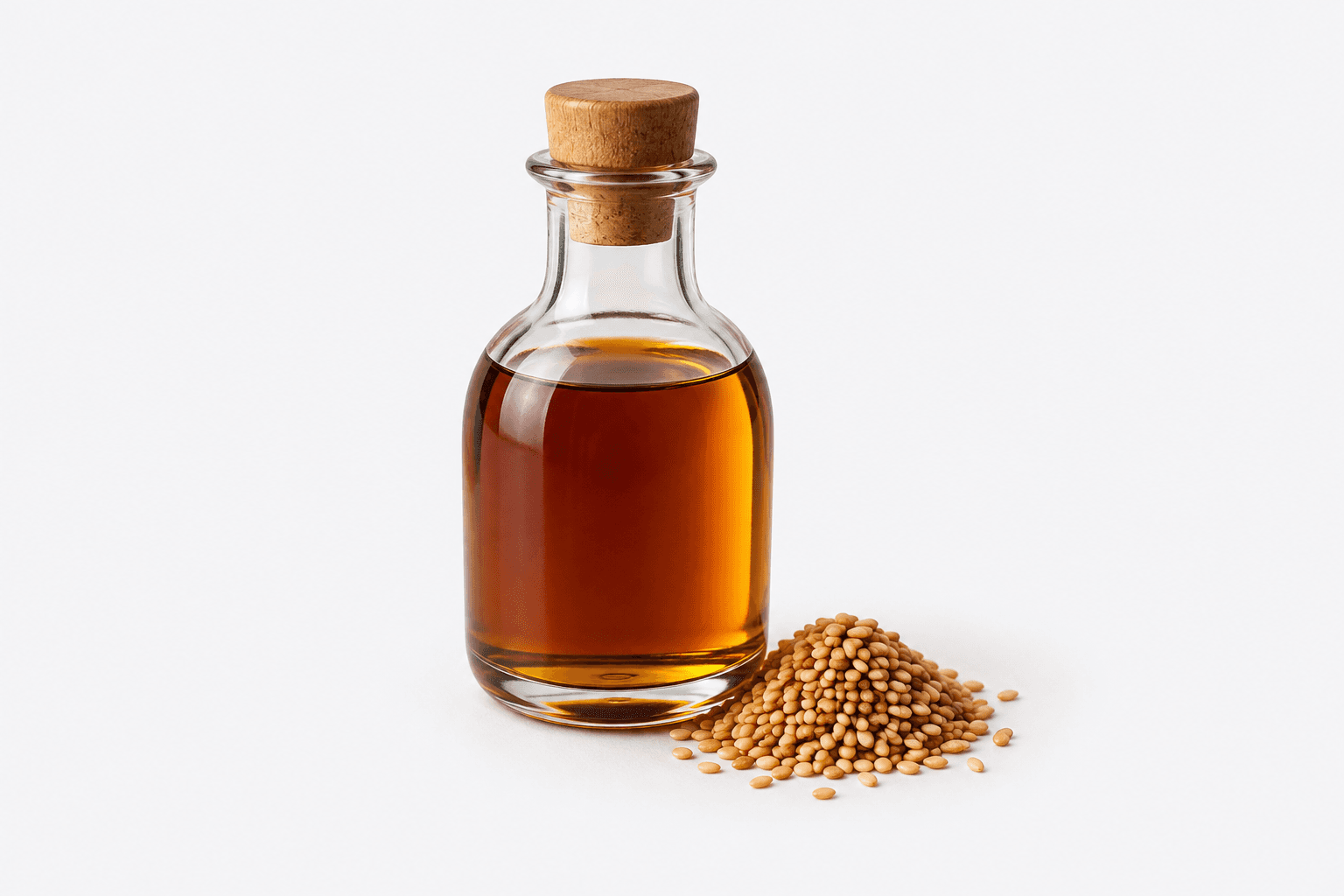
Sesame oil is pressed from toasted sesame seeds. Unlike most vegetable oils, which are pressed without roasting, the aroma created during toasting is very nearly the whole point of this oil. It is therefore used as a finishing oil rather than a cooking medium, and long exposure to high heat drives that aroma off — which is why it goes in at the end, off the heat. It comes from a different plant than perilla oil. Antioxidants formed during toasting make it slower to go rancid than perilla oil, but it still belongs somewhere cool.
Scientific name Sesamum indicum
In Korean cooking, a last drop of sesame oil changes what a dish is. But 'it's good for you' tends to travel alongside it.
The numbers are thin support for that. The fat profile is unremarkable: 14.2 g saturated, 39.7 g monounsaturated, 41.7 g polyunsaturated. Vitamin E is 1.4 mg — a tenth of olive oil's 14.4 mg, a twelfth of canola's 17.5 mg.
Lignans like sesamin and sesamolin get cited as antioxidants. Cell and animal work is plentiful; large human trials with disease endpoints do not exist. This page states that as it is.
There is every reason to use sesame oil. The reason is taste.
Key benefits
- Nutrition data
The fat profile is ordinary — neither bad nor special
Per 100 g, sesame oil holds 14.2 g saturated, 39.7 g monounsaturated and 41.7 g polyunsaturated fat.
For comparison:
Oil Saturated fat Canola 7.4 g Olive 13.8 g Sesame 14.2 g Butter 50.5 g Coconut 82.5 g So on saturated fat, sesame oil sits essentially where olive oil does. Swapping butter for sesame oil helps blood lipids; swapping olive or canola oil for sesame oil has no numerical case.
Most of that 41.7 g of polyunsaturated fat is linoleic acid, an omega-6. Alpha-linolenic acid is 0.3 g — effectively nil. Sesame oil is not an omega-3 source.
- Nutrition data
Vitamin E is far lower than the reputation suggests
'Sesame oil is rich in vitamin E' circulates widely. The USDA figure is 1.4 mg per 100 g.
A teaspoon (4.5 g) gives 0.06 mg — 0.4 % of the 15 mg adult requirement. A handful of nuts (30 g of almonds carries 7.7 mg) is more than a hundredfold ahead.
Vitamin K is 13.6 µg, a quarter of olive oil's 60.2 µg.
The confusion probably comes from the lignans. Sesamolin genuinely slows rancidity in storage, which is why sesame oil keeps reasonably well despite its polyunsaturated load. An oil keeping well on the shelf and an antioxidant effect inside a human body are different claims.
- Not established
The health effects of sesamin and sesamolin are not established
Small trials have looked at sesame lignans against blood pressure, lipids and inflammatory markers. Most run a few dozen participants over a few weeks, and the results disagree.
What can honestly be said:
- There is no large randomised trial with disease endpoints — heart attack, death, cancer.
- Meta-analyses of the small trials exist, but the populations and doses vary so widely that the conclusions are weak.
- Nothing establishes that animal and cell findings transfer to people.
The lignan content of a teaspoon of sesame oil is far below the isolated sesamin doses used in supplement trials. Even if sesamin were shown to work, that would not mean the cooking amount works.
How to eat it well
- Add it off the heat. The aroma compounds are volatile and cook away. If aroma is the whole point, heating erases the point.
- Use another oil for frying. Toasted sesame oil smokes around 175 °C. Canola or a refined oil belongs in the pan.
- Dressed vegetables, bibimbap, a finish on noodles — a teaspoon is enough. More does not scale the aroma up.
- Buy small bottles and finish them. Refrigerate after opening and it lasts longer.
- Perilla oil carries far more alpha-linolenic acid, but goes rancid very fast and must be refrigerated.
How to read the grades
Each benefit carries a label showing how far research on people supports it. Grades differ between items even within the same ingredient.
- Nutrition data
- A fact verifiable from food composition databases or health authorities. This is a different kind of statement from a clinical effect.
- Strong evidence
- Consistently confirmed across randomised controlled trials or meta-analyses.
- Moderate evidence
- Human studies exist, but effect sizes are small or results are mixed.
- Early research
- Cell or animal work, or small preliminary studies.
- Not established
- Commonly claimed, but not confirmed in studies on people.
What to watch out for
- Sesame is a labelled allergen in Korea, the EU and the US. Sesame allergy can be severe, and the allergen persists in the oil.
- A teaspoon is 40 kcal. Two or three free-hand pours while dressing vegetables passes 100 kcal.
- There is no basis for increasing sesame oil for health. The evidence above reaches 'not harmful', not 'beneficial'.
- It is unsuited to frying. The smoke point is low.
- Cheaper bottles are sometimes blended with other oils. Check the origin and the stated content.
Nutrition
Per 100 g, about seven tablespoons. Sesame oil is usually used a teaspoon at a time — 4.5 g, 40 kcal.
Percentages are of the US FDA Daily Value for adults and children 4 and over. National reference intakes differ by sex and age.
Calculate this alongside other ingredients →
Key nutrients
Dishes with this ingredient
Sources
The databases and health authorities this article's nutrition figures and health statements draw on.