Contents
What it is
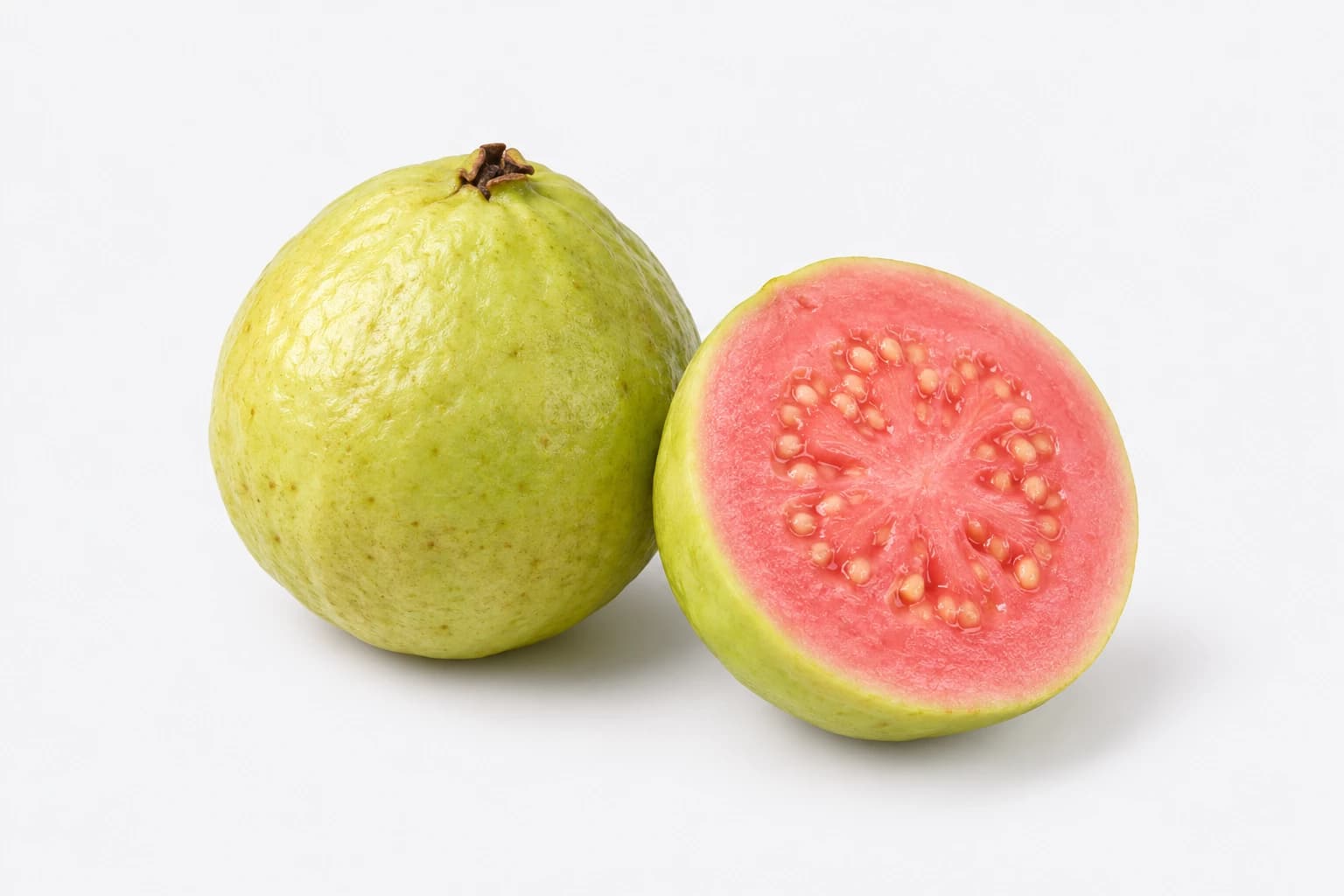
The guava is the fruit of a tree in the myrtle family, native to Central and South America and now grown across the tropics and subtropics. It is eaten skin and all, and the flesh is white or pink depending on variety. Inside sit many very hard seeds that crunch between the teeth; they can be swallowed, or strained out to use the pulp alone. The aroma is powerful enough to fill a room once the fruit ripens. Guavas are eaten fresh and widely made into juice and jam, and the leaves are dried for tea.
Scientific name Psidium guajava
Guava carries 228 mg of vitamin C per 100 g — more than four times an orange.
In 2024 a trial tested what that vitamin C can actually do. Vitamin C raises the absorption of iron from plants. So: pair a vitamin C-rich fruit with an iron-containing meal, and anemia should fall.
2024, The Journal of Nutrition. Two hundred children aged 6 to 10 in rural Haryana, India (46% anemic, 71% iron-deficient) were split two ways and fed through the school meal programme for seven months.
- Control — a mungbean dal meal (3.0 mg iron; vitamin C to iron molar ratio about 0.5:1)
- Guava arm — the same dal with fresh guava alongside (3.2 mg iron; about 170 mg vitamin C; ratio about 18:1)
The results have to be read in order.
- Body iron stores, the primary outcome, did not rise significantly. Effect 0.65 mg/kg body weight, 95% CI −0.34 to 1.63, p=0.197
- Hemoglobin rose 3.7 g/L more (p=0.001)
- Anemia prevalence fell 51% more (p=0.022)
- Iron-deficiency anemia fell 56%, but at p=0.087 it did not clear the threshold
The paper's own title states this — it reduced anemia and increased hemoglobin, but not iron stores.
Key benefits
- Moderate evidence
The vitamin C helped iron absorption — but did not fill the stores
[1]2024, The Journal of Nutrition.
- 200 schoolchildren aged 6 to 10 in rural Haryana, India
- At baseline, 46% anemic and 71% iron-deficient
- Randomised controlled, seven months, served under supervision every school day
- Both arms got mungbean dal; one also got fresh guava
Control Guava arm Iron 3.0 mg 3.2 mg Vitamin C — about 170 mg Vitamin C to iron molar ratio about 0.5:1 about 18:1 The results:
Outcome Result Body iron stores (primary) 0.65 mg/kg, 95% CI −0.34 to 1.63, p=0.197 — not significant Hemoglobin 3.7 g/L greater rise (95% CI 1.6 to 5.6, p=0.001) Anemia prevalence 51% greater fall (95% CI −74 to −10, p=0.022) Iron-deficiency anemia 56% fall, p=0.087 — not significant The effects were more pronounced in children who were iron deficient at the start.
Start with the strengths. Two hundred children over seven months is not short, and because the meals were served under supervision at school, whether they were actually eaten is not in doubt. Compliance is the commonest weakness in diet research and this design solved it. The comparison is also well set: iron was 3.0 against 3.2 mg, almost identical, and the only thing that differed was vitamin C. So you can say what did the work.
But the primary outcome was missed.
Iron stores and hemoglobin are different things. Hemoglobin is how well blood carries oxygen right now; iron stores are the reserve the body has banked. This trial raised the first and did not fill the second.
The paper's conclusion states the difference precisely — absorbed iron did increase, but not by enough to also raise body iron stores.
Why that matters. With the stores still empty, children can slide back into anemia once the feeding programme ends. A rise in hemoglobin is not the same as a problem solved.
And this trial does not transfer whole to another table.
- The participants were children in a region where iron deficiency was widespread — 71% of them. It is not a basis for expecting the same in someone who is not short of iron
- It was paired with one specific iron source, mungbean dal, at every meal
- The guava supplied about 170 mg of vitamin C, roughly 75 g of fresh fruit
The honest conclusion:
- Pairing a vitamin C-rich fruit with a plant-iron meal raises absorption — that is what this trial supports
- But iron stores, the primary outcome, did not move
- It is a finding about people who are iron deficient
- The grade is "moderate". The design is good, but it missed its primary outcome and the population is specific
- None of this is unique to guava. Any fruit rich in vitamin C works in the same direction
- Nutrition data
228 mg of vitamin C — among the highest of any fruit
Per 100 g of raw guava:
- Vitamin C 228 mg
- Fibre 5.4 g — very high for a fruit
- Lycopene 5,200 µg
- Potassium 417 mg, folate 49 µg, magnesium 22 mg
- 68 kcal, carbohydrate 14.3 g, sugar 8.92 g
- Protein 2.55 g, fat 0.95 g, sodium 2 mg
- Beta-carotene 374 µg, vitamin A 31 µg RAE, copper 0.23 mg
Set the 228 mg against other fruit:
Fruit Vitamin C (100 g) Guava 228 mg Kiwi 92.7 mg Strawberry 58.8 mg Orange 53.2 mg Mango 36.4 mg Apple 4.6 mg Against an adult requirement of around 100 mg, one medium fruit (about 55 g) already clears the day.
The 5.4 g of fibre deserves attention too. An apple holds 2.4 g and a mango 1.6 g. Much of that fibre sits in and around the seeds, which is why straining it into juice drops the figure sharply.
Lycopene at 5,200 µg is higher than raw tomato, which holds about 2,570 µg per 100 g. The pink flesh is that pigment; white-fleshed varieties have almost none.
There is no daily value for lycopene, and this site does not print a percentage where no reference exists. What has been confirmed in people from eating lycopene amounts to what is written in the tomato entry, and no more.
Sugar at 8.92 g is low among fruits — mango holds 13.7 g, banana 12.2 g. With 68 kcal and 5.4 g of fibre alongside, the glucose rise is slower than in fruit carrying similar sugar.
Choosing. As it ripens the smell strengthens and the skin turns from green towards yellow. A slight give under a fingertip is the moment to eat it. Firm ones ripen at room temperature within days.
Eat the skin. The vitamin C and fibre concentrate in the skin and just beneath it. Wash it well and slice it whole.
The seeds are hard. Some varieties are hard enough to hurt a tooth, so scoop out the centre for children or fragile teeth — accepting that you lose fibre with it.
- Not established
The blood sugar and diarrhoea claims are ones this site could not verify
Two claims attach to guava regularly. Neither has confirmed human evidence behind it.
First, that it lowers blood sugar.
A 2019 double-blind study found that guava fruit extracted with supercritical carbon dioxide inhibited intestinal glucose absorption.
But what that study used was an extract, not the fruit. It is the same problem set out in this site's celery entry — a result from an extract does not carry across to eating the food. Extraction selects and concentrates particular compounds, and what arrives when you eat a fruit differs in both amount and composition.
Claims about guava leaf tea need more care still. Guava leaf is a different material from the fruit, and this entry is about the fruit.
Second, that it stops diarrhoea.
This is a traditional use, but this site could not find a clinical trial that fed guava fruit, measured diarrhoea and compared against a control.
Third, a claim about platelets.
A 2016 randomised trial in healthy volunteers examined the platelet-inhibiting effect of guava juice. But that is platelet aggregation, a laboratory measure, not an outcome like bleeding or clotting, and the study was small. Nor does the direction only point one way — if you take antiplatelet or anticoagulant medication, this is a reason for care rather than reassurance.
To summarise:
- Confirmed: pairing vitamin C-rich guava with an iron-containing meal reduced anemia (but not the primary outcome, iron stores)
- Not confirmed: lowering blood sugar, improving diarrhoea
- Confirmed by composition: vitamin C 228 mg, fibre 5.4 g, lycopene 5,200 µg
Containing a lot of something and improving something when a person eats it are separate claims. This site marks them at different grades.
How to eat it well
- Eat the skin. The vitamin C and fibre concentrate in it and just beneath.
- One medium fruit is about 55 g and on its own clears an adult's vitamin C for the day.
- Pair it with an iron-containing meal to favour absorption of plant iron — beans, greens, whole grains.
- Do not juice it. Straining the seeds removes much of the 5.4 g of fibre.
- The seeds are hard. Scoop the centre out for fragile teeth, accepting the loss of fibre.
- Ripen firm fruit at room temperature. Strong smell and a slight give mean it is ready.
- Refrigerate after it ripens.
- The lycopene is in pink-fleshed varieties. White flesh has almost none.
How to read the grades
Each benefit carries a label showing how far research on people supports it. Grades differ between items even within the same ingredient.
- Nutrition data
- A fact verifiable from food composition databases or health authorities. This is a different kind of statement from a clinical effect.
- Strong evidence
- Consistently confirmed across randomised controlled trials or meta-analyses.
- Moderate evidence
- Human studies exist, but effect sizes are small or results are mixed.
- Early research
- Cell or animal work, or small preliminary studies.
- Not established
- Commonly claimed, but not confirmed in studies on people.
What to watch out for
- Iron stores, the anemia trial's primary outcome, did not rise significantly (p=0.197). What rose were hemoglobin and the anemia rate.
- That trial studied 6-to-10-year-olds in a region where 71% were iron deficient. It is not a basis for applying the result to someone who is not short of iron.
- The fall in iron-deficiency anemia did not clear the threshold, at p=0.087.
- The blood sugar study used a supercritical extract, not the fruit.
- No human trial was found behind the diarrhoea claim.
- If you take antiplatelet or anticoagulant medication, a small trial found platelet inhibition — talk to your clinician.
- Guava leaf and leaf tea are different material from the fruit. This entry is about the fruit.
Nutrition
Per 100 g of raw guava. A medium fruit is about 55 g, so the figures below are a little under two of them. The values are for the fruit eaten with its skin.
- Calories
- 68 kcal3%
- Vitamin C
- 228 mg253%
- Fiber
- 5.4 g19%
- Lycopene
- 5,200 µg
- Potassium
- 417 mg9%
- Folate
- 49 µg12%
- Carbohydrates
- 14.3 g5%
- Sugars
- 8.92 g
- Protein
- 2.55 g5%
- Fat
- 0.95 g1%
- Magnesium
- 22 mg5%
- Calcium
- 18 mg1%
- Phosphorus
- 40 mg3%
- Beta-carotene
- 374 µg
- Vitamin A
- 31 µg3%
- Copper
- 0.23 mg26%
- Iron
- 0.26 mg1%
- Sodium
- 2 mg<1%
Percentages are of the US FDA Daily Value for adults and children 4 and over. National reference intakes differ by sex and age.
Calculate this alongside other ingredients →
Key nutrients
By health concern
Dishes with this ingredient
Sources
The databases and health authorities this article's nutrition figures and health statements draw on.
- 1Vitamin C-Rich Guava Consumed with Mungbean Dal Reduces Anemia and Increases Hemoglobin but not Iron Stores: A Randomized Controlled Trial of Food-to-Food Fortification in Indian ChildrenClinical trialRani V, et al. The Journal of Nutrition 2024PMID 39481541
- 2USDA FoodData CentralFood composition database
- 3PubMedResearch literature
- 4World Health Organization · Healthy dietHealth authority