Contents
What it is
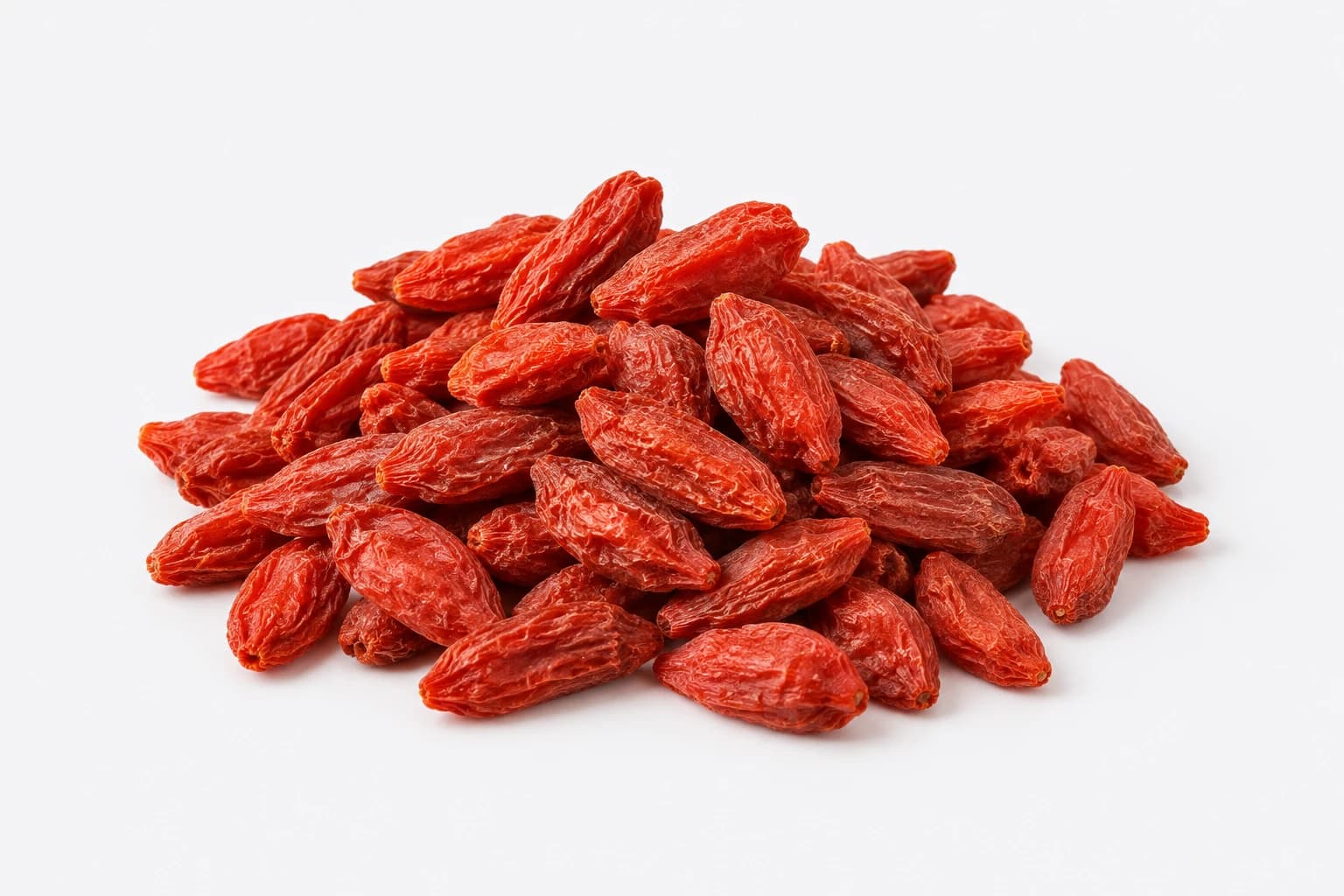
The goji berry is the fruit of a shrub in the nightshade family — elongated, orange-red berries. It is native to northwestern China and has long been used in Korea and China as both medicine and food. Fresh berries bruise easily and travel badly, so virtually the entire crop is dried. Dried, they are chewy like a raisin, mildly sweet with a slightly bitter finish. They are steeped as tea, added to porridge and medicinal dishes, or simply eaten by the handful. Anyone taking warfarin should be careful, as interactions have been reported.
Scientific name Lycium barbarum
Goji berries have long carried the claim of being good for the eyes. Two trials have tested that in people.
2021, Nutrients. Twenty-seven healthy adults aged 45 to 65 were split two ways for 90 days.
- Goji arm — 28 g of dried goji berries, five times a week
- Comparator arm — a supplement of 6 mg lutein and 4 mg zeaxanthin
The results:
- Macular pigment optical density (MPOD) rose in the goji arm — p=0.029 at 0.25 retinal eccentricity, p=0.044 at 1.75
- Nothing changed in the supplement arm
- Skin carotenoids rose in the goji arm at day 45 and day 90 (p=0.025, p=0.006)
Stop there and it is good news. But the design has to be looked at.
- Twenty-seven people. Split in two, that is thirteen or fourteen an arm
- No masking. Dried berries and a capsule are told apart by anyone
- No placebo arm. The comparison is not against nothing but against another supplement
- The title itself says "pilot trial"
And macular pigment optical density is not eyesight. It is a surrogate for how much pigment has accumulated in the macula, and this trial did not measure what happened to anyone's vision.
Key benefits
- Early research
Macular pigment rose — but 27 people, no masking, and not eyesight
[1][2]2021, Nutrients — University of California, Davis.
- 27 healthy adults aged 45 to 65
- Randomised, unmasked, parallel-arm, 90 days
- Goji arm: 28 g of dried goji berries, five times a week
- Comparator: a supplement with 6 mg lutein and 4 mg zeaxanthin
Outcome Goji arm Supplement arm MPOD at 0.25 eccentricity rose (p=0.029) no change MPOD at 1.75 eccentricity rose (p=0.044) no change Skin carotenoids, day 45 rose (p=0.025) no change Skin carotenoids, day 90 rose (p=0.006) no change Start with what is interesting. The arm eating food went up and the arm taking the supplement did not — for pigments of the same family. That points towards the food matrix mattering for absorption, which is consistent with other entries on this site.
But how much weight this result will bear has to be stated precisely.
First, 27 people. Split in two, that is thirteen or fourteen an arm. At that size, separating a real difference from a chance one is hard.
Second, no masking. The paper says "unmasked" itself. A handful of dried berries and a capsule are distinguishable to participant and researcher alike. MPOD is often measured by a psychophysical method in which the participant presses a button in response to light, so knowing what you are taking has room to leak into the result.
Third, the comparator is not a placebo. It is a supplement arm. So what this trial showed is not "goji beats taking nothing" but "goji raised MPOD better than this supplement did".
Fourth, MPOD is not eyesight. It is a surrogate used as a risk marker for macular degeneration. This trial measured neither vision nor the occurrence of macular degeneration. The paper's closing line is that it "may help prevent or delay the development of AMD" — a sentence that jumps from a surrogate in 27 people over 90 days to preventing disease.
2011, Optometry and Vision Science also carries a randomised trial of goji against macular characteristics and plasma antioxidants. Same direction, also small.
The honest conclusion:
- Eating dried goji berries regularly may increase the pigment that accumulates in the macula — that is as far as this trial reaches
- It does not mean you see better, or that macular degeneration is prevented
- Twenty-seven people, unmasked, a pilot
- The grade is "early research"
- If eye health is the goal, vegetables rich in lutein and zeaxanthin carry thicker evidence — see the kale and spinach entries
- Nutrition data
This is a dried fruit — 45.6 g of sugar, and 298 mg of sodium
Per 100 g of dried goji berries:
- 349 kcal, carbohydrate 77.1 g, sugar 45.6 g, fibre 13.0 g
- Protein 14.3 g — very high for a dried fruit
- Fat 0.39 g
- Iron 6.8 mg, calcium 190 mg
- Vitamin C 48.4 mg
- Sodium 298 mg
What is missing from this table has to be said first.
The USDA record for this food is sparse. Magnesium, potassium, zinc and vitamin A are among the blanks. That does not mean they are absent — it means no measured value is in this record.
And the most ironic blank is zeaxanthin. The whole logic of the trial above rests on goji's zeaxanthin, and the official composition table for this food carries no zeaxanthin figure at all. So this site does not print one. Pulling a number from elsewhere would mix the table's sources, and at that moment the table stops being trustworthy.
Now the figures that are there.
The 45.6 g of sugar is the first number to look at. It is a dried fruit, so of course — water leaves and sugar concentrates. The trial's 28 g a day carries about 12.8 g of sugar and 98 kcal.
100 g 28 g a day (trial dose) Energy 349 kcal 98 kcal Sugar 45.6 g 12.8 g Fibre 13.0 g 3.6 g Iron 6.8 mg 1.9 mg Sodium 298 mg 83 mg Sodium at 298 mg stands out among dried fruits. Raisins hold 11 mg and prunes about 2 mg. At 298 mg per 100 g this is 13% of the daily value. Processing may have something to do with it, but this table alone cannot say why.
Fibre at 13.0 g and protein at 14.3 g are high for a dried fruit, because the seeds are eaten whole.
Iron at 6.8 mg also looks high. But it is plant iron, and as set out in this site's guava and amaranth entries, containing a lot and absorbing it are different things.
How to eat them. Chew them as they are, soak them into porridge or rice, or steep them as tea. Steeping extracts only what dissolves — the fibre and protein stay in the solids.
Store sealed and cool. Damp makes them clump and invites mould. For long keeping, freeze them.
- Not established
Claims about vision, immunity and the liver are unverified — and a warfarin warning
Many claims attach to goji berries. Only the macular pigment finding above has been confirmed in people.
"It improves eyesight." As set out above, what the trial measured is how much pigment has built up in the macula, not vision. This site could not find a trial that fed goji berries, measured eyesight and compared against a control.
"It boosts immunity." There is a great deal of research on goji polysaccharides acting on immune cells in the laboratory. An action observed in cells and animals is a different claim from an outcome in a person who ate the food. This site did not find results such as fewer infections in people.
"It protects the liver." A traditional use with animal research behind it. Not confirmed in people.
And there is an interaction that has to be written down.
If you take warfarin, be careful with goji berries.
There are several case reports of a rising INR and bleeding after drinking goji juice or tea. The mechanism is not fully established, but an effect on the enzymes that metabolise warfarin has been proposed.
This is not something a composition table can show you. And it is a different route from the vitamin K issue set out in this site's cheonggukjang and natto entries. If you are on warfarin, talk to your clinician before starting goji.
Caution has also been reported for people on blood pressure or blood glucose medication.
It is not recommended in pregnancy. There is a traditional record linking it to uterine contraction, and no trial has established safety.
To summarise:
- Confirmed: 28 g five times a week for 90 days raised macular pigment (27 people, unmasked, a pilot)
- Not confirmed: improved vision, boosted immunity, liver protection
- To be careful about: case reports of interaction with warfarin, use in pregnancy
How to eat it well
- The trial's dose was 28 g a day, five times a week — roughly a handful, 98 kcal and 12.8 g of sugar.
- It is a dried fruit, so the sugar is concentrated. If you manage blood glucose, count it.
- Chew them plain, soak them into porridge or rice, or steep them as tea.
- Steeping leaves the fibre and protein in the solids. Eat those too and you get more.
- Sodium is 298 mg per 100 g, high among dried fruits.
- Keep them sealed and cool. Damp makes them clump and mould.
- Freeze them for long keeping.
- If eye health is the goal, the evidence behind lutein and zeaxanthin from kale and spinach is thicker.
How to read the grades
Each benefit carries a label showing how far research on people supports it. Grades differ between items even within the same ingredient.
- Nutrition data
- A fact verifiable from food composition databases or health authorities. This is a different kind of statement from a clinical effect.
- Strong evidence
- Consistently confirmed across randomised controlled trials or meta-analyses.
- Moderate evidence
- Human studies exist, but effect sizes are small or results are mixed.
- Early research
- Cell or animal work, or small preliminary studies.
- Not established
- Commonly claimed, but not confirmed in studies on people.
What to watch out for
- If you take warfarin, talk to your clinician. Rising INR and bleeding have been reported in case reports.
- Possible interaction with blood pressure and blood glucose medication has been reported.
- Not recommended in pregnancy. No trial has established safety.
- The macular pigment trial had 27 people, was unmasked and was a pilot, and the comparator was a supplement, not a placebo.
- What it measured was pigment accumulated in the macula, not eyesight.
- Sugar is 45.6 g per 100 g. It is dried, so it is concentrated.
- Sodium is 298 mg per 100 g, high for a dried fruit.
- Many entries are missing from the composition table. No zeaxanthin figure is recorded, so this site does not print one.
- Claims about immunity and the liver are unconfirmed in people.
Nutrition
Per 100 g of dried goji berries. The 28 g a day used in the trial below is roughly a handful, 28% of this table. The USDA entry for this food is sparse, so many nutrients are missing — not absent, simply not measured in the record.
- Calories
- 349 kcal17%
- Carbohydrates
- 77.1 g28%
- Sugars
- 45.6 g
- Fiber
- 13.0 g46%
- Protein
- 14.3 g29%
- Fat
- 0.39 g<1%
- Iron
- 6.8 mg38%
- Calcium
- 190 mg15%
- Vitamin C
- 48.4 mg54%
- Sodium
- 298 mg13%
Percentages are of the US FDA Daily Value for adults and children 4 and over. National reference intakes differ by sex and age.
Calculate this alongside other ingredients →
Key nutrients
Dishes with this ingredient
Sources
The databases and health authorities this article's nutrition figures and health statements draw on.
- 1Goji Berry Intake Increases Macular Pigment Optical Density in Healthy Adults: A Randomized Pilot TrialClinical trialLi X, et al. Nutrients 2021PMID 34959963
- 2Goji berry effects on macular characteristics and plasma antioxidant levelsClinical trialBucheli P, et al. Optometry and Vision Science 2011PMID 21169874
- 3USDA FoodData CentralFood composition database
- 4PubMedResearch literature