Contents
What it is
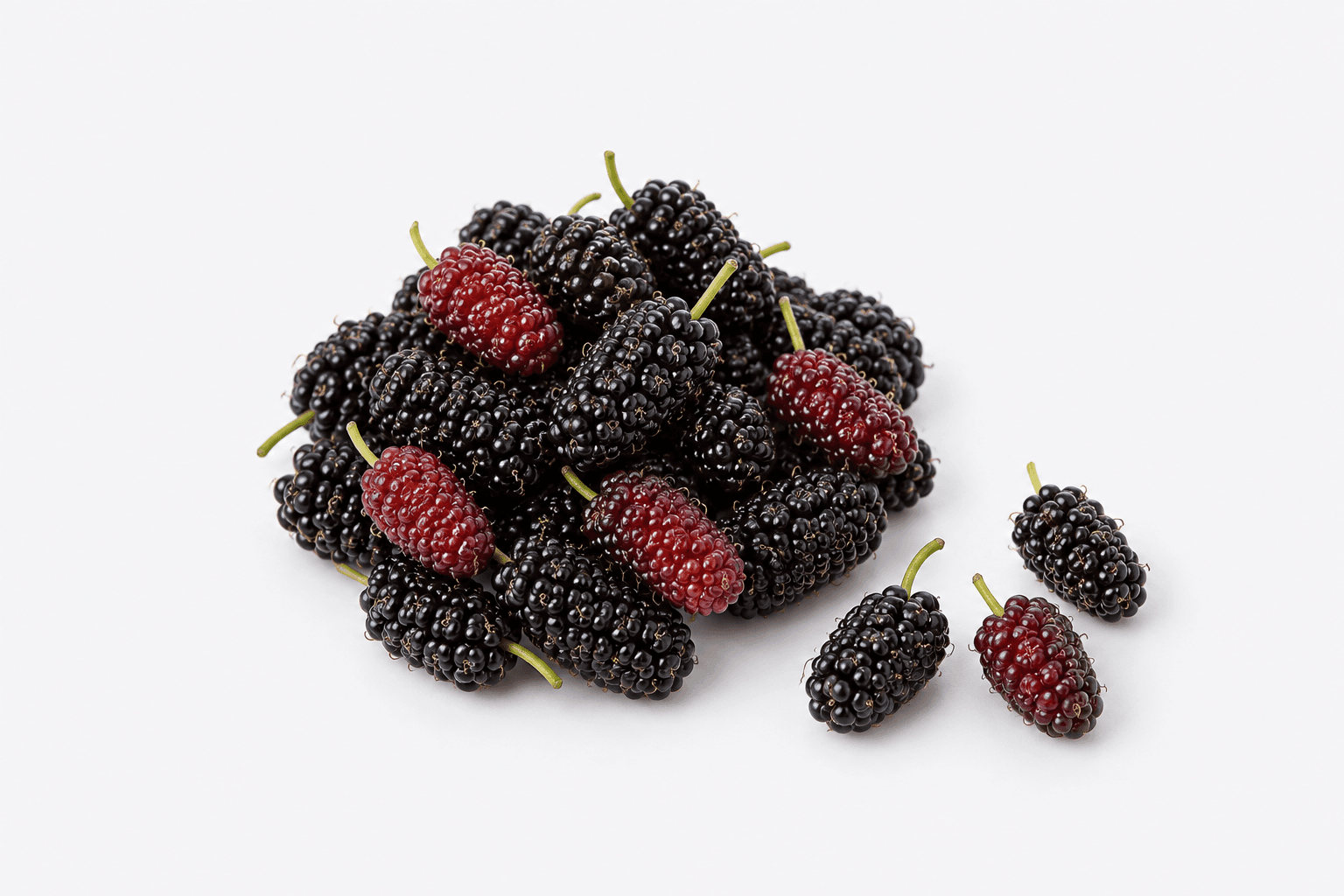
The mulberry is the fruit of the mulberry tree — a tree planted above all for its leaves, to feed silkworms, so in Korea the fruit was long closer to a by-product of sericulture. The tree is native to East Asia. The fruit is a cluster of small drupelets forming an elongated berry, which makes it look like a raspberry although the two are unrelated. Ripe, it turns deep purple-black and is so soft and juicy that it bursts as you pick it and stains hands and clothes deeply. It travels badly, so fresh fruit is uncommon and most is pressed into juice or made into jam and liqueur.
Scientific name Morus
Mulberries are the fruit of the mulberry tree. They arrive briefly in early summer and, being full of water, go soft almost at once.
What stands out is 36.4 mg of vitamin C — below strawberry (58.8 mg) but close to four times blueberry (9.7 mg). Iron at 1.85 mg is also high for a fruit.
The clinical evidence needs careful reading.
A 2017 meta-analysis in the European Journal of Nutrition pooled 13 randomised trials rated high quality by Jadad score. The results split cleanly.
- Post-meal glucose fell — 30 min −1.04, 60 min −0.87, 90 min −0.55 (mmol/L)
- Fasting glucose, HbA1c and HOMA-IR showed no difference
- Total cholesterol, triglycerides, LDL and HDL showed no difference either
And one thing must be flagged: what the analysis examined was "products derived from Morus alba", a large share of which are extracts of the leaf. That is not the same as eating the berries.
Key benefits
- Early research
Only post-meal glucose moved — and mostly it was the leaf, not the fruit
[1]2017, European Journal of Nutrition. The authors searched PubMed, PubMed Central, ScienceDirect, SciSearch and Thai databases, including 13 randomised controlled trials rated high quality by Jadad score.
What fell:
- Glucose at 30 min — MD −1.04 (95% CI −1.36 to −0.73)
- Glucose at 60 min — MD −0.87 (95% CI −1.27 to −0.48)
- Glucose at 90 min — MD −0.55 (95% CI −0.87 to −0.22)
All three intervals exclude zero. The effect shrinking over time is consistent too — 1.04 → 0.87 → 0.55.
What did not move:
- Fasting blood sugar — no difference
- HbA1c — no difference
- HOMA-IR (insulin resistance) — no difference
- Total cholesterol, triglycerides, LDL, HDL — no difference on any of the four
No serious adverse effects were found in either arm.
How to read this.
First, post-meal glucose is about that one meal. HbA1c reflects average glucose over the past two to three months. A lower post-meal peak without a change in HbA1c can mean the curve of one meal shifted while the overall glucose burden did not. It is also possible the trials were too short for HbA1c to move.
Second, lipids did not move at all — not one of the four. There is no support here for "mulberry is good for your blood vessels".
Third, and most important — the authors' phrase is "products derived from M. alba". Far more of that research used the leaf than the fruit.
Mulberry leaf contains 1-deoxynojirimycin (DNJ), which inhibits alpha-glucosidase, the gut enzyme that breaks down carbohydrate, slowing how fast sugar is absorbed. That is the same class of mechanism as the diabetes drug acarbose. A pattern of lower post-meal glucose with unchanged fasting glucose fits that mechanism exactly.
But DNJ is a leaf compound, and evidence that the berry delivers it in comparable amounts is a separate question.
The honest conclusion:
- That mulberry leaf tea or extract lowers the post-meal glucose peak has 13 randomised trials behind it
- Fasting glucose, HbA1c, insulin resistance and lipids did not change
- Expecting the same from eating the berries goes past the evidence
- The authors themselves wrote that "large-scale RCTs would be informative"
- Nutrition data
36.4 mg of vitamin C and 1.85 mg of iron — inside 43 kcal
Per 100 g of raw mulberries:
- 43 kcal, protein 1.44 g, fat 0.39 g
- Of 9.8 g of carbohydrate, 1.7 g is fibre, sugar 8.1 g
- Vitamin C 36.4 mg — 40% of the requirement
- Iron 1.85 mg — high among fruit
- Vitamin K 7.8 µg, potassium 194 mg, calcium 39 mg
- Riboflavin 0.101 mg, vitamin E 0.87 mg
43 kcal is low even among berries — below blueberry (57 kcal) and grape (69 kcal), a little above strawberry (32 kcal).
The 36.4 mg of vitamin C stands out. A 70 g handful gives 25 mg, 28% of the requirement.
1.85 mg of iron is high for fruit — more than four times strawberry's 0.41 mg. It is non-haem iron, so absorption is low — but mulberry carries vitamin C alongside it, so the fruit supplies its own absorption helper.
The purple is anthocyanin, the same family of pigment as in blueberry and aronia. It does show antioxidant activity in a test tube, but this site did not identify evidence that mulberry anthocyanin changes a health outcome in people.
8.1 g of sugar is moderate for fruit. A 70 g handful is 5.7 g.
Keeping is this fruit's weakness. Thin-skinned and full of water, it starts softening the moment it is picked — which is why you rarely see it in shops. It travels mostly frozen, or as juice, jam or liqueur.
Processed forms are different foods.
- Frozen — composition largely holds. It goes soft on thawing
- Juice and syrup — sugar is added. An entirely different food from the table above
- Jam — more sugar again
It stains hands and clothes. Anthocyanin does not wash out easily.
- Not established
"Good for the eyes", "stops hair going grey" — no evidence was identified
This entry sorts through claims that are not established.
Several traditional claims attach to mulberry: "good for the eyes", "prevents greying", "tonifies the kidneys". It has a documented history of use in traditional East Asian medicine.
This site's position should be clear. That there is a traditional use is a fact, and that fact is not in dispute. But this site counts as evidence only whether an outcome changed in a trial in people.
First, "good for the eyes". Anthocyanin is usually the reason given. But the evidence linking anthocyanin to visual function mostly concerns bilberry extract, and even there the results are inconsistent. This site found no randomised trial in which feeding people mulberry changed visual function.
Second, "stops hair going grey". Grey hair comes from declining melanocyte function in the follicle, driven mainly by age and genetics. There is no human evidence that a food reverses it.
Third, the meta-analysis above did not address these claims at all. It looked at glucose and lipids, and lipids did not move.
Does that mean there is no reason to eat mulberries? No. A fruit with 36.4 mg of vitamin C and 1.85 mg of iron in 43 kcal needs no further reason. That its season is short and it is hard to find is itself a reason to eat it when you can.
But that is eating fruit, not a benefit — and this site keeps the two apart.
One more thing — take care if you are on diabetes medication. If mulberry leaf products inhibit alpha-glucosidase, they overlap with drugs of the same class (acarbose, voglibose). Discuss the risk of hypoglycaemia with your doctor.
How to eat it well
- Eat them as soon as they are picked. They are full of water and go soft fast.
- Rinse briefly. Left soaking, they turn to mush and lose colour.
- Freezing keeps them best. Spread them in one layer to freeze, then bag them.
- On yoghurt or oats they sweeten without sugar.
- For the iron, the fruit's own vitamin C already helps, so it needs no pairing.
- Mulberry syrup and juice are sugar-added preparations. Do not count them as fruit.
- Mulberry leaf tea is a different food. The glucose evidence above is mostly about the leaf.
- It stains hands and boards. Keep it off pale cutting boards.
How to read the grades
Each benefit carries a label showing how far research on people supports it. Grades differ between items even within the same ingredient.
- Nutrition data
- A fact verifiable from food composition databases or health authorities. This is a different kind of statement from a clinical effect.
- Strong evidence
- Consistently confirmed across randomised controlled trials or meta-analyses.
- Moderate evidence
- Human studies exist, but effect sizes are small or results are mixed.
- Early research
- Cell or animal work, or small preliminary studies.
- Not established
- Commonly claimed, but not confirmed in studies on people.
What to watch out for
- Beyond post-meal glucose there is no evidence. Fasting glucose, HbA1c, HOMA-IR and all four lipid measures showed no difference.
- The meta-analysis examined "products derived from M. alba", a large share of them leaf extracts. That is not the same as eating the berries.
- If you take diabetes medication, mulberry leaf products share a mechanism with alpha-glucosidase inhibitors such as acarbose. Speak to your doctor.
- Claims about eyesight and grey hair have no human evidence this site could identify.
- Juice, syrup and jam are sugar-added preparations and differ from the table above.
- On warfarin, note 7.8 µg of vitamin K per 100 g. Not a large amount, but do not increase it sharply.
- Unripe white berries and the tree's white latex can irritate the gut. Eat them ripe.
- The antioxidant effect of anthocyanin is at test-tube level and is not established in people.
Nutrition
Per 100 g of raw mulberries. A handful is roughly 70 g.
- Calories
- 43 kcal2%
- Protein
- 1.44 g3%
- Carbohydrates
- 9.8 g4%
- Fiber
- 1.7 g6%
- Sugars
- 8.1 g
- Vitamin C
- 36.4 mg40%
- Iron
- 1.85 mg10%
- Vitamin K
- 7.8 µg7%
- Potassium
- 194 mg4%
- Calcium
- 39 mg3%
- Vitamin B2
- 0.101 mg8%
- Vitamin E
- 0.87 mg6%
Percentages are of the US FDA Daily Value for adults and children 4 and over. National reference intakes differ by sex and age.
Calculate this alongside other ingredients →
Key nutrients
By health concern
Sources
The databases and health authorities this article's nutrition figures and health statements draw on.