Contents
What it is
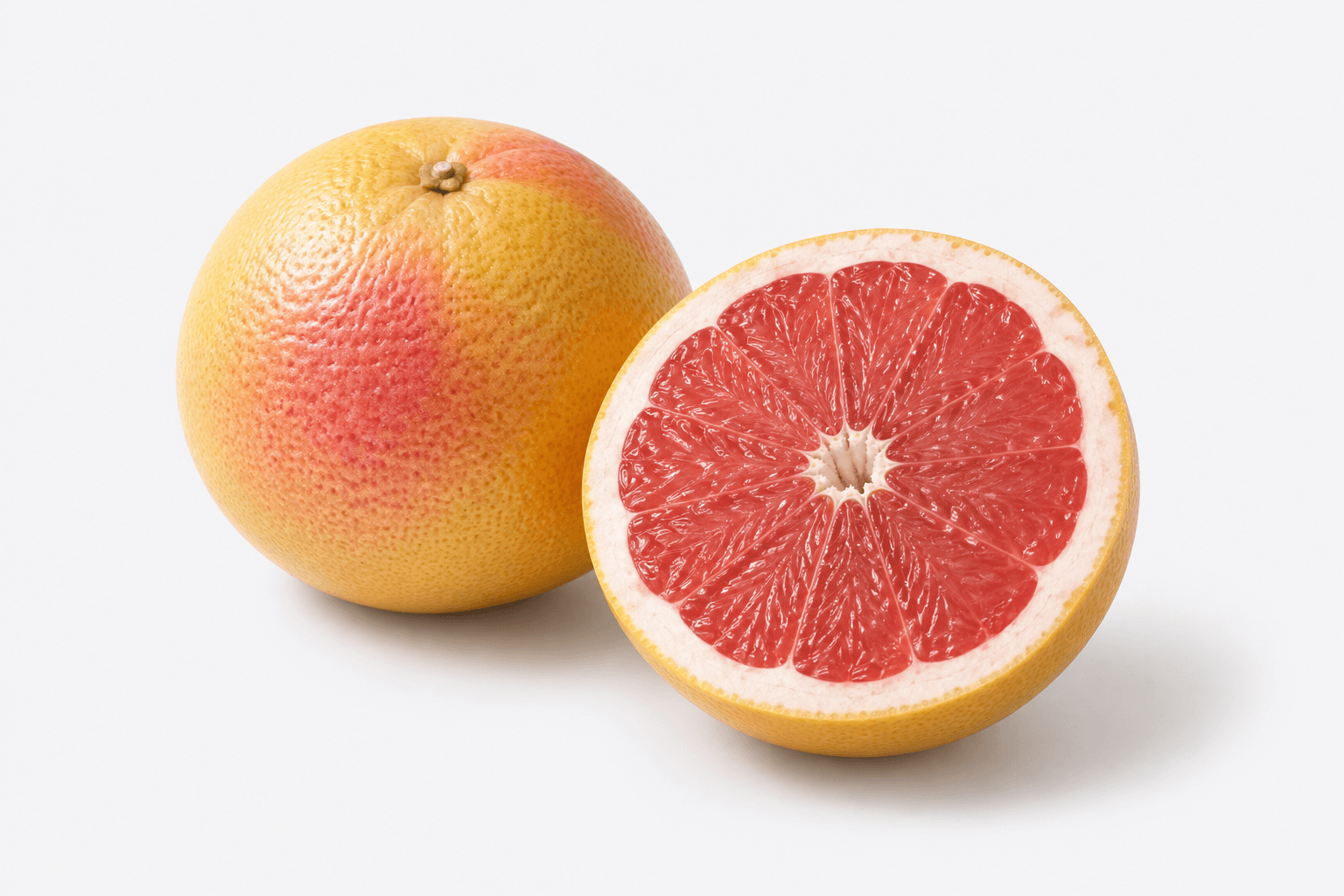
The grapefruit is a citrus thought to have arisen as a natural cross between the pomelo and the orange, first recorded in Barbados in the eighteenth century. The English name comes from the way the fruit hangs in clusters on the tree, like grapes. What most sets it apart from other citrus is a pronounced bitterness, which comes from naringin. It is known to interfere with the metabolism of a number of medicines, so anyone on medication should check the leaflet before making a habit of it.
Scientific name Citrus paradisi
This page does not lead with benefits. Grapefruit is the textbook food that interferes with medication, and that is the first thing to know about it.
Furanocoumarins in grapefruit irreversibly inhibit CYP3A4 in the wall of the small intestine. Many drugs are broken down by that enzyme before reaching the bloodstream; block it and the same dose produces higher blood levels than intended.
Three features matter.
- Small amounts are enough. A single glass, or one fruit, has been reported to do it.
- It lasts. Because the inhibition is irreversible, the body has to make new enzyme — so the effect runs more than a day. Spacing the fruit away from the pill does not help.
- It depends on the drug. Plenty of medicines are unaffected.
Nutritionally grapefruit is a good fruit: 42 kcal, 31.2 mg of vitamin C, and 1,420 µg of lycopene in the red varieties. But that conversation comes after the medication check.
Key benefits
- Strong evidence
Drug interaction — why this is the first item on the page
[1]This is not a benefit but a confirmed risk.
A 2013 review in CMAJ set out the problem. Grapefruit's furanocoumarins inhibit intestinal CYP3A4, so drugs metabolised by that enzyme are absorbed in greater quantity.
Classes known to be affected include:
- Some statins (simvastatin, lovastatin) — raising the risk of muscle injury
- Some calcium channel blockers (blood pressure)
- Some immunosuppressants (tacrolimus, ciclosporin) — important after transplant
- Some antiarrhythmics, some sedatives and anxiolytics, some cancer drugs
Three qualifiers belong with that list.
- Drugs in the same class differ. Several statins are unaffected (pravastatin, rosuvastatin among them). 'I take a statin so no grapefruit' is too coarse to be right.
- The direction can reverse. Grapefruit also blocks a transporter that helps absorption, and some combinations end up with less drug effect.
- Do not decide from this list. The answer is in your medicine's leaflet and with your pharmacist or doctor.
The worst response is stopping medication on your own. Dropping the grapefruit is always the safer side.
- Nutrition data
Half a fruit gives a third of a day's vitamin C
Grapefruit holds 31.2 mg of vitamin C per 100 g. Half a fruit (about 120 g) gives 37 mg — 37 % of the 100 mg adult requirement.
Red grapefruit carries 1,420 µg of lycopene. White grapefruit has almost none; the red colour is the lycopene. Less than raw tomato's 2,570 µg, but high among fruits.
Lycopene is frequently linked to health outcomes in observational studies, but supplement trials have not produced consistent results. It is the same story as on the tomato page, and the claim here can go no further.
Vitamin A is 58 µg RAE, folate 13 µg, potassium 135 mg. At 42 kcal it is on the low side for a fruit.
- Nutrition data
The 'grapefruit diet' is not established
The idea that eating grapefruit before a meal causes weight loss is old. Small trials have reported modest reductions, but they could not separate grapefruit itself from 'filling up on a low-calorie food before eating'.
If it is the latter, grapefruit is not special — soup or salad would do the same. There is separate evidence that a low-calorie preload reduces total intake.
Claims about a fat-burning enzyme, or about grapefruit having 'negative calories', have no basis.
There are good reasons to eat grapefruit: low energy, real vitamin C, and enough water to be filling. None of them amounts to a special slimming effect.
How to eat it well
- On any medication, check first. Look for 'grapefruit' in the leaflet; if it is not there, ask a pharmacist. That single check is the point of this page.
- Spacing them apart does not solve it. The enzyme takes over a day to recover. If your drug interacts, grapefruit comes out of the diet.
- Juice is the same. If anything, juice delivers more at once.
- Eating the pith adds fibre but is bitter. Worth knowing: the bitter naringin is not the culprit — furanocoumarins are.
- Do not sugar it. If the bitterness bothers you, red varieties are milder than white.
- Cut it just before eating; peeled and standing, the vitamin C declines.
How to read the grades
Each benefit carries a label showing how far research on people supports it. Grades differ between items even within the same ingredient.
- Nutrition data
- A fact verifiable from food composition databases or health authorities. This is a different kind of statement from a clinical effect.
- Strong evidence
- Consistently confirmed across randomised controlled trials or meta-analyses.
- Moderate evidence
- Human studies exist, but effect sizes are small or results are mixed.
- Early research
- Cell or animal work, or small preliminary studies.
- Not established
- Commonly claimed, but not confirmed in studies on people.
What to watch out for
- If you take any medicine, check. Statins, some blood pressure drugs, immunosuppressants and some antiarrhythmics are the common ones.
- Never stop medication on your own. Dropping the grapefruit is always safer.
- It is not only grapefruit. Pomelo and Seville orange (the marmalade one) also carry furanocoumarins. Ordinary oranges have almost none.
- After a transplant, take particular care. Swings in immunosuppressant levels are dangerous.
- With reflux, the acidity can aggravate symptoms.
- There is no established evidence that the lycopene in red grapefruit changes health outcomes.
Nutrition
Per 100 g of raw pink and red grapefruit. Half a medium fruit is about 120 g.
- Calories
- 42 kcal2%
- Carbohydrates
- 10.7 g4%
- Fiber
- 1.6 g6%
- Vitamin C
- 31.2 mg35%
- Lycopene
- 1420 µg
- Vitamin A
- 58 µg6%
- Potassium
- 135 mg3%
- Folate
- 13 µg3%
Percentages are of the US FDA Daily Value for adults and children 4 and over. National reference intakes differ by sex and age.
Calculate this alongside other ingredients →
Key nutrients
Dishes with this ingredient
Sources
The databases and health authorities this article's nutrition figures and health statements draw on.
- 1Grapefruit-medication interactions: forbidden fruit or avoidable consequences?Systematic reviewsBailey DG, et al. CMAJ 2013PMID 23184849
- 2USDA FoodData CentralFood composition database
- 3NIH Office of Dietary SupplementsHealth authority
- 4European Food Safety Authority (EFSA)Health authority
- 5PubMedResearch literature