Contents
What it is
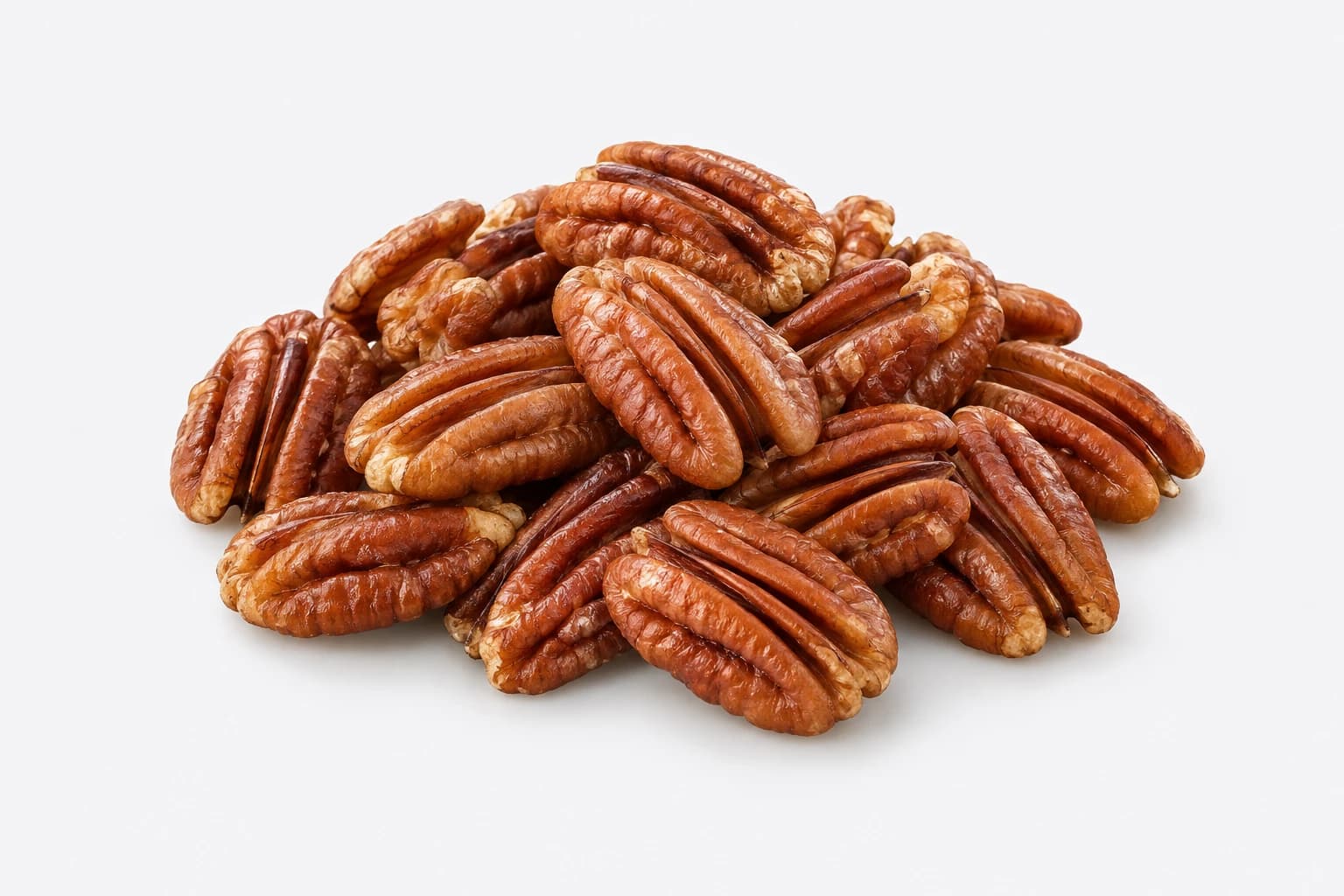
The pecan is the seed of a tree in the walnut family, native to the southern United States, which still produces most of the world's crop. It is longer than a walnut with a smooth shell, and the kernel splits into two wrinkled halves much like a walnut's. It is less astringent than a walnut and leans sweeter, which is why it turns up so often in baking. The fat content is very high and it goes rancid quickly, so sealed storage in the fridge or freezer extends it considerably.
Scientific name Carya illinoinensis
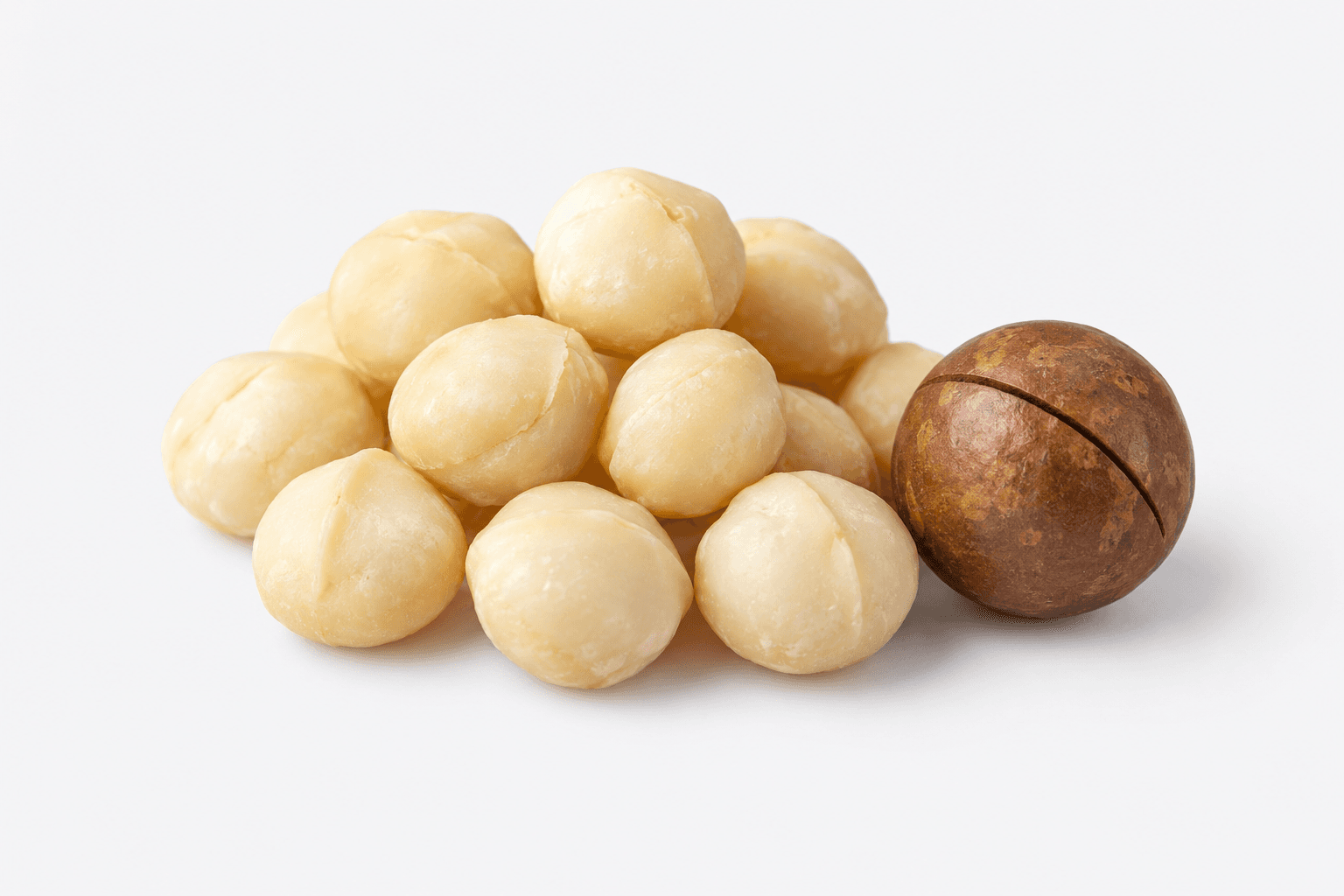
This site's macadamia entry says it plainly: the trial that merely laid nuts on top of the usual diet moved no lipids.
Pecans went the other way. Seeing why that matters is what this page is for.
2021, The Journal of Nutrition. Fifty-six adults at cardiovascular risk (BMI ≥28 or hypercholesterolaemia) were split three ways for eight weeks.
- Control (18) — usual diet
- ADD (16) — 68 g of pecans added to the usual diet
- SUB (18) — 68 g of pecans substituted for isocaloric foods already in the diet
Both pecan arms fell.
| Measure | ADD | SUB |
|---|---|---|
| Total cholesterol | 204 → 195 mg/dL | 205 → 195 mg/dL |
| LDL cholesterol | 143 → 129 mg/dL | 144 → 135 mg/dL |
| Triglycerides | 139 → 125 mg/dL | 133 → 120 mg/dL |
| Non-HDL cholesterol | 151 → 140 mg/dL | 155 → 143 mg/dL |
| Apolipoprotein B | 99.1 → 93.0 mg/dL | 104 → 97.1 mg/dL |
| Control | no change |
Adding alone was enough here. In the macadamia trial it was not. Nuts are not interchangeable.
Key benefits
- Moderate evidence
Both the add arm and the substitute arm fell — on 68 g a day, with sixteen people per arm
[1][2]2021, The Journal of Nutrition. The design carries an unusual strength.
The question that dogs food research is whether an effect comes from the food or from what the food displaced. This trial built that question into the design.
- Control 18 — usual diet
- ADD 16 — 68 g of pecans added to the usual diet
- SUB 18 — 68 g of pecans substituted for isocaloric foods
- At baseline and 8 weeks, a high-fat meal with four hours of postprandial blood draws
- Registered at clinicaltrials.gov (NCT04376632)
The results are in the table above, and the postprandial measures split.
- ADD — postprandial triglycerides fell (p≤0.01)
- SUB — postprandial glucose fell (p<0.05)
- All fasting lipid changes reached p≤0.05 in both pecan arms, with no changes in control
How to read this.
First, the picture sharpens against macadamia. The 2023 macadamia free-living trial added nuts at 15% of daily calories and moved no lipids significantly. The pecan ADD arm did move.
Several things could explain that. The fatty acid profiles differ — macadamia has 1.5 g of polyunsaturated fat, pecans 21.6 g. Fibre differs a little, 8.6 g against 9.6 g. The populations differ. But these trials never compared themselves to each other. Why they diverged cannot be settled from this data.
Second, do not read it as "adding is enough". The ADD arm laid 68 g of pecans on top of the usual diet every day. 68 g is about 470 kcal. That lipids improved anyway across eight weeks is interesting, but the calories did not vanish, and the abstract does not report weight change.
Third, each arm held 16–18 people. Very small. And participants had a BMI of 28 or above, or high cholesterol. Larger falls in people whose lipids start high is a common pattern, and it does not mean the same figures apply to healthy people.
Fourth, the changes are reported mostly against baseline. That said, there was a control group and it did not move, so the between-group frame is present.
Fifth, there is a follow-up. A 2025 trial in the same journal reported improved lipoprotein particle concentrations against usual intake. Same direction.
The honest conclusion:
- The direction — that pecans move lipids — is consistent across two trials
- But the dose was 68 g a day and the arms held sixteen to eighteen people
- The participants already had elevated lipids
- The grade here is "moderate" — consistent, but small
- Nutrition data
72 g of fat with 9.6 g of fibre — but vitamin E is low
Per 100 g of raw pecans:
- 691 kcal, fat 72.0 g — saturated 6.18 g, monounsaturated 40.8 g, polyunsaturated 21.6 g
- Fibre 9.6 g, carbohydrate 13.9 g, sugar 3.97 g, protein 9.17 g
- Manganese 4.5 mg, zinc 4.53 mg, copper 1.2 mg
- Magnesium 121 mg, phosphorus 277 mg, potassium 410 mg
- Vitamin E 1.4 mg, vitamin K 3.5 µg, folate 22 µg
- Sodium 0 mg, cholesterol 0
Per handful (30 g, about nineteen halves):
100 g A handful (30 g) Trial dose (68 g) Energy 691 kcal 207 kcal 470 kcal Fat 72.0 g 21.6 g 49.0 g Fibre 9.6 g 2.9 g 6.5 g Manganese 4.5 mg 1.35 mg 3.06 mg The 9.6 g of fibre is high among nuts. Almonds beat it at 12.5 g, but pecans sit above walnuts at 6.7 g and macadamias at 8.6 g.
Manganese at 4.5 mg exceeds the adult adequate intake in 100 g (around 4.0 mg for men and 3.5 mg for women). Even a handful gives 1.35 mg, roughly a third of a day.
Saturated fat is low at 6.18 g — only 8.6% of the 72 g of fat, and half of macadamia's 12.1 g. Monounsaturated 40.8 g and polyunsaturated 21.6 g make up the rest.
But vitamin E is 1.4 mg. Almonds hold 25.6 mg per 100 g. Like macadamias, pecans are not a vitamin E source. The generalisation that nuts are rich in vitamin E does not hold here either.
At 691 kcal they sit second only to macadamias:
Nut Energy Fat Fibre Macadamia 718 kcal 75.8 g 8.6 g Pecan 691 kcal 72.0 g 9.6 g Pine nut 673 kcal 68.4 g 3.7 g Walnut 654 kcal 65.2 g 6.7 g Almond 579 kcal 49.9 g 12.5 g A handful is 207 kcal. Count them.
Store sealed in the fridge or freezer. With 21.6 g of polyunsaturated fat they go rancid fast at room temperature. Bitterness means discard.
Toast three to four minutes in a dry pan over low heat. All that fat burns quickly, so judge by aroma rather than colour.
- Not established
"The most antioxidant nut" — the ranking's own source was withdrawn
This entry is about one much-quoted number.
Articles on pecans often carry the line "highest antioxidant capacity of any nut". What is usually offered as evidence is a value called ORAC.
What ORAC is. Oxygen Radical Absorbance Capacity, a laboratory assay measuring how well a substance mops up radicals in a test tube. The US Department of Agriculture once published a database of ORAC values by food, and pecans ranked near the top of the nuts in it.
That database no longer exists. The USDA withdrew it from its website in 2012, on the grounds that the values have no relevance to the effects of these compounds on human health, noting too that the food industry was misusing them in marketing.
Why no relevance?
First, a tube is not a body. Putting radicals and antioxidants in one dish and measuring is a different process from a compound being swallowed, digested, absorbed and reaching tissue.
Second, unabsorbed is irrelevant. Many polyphenols are not absorbed intact; they are metabolised in the gut or excreted. A compound scoring high in a tube often barely reaches the blood.
Third, a ranking does not tell you a food's value. Things eaten in tiny amounts, such as spices, rise to the top of any per-100 g ranking. It is the same reason this site keeps turmeric and cinnamon out of its nutrient rankings.
So this site does not report pecans' ORAC ranking as a benefit.
What has been confirmed is in the two entries above. Two randomised trials lowered total cholesterol, LDL, triglycerides and apolipoprotein B. Those were measured in people.
With a tree nut allergy, pecans belong on the list. They are in the same family as walnuts, so be especially careful if you have reacted to walnuts.
How to eat it well
- A handful is 30 g, about nineteen halves, 207 kcal. Portion them out.
- The trial's 68 g a day is 470 kcal. Decide whether that is an amount you want to copy.
- Store sealed in the fridge or freezer. All that polyunsaturated fat goes rancid quickly.
- Bitterness means rancid. Throw them out.
- Toast three to four minutes in a dry pan over low heat, judging by aroma.
- Do not expect vitamin E — 1.4 mg per 100 g, about an eighteenth of an almond's.
- Check the label on salted or candied products. Raw pecans hold 0 mg of sodium.
- With a walnut allergy, be especially careful: they are in the same family.
How to read the grades
Each benefit carries a label showing how far research on people supports it. Grades differ between items even within the same ingredient.
- Nutrition data
- A fact verifiable from food composition databases or health authorities. This is a different kind of statement from a clinical effect.
- Strong evidence
- Consistently confirmed across randomised controlled trials or meta-analyses.
- Moderate evidence
- Human studies exist, but effect sizes are small or results are mixed.
- Early research
- Cell or animal work, or small preliminary studies.
- Not established
- Commonly claimed, but not confirmed in studies on people.
What to watch out for
- The trial dose was 68 g a day, about 470 kcal. That is not a handful.
- Each arm held 16–18 people, and participants had a BMI of 28 or above or high cholesterol. The same figures do not transfer to healthy people.
- Why pecans and macadamias diverged cannot be settled from this data. The two trials never compared themselves to each other.
- The ORAC database behind the "most antioxidant nut" ranking was withdrawn by the USDA in 2012, on the grounds that it has no relevance to human health.
- 691 kcal per 100 g, second only to macadamias among the common nuts.
- Vitamin E is low, contrary to the general image of nuts.
- With a tree nut allergy, pecans count, and they share a family with walnuts.
- The polyunsaturated fat goes rancid fast. Avoid storing at room temperature.
Nutrition
Per 100 g of raw pecans. A handful is 30 g, about nineteen halves. The 68 g a day used in the trial below is more than two handfuls.
- Calories
- 691 kcal35%
- Fat
- 72.0 g92%
- Fiber
- 9.6 g34%
- Manganese
- 4.5 mg196%
- Zinc
- 4.53 mg41%
- Copper
- 1.2 mg133%
- Magnesium
- 121 mg29%
- Phosphorus
- 277 mg22%
- Potassium
- 410 mg9%
- Protein
- 9.17 g18%
- Carbohydrates
- 13.9 g5%
- Sugars
- 3.97 g
- Vitamin E
- 1.4 mg9%
- Sodium
- 0 mg0%
Percentages are of the US FDA Daily Value for adults and children 4 and over. National reference intakes differ by sex and age.
Calculate this alongside other ingredients →
Key nutrients
Dishes with this ingredient
Compare with
Sources
The databases and health authorities this article's nutrition figures and health statements draw on.
- 1Pecan-Enriched Diets Alter Cholesterol Profiles and Triglycerides in Adults at Risk for Cardiovascular Disease in a Randomized, Controlled TrialClinical trialGuarneiri LL, et al. The Journal of Nutrition 2021PMID 34383903
- 2Pecan Intake Improves Lipoprotein Particle Concentrations Compared with Usual Intake in Adults at Increased Risk of Cardiometabolic Diseases: A Randomized Controlled TrialClinical trialHart TL, et al. The Journal of Nutrition 2025PMID 40113170
- 3USDA FoodData CentralFood composition database
- 4PubMedResearch literature
- 5NIH Office of Dietary SupplementsHealth authority