Contents
What it is
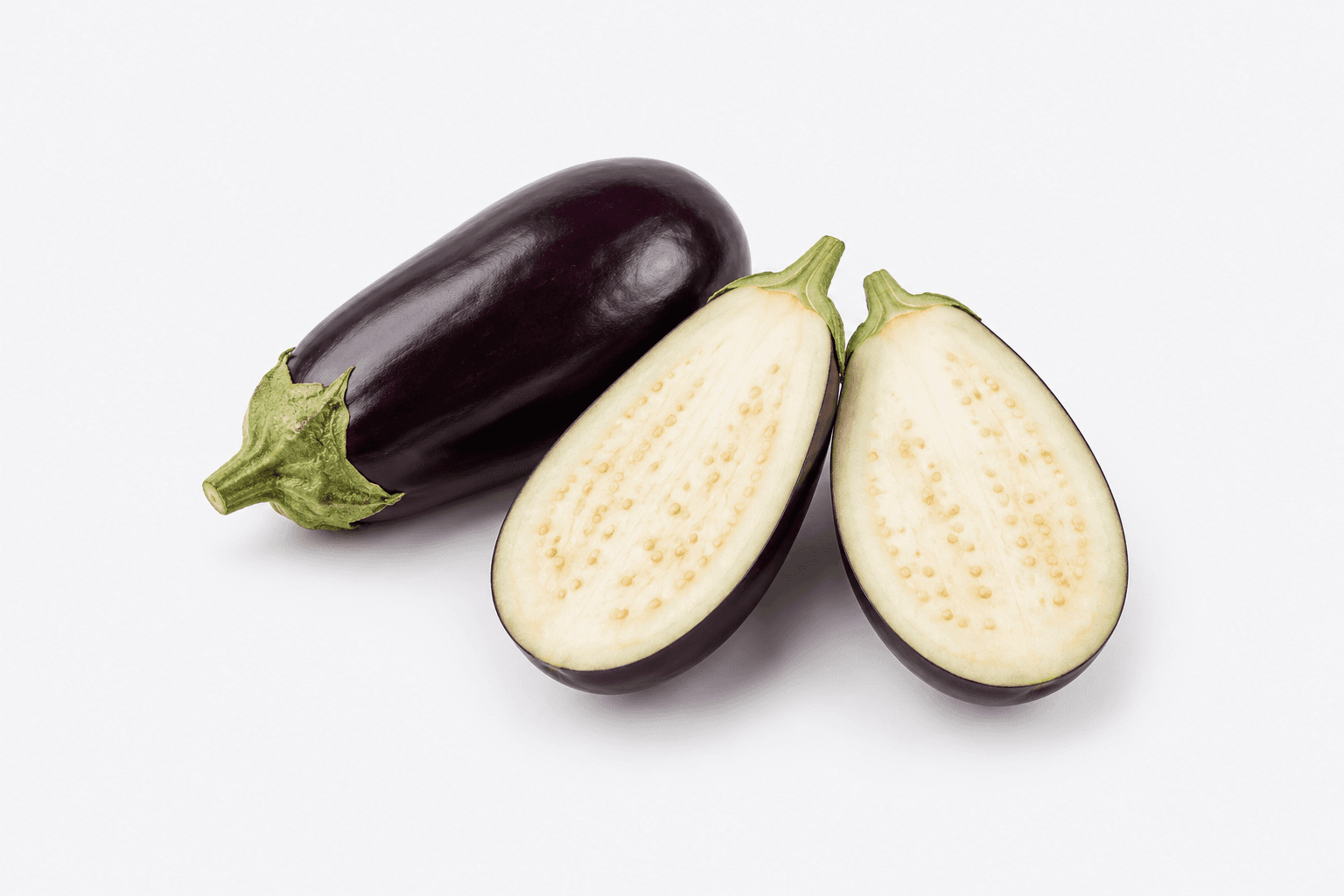
The aubergine is the fruit of a nightshade, a relative of tomato, potato and chilli, and it is native to India. Its flesh is a sponge full of air pockets, which makes it extraordinarily good at soaking up oil — and cooking methods really divide along that property: fried in a pan it drinks oil, while steaming or grilling first collapses the pockets so it absorbs much less. Cut surfaces brown quickly, and the purple of the skin is anthocyanin. Cooking softens it and brings out sweetness.
Scientific name Solanum melongena
Eggplant is a good vegetable — low in calories, with some fibre. But that is not what this page is about.
Eggplant is an unusual case: used so widely as a folk remedy that it actually went through two randomised controlled trials.
In Brazil, dried eggplant powder has been sold as a treatment for hyperlipidaemia. So researchers tested it.
- 2000 — 38 people with high cholesterol, eggplant infusion, five weeks. No difference from controls
- 2004 — 41 people with hyperlipidaemia, dried eggplant powder capsules, three months. The placebo group changed the same way
The second trial's sentence, verbatim: total cholesterol and LDL fell in the eggplant group (p<0.05), "however similar effect was also observed in the placebo group".
This is exactly why placebo controls exist. A change that reads as "it went down" when you look at one group alone disappears once a placebo group sits beside it.
The composition deserves its own look. 100 g holds 25 kcal, 3.0 g of fibre and 2 mg of sodium. The low energy and that spongy structure are reason enough to cook with it — the reason just is not cholesterol.
And the sponge has a price. It drinks oil. The arithmetic is below.
Key benefits
- Not established
Two randomised trials — both matched placebo
[1][2]This entry is not a benefit but a record that no benefit was established.
In Brazil eggplant became an established folk remedy for high blood lipids, to the point that dried eggplant powder was sold as a product for that purpose. Two clinical trials followed.
First, 2000, Brazilian Journal of Medical and Biological Research.
- 38 people with hypercholesterolaemia, split between eggplant infusion (19) and placebo (19)
- Five weeks, with total cholesterol and its fractions, triglycerides and apolipoproteins A and B measured at baseline, three weeks and five weeks
- Result: no differences were observed compared with control
- An intraindividual analysis did show significant falls in total and LDL cholesterol and apolipoprotein B
- But after dietary guidance was added, no differences were seen within or between groups on any parameter
The authors concluded that the effect was "modest and transitory" and no different from what standard guidance for dyslipidaemia — diet and physical activity — already achieved.
Second, 2004, Arquivos Brasileiros de Endocrinologia e Metabologia. A double-blind placebo-controlled study.
- 41 people with hyperlipidaemia — 21 on eggplant, 20 on placebo
- Two 450 mg capsules of dried eggplant powder twice daily, for three months. That dose was the one actually used for hyperlipidaemia in Brazil
- Result: at three months, total cholesterol, LDL and the LDL/HDL ratio fell in the eggplant group (p<0.05)
- "However similar effect was also observed in the placebo group"
- Triglycerides, HDL, VLDL, AST, ALT, γ-GT, glucose and BMI showed no significant change
The authors concluded that eggplant, in the form sold in Brazil, requires further trials before it can be recommended for hyperlipidaemia.
Two lessons here.
First, "I took it and my numbers fell" is not evidence. The numbers fell in the eggplant group in both trials. They fell just as much on placebo. Someone who has started paying attention to their health also changes their diet and activity, and lab values drift on their own (regression to the mean). Without a placebo group, all of that gets misread as effect.
Second, the standard measures did better. In the 2000 trial, once dietary guidance was given, nothing of the eggplant effect remained. Eggplant added nothing to what diet and exercise were already doing.
The honest conclusion: there is no evidence that eggplant lowers cholesterol. Eating it is a good thing, but that is eating a vegetable, not taking a treatment.
- Nutrition data
25 kcal per 100 g — but look at how much oil goes in
Per 100 g of raw eggplant:
- 25 kcal, protein 0.98 g, fat 0.18 g
- Of 5.88 g of carbohydrate, 3.0 g is fibre, sugar 3.53 g
- Potassium 229 mg, manganese 0.232 mg, folate 22 µg
- Magnesium 14 mg, vitamin C 2.2 mg, vitamin K 3.5 µg
- Sodium 2 mg
The 25 kcal defines it — a little above courgette (17 kcal) and level with cabbage (25 kcal). A whole medium fruit at 250 g is 63 kcal.
3.0 g of fibre is high for a vegetable, more than cabbage (2.5 g) or courgette (1.0 g).
But those numbers rarely survive to the table.
The inside of an eggplant is a sponge full of air pockets. Meeting hot oil, the air escapes and oil fills the space. Eggplant is among the most oil-absorbent vegetables there is.
Cooking For one 250 g eggplant Raw 63 kcal Steamed or boiled 63 kcal (almost unchanged) Fried in 2 tbsp oil 63 + 240 = about 300 kcal Deep-fried More Two tablespoons of oil is 240 kcal — four times the eggplant itself. That is where "eggplant is good for dieting" tends to come apart.
There are ways to cut the absorption:
- Salt it, leave it 20 minutes, then squeeze out the water. As the cells lose water the structure collapses, leaving less room for oil
- Steam or microwave it first, then fry. The air pockets have already collapsed
- Get the pan properly hot before it goes in. A lukewarm pan just gets drunk dry
Do not peel it. The purple is nasunin, an anthocyanin, and the fibre concentrates in the skin too. But there is no evidence that nasunin does anything in people — having a pigment and having an effect are different claims.
Cut surfaces brown. That is polyphenol oxidase; salted water or cooking it straight away limits it.
- Not established
"Eggplant soaks up oil, so it absorbs and removes cholesterol" — that is not what happens
This entry sorts through a common misunderstanding.
You often hear it explained this way: "eggplant soaks up oil like a sponge, so it soaks up the fat and cholesterol inside your body and carries them out."
This confuses two different things.
First, what happens in a frying pan is not what happens in your gut. Eggplant absorbs oil in the pan because of its physical structure — liquid filling air pockets. But when you eat that eggplant, you eat the oil it absorbed too. It goes into you, not out of you.
Second, digestion destroys the structure. After chewing, stomach acid and digestive enzymes, no sponge remains. What reaches the intestine is eggplant's constituents, not an eggplant-shaped sponge.
Is there nothing that binds fat and bile acids in the gut? There is — soluble fibre. Oat beta-glucan and psyllium lower LDL that way, with evidence behind them.
But the soluble share of eggplant's 3.0 g of fibre is low next to those foods. And decisively — two clinical trials that fed people eggplant both matched placebo. However plausible a mechanism sounds, if the human result does not appear, that is the end of it.
The same applies to "nasunin is an antioxidant". Nasunin is the anthocyanin in eggplant skin, and it shows antioxidant activity in a test tube. But this site did not identify evidence that it changes a health outcome in people.
None of this means you should not eat eggplant. A vegetable with 25 kcal and 3 g of fibre needs no further defence. But that is the benefit of eating vegetables, not a benefit unique to eggplant.
How to eat it well
- Salt it, wait 20 minutes, squeeze out the water. Oil absorption drops sharply.
- Steam or microwave before frying and it takes far less oil.
- Get the pan hot before it goes in. A lukewarm pan just soaks it dry.
- Do not peel it. The fibre and the pigment are in the skin.
- Cook it soon after cutting. Left standing, it browns.
- Two tablespoons of oil is 240 kcal — four times a whole eggplant (63 kcal).
- Steaming or grilling stays closest to the composition table. The calories barely move.
- If you are eating it for cholesterol, there is no evidence for that.
How to read the grades
Each benefit carries a label showing how far research on people supports it. Grades differ between items even within the same ingredient.
- Nutrition data
- A fact verifiable from food composition databases or health authorities. This is a different kind of statement from a clinical effect.
- Strong evidence
- Consistently confirmed across randomised controlled trials or meta-analyses.
- Moderate evidence
- Human studies exist, but effect sizes are small or results are mixed.
- Early research
- Cell or animal work, or small preliminary studies.
- Not established
- Commonly claimed, but not confirmed in studies on people.
What to watch out for
- There is no evidence it lowers cholesterol. Two randomised placebo-controlled trials both matched placebo, and the 2004 trial stated that the placebo group changed the same way.
- Do not use eggplant as a treatment for high blood lipids. It cannot replace prescribed medication.
- It absorbs a great deal of oil. Depending on the method, the calories multiply four or five times.
- Eggplant is a nightshade (Solanaceae), like tomato, potato and chilli. Take care with a nightshade allergy.
- The claim that nightshades worsen arthritis is not established in humans. There is neither good evidence to avoid them nor confirmation that they are harmless.
- Nasunin's antioxidant effect is at test-tube level and has not been confirmed in people.
- If you restrict potassium for kidney disease, 100 g holds 229 mg.
- Do not eat large amounts raw. Solanine-type compounds in nightshades are higher uncooked; ordinary cooking reduces them adequately.
Nutrition
Per 100 g of raw eggplant. A medium fruit weighs around 250 g.
- Calories
- 25 kcal1%
- Protein
- 0.98 g2%
- Carbohydrates
- 5.88 g2%
- Fiber
- 3.0 g11%
- Sugars
- 3.53 g
- Potassium
- 229 mg5%
- Manganese
- 0.232 mg10%
- Folate
- 22 µg5%
- Magnesium
- 14 mg3%
- Vitamin C
- 2.2 mg2%
- Vitamin K
- 3.5 µg3%
- Sodium
- 2 mg<1%
Percentages are of the US FDA Daily Value for adults and children 4 and over. National reference intakes differ by sex and age.
Calculate this alongside other ingredients →
Key nutrients
By health concern
Dishes with this ingredient
Sources
The databases and health authorities this article's nutrition figures and health statements draw on.
- 1Eggplant (Solanum melongena) infusion has a modest and transitory effect on hypercholesterolemic subjectsClinical trialGuimarães PR, et al. Brazilian Journal of Medical and Biological Research 2000PMID 10973133
- 2Absence of hypolipidemic effect of Solanum melongena L. (eggplant) on hyperlipidemic patientsClinical trialSilva GE, et al. Arquivos Brasileiros de Endocrinologia e Metabologia 2004PMID 15640898
- 3USDA FoodData CentralFood composition database
- 4PubMedResearch literature
- 5NIH Office of Dietary SupplementsHealth authority