Contents
What it is
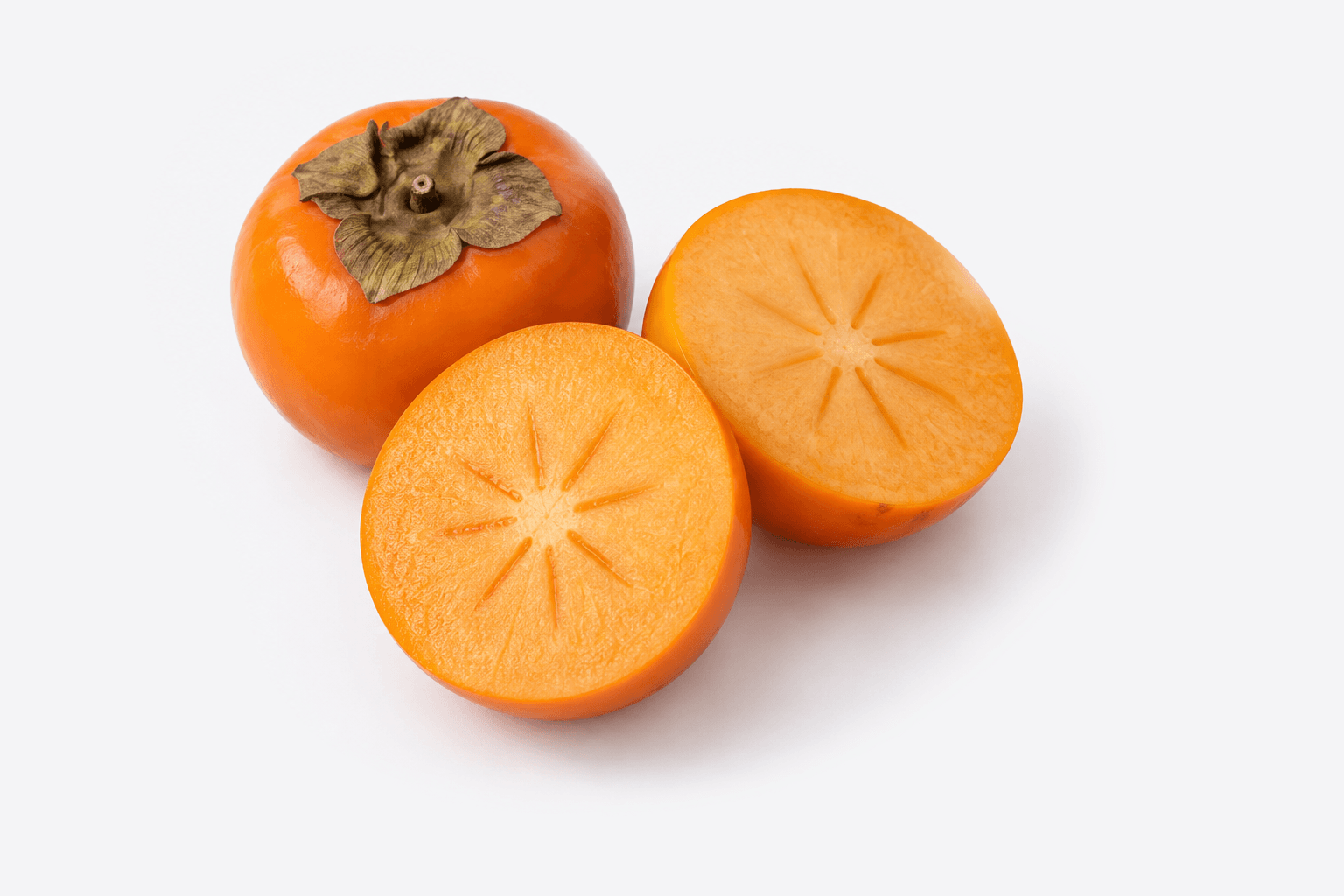
The persimmon is the fruit of a tree native to East Asia. The broad split is between astringent and non-astringent types; the astringency is the sensation of soluble tannins binding to proteins on the tongue. Once those tannins convert to an insoluble form the astringency disappears, so astringent persimmons are dried or treated with alcohol or carbon dioxide before eating — dried persimmon and the soft, jellied ripe fruit are both results of that. Sweet persimmons are varieties in which the change happens on the tree by itself. Eating a lot on an empty stomach can form a mass in the stomach.
Scientific name Diospyros kaki
Persimmon is an autumn fruit. Sweet varieties are eaten firm; astringent ones are ripened soft or dried.
Fibre and vitamin A are what stand out. 100 g holds 3.6 g of fibre — more than apple (2.4 g). The 81 µg RAE of vitamin A comes from the beta-carotene (253 µg) that makes it orange.
Search for clinical evidence on persimmon and you land on essentially one study: a randomised double-blind placebo-controlled trial from 2013 in Annals of Nutrition and Metabolism, reporting a fall in total cholesterol.
What that trial actually did matters.
- What was fed was not persimmon but tannin-rich fibre extracted from young (unripe) fruit
- It was baked into cookie bars, taken three times a day before meals
- The dose was 9 g or 15 g a day
- There were 40 participants, over 12 weeks
That is a different thing from eating a persimmon, as set out below.
And persimmon carries a well-known caution — eating a lot of astringent persimmon on an empty stomach can form a gastric bezoar. The medical literature carries a steady trickle of case reports under the name diospyrobezoar.
Key benefits
- Early research
Total cholesterol fell — but on fibre from unripe fruit, not on persimmon
[1]2013, Annals of Nutrition and Metabolism. A randomised, double-blind, placebo-controlled trial.
The design:
- 40 participants with plasma total cholesterol of 180–259 mg/dL
- Three groups — placebo 0 g (14), low dose 3 g (13), high dose 5 g (13)
- Cookie bars containing tannin-rich fibre, three times a day before meals, for 12 weeks
- So the actual daily doses were 0 g / 9 g / 15 g
The results:
- Total cholesterol — significantly down at 12 weeks in the low-dose group (p<0.005), and at 6 weeks (p<0.05) and 12 weeks (p<0.001) in the high-dose group
- LDL cholesterol — down only in the high-dose group, at 6 weeks (p<0.05) and 12 weeks (p<0.001)
- HDL and triglycerides did not change
The proposed mechanism is bile-acid binding. If tannin fibre traps bile acids in the gut and carries them out, the liver has to spend cholesterol making more. Drugs such as cholestyramine work on the same principle, and oat beta-glucan and psyllium are explained the same way.
Four things have to be kept straight.
First, what was fed was not persimmon. It was a fibre fraction extracted from unripe fruit, whose composition differs from the ripe sweet persimmon you eat. The soluble tannins responsible for astringency turn insoluble as the fruit ripens, which is why ripe fruit is not astringent.
Second, the dose is different. Nine to fifteen grams a day of a purified fibre fraction. A 100 g persimmon holds 3.6 g of total dietary fibre, so matching 15 g would take over 400 g of fruit — and even then its fibre is not the same material as the extract.
Third, persimmon brings sugar with it. 400 g means 50 g of sugar. The cookie bars in the trial did not.
Fourth, 40 people over 12 weeks. A small trial, and no larger confirmatory trial was identified.
So this site's conclusion: there is one human trial behind the idea that persimmon fibre binds bile acids. But turning that into "eating persimmons lowers cholesterol" goes past what the evidence says.
- Nutrition data
3.6 g of fibre and 253 µg of beta-carotene — and 12.5 g of sugar
Per 100 g of raw sweet persimmon:
- 70 kcal, protein 0.58 g, fat 0.19 g
- Of 18.6 g of carbohydrate, 3.6 g is fibre, 12.5 g is sugar
- Vitamin A 81 µg RAE, beta-carotene 253 µg
- Manganese 0.355 mg — 15% of the requirement
- Vitamin C 7.5 mg, potassium 161 mg, copper 0.113 mg, vitamin E 0.73 mg
The 3.6 g of fibre is this fruit's strength — more than apple (2.4 g), pear (3.1 g) or grape (0.9 g). One persimmon, around 170 g of flesh, gives 6.1 g, close to a quarter of the 25 g daily target.
The 253 µg of beta-carotene makes the orange. It is fat-soluble, so absorption improves alongside some fat.
But the 12.5 g of sugar belongs in the same view.
100 g One fruit (170 g) Energy 70 kcal 119 kcal Sugar 12.5 g 21.3 g Fibre 3.6 g 6.1 g 21 g of sugar in one persimmon is not low for a fruit. An apple of 200 g is around 20 g, so it is comparable — and a persimmon looks smaller, which makes it easier to eat more.
Dried persimmon is a different food entirely. Drying removes water, so sugar per unit weight is far higher. A dried persimmon looks smaller than a fresh one but carries more sugar. With diabetes, dried persimmon deserves particular care.
Sweet and astringent persimmons differ.
- Sweet varieties lose their soluble tannins as they grow and are not astringent. They are eaten firm
- Astringent varieties keep soluble tannins. Ripened soft or dried, the tannins turn insoluble and the astringency disappears
Astringency vanishes not because the tannin is gone but because it changes into a form that no longer binds the proteins in your mouth. That distinction connects to the caution below.
- Not established
Astringent persimmon on an empty stomach — on diospyrobezoar
This entry has to be clear about what kind of evidence it rests on.
"Do not eat persimmon on an empty stomach" is an old saying. It does have support in the medical literature — but as case reports.
Diospyrobezoar, the persimmon bezoar, is an established term, and cases causing intestinal or duodenal obstruction have been reported across journals — BMC Surgery in 2017, Cureus in 2022, 2024 and 2025, among others.
The mechanism runs like this. Persimmon's soluble tannins, meeting stomach acid (pH 1.5–3.5), congeal with fibre and protein into a mass. Grown large enough, it cannot leave the stomach, and rarely it passes down and obstructs the bowel.
Certain conditions raise the risk:
- Eating astringent persimmon, which still holds soluble tannins
- Eating it on an empty stomach, when acid is concentrated
- Previous gastric surgery (gastrectomy, sleeve gastrectomy) or diabetic gastroparesis, which slow gastric emptying
- Eating a lot at once
But this needs balancing.
First, these are case reports. A case report says "this happened" — it does not tell you what percentage of people eating persimmon it happens to. Bezoars are rare.
Second, nothing happens to most people who eat persimmon. Korea consumes enormous quantities every autumn, and bezoar is not a common diagnosis.
Third, the at-risk group is nonetheless real. For someone who has had gastric surgery or whose stomach empties slowly, this is not a theoretical risk. They are better off avoiding astringent persimmon and not eating much of the sweet kind on an empty stomach either.
There is also a saying about not eating persimmon with crab. That belongs to traditional food-pairing lore, and this site did not identify human evidence for it. It appears to be an inference from the fact that tannins bind protein.
How to eat it well
- Sweet varieties firm, astringent ones ripened soft. Eating an astringent persimmon unripened is unpleasant, and that is also where the bezoar risk sits.
- Do not eat a lot on an empty stomach, especially astringent ones.
- Eating the skin adds fibre. Sweet varieties have thin skin you can eat as is.
- Beta-carotene is fat-soluble. Alongside nuts or yoghurt it absorbs better.
- To ripen an astringent persimmon faster, bag it with an apple. The ethylene the apple gives off speeds ripening.
- Dried persimmon is concentrated sugar. Count it as a sweet, not as a substitute for the fresh fruit.
- With diabetes, half a fruit at a time is more sensible. One holds 21 g of sugar.
- If you have had gastric surgery, avoid astringent persimmon.
How to read the grades
Each benefit carries a label showing how far research on people supports it. Grades differ between items even within the same ingredient.
- Nutrition data
- A fact verifiable from food composition databases or health authorities. This is a different kind of statement from a clinical effect.
- Strong evidence
- Consistently confirmed across randomised controlled trials or meta-analyses.
- Moderate evidence
- Human studies exist, but effect sizes are small or results are mixed.
- Early research
- Cell or animal work, or small preliminary studies.
- Not established
- Commonly claimed, but not confirmed in studies on people.
What to watch out for
- The cholesterol trial above used tannin fibre extracted from unripe fruit, baked into bars at 9–15 g a day — not persimmon. There were 40 participants.
- HDL and triglycerides did not change. LDL fell only in the high-dose group.
- Eating a lot of astringent persimmon on an empty stomach can form a gastric bezoar (diospyrobezoar). Case reports continue to appear, including cases operated on for bowel obstruction.
- Previous gastric surgery or diabetic gastroparesis raises that risk. Avoid astringent persimmon.
- One fruit (170 g) holds 21.3 g of sugar. With diabetes, the amount has to be counted.
- Dried persimmon has concentrated sugar and is nothing like fresh fruit weight for weight.
- The traditional persimmon-and-crab taboo has no human evidence this site could identify.
- Tannins can interfere with iron absorption. If you take iron for anaemia, space them apart.
Nutrition
Per 100 g of raw Japanese persimmon (Diospyros kaki). A medium fruit gives 150–200 g of edible flesh.
- Calories
- 70 kcal4%
- Protein
- 0.58 g1%
- Carbohydrates
- 18.6 g7%
- Fiber
- 3.6 g13%
- Sugars
- 12.5 g
- Vitamin A
- 81 µg9%
- Beta-carotene
- 253 µg
- Manganese
- 0.355 mg15%
- Vitamin C
- 7.5 mg8%
- Potassium
- 161 mg3%
- Copper
- 0.113 mg13%
- Vitamin E
- 0.73 mg5%
Percentages are of the US FDA Daily Value for adults and children 4 and over. National reference intakes differ by sex and age.
Calculate this alongside other ingredients →
Key nutrients
Dishes with this ingredient
Sources
The databases and health authorities this article's nutrition figures and health statements draw on.
- 1Persimmon fruit tannin-rich fiber reduces cholesterol levels in humansClinical trialGato N, Kadowaki A, Hashimoto N, Yokoyama S, Matsumoto K Annals of Nutrition and Metabolism 2013PMID 23171573
- 2USDA FoodData CentralFood composition database
- 3PubMedResearch literature
- 4NIH Office of Dietary SupplementsHealth authority