Contents
What it is
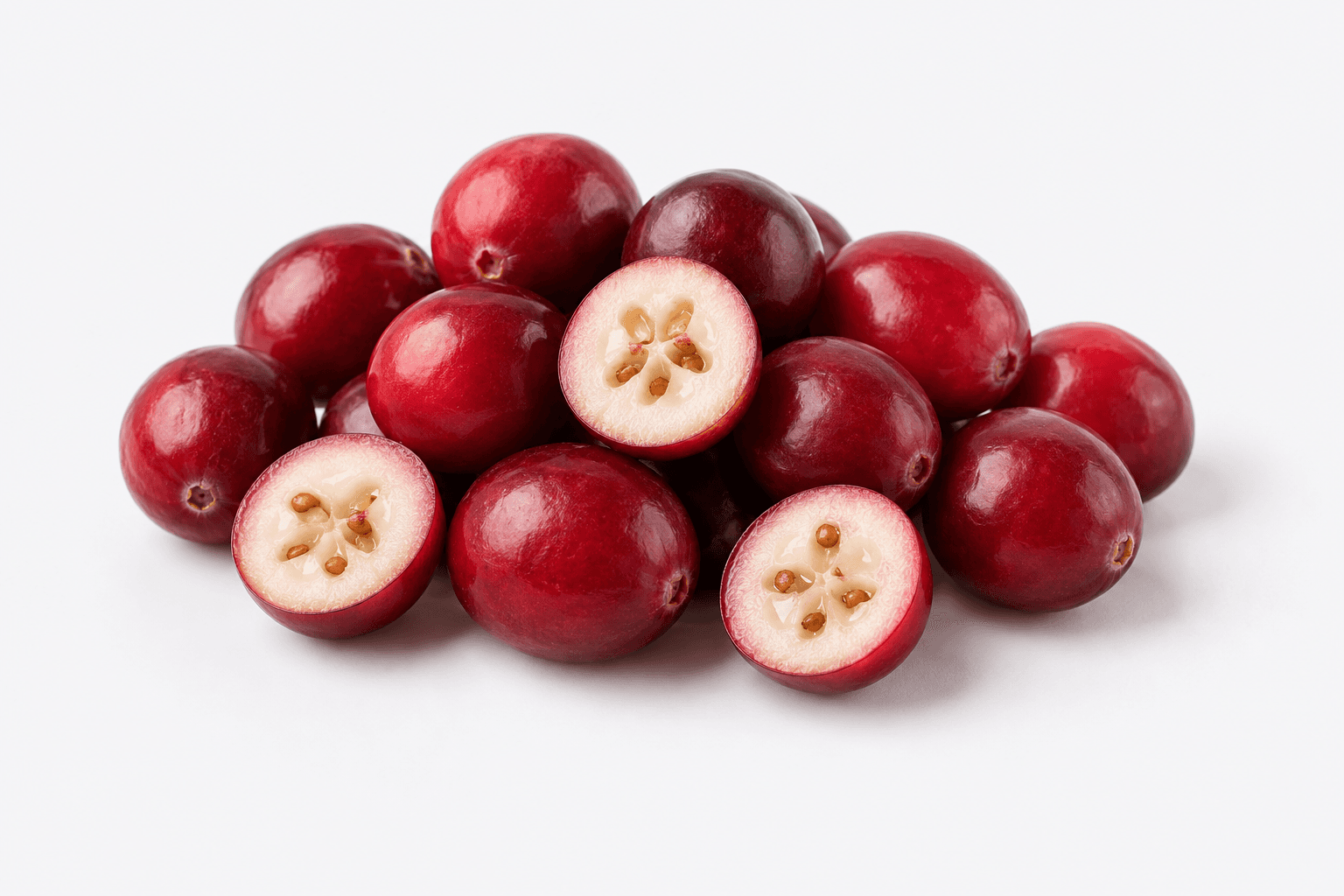
The cranberry is the fruit of a trailing shrub in the heath family, the same genus as the blueberry. It is native to northeastern North America and is known for an unusual harvest: the bogs are flooded and the floating berries are swept up. Raw, it is so sour and astringent that few people eat it as it is. Almost all of the crop is therefore sweetened and dried, or turned into juice and sauce — and the sweetness of dried cranberries comes mostly from the sugar added to them.
Scientific name Vaccinium macrocarpon
Cranberry and urinary tract infection is that rare folk remedy with large-scale clinical evidence behind it. The Cochrane review has been updated five times since 1998.
Through the 2012 version the verdict was 'no effect'. The 2023 version changed it — 26 new studies brought the total to 50 trials and 8,857 participants, and UTI risk came out 30 % lower (relative risk 0.70).
There is no reason to hide that the conclusion changed. Conclusions change when evidence accumulates.
Two things need stating plainly.
- This is prevention, not treatment. A separate Cochrane review of cranberry for an infection you already have concluded there is no evidence.
- It did not work for everyone. Results split by group, and the list is below.
Key benefits
- Strong evidence
30 % lower UTI risk — but it split by group
[1]The 2023 Cochrane review pooled 50 randomised controlled trials and 8,857 participants. Overall, symptomatic culture-verified UTIs fell 30 % (relative risk 0.70, 95 % CI 0.58–0.84, moderate certainty).
What follows matters more. Broken down by population, the results diverged.
Group Relative risk Effect Women with recurrent UTIs 0.74 (0.55–0.99) yes Children 0.46 (0.32–0.68) yes People made susceptible by a procedure 0.47 (0.37–0.61) yes Elderly people in institutions 0.93 (0.67–1.30) no Pregnant women 1.06 (0.75–1.50) no Neurogenic bladder 0.97 (0.78–1.19) no In the bottom three the confidence interval crosses 1. That means no effect.
Against antibiotics there was little or no difference (relative risk 1.03). Read that as the comparison was underpowered — two trials, 385 participants — rather than as cranberry matching antibiotics.
The proposed mechanism is that proanthocyanidins (PACs) stop E. coli adhering to the bladder wall. But the certainty of evidence on which form (juice or tablet) and what dose was rated very low.
- Not established
There is no evidence for treating an infection you already have
[2]This is not a benefit but a correction of a common belief.
Prevention and treatment are different questions, and Cochrane reviewed them separately. The treatment review found no evidence.
Nothing supports drinking cranberry juice after symptoms start and expecting the infection to clear. A UTI that climbs to the kidneys becomes dangerous, so symptoms mean seeing a doctor. Waiting it out on cranberry juice is what this page most wants to prevent.
The symptoms: burning or pain when urinating, frequent urge, a feeling of incomplete emptying, cloudy or bloody urine. Add fever, flank pain or nausea and it may be pyelonephritis — do not delay.
- Nutrition data
Raw cranberries and bottled juice are different foods
Raw cranberries are 46 kcal per 100 g, with 3.6 g of fibre and about 4 g of sugar. Sharp, but low in sugar.
The problem is that the sharpness means almost nobody eats them raw.
Form kcal per 100 g Note Raw cranberries 46 what this page is about Cranberry juice cocktail 55 sugar added; around 27 % juice is common Dried cranberries over 300 usually sweetened The trials above mostly used standardised juice or PAC-standardised tablets, not the 'cranberry flavour' drink in a supermarket. Drinking a sugary beverage daily to avoid UTIs trades one problem for another.
Vitamin E is 1.32 mg, high for a fruit; vitamin C is 14 mg and manganese 0.267 mg.
How to eat it well
- Choose unsweetened 100 % juice or a PAC-standardised product. The label's juice content and added sugar tell you which.
- For prevention, be consistent. The trials ran daily intake over weeks to months.
- Keep raw cranberries frozen and add a few to oats or yoghurt, which softens the sharpness.
- Treat dried cranberries as a sweet. Most are sugar-infused, and this page's evidence does not apply to them.
- In a sauce, cut the sugar and lean on orange juice for sweetness.
How to read the grades
Each benefit carries a label showing how far research on people supports it. Grades differ between items even within the same ingredient.
- Nutrition data
- A fact verifiable from food composition databases or health authorities. This is a different kind of statement from a clinical effect.
- Strong evidence
- Consistently confirmed across randomised controlled trials or meta-analyses.
- Moderate evidence
- Human studies exist, but effect sizes are small or results are mixed.
- Early research
- Cell or animal work, or small preliminary studies.
- Not established
- Commonly claimed, but not confirmed in studies on people.
What to watch out for
- See a doctor if you have symptoms. There is no evidence for treatment. The worst case is waiting on cranberry until it becomes pyelonephritis.
- On warfarin, take care. Cranberry juice has been reported to increase warfarin's effect. Discuss it with your clinician.
- With a history of calcium oxalate stones, cranberry is relatively high in oxalate and warrants caution.
- In pregnancy the effect was not confirmed. In the review above, pregnant women showed a relative risk of 1.06 — no difference.
- Gastrointestinal side effects may be more common than with placebo (relative risk 1.33, CI 1.00–1.77).
- Bottled juices are high in sugar. With diabetes, choose unsweetened.
Nutrition
Per 100 g of raw cranberries. Bottled juice and dried cranberries have sugar added and a completely different profile.
- Calories
- 46 kcal2%
- Carbohydrates
- 12 g4%
- Fiber
- 3.6 g13%
- Vitamin C
- 14 mg16%
- Vitamin E
- 1.32 mg9%
- Manganese
- 0.267 mg12%
- Vitamin K
- 5 µg4%
Percentages are of the US FDA Daily Value for adults and children 4 and over. National reference intakes differ by sex and age.
Calculate this alongside other ingredients →
Key nutrients
Dishes with this ingredient
Sources
The databases and health authorities this article's nutrition figures and health statements draw on.
- 1Cranberries for preventing urinary tract infectionsMeta-analysisWilliams G, et al. Cochrane Database Syst Rev 2023PMID 37947276
- 2Cranberries for treating urinary tract infectionsSystematic reviewsJepson RG, et al. Cochrane Database Syst Rev 2023PMID 38096261
- 3USDA FoodData CentralFood composition database
- 4Cochrane LibrarySystematic reviews
- 5NIH Office of Dietary SupplementsHealth authority
- 6PubMedResearch literature