Contents
What it is
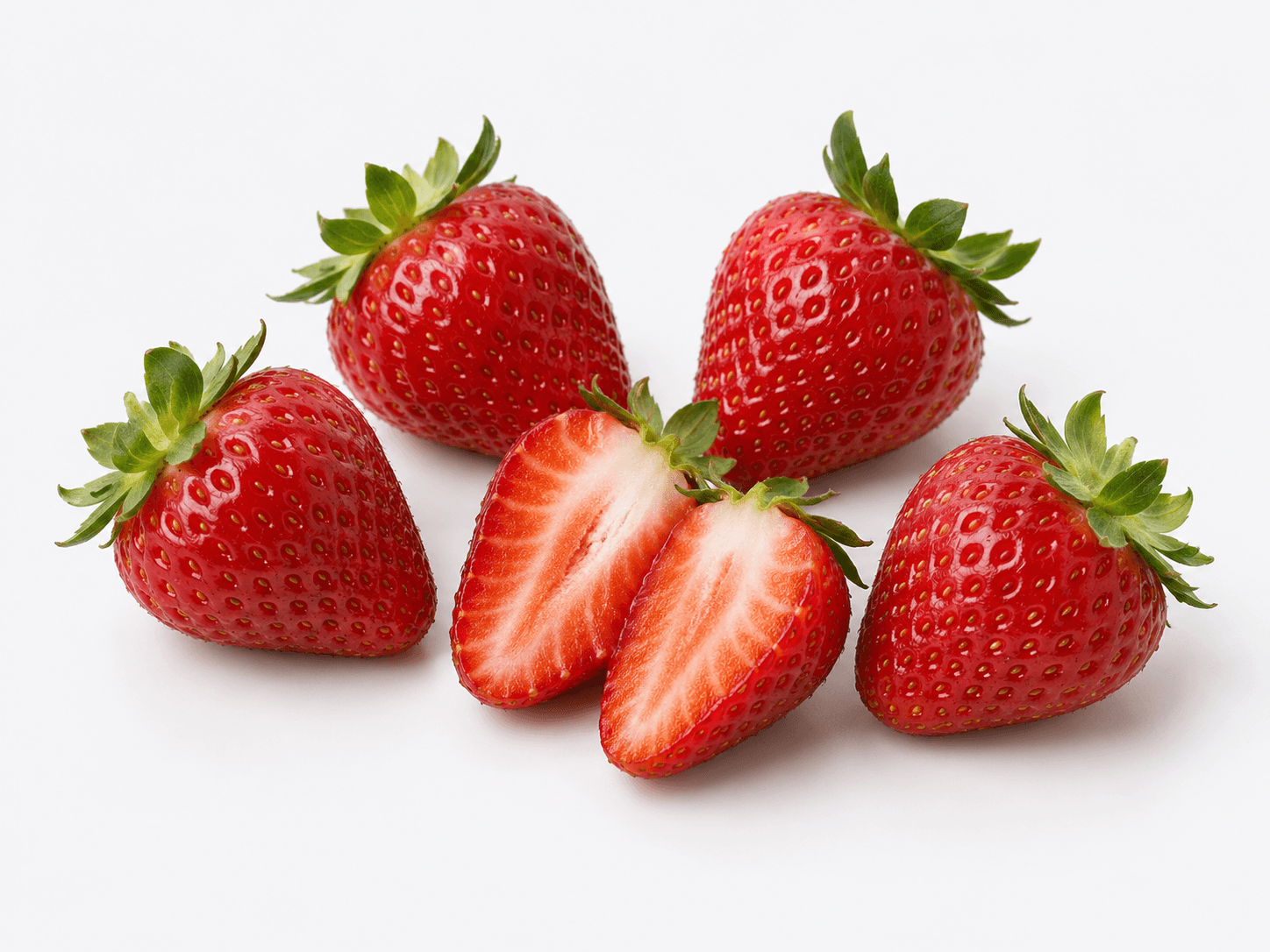
The strawberry is the fruit of a perennial in the rose family. The red, plump part we eat is not actually the fruit but a swollen receptacle; the tiny specks embedded in its surface are the true fruits. The cultivated strawberry is a hybrid, created in Europe from two species out of the Americas — hence the × in its scientific name. It does not ripen further after picking, so choose fruit already red. It has no skin to protect it, bruises easily, and softens fast once wet, so wash it with the hull still on and only just before eating.
Scientific name Fragaria × ananassa
Strawberries carry 58.8 mg of vitamin C per 100 g — more than an orange (53 mg). They run 32 kcal and 4.9 g of sugar, low for a fruit.
That much the composition table settles.
The rest is less settled. Strawberry anthocyanins get discussed for cardiovascular effects, yet the randomised trial that tested strawberries directly showed nothing on the endpoint it had chosen in advance. Leave that out and it is not an honest article.
Key benefits
- Nutrition data
More vitamin C than an orange
58.8 mg per 100 g, against an orange's 53 mg. Eight medium berries come to about 150 g, so roughly 88 mg — enough for an adult's 75–90 mg daily requirement.
Energy is 32 kcal per 100 g and sugar 4.9 g. Compared with grapes (15.5 g) or bananas, the sugar load is markedly lower. You also get 2 g of fibre, 24 µg of folate and 0.39 mg of manganese.
Vitamin C is water-soluble and heat-sensitive. Eating strawberries raw is the simplest way to keep it.
- Moderate evidence
Vascular function shifted; cholesterol did not
[1]A double-blind crossover trial in 34 adults with moderately raised cholesterol. Participants took 50 g of freeze-dried strawberry powder a day for four weeks, with LDL cholesterol set as the primary outcome.
The result was no difference at all. Not in LDL, and not in total cholesterol, triglycerides, glucose, insulin, inflammation (hs-CRP), fasting endothelial function or blood pressure.
What did move was the acute response. One hour after the strawberry drink, flow-mediated dilation improved by 1.5 % (P = 0.0008), and at two hours systolic blood pressure was 3.1 mmHg lower (P = 0.02).
Read it this way: strawberries act on blood vessels transiently, but four weeks of them will not move your cholesterol. Promoting a trial's secondary outcomes when the primary one was null is common; the honest summary here is 'vascular function may improve, metabolic markers do not'.
- Moderate evidence
People eating more anthocyanins had less coronary disease
[2]In a meta-analysis of prospective cohorts, the highest anthocyanin intake group had 9 % lower coronary heart disease risk (relative risk 0.91, 95 % CI 0.83–0.99) and 8 % lower cardiovascular mortality (0.92, 0.87–0.97), with almost no heterogeneity between studies (I² of 12 % and 0 %).
But the same analysis found no association with myocardial infarction, stroke or total cardiovascular disease. And the effect was clearer for anthocyanidin intake than for berries as a food — the focus sits on the compound rather than on strawberries.
These are observational studies. People who eat a lot of anthocyanins generally eat a lot of fruit and vegetables.
How to eat it well
- Do not hull them before washing. Water gets into the hole, dilutes the flavour and leaches vitamin C. Hull after washing.
- Thirty seconds under running water. The surface is fragile; a long soak turns them mushy.
- Wash right before eating. Washed and stored, they soften much faster.
- Sugar or condensed milk doubles or triples the sugar. The low sugar content is the point of strawberries; this erases it.
- Frozen strawberries keep vitamin C well. Out of season, they are a good choice.
How to read the grades
Each benefit carries a label showing how far research on people supports it. Grades differ between items even within the same ingredient.
- Nutrition data
- A fact verifiable from food composition databases or health authorities. This is a different kind of statement from a clinical effect.
- Strong evidence
- Consistently confirmed across randomised controlled trials or meta-analyses.
- Moderate evidence
- Human studies exist, but effect sizes are small or results are mixed.
- Early research
- Cell or animal work, or small preliminary studies.
- Not established
- Commonly claimed, but not confirmed in studies on people.
What to watch out for
- Oral allergy syndrome is relatively common. With birch pollen allergy, the mouth may itch or tingle. Cooking usually removes it.
- Outbreaks of norovirus and hepatitis A have been traced to imported frozen strawberries. If you are immunocompromised, heat them.
- Seeds on the surface and no peel make them structurally prone to holding pesticide residue. Rubbing under water is the practical answer.
- People sensitive to salicylates may react.
- With diabetes, strawberries carry a lower sugar load than most fruit — but count the amount within your total carbohydrate.
Nutrition
Approximate values per 100 g edible portion.
- Calories
- 32 kcal2%
- Carbohydrates
- 7.7 g3%
- Sugars
- 4.9 g
- Fiber
- 2.0 g7%
- Vitamin C
- 58.8 mg65%
- Folate
- 24 µg6%
- Potassium
- 153 mg3%
- Manganese
- 0.39 mg17%
Percentages are of the US FDA Daily Value for adults and children 4 and over. National reference intakes differ by sex and age.
Calculate this alongside other ingredients →
Key nutrients
Dishes with this ingredient
Sources
The databases and health authorities this article's nutrition figures and health statements draw on.
- 1Strawberry Consumption, Cardiometabolic Risk Factors, and Vascular Function: A Randomized Controlled Trial in Adults with Moderate HypercholesterolemiaClinical trialHuang L, et al. J Nutr 2021PMID 33758944
- 2Dietary intake of anthocyanins and risk of cardiovascular disease: A systematic review and meta-analysis of prospective cohort studiesMeta-analysisKimble R, et al. Crit Rev Food Sci Nutr 2019PMID 30277799
- 3USDA FoodData CentralFood composition database
- 4NIH Office of Dietary SupplementsHealth authority
- 5PubMedResearch literature