Contents
What it is
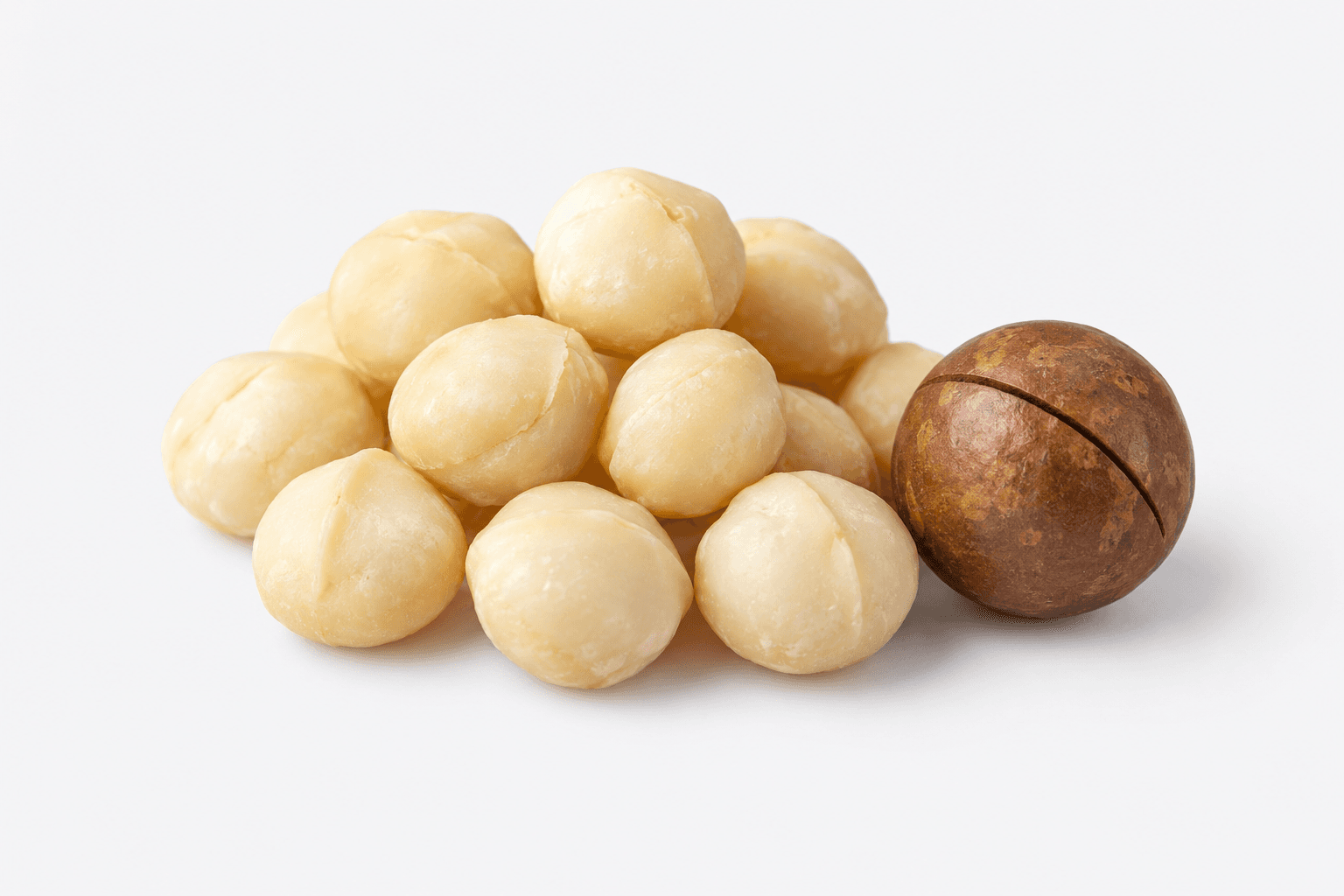
The macadamia is the seed of a tree native to eastern Australia — the only crop on this site that comes from there — and it is now grown heavily in Hawaii and South Africa as well. Its shell is among the hardest of any nut, too hard to crack by hand, which is why the nuts are usually sold with a slot already cut into them. The fat fraction is among the highest of any nut, and most of that fat is monounsaturated. That is what gives it the soft, buttery bite.
Scientific name Macadamia integrifolia
Macadamias carry more fat than any other common nut: 75.8 g per 100 g, at 718 kcal.
And there is a story that they lower cholesterol. A trial does support it — and another trial found the opposite. Put the two side by side and you can see what happened.
2008, The Journal of Nutrition — controlled feeding. Twenty-five mildly hypercholesterolaemic people ate a macadamia diet and an average American diet for five weeks each.
- Total cholesterol 5.45 → 4.94 mmol/L (p<0.05)
- LDL 3.44 → 3.14 mmol/L (p<0.05)
- Triglycerides unchanged
2023, Journal of Nutritional Science — free living. Thirty-five adults with abdominal obesity added macadamias at 15% of daily calories to their usual diet for eight weeks, and went without for eight.
- Weight, BMI, waist, percent body fat, glycaemic measures — no significant change in any
- Total cholesterol −2.1% (−4.3 mg/dl, 95% CI −14.8 to 6.1) — not significant
- LDL −4% (−4.7 mg/dl, 95% CI −14.3 to 4.8) — not significant
Look at where the difference sits. The 2008 macadamia diet ran at 7% saturated fat against a comparator at 13%. In 2023, saturated fat intake was unaltered.
So what moved the cholesterol was not adding macadamias. It was using them to push saturated fat out.
Key benefits
- Early research
It moved when saturated fat was swapped — not when nuts were merely added
[1][2]Two randomised trials that fed people macadamias give different answers. The difference between them is the point of this entry.
2008, The Journal of Nutrition.
- 25 mildly hypercholesterolaemic people (15 women, 10 men), randomised crossover controlled feeding, five weeks per diet
- Macadamia diet (MAC): 42.5 g (1.5 oz) per 2,100 kcal. 33% total fat, 7% saturated, 18% monounsaturated, 5% polyunsaturated
- Average American diet (AAD): 33% total fat, 13% saturated, 11% monounsaturated, 5% polyunsaturated
Outcome Macadamia diet American diet Total cholesterol 4.94 mmol/L 5.45 mmol/L p<0.05 LDL cholesterol 3.14 mmol/L 3.44 mmol/L p<0.05 Non-HDL cholesterol 3.83 4.26 p<0.05 Total:HDL ratio 4.60 4.89 p<0.05 LDL:HDL ratio 2.91 3.09 p<0.05 Triglycerides unchanged In mg/dL the total cholesterol gap is about 20 mg/dL and the LDL gap about 12 mg/dL. Not small.
2023, Journal of Nutritional Science.
- 35 adults with abdominal obesity, randomised crossover, eight weeks each, two-week washout
- Free-living. Macadamias added to the usual diet at about 15% of daily calories
- Body composition by bioelectrical impedance, intake by 24-hour recalls
Outcome Result Weight, BMI, waist, percent body fat no significant change Glycaemic measures no significant change Total cholesterol −2.1% (−4.3 mg/dl, 95% CI −14.8 to 6.1) — not significant LDL cholesterol −4% (−4.7 mg/dl, 95% CI −14.3 to 4.8) — not significant Total fat and MUFA intake increased Saturated fat intake unaltered Both confidence intervals cross zero. In this trial macadamias did not move the lipids.
So why the different answers?
First, the comparator differs. The 2008 trial measured a macadamia diet against a 13%-saturated-fat diet. What it shows is the result of taking saturated fat from 13% down to 7%. The 2023 trial laid macadamias on top of the usual diet, and saturated fat intake stayed put.
Second, the authors said so themselves. The closing sentence of the 2008 paper reads:
Nuts as an isocaloric substitute for high SFA foods increase the proportion of unsaturated fatty acids and decrease SFA, thereby lowering CVD risk.
That is not a sentence about macadamias being special. It is a sentence about displacing saturated fat.
Third, the 2023 trial carries a footnote of its own. The cholesterol lowering was larger in those with overweight rather than obesity, and in those below the median percent body fat. But that is a post-hoc split, and the overall result was not significant.
The honest conclusion:
- Use macadamias to replace fatty snacks or high-saturated-fat foods and the lipids may improve
- Simply add them to what you already eat and, as the 2023 trial showed, the lipids will probably stay where they are
- The trials held 25 and 35 people. Small
- The grade here is "early research"
- Nutrition data
75.8 g of fat, the most of any common nut — yet a fiftieth of an almond's vitamin E
Per 100 g of raw macadamias:
- 718 kcal — the highest of the common nuts
- Fat 75.8 g — saturated 12.1 g, monounsaturated 58.9 g, polyunsaturated 1.5 g
- Fibre 8.6 g, carbohydrate 13.8 g, sugar 4.57 g
- Protein 7.91 g
- Vitamin B1 (thiamin) 1.2 mg, manganese 4.13 mg
- Magnesium 130 mg, copper 0.756 mg, potassium 368 mg, iron 3.69 mg
- Vitamin E 0.54 mg, sodium 5 mg, cholesterol 0
Per handful (30 g, about twelve nuts):
100 g A handful (30 g) Energy 718 kcal 215 kcal Fat 75.8 g 22.7 g Monounsaturated 58.9 g 17.7 g Fibre 8.6 g 2.6 g Vitamin B1 1.2 mg 0.36 mg The 58.9 g of monounsaturated fat is what this nut is. About 78% of its fat is monounsaturated — the same family as olive oil's main component, and the highest such proportion among the common nuts.
Vitamin B1 is 1.2 mg. Adult requirements sit around 1.2 mg for men and 1.1 mg for women, so 100 g covers more than a day. Even a handful gives 0.36 mg, roughly 30% of a day. That is a standout number among nuts.
Manganese at 4.13 mg is also high, above the adequate intake of about 4.0 mg for men and 3.5 mg for women.
But vitamin E is 0.54 mg. This is where the balance belongs. Almonds hold about 25 mg per 100 g. Macadamias are not a vitamin E source. The generalisation that nuts are rich in vitamin E does not hold for this one.
The 718 kcal has to be taken as it is, the highest of the common nuts:
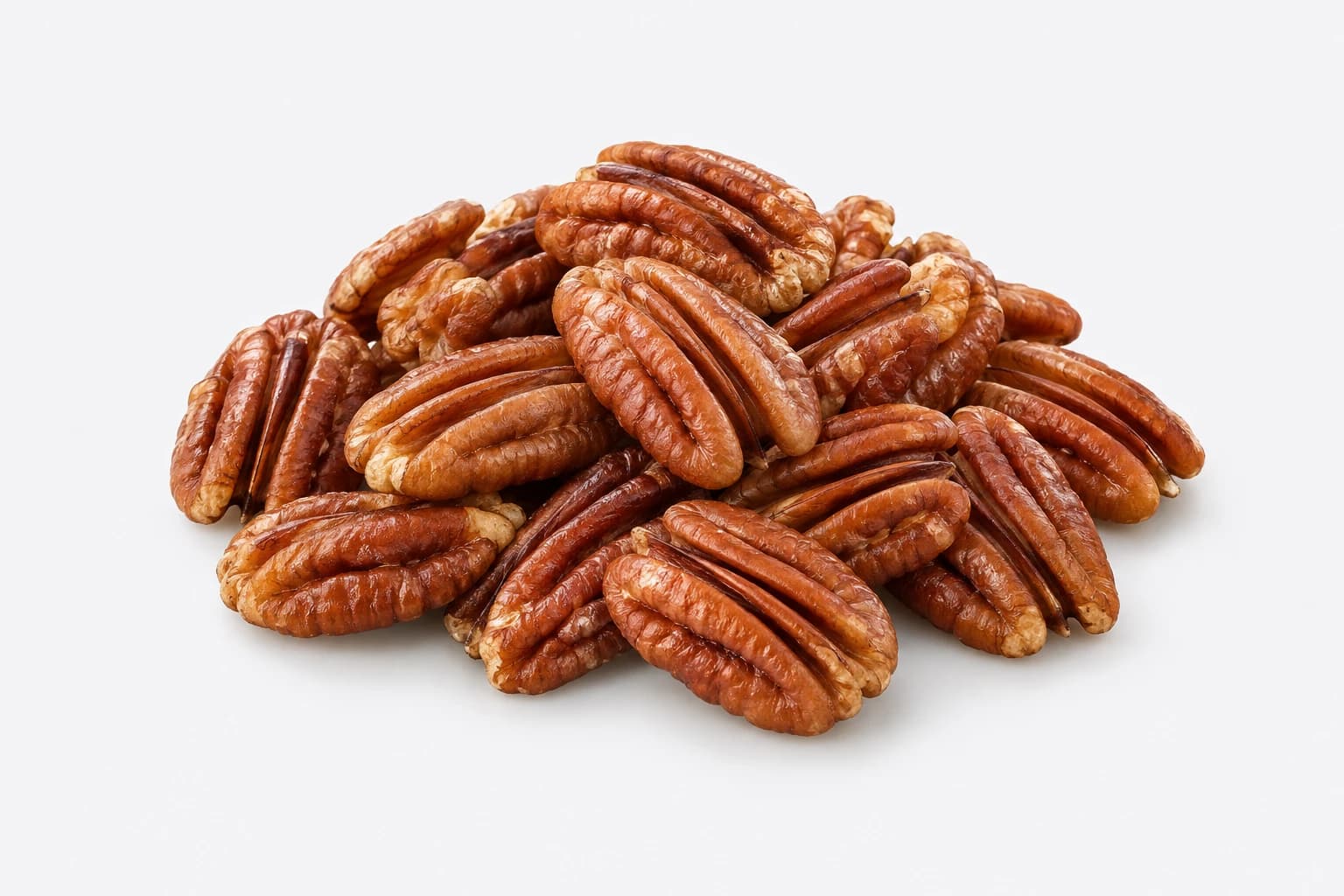
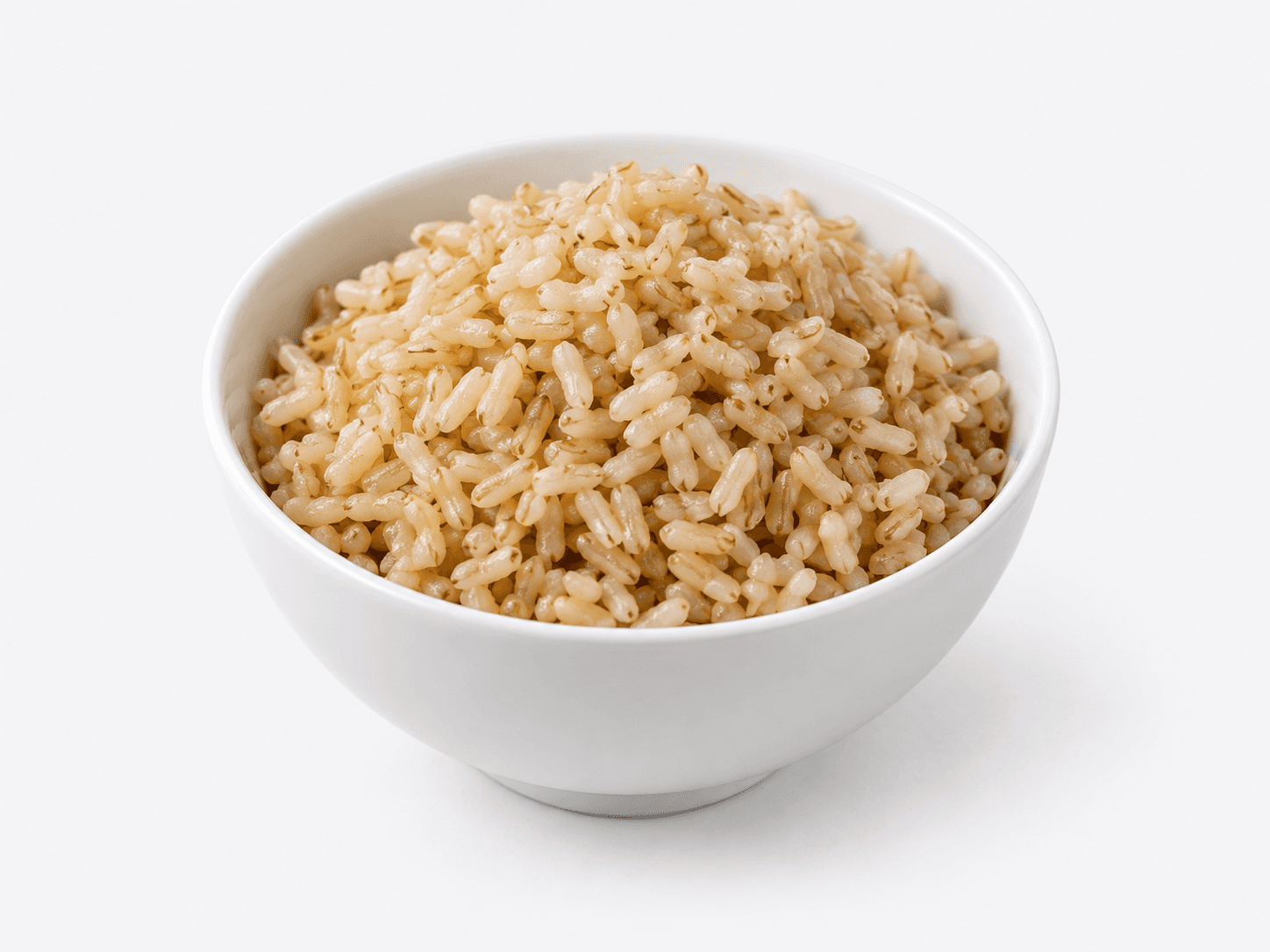
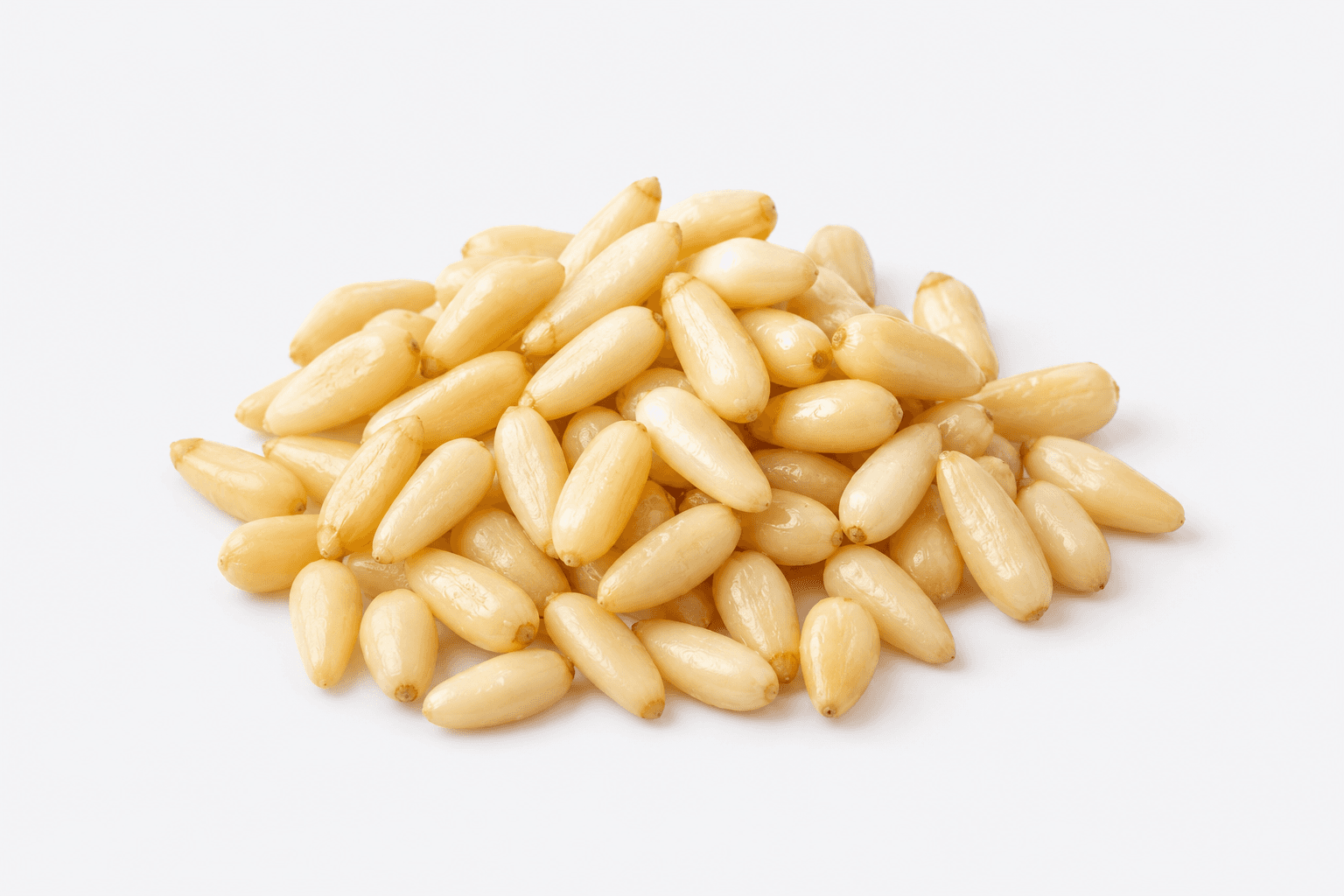
Nut Energy Fat Macadamia 718 kcal 75.8 g Walnut 654 kcal 65.2 g Pine nut 673 kcal 68.4 g Almond 579 kcal 49.9 g A handful is 215 kcal, about two-thirds of a bowl of rice. Count them.
The shell is hard. Macadamia shells are among the hardest of any nut and resist cracking by hand; what you buy is almost always already shelled.
Store them sealed and refrigerated. All that fat goes rancid quickly. Discard them if they taste bitter or soft.
- Not established
The weight worry the evidence answers, and the danger it confirms — for dogs
Two separate things here: a worry the evidence contradicts, and a hazard the evidence confirms.
First, weight. At 718 kcal per 100 g, worrying about weight gain is reasonable.
The 2023 trial looked at exactly that. Thirty-five adults with abdominal obesity spent eight weeks adding macadamias at 15% of daily calories to their usual diet. Adding, with nothing taken away.
No significant change in weight, BMI, waist circumference or percent body fat.
The paper's summary sentence is that daily macadamia consumption does not lead to gains in weight or body fat under free-living conditions in overweight or obese adults.
Let us not overstate it. Thirty-five people, eight weeks. And the result does not mean the calories do not count. Nuts are filling, take time to chew, and some of their fat stays trapped in cell walls and passes through — that is the usual explanation. Eating from the bag without counting is a different matter.
Now the confirmed hazard — do not give them to dogs.
Macadamias are established as toxic to dogs. Within roughly twelve hours of eating them dogs typically show hind-limb weakness, an unsteady gait, vomiting, tremors and fever. The responsible compound has not been identified. Most recover within a few days, but a dog showing symptoms needs a vet.
This is separate from the human story. No comparable reaction has been reported in people. But it genuinely matters to anyone who keeps macadamias at home, and it is routinely left out of articles about them. Treat it the way you treat chocolate and dogs.
With a tree nut allergy, macadamias belong on the list. If you have reacted to another nut, be careful the first time.
How to eat it well
- A handful is 30 g, about twelve nuts, 215 kcal. Portion them out rather than eating from the bag.
- Replace rather than add. The lipid effect belongs to swapping out fatty snacks.
- Do not expect vitamin E — 0.54 mg per 100 g, about a fiftieth of an almond's.
- Store sealed and refrigerated. The fat turns rancid quickly.
- Bitterness or softness means rancid. Throw them out.
- Check the sodium on salted products. Raw macadamias hold 5 mg per 100 g.
- A brief toast in a dry pan lifts the aroma. They are fatty and colour fast, so keep the heat low and the time short.
- Never give them to a dog. They are toxic to dogs.
How to read the grades
Each benefit carries a label showing how far research on people supports it. Grades differ between items even within the same ingredient.
- Nutrition data
- A fact verifiable from food composition databases or health authorities. This is a different kind of statement from a clinical effect.
- Strong evidence
- Consistently confirmed across randomised controlled trials or meta-analyses.
- Moderate evidence
- Human studies exist, but effect sizes are small or results are mixed.
- Early research
- Cell or animal work, or small preliminary studies.
- Not established
- Commonly claimed, but not confirmed in studies on people.
What to watch out for
- Toxic to dogs, with hind-limb weakness, unsteady gait, vomiting, tremors and fever reported. Keep them out of reach if you have a dog.
- The trial that improved lipids was controlled feeding at 7% saturated fat. The trial that merely added nuts to the usual diet found no significant change.
- The trials held 25 and 35 people.
- 718 kcal per 100 g, the highest of the common nuts. Even a handful is 215 kcal.
- Vitamin E is low, contrary to the general image of nuts.
- With a tree nut allergy, macadamias count.
- The high fat goes rancid quickly. Do not eat them if they taste bitter.
Nutrition
Per 100 g of raw macadamia nuts. A handful is 30 g, roughly twelve nuts, so the figures below are more than three handfuls.
- Calories
- 718 kcal36%
- Fat
- 75.8 g97%
- Fiber
- 8.6 g31%
- Carbohydrates
- 13.8 g5%
- Sugars
- 4.57 g
- Protein
- 7.91 g16%
- Vitamin B1
- 1.2 mg100%
- Manganese
- 4.13 mg180%
- Magnesium
- 130 mg31%
- Copper
- 0.756 mg84%
- Potassium
- 368 mg8%
- Iron
- 3.69 mg21%
- Vitamin E
- 0.54 mg4%
- Sodium
- 5 mg<1%
Percentages are of the US FDA Daily Value for adults and children 4 and over. National reference intakes differ by sex and age.
Calculate this alongside other ingredients →
Key nutrients
Dishes with this ingredient
Sources
The databases and health authorities this article's nutrition figures and health statements draw on.
- 1A macadamia nut-rich diet reduces total and LDL-cholesterol in mildly hypercholesterolemic men and womenClinical trialGriel AE, et al. The Journal of Nutrition 2008PMID 18356332
- 2Macadamia nut effects on cardiometabolic risk factors: a randomised trialClinical trialJones JL, et al. Journal of Nutritional Science 2023PMID 37180485
- 3USDA FoodData CentralFood composition database
- 4PubMedResearch literature
- 5NIH Office of Dietary SupplementsHealth authority