Contents
What it is
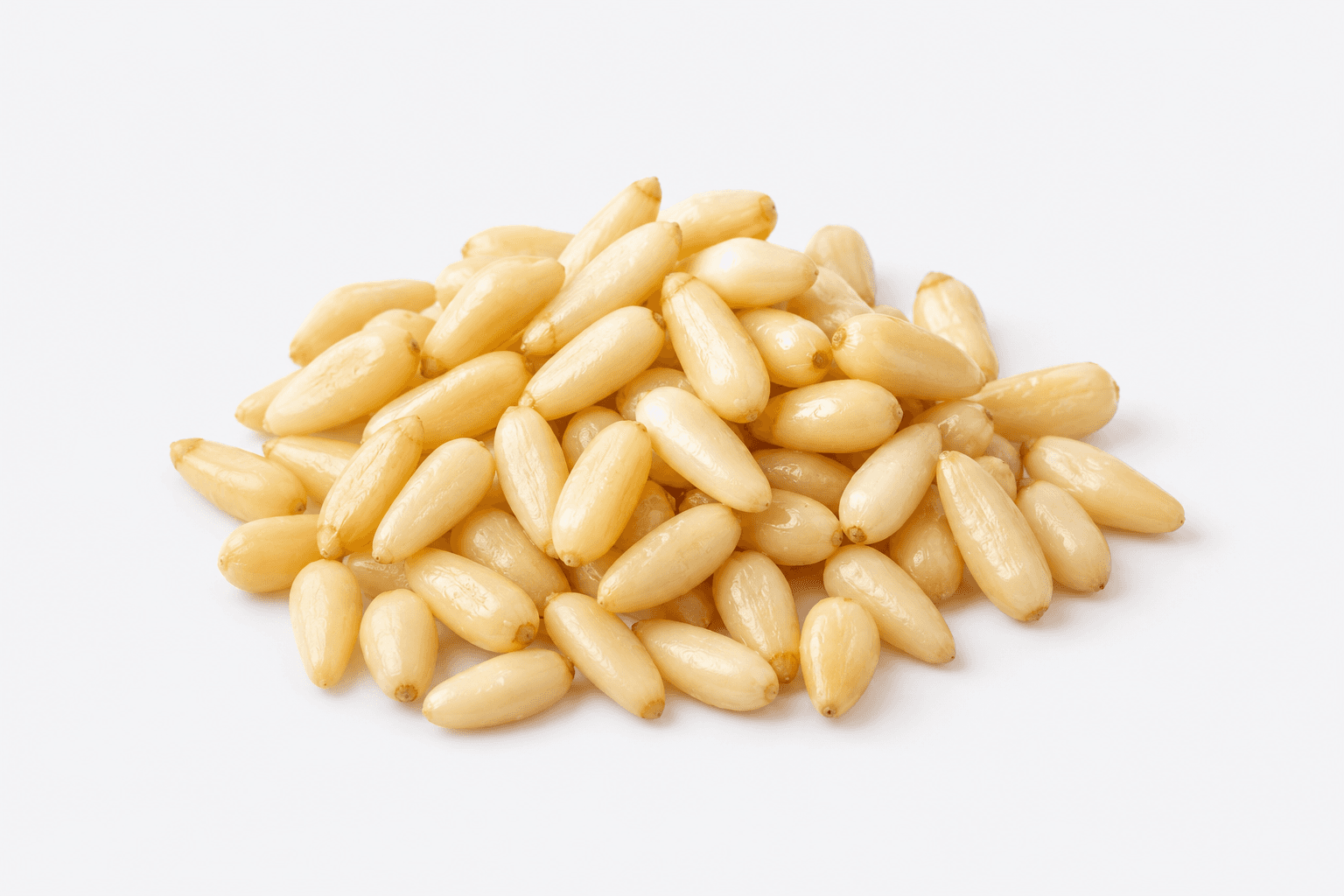
The pine nut is the seed inside the cone of the Korean pine. The tree grows in Korea, northeastern China and the Russian Far East, and within Korea the Gapyeong crop is the best known. A cone takes two years to mature and someone has to climb the tree to gather it, which puts pine nuts among the most expensive nuts there are. They are soft and oily enough that the fat spreads as you chew, and Korean cooking uses them in porridge, in cinnamon punch and as a garnish on rice cakes. They go rancid very fast, so the freezer is the safe place for them. Rarely, people report a bitter taste that lingers for days after eating them.
Scientific name Pinus koraiensis
In Korea pine nuts float on cinnamon punch and sweet rice, are ground into porridge and scattered over vegetable dishes. They are not a nut you eat by the handful.
And there is a claim that they suppress appetite. One trial supports it, and reading that trial precisely is what this page is for.
2008, Lipids in Health and Disease. Eighteen overweight post-menopausal women were given capsules with a light breakfast, and gut hormones and appetite sensations were measured over four hours.
What was in the capsules matters.
- 3 g of free fatty acids from Korean pine (Pinus koraiensis)
- or 3 g of pine nut triglycerides
- or 3 g of placebo (olive oil)
Nobody was fed pine nuts. The fat was separated out and put into a capsule.
The results:
- Total CCK over four hours 60% higher than placebo (free fatty acids), 22% higher (triglycerides)
- GLP-1 25% higher (free fatty acids)
- Ghrelin and PYY: no difference
- The item "prospective food intake" was 36% lower
Look at that last line. It is not how much anyone ate. It is a questionnaire score asking how much they thought they could eat. This trial never put a meal in front of participants and measured what they took.
Key benefits
- Early research
The gut hormones rose — but it was pine nut oil, and intake was never measured
[1]2008, Lipids in Health and Disease. A cell experiment and a human trial are bundled into one paper.
The cell part. Several fatty acids were applied to STC-1 cells and CCK secretion compared. At 50 μM, Korean pine nut free fatty acids produced 493 pg/ml, the most of any tested, against 46 pg/ml for the capric acid control. Italian stone pine fatty acids, oleic, linoleic and alpha-linolenic acids were also compared.
The human part.
- 18 overweight post-menopausal women, randomised double-blind crossover
- 3 g capsules with a light breakfast: Korean pine nut free fatty acids / pine nut triglycerides / placebo (olive oil)
- CCK, GLP-1, PYY, ghrelin and appetite sensations measured at 0, 30, 60, 90, 120, 180 and 240 minutes
- One week of washout between intervention days
Outcome Result CCK at 30 minutes higher than placebo with free fatty acids (p<0.01) CCK at 60 minutes higher than placebo with triglycerides (p<0.01) CCK, four-hour total free fatty acids +60%, triglycerides +22% (p<0.01) GLP-1 at 60 minutes higher than placebo with free fatty acids (p<0.01) GLP-1, four-hour total free fatty acids +25% (p<0.05) Ghrelin no difference PYY no difference "Prospective food intake" 36% lower with free fatty acids (p<0.05) How to read that table precisely.
First, the intervention was not pine nuts. It was 3 g of fatty acids extracted from them. Pine nuts are 68.4 g fat per 100 g, so 3 g of fat corresponds to roughly 4–5 g of nuts — but chewing whole nuts and swallowing isolated fatty acids in a capsule are not the same intervention. Isolated free fatty acids reach the gut receptors without needing digestion.
Second, actual intake was not measured. That last row, "prospective food intake", is a visual analogue scale questionnaire item — the answer to "how much do you think you could eat right now?" No buffet was set in front of anyone and weighed. For appetite suppressants, those two often part ways.
Third, hunger itself is not reported as moving. The only appetite item the abstract reports as significant is prospective food intake.
Fourth, ghrelin and PYY did not move. Ghrelin is the hormone best known as a hunger signal. For a claim about appetite suppression, that is not a welcome result.
Fifth, the placebo was olive oil. Olive oil is also fat and also releases CCK. So this was fat against fat, not fat against nothing, which makes the observed difference more plausibly specific to pine nut fatty acids. That is a strength of the design.
Sixth, 18 people, one meal, four hours. It says nothing about weight or about intake over time.
The honest conclusion:
- That pine nut fatty acids raise CCK and GLP-1 was observed in this trial
- Whether that makes anyone eat less, this trial did not answer
- And the result belongs to an oil capsule, not to a handful of nuts
- The grade here is "early research"
- Nutrition data
8.8 mg of manganese and 251 mg of magnesium — meaningful even at scattering quantities
Per 100 g of dried pine nuts:
- 673 kcal, fat 68.4 g — saturated 4.9 g, monounsaturated 18.8 g, polyunsaturated 34.1 g
- Protein 13.7 g, carbohydrate 13.1 g, fibre 3.7 g
- Manganese 8.8 mg, magnesium 251 mg, phosphorus 575 mg, potassium 597 mg
- Zinc 6.45 mg, iron 5.53 mg, copper 1.32 mg
- Vitamin E 9.33 mg, vitamin K 53.9 µg
- Calcium 16 mg, sodium 2 mg
Pine nuts are not eaten by the handful, so a tablespoon (10 g) is the more realistic basis.
100 g A tablespoon (10 g) Share of a day Energy 673 kcal 67 kcal Manganese 8.8 mg 0.88 mg 22% men, 25% women Magnesium 251 mg 25 mg about 6–8% Zinc 6.45 mg 0.65 mg 6% men, 8% women Vitamin K 53.9 µg 5.4 µg about 5–7% Fat 68.4 g 6.8 g The 8.8 mg of manganese is the standout. Adequate intake for adults sits around 4.0 mg for men and 3.5 mg for women, so 100 g is more than double. A single tablespoon reaches a quarter of a day. That is a rare case where a scattering quantity still counts.
Polyunsaturated fat at 34.1 g is half the fat. The opposite end from macadamia (1.5 g) and the olive oil family. But a lot of polyunsaturated fat also means fast rancidity.
Zinc at 6.45 mg is high, near the top among nuts — not oyster territory, but good for a plant food.
Calcium is low at 16 mg. A different world from sesame (975 mg) or almonds. Do not treat pine nuts as a calcium source.
Storage matters. With 34 g of polyunsaturated fat, they go rancid quickly at room temperature. Keep them sealed in the fridge or freezer; freezing does not make them hard. Bitterness means rancid — throw them out.
Toast them low and short. All that fat burns fast. Two to three minutes in a dry pan, judged by aroma rather than colour.
Remove the cap. The small brown cap on the pointed end tastes astringent, and it is usual to pick it off for porridge or garnish.
- Not established
If everything tastes metallic a few days later — that is pine mouth
[2]This entry is about a documented phenomenon, and one that is largely missing from Korean-language material.
Pine mouth, or pine nut syndrome. A 2012 review in Seminars in Neurology records that at least several thousand cases have now been described in the literature.
The case definition:
- Begins one to three days after eating affected pine nuts
- A taste disturbance, usually described as bitter or metallic
- Generally without pain or other systemic symptoms
What is blamed. The author writes that affected nuts appear to include all, or some portion, of nuts harvested from Pinus armandii (Chinese white pine), and could include other species. But the specific toxin has not yet been isolated, and the paper states plainly that the mechanism of toxicity and the factors determining susceptibility need further work.
Treatment. The paper's sentence:
There are no proven therapies for pine mouth. The only treatment is to cease ingesting implicated nuts and to wait for symptoms to abate.
It usually clears within days to a couple of weeks.
There is a reason this is worth knowing. Because it starts a day or two afterwards, people do not connect it to the pine nuts. Unnecessary investigations chasing the cause have been reported. If everything tastes bitter or metallic within a few days of eating pine nuts, suspect the pine nuts first.
And this connects back to the earlier section.
The claim that pine nuts suppress appetite rests on one trial of oil capsules. This site has not found a trial showing that eating pine nuts reduces appetite or body weight. Increasing pine nuts for weight loss cannot be recommended on the current evidence. They are 673 kcal per 100 g, and even a tablespoon is 67 kcal.
There is a better case for pine nuts — that manganese, magnesium and zinc arrive even in scattering quantities. That part is confirmed.
How to eat it well
- A tablespoon is about 10 g and 67 kcal. A scattering quantity is enough.
- Seal them in the fridge or freezer. All that polyunsaturated fat turns rancid fast at room temperature.
- Bitterness means rancid. Throw them out.
- Toast two to three minutes in a dry pan over low heat, judging by aroma rather than colour.
- Pick off the brown cap to lose the astringency.
- Ground into porridge or vegetable dishes the fat adds richness and helps fat-soluble vitamins from other ingredients.
- Not a calcium source — 16 mg per 100 g.
- Do not scale them up expecting appetite suppression. The evidence is one oil-capsule trial, and the calories arrive regardless.
How to read the grades
Each benefit carries a label showing how far research on people supports it. Grades differ between items even within the same ingredient.
- Nutrition data
- A fact verifiable from food composition databases or health authorities. This is a different kind of statement from a clinical effect.
- Strong evidence
- Consistently confirmed across randomised controlled trials or meta-analyses.
- Moderate evidence
- Human studies exist, but effect sizes are small or results are mixed.
- Early research
- Cell or animal work, or small preliminary studies.
- Not established
- Commonly claimed, but not confirmed in studies on people.
What to watch out for
- Pine mouth is documented. A bitter or metallic taste one to three days after eating points at the pine nuts. There is no proven treatment; stopping usually resolves it.
- The appetite trial used 3 g capsules of extracted fatty acids, not pine nuts, and never measured actual intake.
- Ghrelin and PYY did not move in that trial.
- Eighteen people, one meal, four hours. It says nothing about weight.
- 673 kcal per 100 g, and 67 kcal even in a tablespoon.
- With a tree nut allergy, pine nuts need checking too.
- They go rancid quickly. Avoid storing them at room temperature.
Nutrition
Per 100 g of dried pine nuts. Pine nuts are scattered over food rather than eaten by the handful. A tablespoon is about 10 g, so the figures below are ten tablespoons.
- Calories
- 673 kcal34%
- Fat
- 68.4 g88%
- Protein
- 13.7 g27%
- Manganese
- 8.8 mg383%
- Magnesium
- 251 mg60%
- Phosphorus
- 575 mg46%
- Potassium
- 597 mg13%
- Zinc
- 6.45 mg59%
- Iron
- 5.53 mg31%
- Copper
- 1.32 mg147%
- Vitamin E
- 9.33 mg62%
- Vitamin K
- 53.9 µg45%
- Fiber
- 3.7 g13%
- Sodium
- 2 mg<1%
Percentages are of the US FDA Daily Value for adults and children 4 and over. National reference intakes differ by sex and age.
Calculate this alongside other ingredients →
Key nutrients
Dishes with this ingredient
Sources
The databases and health authorities this article's nutrition figures and health statements draw on.
- 1The effect of Korean pine nut oil on in vitro CCK release, on appetite sensations and on gut hormones in post-menopausal overweight womenClinical trialPasman WJ, et al. Lipids in Health and Disease 2008PMID 18355411
- 2Pine mouth (pine nut) syndrome: description of the toxidrome, preliminary case definition, and best evidence regarding an apparent etiologySystematic reviewsMunk MD Seminars in Neurology 2012PMID 23677661
- 3USDA FoodData CentralFood composition database
- 4PubMedResearch literature
- 5NIH Office of Dietary SupplementsHealth authority