Contents
What it is
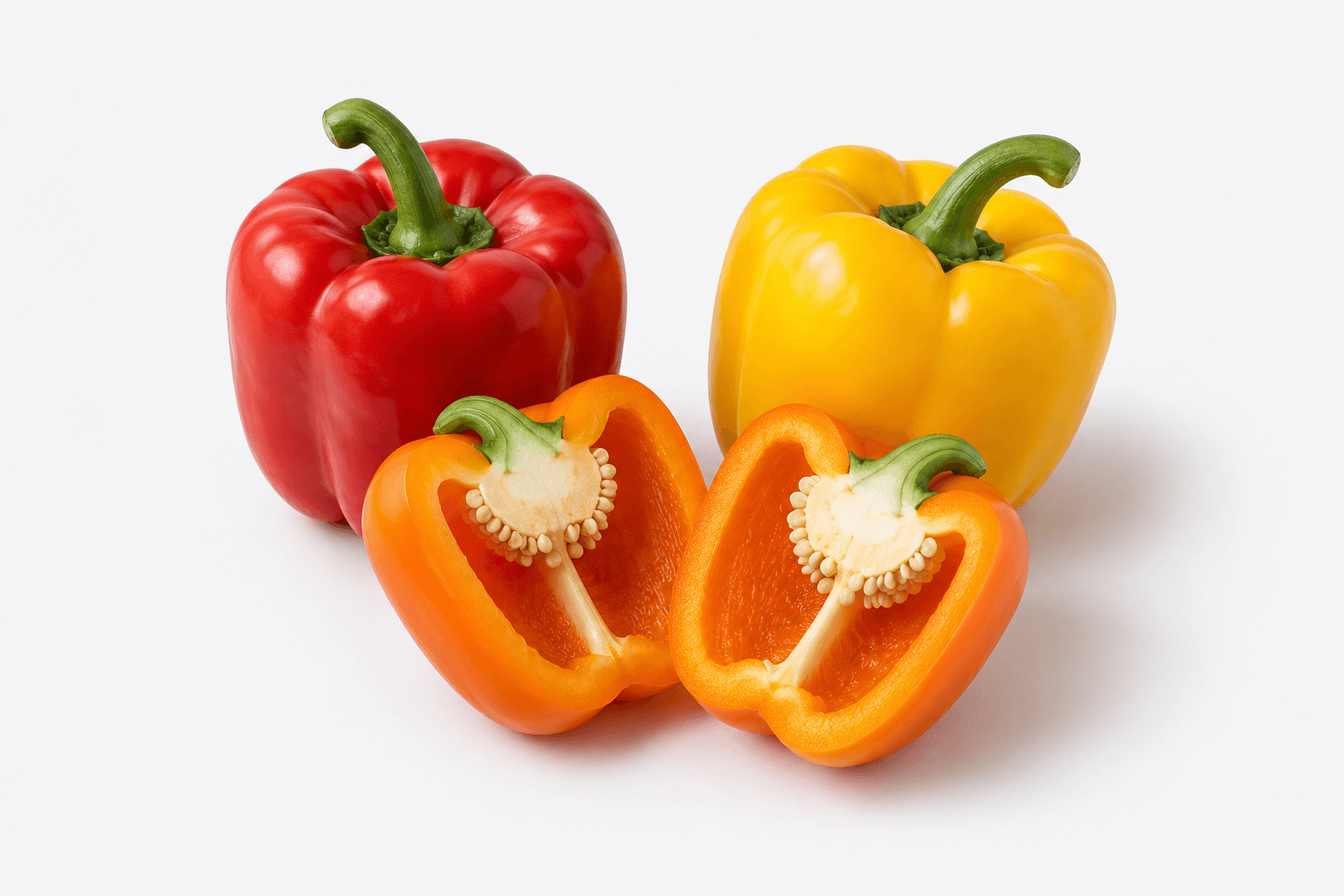
The bell pepper is the fruit of a plant in the nightshade family and the very same species as the chilli. It is native to Central and South America. It has been bred to carry almost no capsaicin, which is why it is sweet rather than hot despite sharing a species with the chilli. Green, yellow, orange and red are mostly stages of ripeness, and sweetness and pigment both rise as the fruit ripens. It is eaten raw for the crunch, or roasted, which loosens the skin and deepens the sweetness.
Scientific name Capsicum annuum
Vitamin C brings citrus to mind, but the actual leaders include the red bell pepper: 128 mg per 100 g, more than double an orange's 53 mg.
The adult requirement is 75–90 mg, so half a pepper covers it.
Most of vitamin C's reputation, though, is attached to colds — and here honesty is required. In the Cochrane review (11,306 people, 29 comparisons), cold incidence in the general population was not reduced. What fell was duration, by about 8 %.
There are good reasons to eat peppers. Preventing colds is not one of them.
Key benefits
- Nutrition data
128 mg of vitamin C — one and a half times the daily requirement
Raw red bell pepper carries 128 mg of vitamin C per 100 g, clearing the adult requirement of 75–90 mg in one go.
For comparison: orange 53 mg, strawberry 59 mg, broccoli 89 mg, lemon 53 mg. It sits at the top of commonly eaten produce.
Colour matters a lot. Green peppers run about 80 mg, yellow 184 mg and red 128 mg. Green is simply unripe; vitamin C and carotenoids rise as the fruit ripens.
Alongside it: 1,620 µg of beta-carotene (157 µg RAE of vitamin A), 0.29 mg of vitamin B6 and 1.58 mg of vitamin E. Few vegetables carry that much vitamin E.
Vitamin C also sharply raises non-haem iron absorption. If your iron comes from beans, greens or grains, putting peppers on the same plate is a practical move.
- Not established
Cold prevention was not confirmed
[1]The Cochrane review on vitamin C and the common cold. Across 29 comparisons (11,306 people) of regular supplementation, the pooled risk ratio in the general community — 10,708 people — was 0.97 (95 % CI 0.94–1.00): effectively nothing.
There is an exception. Among 598 marathon runners, skiers and soldiers on subarctic exercises, the risk ratio was 0.48 (0.35–0.64) — nearly halved. That result belongs to extreme physical stress.
Duration did fall: by 8 % (3–12 %) in adults and 14 % (7–21 %) in children, and up to 18 % in children taking 1–2 g a day.
A crucial caveat: the review excluded trials using less than 0.2 g a day. These are supplement trials at 200 mg and above, and a single pepper (about 128 mg) does not reach that dose.
In short, there is no evidence behind 'eat peppers and you won't catch colds'.
- Moderate evidence
The evidence is about eating more vegetables
[2]A dose–response meta-analysis of 95 prospective studies (142 publications). For every extra 200 g a day of fruit and vegetables, relative risks were 0.92 for coronary heart disease, 0.84 for stroke, 0.92 for cardiovascular disease and 0.90 for all-cause mortality.
Bell peppers are only 26 kcal per 100 g, so they add volume cheaply. One pepper is usually about 150 g — roughly 40 kcal.
Being pleasant raw is a practical advantage too. Not many vegetables deliver their vitamin C intact, without cooking losses.
That said, this evidence is pooled observational data, and it is about total vegetables, not about peppers.
How to eat it well
- Raw, if you are after the vitamin C. It is heat- and water-sensitive; boiling destroys or leaches much of it.
- With oil, if you are after the carotenoids. The two nutrients want opposite handling — alternate raw and sautéed.
- Red and yellow are riper than green. More sweetness, more vitamin C, more carotenoids.
- If your iron is low, add peppers to bean and greens dishes. Vitamin C raises non-haem iron absorption.
- Washed and refrigerated they keep about a week. They soften from the stem end, so check there.
How to read the grades
Each benefit carries a label showing how far research on people supports it. Grades differ between items even within the same ingredient.
- Nutrition data
- A fact verifiable from food composition databases or health authorities. This is a different kind of statement from a clinical effect.
- Strong evidence
- Consistently confirmed across randomised controlled trials or meta-analyses.
- Moderate evidence
- Human studies exist, but effect sizes are small or results are mixed.
- Early research
- Cell or animal work, or small preliminary studies.
- Not established
- Commonly claimed, but not confirmed in studies on people.
What to watch out for
- Do not expect cold prevention. The Cochrane review above is why.
- High-dose vitamin C supplements raise the risk of diarrhoea and kidney stones. The upper limit is 2,000 mg a day — hard to reach with peppers.
- The claim that nightshades worsen arthritis is widespread, but I could not find reliable human evidence for it.
- Oral allergy syndrome. With birch or mugwort pollen allergy, raw peppers can make the mouth itch. Cooking usually resolves it.
- The figures above are for raw red pepper. Vitamin C ranges from about 80 to 184 mg depending on colour and ripeness.
Nutrition
Approximate values per 100 g edible portion.
- Calories
- 26 kcal1%
- Carbohydrates
- 6.0 g2%
- Fiber
- 2.1 g8%
- Vitamin C
- 128 mg142%
- Vitamin A
- 157 µg17%
- Beta-carotene
- 1620 µg
- Vitamin B6
- 0.29 mg17%
- Vitamin E
- 1.58 mg11%
- Folate
- 46 µg12%
- Potassium
- 211 mg4%
Percentages are of the US FDA Daily Value for adults and children 4 and over. National reference intakes differ by sex and age.
Calculate this alongside other ingredients →
Key nutrients
Dishes with this ingredient
Sources
The databases and health authorities this article's nutrition figures and health statements draw on.
- 1Vitamin C for preventing and treating the common coldMeta-analysisHemilä H, et al. Cochrane Database Syst Rev 2013PMID 23440782
- 2Fruit and vegetable intake and the risk of cardiovascular disease, total cancer and all-cause mortality-a systematic review and dose-response meta-analysis of prospective studiesMeta-analysisAune D, et al. Int J Epidemiol 2017PMID 28338764
- 3USDA FoodData CentralFood composition database
- 4NIH Office of Dietary SupplementsHealth authority
- 5Cochrane LibrarySystematic reviews
- 6PubMedResearch literature