Contents
What it is
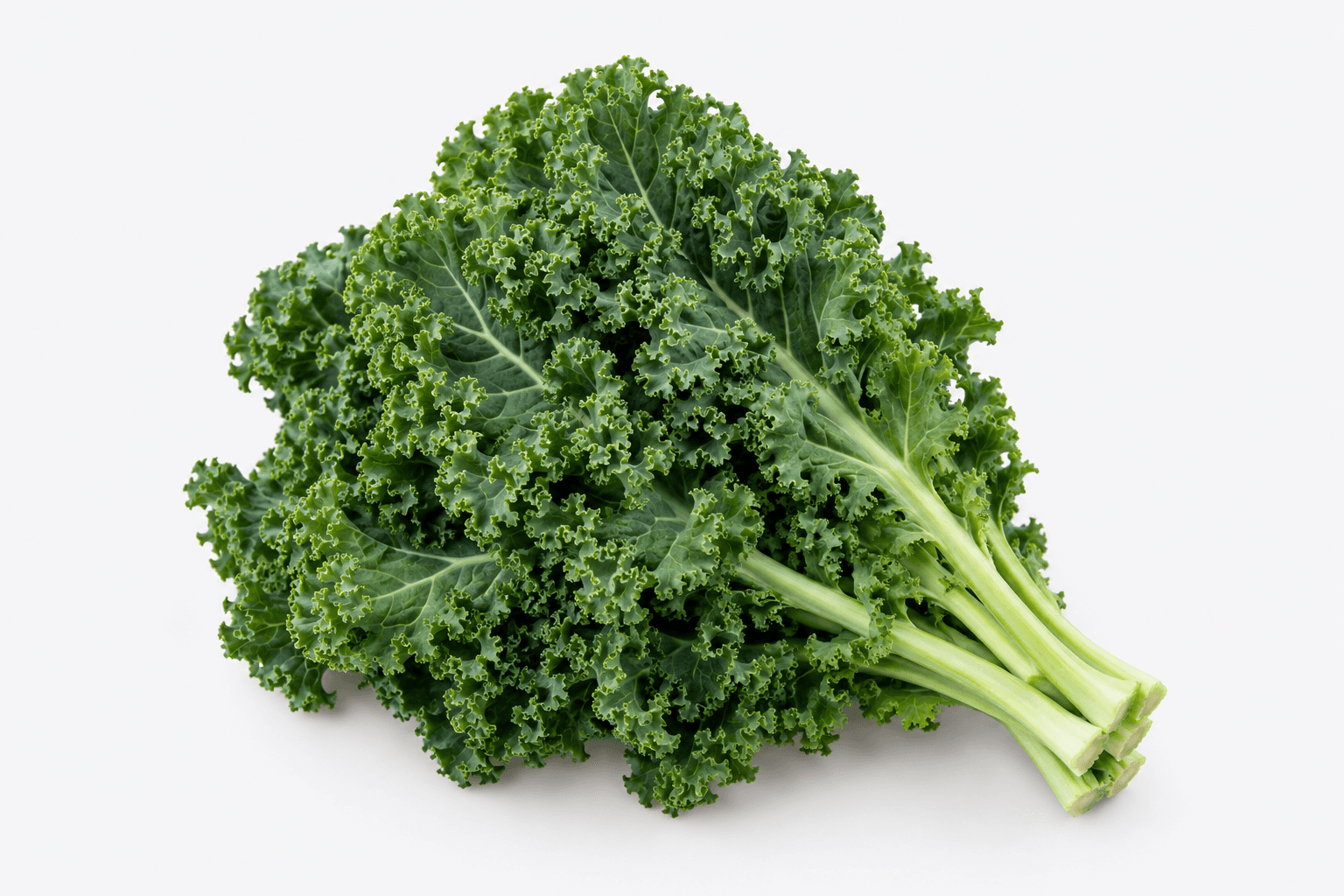
Kale is a variety of the cabbage species whose leaves never close into a head but grow open — the species epithet acephala means headless. It shares that species with broccoli, cauliflower and Brussels sprouts. It is native to the Mediterranean and the coasts of Europe. The leaves are thick, tough and somewhat bitter, so for raw use the stems are stripped out and the leaves massaged by hand until they soften. A frost brings the sweetness up.
Scientific name Brassica oleracea var. acephala
Kale has sat near the top of superfood lists for years. On the composition table, fair enough: 35 kcal carrying 390 µg of vitamin K, 93.4 mg of vitamin C and 254 mg of calcium.
The lutein story is different. Kale holds 6,260 µg of lutein and zeaxanthin per 100 g, and that figure is what usually gets cited for eye health. But in the primary analysis of AREDS2, a randomised trial in 4,203 people, lutein + zeaxanthin supplementation did not significantly slow progression to advanced macular degeneration.
Introducing kale without that fact would not be honest.
Key benefits
- Nutrition data
390 µg of vitamin K — one plate is three times the daily need
Raw kale carries 390 µg of vitamin K (phylloquinone) per 100 g. Adequate intake is 120 µg for men and 90 µg for women, so it clears three times over.
Vitamin K is the cofactor that lets clotting factors and bone osteocalcin do their job.
Calcium is 254 mg, high for a vegetable — and unlike spinach, kale is low in oxalate, so much of it is actually absorbable. Spinach's calcium is mostly bound up and lost; kale's largely is not.
Vitamin C at 93.4 mg beats an orange (53 mg), though it is heat-sensitive and much of it goes in cooking.
See the cautions below about warfarin. All that vitamin K is a strength and a thing to watch at the same time.
- Not established
Plenty of lutein, but the eye evidence is not established
[1]Kale's lutein and zeaxanthin come to 6,260 µg per 100 g — top of the commonly eaten vegetables.
The human evidence, though, is not simple. AREDS2 was a double-masked phase 3 trial randomising 4,203 people aged 50–85 at risk of progression to advanced macular degeneration, giving lutein 10 mg + zeaxanthin 2 mg over five years.
Progression at five years was 31 % on placebo and 29 % on lutein + zeaxanthin. In the primary analysis the hazard ratio was 0.90 (98.7 % CI 0.76–1.07), P = 0.12 — not significant.
What the trial did show is that more lung cancers occurred in the beta-carotene arm, mostly among former smokers, so the authors concluded that lutein + zeaxanthin is an appropriate carotenoid substitute in the formulation. That is 'safer replacement', not 'it works'.
Also: the trial used supplements, in people already at risk. That is not the same situation as a healthy person eating kale. The honest statement today stops at 'kale is rich in lutein'.
- Moderate evidence
Leafy greens and crucifers — the mortality and cardiovascular evidence
[2]A dose–response meta-analysis pooled 95 prospective studies (142 publications). For every extra 200 g a day of fruit and vegetables, relative risks were 0.92 for coronary heart disease, 0.84 for stroke, 0.92 for cardiovascular disease and 0.90 for all-cause mortality.
The analysis also split by type. Green leafy vegetables and cruciferous vegetables were inversely associated with cardiovascular disease and all-cause mortality, and crucifers and green-yellow vegetables with total cancer risk. Kale is both.
Risk kept falling up to 800 g a day (600 g for cancer).
These are pooled observational studies, so not causation. But the natural reading is 'because you ate more vegetables', not 'because it was kale' — and that reading is easier to act on.
How to eat it well
- Raw for the vitamin C; with fat for the carotenoids. The two goals ask for opposite handling.
- Lutein and beta-carotene are fat-soluble. A little olive oil in the pan, or eating it alongside avocado, raises absorption.
- The stems are tough — strip the leaves. Chop the stems finely for a stir-fry instead of discarding them.
- Massage the leaves when eating raw. Breaking the cell walls softens the texture.
- Blanching leaches some vitamin C and K into the water. Dishes that use the liquid come out ahead.
How to read the grades
Each benefit carries a label showing how far research on people supports it. Grades differ between items even within the same ingredient.
- Nutrition data
- A fact verifiable from food composition databases or health authorities. This is a different kind of statement from a clinical effect.
- Strong evidence
- Consistently confirmed across randomised controlled trials or meta-analyses.
- Moderate evidence
- Human studies exist, but effect sizes are small or results are mixed.
- Early research
- Cell or animal work, or small preliminary studies.
- Not established
- Commonly claimed, but not confirmed in studies on people.
What to watch out for
- On warfarin (Coumadin), check first. Vitamin K directly opposes the drug. This does not mean cutting kale out; it means keeping your intake steady and telling your doctor. Sudden increases or drops are the danger.
- With low thyroid function, cruciferous goitrogens can matter. With adequate iodine, ordinary portions are not a real concern, and cooking reduces them. Drinking large amounts of raw kale juice daily is the pattern I would not recommend.
- With a history of kidney stones, oxalate here is far lower than spinach but not zero.
- Potassium is 348 mg. Count it on a potassium-restricted renal diet.
- AREDS2 above was a supplement trial and its primary analysis was not significant.
Nutrition
Approximate values per 100 g edible portion.
- Calories
- 35 kcal2%
- Protein
- 2.9 g6%
- Carbohydrates
- 4.4 g2%
- Fiber
- 4.1 g15%
- Vitamin K
- 390 µg325%
- Vitamin C
- 93.4 mg104%
- Vitamin A
- 241 µg27%
- Beta-carotene
- 2870 µg
- Lutein
- 6260 µg
- Calcium
- 254 mg20%
- Potassium
- 348 mg7%
Percentages are of the US FDA Daily Value for adults and children 4 and over. National reference intakes differ by sex and age.
Calculate this alongside other ingredients →
Key nutrients
Dishes with this ingredient
Compare with
Sources
The databases and health authorities this article's nutrition figures and health statements draw on.
- 1Lutein + zeaxanthin and omega-3 fatty acids for age-related macular degeneration: the Age-Related Eye Disease Study 2 (AREDS2) randomized clinical trialClinical trialAge-Related Eye Disease Study 2 Research Group JAMA 2013PMID 23644932
- 2Fruit and vegetable intake and the risk of cardiovascular disease, total cancer and all-cause mortality-a systematic review and dose-response meta-analysis of prospective studiesMeta-analysisAune D, et al. Int J Epidemiol 2017PMID 28338764
- 3USDA FoodData CentralFood composition database
- 4NIH Office of Dietary SupplementsHealth authority
- 5PubMedResearch literature