Contents
What it is
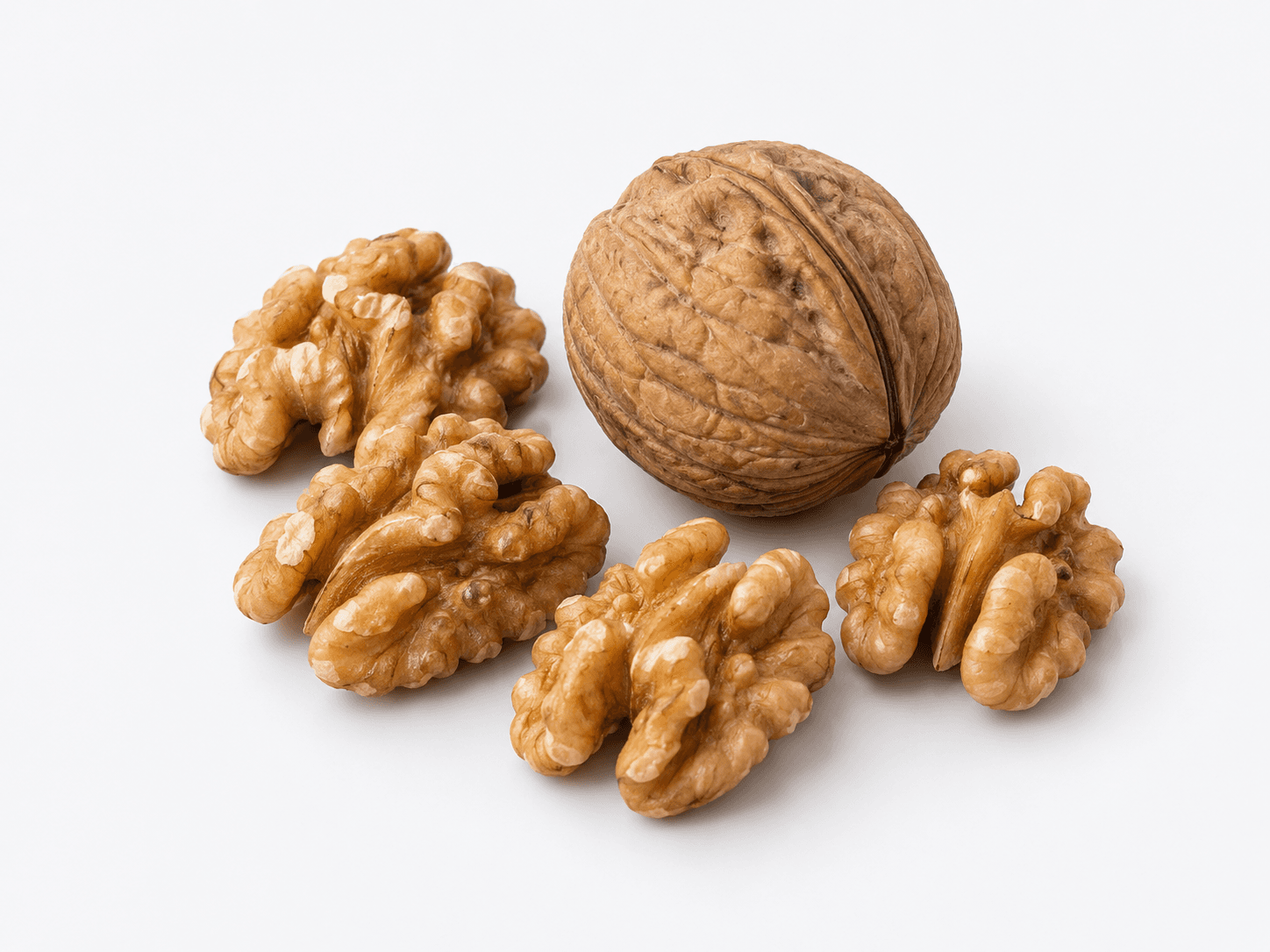
The walnut is the seed of a tree in the walnut family, native to western and Central Asia. Inside the hard shell the kernel splits into two wrinkled halves, and the thin skin wrapped around them carries tannins and tastes astringent — that astringency is both the walnut's signature and the reason opinions divide; a brief soak in warm water reduces it. Among nuts it is relatively high in polyunsaturated fat, which makes it go rancid especially fast. Sealed storage in the fridge or freezer is the safe choice.
Scientific name Juglans regia
Most nuts are high in omega-6 and low in omega-3. Walnuts are the exception, with 9.1 g of ALA (alpha-linolenic acid) per 100 g — not comparable to almonds (0.003 g) or cashews.
One caveat has to travel with that figure. ALA is an omega-3 like the EPA and DHA in fish, but a different form, and the body converts it into EPA and DHA at single-digit percentages. Walnuts do not replace fish.
Key benefits
- Nutrition data
By far the richest nut in plant omega-3
A handful of about 30 g supplies 2.7 g of ALA, above the adequate intake usually cited for adults. For a diet without fish it is a realistic route to the omega-3 family.
- Moderate evidence
It nudges LDL cholesterol down
A meta-analysis of 26 clinical trials (1,059 participants) found total cholesterol down 6.99 mg/dL (3.25%), LDL down 5.51 mg/dL (3.73%) and triglycerides down 4.69 mg/dL. The reductions were larger when the comparison diet was American or Western — which also means it is hard to tell how much is the walnuts and how much was a poor starting diet. Body weight did not differ.[1]
- Not established
The cognition research is still open
A large, long-running trial tested whether walnuts slow cognitive decline in older adults and found no clear difference across all participants. This is not an established benefit. That a walnut looks like a brain is not evidence.[2]
- Nutrition data
Copper and magnesium alongside
At 1.6 mg per 100 g, walnuts comfortably exceed the daily copper requirement. Copper is needed for iron handling and connective tissue, and it is not a nutrient most people track.
How to eat it well
- A handful a day — about 7 halves, 30 g — is enough. At 654 kcal per 100 g they are among the more energy-dense nuts.
- The bitterness is tannin in the skin, where the polyphenols sit, so leave it on. A brief blanch reduces it if it bothers you.
- Keep heating short. ALA is highly unsaturated and oxidises with long roasting. Eat them raw or add them at the end.
- Crumbled into salad or oatmeal, they are easier to keep up than eaten on their own.
- Refrigerate or freeze them. High fat and fast oxidation mean they turn rancid within weeks at room temperature.
How to read the grades
Each benefit carries a label showing how far research on people supports it. Grades differ between items even within the same ingredient.
- Nutrition data
- A fact verifiable from food composition databases or health authorities. This is a different kind of statement from a clinical effect.
- Strong evidence
- Consistently confirmed across randomised controlled trials or meta-analyses.
- Moderate evidence
- Human studies exist, but effect sizes are small or results are mixed.
- Early research
- Cell or animal work, or small preliminary studies.
- Not established
- Commonly claimed, but not confirmed in studies on people.
What to watch out for
- Tree nut allergy applies. Walnuts are among the nuts most often reported in severe reactions.
- Throw them out if they smell rancid. There is no reason to eat oxidised fat.
- They are energy dense: a handful is roughly 196 kcal.
- ALA is not EPA or DHA. If your omega-3 goal is triglycerides or cardiovascular risk, the evidence behind oily fish is far deeper.
- They contain oxalate, so moderate the amount with a history of kidney stones.
Nutrition
Approximate values per 100 g edible portion.
- Calories
- 654 kcal33%
- Carbohydrates
- 13.7 g5%
- Fiber
- 6.7 g24%
- Protein
- 15.2 g30%
- Fat
- 65.2 g84%
- Omega-3
- 9.1 g
- Magnesium
- 158 mg38%
- Copper
- 1.6 mg178%
Percentages are of the US FDA Daily Value for adults and children 4 and over. National reference intakes differ by sex and age.
Calculate this alongside other ingredients →
Key nutrients
By health concern
Dishes with this ingredient
- Walnut, apple and cabbage salad15 min
- Strawberry and spinach salad10 min
- Flaxseed yoghurt bowl5 min
- Pear and cabbage salad15 min
- Roast Brussels sprouts with walnuts30 min
- Persimmon and walnut salad15 min
- Adzuki and barley porridge, without sugar70 min
- Fig and rocket salad10 min
- Amaranth and squash porridge35 min
Compare with
Sources
The databases and health authorities this article's nutrition figures and health statements draw on.
- 1Effects of walnut consumption on blood lipids and other cardiovascular risk factors: an updated meta-analysis and systematic review of controlled trialsMeta-analysisGuasch-Ferré M, et al. Am J Clin Nutr 2018PMID 29931130
- 2Effect of a 2-year diet intervention with walnuts on cognitive decline. The Walnuts And Healthy Aging (WAHA) study: a randomized controlled trialClinical trialSala-Vila A, et al. Am J Clin Nutr 2020PMID 31912155
- 3USDA FoodData CentralFood composition database
- 4NIH Office of Dietary SupplementsHealth authority
- 5PubMedResearch literature