Contents
What it is
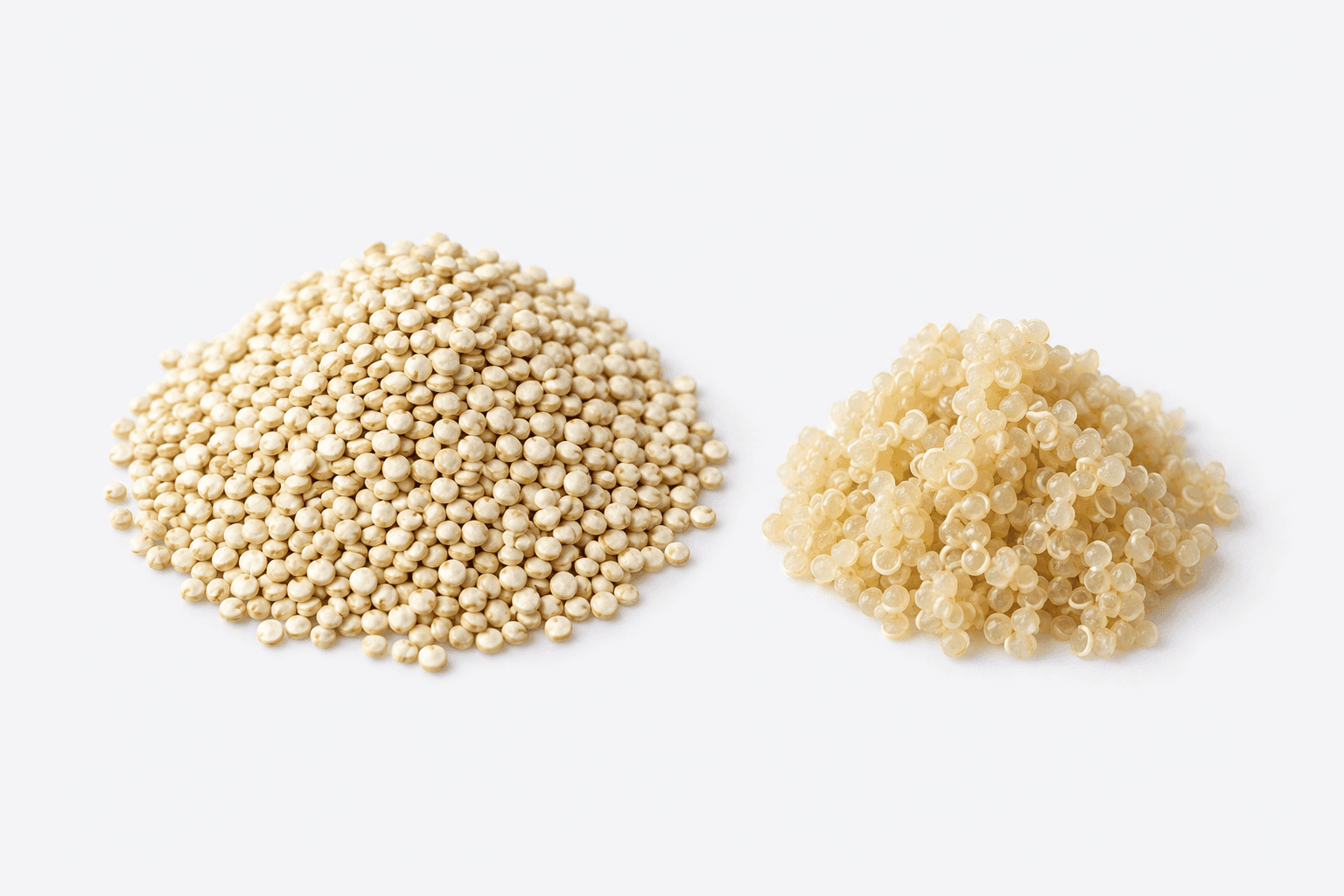
Quinoa is the seed of an annual in the goosefoot family. It is not a grass, so it counts as a pseudocereal rather than a grain, and its relatives are beet and spinach. It is native to the high Andes of South America and was cultivated by the Inca. The outside is coated with saponins, which taste bitter, so it needs rinsing until the water runs clear — most packaged quinoa is pre-washed, but another rinse does no harm. When cooked, the germ separates into a little ring around each seed, which gives quinoa its popping texture.
Scientific name Chenopodium quinoa
The phrase attached to quinoa more than any other is 'complete protein'. It means quinoa carries all nine essential amino acids in adequate proportion, unusual for a grain, and that is true. Lysine, the weak point of most grains, is sufficient in quinoa.
The trouble starts next. Complete and sufficient are different questions.
Cooked quinoa holds 4.4 g of protein per 100 g. A bowl (150 g) gives 6.6 g. The same weight of chicken breast is 31 g; tofu is 8 g.
So quinoa's amino acid profile is good, but the amount does not reach one side dish. 'I eat quinoa, so protein is covered' is the arithmetic this page wants to correct.
There are other reasons to eat quinoa — magnesium and folate, and the fibre it brings when it replaces white rice.
Key benefits
- Nutrition data
Complete protein is accurate — the amount is small
Most grains are short on lysine. Eat only grain and the amino acid balance is off, which is why food cultures pair beans with grain (rice and beans, tortillas and beans).
Quinoa has enough lysine that it does not need that complement. That is what 'complete protein' means.
But look at the amounts.
Food (cooked, 100 g) Protein Chicken breast 31 g Tofu 8 g Quinoa 4.4 g Brown rice 2.6 g White rice 2.7 g Quinoa is a grain with 1.7 g more protein than rice. It should not be read as more than that.
For someone eating no meat the difference does matter. Swapping three bowls of rice a day for quinoa adds about 12 g of protein, of better quality. It still does not mean protein is covered. Beans, tofu and eggs are still needed.
- Nutrition data
High in magnesium and folate for a grain
Cooked quinoa holds 64 mg of magnesium per 100 g — five times white rice's 12 mg. A bowl gives 96 mg, a quarter of the adult requirement (350–400 mg for men).
Magnesium runs short on many diets and has evidence behind it for blood pressure.
Folate is 42 µg, high among grains. A bowl gives 63 µg, 16 % of the 400 µg adult requirement. Dry quinoa shows 184 µg, but cooking leaches more than half of it into the water — folate is water-soluble and heat-sensitive.
Also phosphorus 152 mg, iron 1.49 mg, manganese 0.631 mg and 2.8 g of fibre.
That 2.8 g of fibre is nine times white rice's 0.3 g, but only 1.7 times brown rice's 1.6 g. Quinoa is not unusually high in fibre; white rice is unusually low.
- Not established
Claims about blood sugar and weight are not established
Quinoa is widely said to lower blood sugar and reduce weight. Human trials exist but are small and inconsistent.
Its glycaemic index is genuinely lower than white rice's, which follows from more fibre and protein. But a lower GI and better long-term glucose control are different claims, and no large trial supports the second.
Weight is the same story. Quinoa is 120 kcal per 100 g — almost identical to white rice's 130. If swapping rice for quinoa helps someone lose weight, it is more likely satiety or a wider change in the meal than the calories.
'Superfood' has stuck to quinoa more than to almost anything, but what is confirmed stops at the composition table. It is a good grain; beyond that there is not yet evidence.
How to eat it well
- Rinse it, always. Saponins on the outside taste bitter and irritate the gut. Rub it in a sieve until the water runs clear. Even 'pre-rinsed' packs are worth one rinse.
- Twice as much water as quinoa. Bring to the boil, lower the heat for 15 minutes, then rest it off the heat for 5.
- Mixing it into rice meets less resistance. Start at about three parts rice to one part quinoa.
- Use less water to keep the folate. Boiling it in plenty of water and draining takes the water-soluble vitamins with it.
- Cool it for salads. The texture holds, and cooling raises resistant starch a little.
- Toasting it dry brings out a nutty flavour — rinse, drain, then two or three minutes in a pan.
How to read the grades
Each benefit carries a label showing how far research on people supports it. Grades differ between items even within the same ingredient.
- Nutrition data
- A fact verifiable from food composition databases or health authorities. This is a different kind of statement from a clinical effect.
- Strong evidence
- Consistently confirmed across randomised controlled trials or meta-analyses.
- Moderate evidence
- Human studies exist, but effect sizes are small or results are mixed.
- Early research
- Cell or animal work, or small preliminary studies.
- Not established
- Commonly claimed, but not confirmed in studies on people.
What to watch out for
- Do not count quinoa as your protein. A bowl is 6.6 g. Protein has to come from elsewhere.
- Unrinsed, it is bitter. Saponins are not harmful in these amounts but affect taste and the stomach.
- It is relatively high in oxalate. With a history of calcium oxalate stones, watch the quantity.
- The energy matches white rice. 120 kcal per 100 g. Eat a lot and it is the same as eating a lot of rice.
- It is gluten-free but can be cross-contaminated with wheat during processing. With coeliac disease, choose certified products.
- It is expensive. For the same money, brown rice with beans may give more nutrition per won.
Nutrition
Per 100 g of cooked quinoa. A bowl is about 150 g, and 100 g of dry quinoa nearly triples when cooked.
- Calories
- 120 kcal6%
- Protein
- 4.4 g9%
- Carbohydrates
- 21.3 g8%
- Fiber
- 2.8 g10%
- Magnesium
- 64 mg15%
- Folate
- 42 µg11%
- Phosphorus
- 152 mg12%
- Iron
- 1.49 mg8%
- Manganese
- 0.631 mg27%
Percentages are of the US FDA Daily Value for adults and children 4 and over. National reference intakes differ by sex and age.
Calculate this alongside other ingredients →
Key nutrients
By health concern
Dishes with this ingredient
Compare with
Sources
The databases and health authorities this article's nutrition figures and health statements draw on.