Contents
What it is
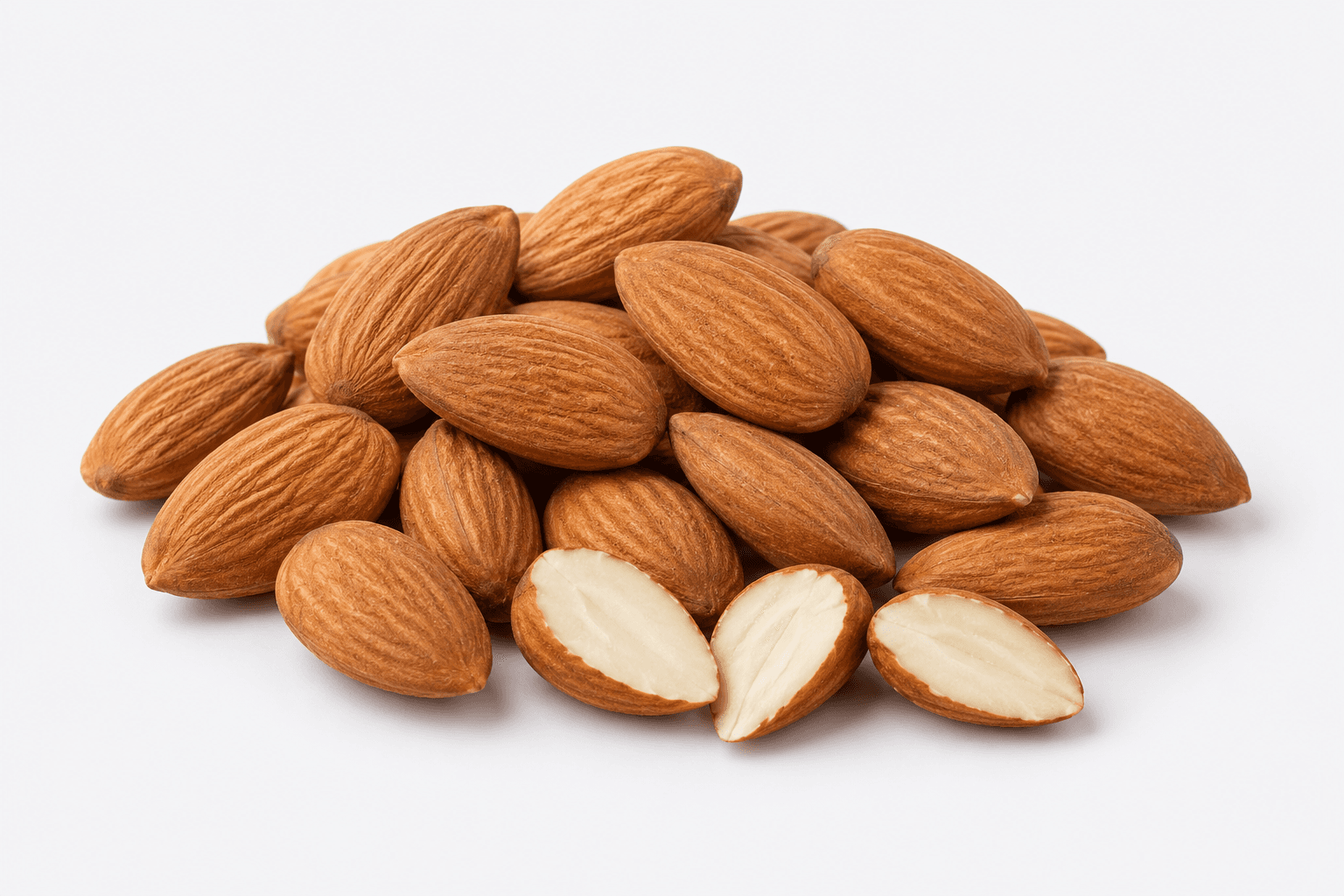
The almond is the seed of a tree in the same genus as the peach and the plum. What we eat is not the flesh of the fruit but the kernel inside its hard stone. The tree is native to western Asia, and California is now by far the largest producer. Almonds are eaten raw or roasted, and are ground into flour or blended into a milk-style drink. They are high in fat, so the oil turns rancid over time — keep them sealed and cool.
Scientific name Prunus dulcis
Almonds are among the richest food sources of vitamin E: 25.6 mg per 100 g, so a handful of about 30 g delivers more than half an adult's 15 mg daily requirement.
That handful also carries a lot of energy — 579 kcal per 100 g. On calories alone almonds look like something to avoid, and yet trials in which people ate them daily found no weight gain. That contradiction is the most interesting thing about them.
Key benefits
- Nutrition data
One of the highest vitamin E contents of any food
Vitamin E is the fat-soluble antioxidant that protects membrane lipids from oxidation. Outside nuts and vegetable oils few foods carry much of it, which makes it genuinely easy to fall short on — and a single handful of almonds supplies over half a day's worth.
- Moderate evidence
They lower LDL cholesterol
This comes from a meta-analysis of 15 randomised trials (534 subjects). At around 42.5 g a day — a generous handful — total cholesterol fell 10.69 mg/dL, LDL 5.83 mg/dL and body weight 1.39 kg. Monounsaturated fat, fibre and plant sterols are thought to act together. HDL fell too, by 1.26 mg/dL, and triglycerides and blood pressure did not change. The size of the change is modest — this is not a substitute for medication.[1]
- Nutrition data
Not all the labelled calories are absorbed
Almond fat is locked inside rigid cell walls that chewing does not fully break open. Measurements put actual absorbed energy about 20% below the labelled figure. That holds for whole almonds; grinding them or turning them into butter narrows the gap.
- Nutrition data
Around 80 mg of magnesium per handful
At 270 mg per 100 g, almonds rank among the better magnesium sources. Magnesium takes part in over 300 enzyme reactions, and intake below the recommendation is common.
How to eat it well
- A handful a day — about 23 almonds, 30 g — is the dose the trials used. Eating more does not scale the benefit up proportionally.
- Whole is better. Grinding or making butter breaks the cell walls and increases fat absorption.
- Avoid salted or sugar-coated versions. Honey butter almonds are a different food.
- The brown skin holds the polyphenols, so there is no reason to remove it.
- Store sealed and cool. The high fat content goes rancid if left warm for long; refrigerate in summer.
How to read the grades
Each benefit carries a label showing how far research on people supports it. Grades differ between items even within the same ingredient.
- Nutrition data
- A fact verifiable from food composition databases or health authorities. This is a different kind of statement from a clinical effect.
- Strong evidence
- Consistently confirmed across randomised controlled trials or meta-analyses.
- Moderate evidence
- Human studies exist, but effect sizes are small or results are mixed.
- Early research
- Cell or animal work, or small preliminary studies.
- Not established
- Commonly claimed, but not confirmed in studies on people.
What to watch out for
- Tree nut allergy can cause severe reactions. Almonds are a major allergen.
- They are energy dense. A handful is about 170 kcal, and eating straight from the bag quickly adds up to a meal's worth.
- They contain oxalate, so heavy intake is best avoided with a history of kidney stones.
- Phytic acid interferes somewhat with iron and zinc absorption; soaking reduces it.
- Almond milk is often only 2–3% almond. Drinking it is not the same as eating them.
Nutrition
Approximate values per 100 g edible portion.
- Calories
- 579 kcal29%
- Carbohydrates
- 21.6 g8%
- Fiber
- 12.5 g45%
- Protein
- 21.2 g42%
- Fat
- 49.9 g64%
- Vitamin E
- 25.6 mg171%
- Magnesium
- 270 mg64%
- Calcium
- 269 mg21%
Percentages are of the US FDA Daily Value for adults and children 4 and over. National reference intakes differ by sex and age.
Calculate this alongside other ingredients →
Key nutrients
By health concern
Dishes with this ingredient
Compare with
Sources
The databases and health authorities this article's nutrition figures and health statements draw on.
- 1Almond Consumption and Risk Factors for Cardiovascular Disease: A Systematic Review and Meta-analysis of Randomized Controlled TrialsMeta-analysisLee-Bravatti MA, et al. Adv Nutr 2019PMID 31243439
- 2USDA FoodData CentralFood composition database
- 3NIH Office of Dietary SupplementsHealth authority
- 4PubMedResearch literature
- 5European Food Safety Authority (EFSA)Health authority