Contents
What it is
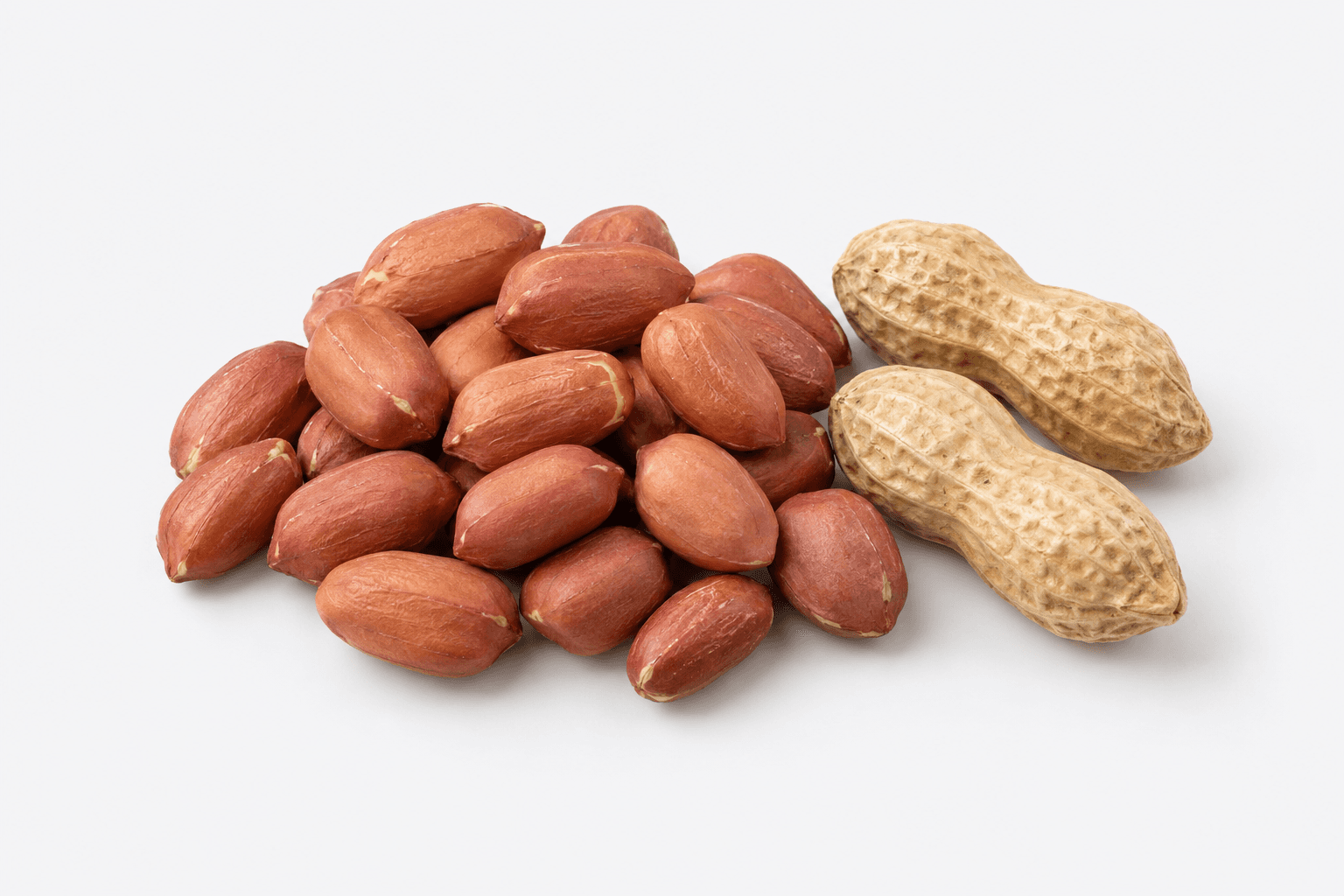
The peanut is not a nut at all but the seed of a legume. As the name says, it ripens underground: after flowering, the stalk below the flower bends down, pushes into the soil, and the pod matures there. It is native to South America. Botanically a bean, it is so high in fat that cooking treats it as a nut. Stored damp it can grow moulds that produce aflatoxin, so peanuts that are soft or taste bitter should be thrown out. It is also one of the foods most associated with severe allergy.
Scientific name Arachis hypogaea
A peanut is not botanically a nut — it is a legume. Yet its nutrient profile and its epidemiology land it in almost the same place as almonds and walnuts.
Here is the interesting part. Most nut-and-mortality research was done in white, higher-income populations. A 2015 study looked instead at low-income Americans and at Shanghai residents — 206,000 people. The result held. And what the Shanghai cohorts ate was, in practice, only peanuts.
The authors' conclusion notes that peanuts, being affordable, 'may be considered a cost-effective measure to improve cardiovascular health.' Nutrition papers rarely argue from price.
Key benefits
- Moderate evidence
Total and cardiovascular mortality ran lower
[1]Three cohorts, 206,000 people, followed up to 12 years: 71,764 mostly low-income residents of the southeastern United States (Southern Community Cohort Study) and 134,265 men and women in Shanghai. Nut intake in the Shanghai cohorts was essentially peanut only, and about half of the US intake was peanuts too.
Comparing the highest fifth of intake with the lowest, total mortality hazard ratios were 0.79 (95 % CI 0.73–0.86) in the US cohort and 0.83 (0.77–0.88) in Shanghai.
Most of the difference came from cardiovascular deaths, and ischaemic heart disease was consistent across every group (0.62 in Black participants, 0.60 in white, 0.70 in Asian).
This is observational. People who eat more peanuts differ in other habits. But three populations with very different smoking rates pointing the same way is worth something on its own.
- Moderate evidence
Peanut butter did not show the same thing
[2]The Netherlands Cohort Study followed 120,852 people aged 55–69 for ten years. Those eating 10 g or more of nuts a day had a total-mortality hazard ratio of 0.77 (95 % CI 0.66–0.89) against non-consumers. For neurodegenerative-disease death it fell to 0.56.
And then the sentence that matters: 'Peanuts and tree nuts were inversely related to mortality, whereas peanut butter was not.'
The authors did not settle why. Hydrogenated fat, sugar and salt — the usual additions to commercial peanut butter — are the candidates.
The practical reading is simple. The evidence attaches to peanuts, and does not travel automatically to processed foods containing peanuts.
- Strong evidence
Introduced early in infancy, it prevents peanut allergy
[3]This one is a randomised trial rather than observation. 640 high-risk infants — severe eczema, egg allergy, or both — were randomised at 4 to 11 months to eat peanut or avoid it, and followed to age five.
Among the 530 whose skin-prick test was initially negative, peanut allergy at 60 months was 13.7 % in the avoidance group and 1.9 % in the consumption group (p < 0.001). Among the 98 already mildly sensitised, it was 35.3 % versus 10.6 % (p = 0.004).
Serious adverse events did not differ between groups.
These results changed infant feeding guidance in several countries. Note that the trial introduced peanut to high-risk infants under medical supervision — that is how it was done. Whole peanuts are a choking hazard; infants get a soft form.
- Nutrition data
Dense in vitamin E and magnesium
Dry-roasted unsalted peanuts carry 4.9 mg of vitamin E per 100 g (33 % of the 15 mg adult requirement), 178 mg of magnesium, 14.4 mg of niacin, 97 µg of folate and 8.4 g of fibre.
Protein is 24.4 g — high even among nuts, which is the legume showing through.
But it is 587 kcal. A handful (about 28 g) is 164 kcal, so 'healthy, therefore plenty' does not follow. The studied intakes started around 10 g a day.
How to eat it well
- A handful (28 g) comfortably clears the studied range. In the Dutch cohort the curve flattened around 10 g a day.
- Eat the papery skins. The polyphenols concentrate there.
- Choose unsalted, unsugared, uncoated. What those studies measured was peanuts, not peanut candy.
- If you buy peanut butter, look for 'peanuts' and 'salt' and nothing else. With hydrogenated fat and sugar it is a different food.
- Store sealed, cool and dry. They are fatty and go rancid quickly.
How to read the grades
Each benefit carries a label showing how far research on people supports it. Grades differ between items even within the same ingredient.
- Nutrition data
- A fact verifiable from food composition databases or health authorities. This is a different kind of statement from a clinical effect.
- Strong evidence
- Consistently confirmed across randomised controlled trials or meta-analyses.
- Moderate evidence
- Human studies exist, but effect sizes are small or results are mixed.
- Early research
- Cell or animal work, or small preliminary studies.
- Not established
- Commonly claimed, but not confirmed in studies on people.
What to watch out for
- Peanut allergy can cause anaphylaxis. None of the benefits above apply to someone with a confirmed allergy. Avoidance is the rule.
- Talk to a paediatrician before a first introduction in infancy. The trial above ran under medical supervision. Whole peanuts are a serious choking risk under four.
- Throw away mouldy peanuts. Aflatoxin is a mould toxin linked to liver cancer and it forms in damp storage. Discard any nut that tastes bitter or looks discoloured.
- They are calorie-dense — 587 kcal per 100 g. They replace another snack; they do not get added to one.
- The mortality studies above are observational and do not establish causation.
Nutrition
Approximate values per 100 g edible portion.
- Calories
- 587 kcal29%
- Protein
- 24.4 g49%
- Fat
- 49.7 g64%
- Carbohydrates
- 21.3 g8%
- Fiber
- 8.4 g30%
- Vitamin E
- 4.9 mg33%
- Magnesium
- 178 mg42%
- Vitamin B3
- 14.4 mg90%
- Folate
- 97 µg24%
- Potassium
- 634 mg13%
- Zinc
- 2.8 mg25%
Percentages are of the US FDA Daily Value for adults and children 4 and over. National reference intakes differ by sex and age.
Calculate this alongside other ingredients →
Key nutrients
Dishes with this ingredient
Compare with
Sources
The databases and health authorities this article's nutrition figures and health statements draw on.
- 1Prospective evaluation of the association of nut/peanut consumption with total and cause-specific mortalitySystematic reviewsLuu HN, et al. JAMA Intern Med 2015PMID 25730101
- 2Relationship of tree nut, peanut and peanut butter intake with total and cause-specific mortality: a cohort study and meta-analysisSystematic reviewsvan den Brandt PA, et al. Int J Epidemiol 2015PMID 26066329
- 3Randomized trial of peanut consumption in infants at risk for peanut allergyClinical trialDu Toit G, et al. N Engl J Med 2015PMID 25705822
- 4USDA FoodData CentralFood composition database
- 5NIH Office of Dietary SupplementsHealth authority
- 6World Health Organization · Healthy dietHealth authority
- 7PubMedResearch literature