Contents
What it is
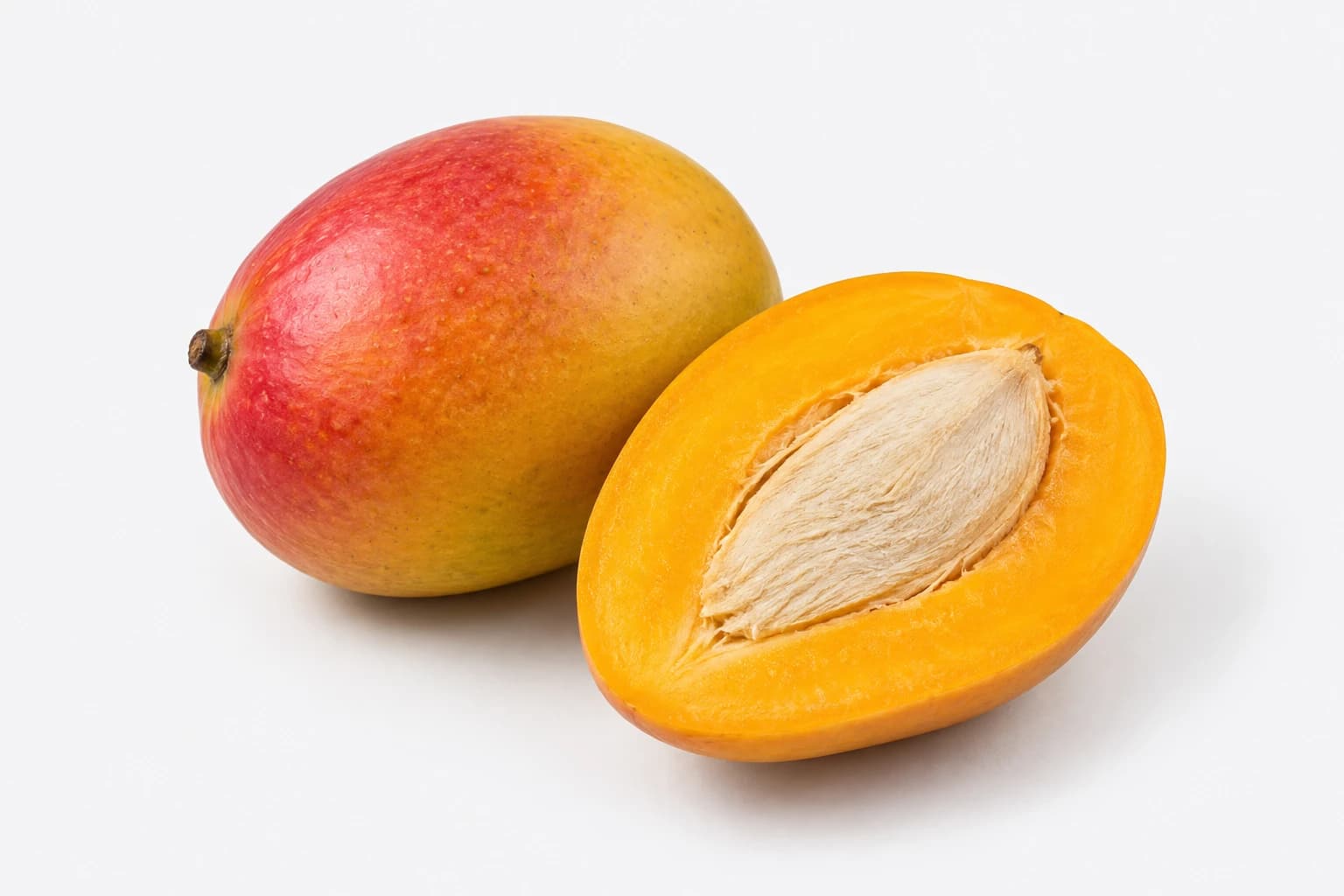
The mango is the fruit of a tree in the cashew family, native to India and Southeast Asia. That family matters: the skin and leaves contain urushiol-type compounds related to those in poison ivy and lacquer trees, so people sensitive to them can break out in a rash from handling the peel or letting it touch the lips. The flesh itself is not the problem. A single large flat stone sits in the middle, so the usual way to prepare one is to cut the two cheeks off either side of it. A ripe mango smells strongly and yields a little to a thumb.
Scientific name Mangifera indica
Mango is 60 kcal per 100 g, with 13.7 g of sugar and 36.4 mg of vitamin C.
And in 2026 a substantial trial appeared in the Journal of the American Heart Association, carefully designed. That design is exactly why the credit cannot go to mango.
2026, JAHA. Eighty-two adults with prediabetes were split two ways for eight weeks.
- Avocado-mango arm — weekly diets provided, incorporating one avocado and one cup of mango daily
- Control arm — energy-matched low-fat, low-fibre foods
- Primary endpoint: flow-mediated vasodilation (FMD)
The results:
- FMD change differed significantly between arms (effect −2.11±0.77%, p=0.008), rising about 1% on avocado-mango and falling on control
- Central and brachial diastolic pressure also differed (p=0.07 and p=0.03), in men specifically
- Other endpoints were generally not different (p>0.05)
Three things have to be read together. The intervention contained avocado, the control diet was low-fat and low-fibre, and part of the improvement is the control getting worse.
Key benefits
- Early research
Vascular function improved — but alongside avocado, and against a control that declined
[1]2026, Journal of the American Heart Association.
- 82 adults with prediabetes (aged 45±15, BMI 30±6), two-arm parallel, partially controlled feeding, eight weeks
- Weekly diets provided: 1,500 kcal/d for women, 1,750 kcal/d for men
- Avocado-mango diet — one avocado and one cup of mango daily
- Control diet — energy-matched low-fat, low-fibre foods
- Primary endpoint flow-mediated vasodilation (FMD); secondary: central and brachial blood pressure, pulse-wave velocity, metabolic, inflammatory and kidney markers
Outcome Result FMD significant between-arm difference (effect −2.11±0.77%, p=0.008). Rose about 1% on avocado-mango, fell on control Central diastolic pressure p=0.07 — not significant, in men Brachial diastolic pressure p=0.03, in men only Other endpoints generally not different (p>0.05) Select lipids and kidney markers marginal (p<0.1) Total fruit, fibre, vitamin C, monounsaturated fat intake significantly higher on avocado-mango Start with the strengths. Eighty-two people is not small in this field, and the diets were provided across eight weeks in partially controlled feeding. The primary endpoint was set in advance, and FMD is an established measure of endothelial function.
But three things stop the credit going to mango.
First, the intervention is two foods. One avocado and one cup of mango went in together every day. No part of this design separates their contributions. And among the nutrients that rose is monounsaturated fat — mostly the avocado's contribution.
This site holds one other entry with the same problem. In the fig trial for constipation in pregnancy, the fig-walnut combination was no better than fig alone. Intervene with a combination and you cannot tell what did the work.
Second, the control diet was low-fat and low-fibre. The comparator was not "the usual diet" but foods deliberately made low in fat and fibre. So what this trial shows sits closer to a diet higher in fruit, fibre and unsaturated fat beating a low-fat, low-fibre one.
Third, part of the improvement is the control declining. The abstract states that FMD rose about 1% on avocado-mango and decreased on control. How much of the gap is rising and how much is falling has to be read separately.
The blood pressure results need care too. The diastolic difference appeared in men only, and central diastolic pressure did not clear the threshold at p=0.07. The abstract states plainly that other endpoints were generally not different.
The honest conclusion:
- This trial supports the direction that raising fruit intake can help vascular function
- But it cannot be carried across as a benefit of mango. Avocado was in there too
- That the control diet was low-fat and low-fibre belongs in the reading
- The grade here is "early research"
- Nutrition data
36.4 mg of vitamin C — but 13.7 g of sugar
Per 100 g of raw mango:
- 60 kcal, sugar 13.7 g, carbohydrate 15.0 g, fibre 1.6 g
- Vitamin C 36.4 mg, vitamin A 54 µg RAE, beta-carotene 640 µg
- Folate 43 µg, vitamin B6 0.119 mg, vitamin E 0.9 mg
- Potassium 168 mg, copper 0.111 mg, calcium 11 mg
- Protein 0.82 g, fat 0.38 g, sodium 1 mg
Half a medium fruit (100 g) and the trial dose (one cup, 165 g):
100 g One cup (165 g) Energy 60 kcal 99 kcal Sugar 13.7 g 22.6 g Vitamin C 36.4 mg 60 mg Fibre 1.6 g 2.6 g The 36.4 mg of vitamin C is this fruit's strength. Against an adult requirement of around 100 mg, 100 g covers more than a third. A cup gives 60 mg.
Vitamin A at 54 µg and beta-carotene at 640 µg are also high for a fruit — the orange colour is that pigment. Both are fat-soluble, so eating them alongside fat favours absorption — which the trial's pairing with avocado happens to satisfy.
But sugar is 13.7 g. High among fruits: strawberries hold 4.9 g and apples about 10.4 g. A cup is 22.6 g, against the WHO's free-sugar guidance of under 25 g a day on 2,000 kcal.
Sugars within whole fruit are not free sugars by that definition. Even so, if you manage blood glucose, know the number. Given that the trial's participants had prediabetes, a cup is not an amount that suits everyone.
Fibre is low at 1.6 g. The brake on the sugar is weaker here than in most fruit.
Dried mango and mango juice are different foods. Drying concentrates the sugar; juicing strains out what fibre there was. And much commercial dried mango has added sugar. Read the ingredient list.
Choosing. Go by smell and give, not colour. A ripe one is fragrant at the stem end and yields slightly to a fingertip. Some varieties stay green when ripe, so colour tells you nothing.
Leave an unripe mango at room temperature. Refrigerating stops it where it is. Chill it after it ripens.
- Not established
Mango skin carries the same compound family as poison ivy
This is safety information that Korean-language material regularly omits.
Mango belongs to the Anacardiaceae family, alongside the lacquer tree, cashew and pistachio.
So mango skin and sap contain urushiol-family compounds — the same family responsible for poison ivy and lacquer rashes.
What can happen.
- Contact dermatitis on the hands that handled the skin, or around the mouth: itching, rash, blisters
- It usually begins one to two days after contact, so people often fail to connect it to the mango
- The flesh carries far less, but flesh that touched the skin can carry some
Who should be careful.
- Anyone who has reacted to lacquer. If lacquer-chicken soup has ever given you a rash, treat mango skin with care
- Anyone who has reacted to cashews or pistachios. Same family
- Anyone handling mangoes in quantity. It has long been reported on mango farms and in processing work
What to do. Nothing difficult.
- Peel it. Do not bite through the skin
- Wash your hands after preparing it
- Wear gloves on a day of preparing several
- Rinsing the peeled flesh once removes some of what transferred to the surface
There is also allergy to the flesh itself. Oral allergy syndrome, with itching or swelling around the mouth, has been reported. If your first mango gives you that, do not brush it off.
One last common claim. The idea that mango aids digestion is usually backed by enzymes such as amylase. This site has not found a clinical trial that fed mango and measured digestive function. For the same reason set out in the fig entry on ficin, containing an enzyme and improving digestion when a person eats it are separate claims.
How to eat it well
- Half a medium fruit is about 100 g, 60 kcal and 13.7 g of sugar. The trial's cup is 165 g and 22.6 g of sugar.
- If you manage blood glucose, a cup is not a small amount. Put it in the count.
- Peel it and wash your hands afterwards. The skin carries poison-ivy-family compounds.
- Wear gloves on a day of preparing several.
- Eaten alongside fat, the beta-carotene is absorbed better.
- Ripen at room temperature, then refrigerate. Judge by smell and give, not colour.
- Much dried mango has added sugar. Check the ingredient list.
- If you have reacted to cashews or pistachios, take care: same family.
How to read the grades
Each benefit carries a label showing how far research on people supports it. Grades differ between items even within the same ingredient.
- Nutrition data
- A fact verifiable from food composition databases or health authorities. This is a different kind of statement from a clinical effect.
- Strong evidence
- Consistently confirmed across randomised controlled trials or meta-analyses.
- Moderate evidence
- Human studies exist, but effect sizes are small or results are mixed.
- Early research
- Cell or animal work, or small preliminary studies.
- Not established
- Commonly claimed, but not confirmed in studies on people.
What to watch out for
- The trial that improved vascular function fed avocado and mango together. Mango's share cannot be known.
- Its control diet was low-fat, low-fibre food, and part of the difference is the control declining.
- The blood pressure difference appeared in men only, and central diastolic pressure was not significant at p=0.07. The abstract states other endpoints were generally not different.
- Sugar is 13.7 g per 100 g, high among fruits. A cup is 22.6 g.
- Fibre is low at 1.6 g.
- Mango is in the Anacardiaceae family. Skin and sap carry urushiol-family compounds and can cause contact dermatitis.
- It shares a family with cashew and pistachio, and oral allergy syndrome has been reported.
- Dried mango and juice are different foods — sugar concentrated or fibre strained out.
Nutrition
Per 100 g of raw mango. The edible part of a medium fruit is about 200 g, so the figures below are half a mango. The one cup a day used in the trial below is about 165 g.
- Calories
- 60 kcal3%
- Vitamin C
- 36.4 mg40%
- Vitamin A
- 54 µg6%
- Beta-carotene
- 640 µg
- Folate
- 43 µg11%
- Sugars
- 13.7 g
- Carbohydrates
- 15.0 g5%
- Fiber
- 1.6 g6%
- Potassium
- 168 mg4%
- Vitamin E
- 0.9 mg6%
- Vitamin B6
- 0.119 mg7%
- Copper
- 0.111 mg12%
- Protein
- 0.82 g2%
- Sodium
- 1 mg<1%
Percentages are of the US FDA Daily Value for adults and children 4 and over. National reference intakes differ by sex and age.
Calculate this alongside other ingredients →
Key nutrients
Dishes with this ingredient
Sources
The databases and health authorities this article's nutrition figures and health statements draw on.
- 1Effects of Increasing Total Fruit Intake With Avocado and Mango on Endothelial Function and Cardiometabolic Risk Factors in Adults With PrediabetesClinical trialPreiss C, et al. Journal of the American Heart Association 2026PMID 41698896
- 2USDA FoodData CentralFood composition database
- 3PubMedResearch literature
- 4World Health Organization · Healthy dietHealth authority