Contents
What it is
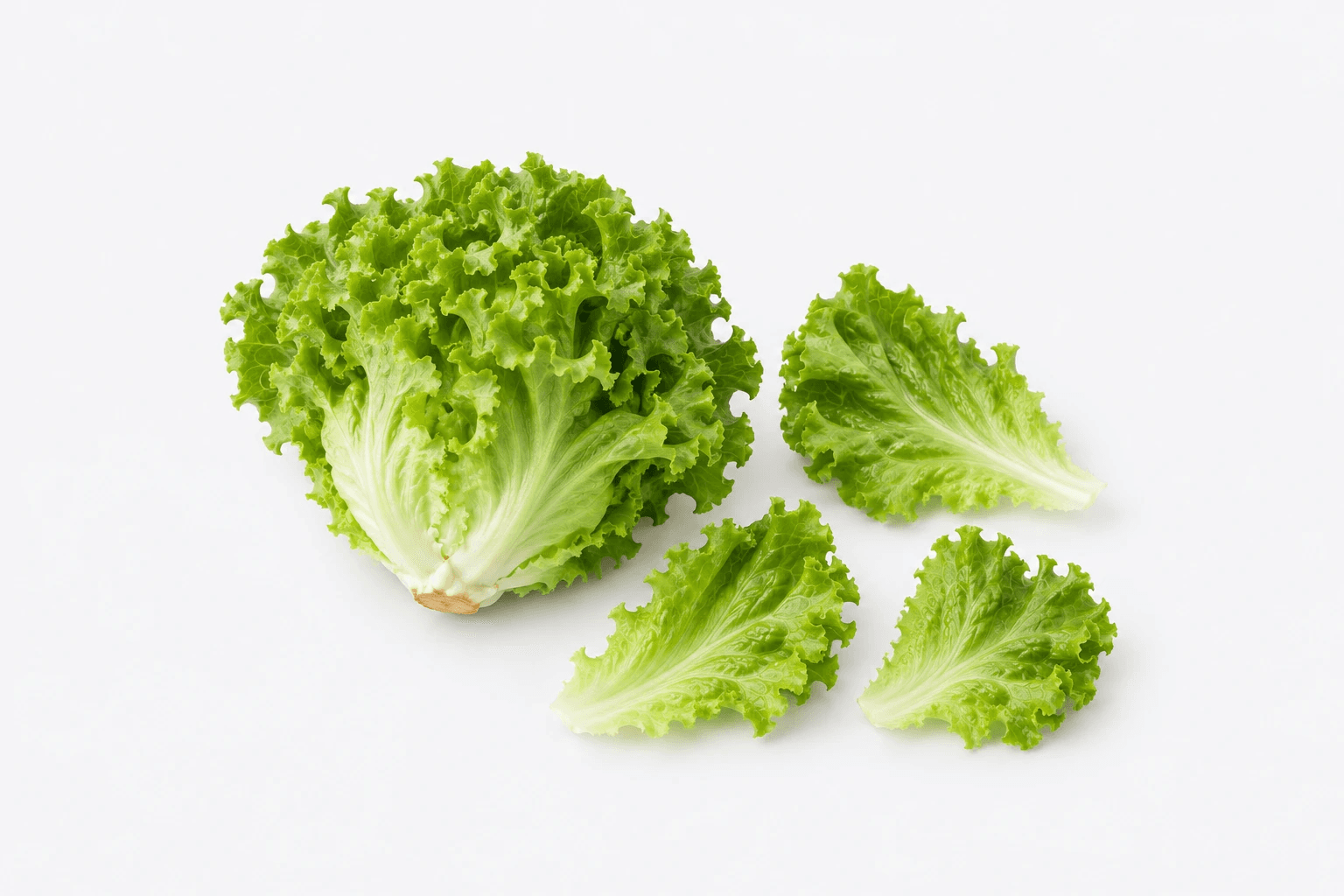
Lettuce is the leaf of an annual in the daisy family, native to the eastern Mediterranean. Cut it and a white sap seeps out; that is why the genus name Lactuca comes from the Latin for milk, and that sap is also the source of lettuce's faint bitterness. The broad division is between heading types such as iceberg and loose-leaf types. Around 95 percent of it is water, so heat wilts it almost instantly — it is a raw vegetable by nature, and in Korea it is above all a wrapping leaf.
Scientific name Lactuca sativa
"Lettuce makes you sleepy" is widely believed in Korea — to the point that students are told to avoid it the night before an exam.
And there is genuine clinical evidence behind the claim. What that evidence was made of is the point of this page.
A randomised, double-blind, placebo-controlled trial published in Nutrients in 2025, run by a team at Kyung Hee University in Korean adults aged 30–65 with poor sleep quality (PSQI > 5).
- Two capsules a day for four weeks
- PSQI global score 6.48 vs 7.41 (p=0.046)
- Total sleep time (actigraphy) 421.7 vs 386.6 min — about 35 minutes (p=0.0023)
- Sleep efficiency 83.9% vs 81.0% (p=0.034)
- On polysomnography, total sleep time 358.9 vs 322.1 min (p=0.046) and wake after sleep onset 39.3 vs 68.2 min (p=0.0042)
The numbers look impressive. But what was given was not lettuce.
- It was an extract of one specific cultivar, Heukharang
- In capsule form
- The paper's own conclusion is about "potential as a functional food"
- The study was funded by a food company, as stated in the paper
That is a different thing from the ten leaves you wrap pork in.
Key benefits
- Early research
The sleep trials are real — but they used extract capsules and seeds
[1][2]Randomised trials in people on lettuce and sleep do exist. This site identified two.
First, 2025, Nutrients. A randomised, double-blind, placebo-controlled trial.
- Participants: Korean adults aged 30–65 with PSQI > 5 (poor sleep quality)
- Intervention: two capsules daily for four weeks
- Measures: PSQI, actigraphy and polysomnography
- Analysis: ANCOVA adjusted for baseline, age and sex
Measure Test Placebo p PSQI global 6.48 7.41 0.046 Total sleep time (actigraphy) 421.7 min 386.6 min 0.0023 Sleep efficiency (actigraphy) 83.9% 81.0% 0.034 Total sleep time (polysomnography) 358.9 min 322.1 min 0.046 Sleep efficiency (polysomnography) 86.9% 79.6% 0.018 Wake after sleep onset 39.3 min 68.2 min 0.0042 That polysomnography was used is a strength. These are instrument measurements, not only a questionnaire.
Second, 2018, Journal of Ethnopharmacology. A double-blind randomised placebo-controlled trial of lettuce seeds for pregnancy-related insomnia. A 2022 pilot also tested lettuce seed syrup for insomnia in patients with breast cancer.
Several distinctions have to be kept.
First, the form differs. These trials used extract capsules and seeds — not the leaves eaten in a wrap. An extract concentrates particular compounds; seeds are a different part of the plant.
Second, the cultivar was specified. The 2025 trial used an extract of Heukharang, a particular cultivar, and its conclusion names that extract. Nothing in the trial shows the green or red leaf lettuce from a supermarket behaves the same.
Third, it cannot be converted into leaves. The paper does not say how many lettuce leaves two capsules correspond to, and this site does not invent numbers that do not exist.
Fourth, look at the size. The PSQI difference is 0.93 points. PSQI runs 0–21, and above 5 counts as poor sleep quality. The test group's final score of 6.48 is still above 5. Sleep improved; it did not cross back over the threshold.
Fifth, the funding came from a food company. This is stated in the paper, along with a declaration that the funder was not involved in design or analysis. That does not invalidate the result, but it is information to hold while reading it.
So is "lettuce makes you sleepy" baseless?
Lettuce's milky sap (lactucarium) is known to contain lactucin and lactucopicrin, the source of its bitterness, and their sedative activity has been studied.
But those compounds concentrate in the stem and sap rather than the leaf, and increase as the plant bolts. The young leaves we eat carry relatively little.
The honest conclusion: there are randomised trials in which a lettuce extract improved sleep. There is no evidence that ten leaves in a wrap do the same. If you felt sleepy after a dinner with lettuce, a full meal is the more likely explanation.
- Nutrition data
15 kcal and 370 µg of vitamin A per 100 g — but a leaf is 5–10 g
Per 100 g of raw green leaf lettuce:
- 15 kcal, protein 1.36 g, fat 0.15 g
- Of 2.87 g of carbohydrate, 1.3 g is fibre, sugar 0.78 g
- Vitamin A 370 µg RAE — 41% of the requirement
- Beta-carotene 4,440 µg
- Folate 38 µg, vitamin C 9.2 mg
- Potassium 194 mg, calcium 36 mg, iron 0.86 mg
- Sodium 28 mg
The 15 kcal defines it. Over 95% water. However much lettuce you eat, the calories barely move.
The 370 µg of vitamin A is the surprise, coming from 4,440 µg of beta-carotene. The darker the leaf the more there is — which is why the dark outer leaves are worth more than the pale inner ones.
But a leaf is 5–10 g. Converted to what you actually eat:
100 g One leaf (8 g) Ten leaves (80 g) Energy 15 kcal 1.2 kcal 12 kcal Vitamin A 370 µg 30 µg 296 µg (33%) Folate 38 µg 3 µg 30 µg Fibre 1.3 g 0.1 g 1.0 g Potassium 194 mg 16 mg 155 mg Ten leaves is 12 kcal, and brings a third of the vitamin A requirement. For the calories, that is an excellent trade.
The fibre is only 1.0 g, though. Eating a lot of lettuce does not fill the fibre gap.
Beta-carotene is fat-soluble, so eating it with grilled pork is not a bad pairing for absorption — though that meat's fat and sodium have to be counted separately.
Varieties differ.
- Green and red leaf lettuce — the table above. Darker leaves, more beta-carotene
- Iceberg — more water and far less vitamin A
- Romaine — between the two
"Lettuce" covers varieties whose nutrition is not comparable.
Washing. Rinse leaf by leaf under running water and shake it completely dry. Wet leaves make the dipping sauce slide off and go soft in storage.
Storage. Dried, wrapped in kitchen paper in a sealed box in the fridge, it keeps three or four days. A browned cut stem is polyphenol oxidase, not spoilage.
- Not established
"Don't eat lettuce the night before an exam" — the evidence makes that an overreaction
This entry sorts through a common worry.
Students are told to avoid lettuce before a test, on the grounds that it makes you drowsy. Read against the trials above, that worry is overdone.
First, what showed an effect was an extract — two capsules a day for four weeks. That is not the same as a few leaves at one meal.
Second, even that effect is not "knocked out". Total sleep time rose by 35 minutes and PSQI improved by 0.93 points. It is not a finding about reduced daytime alertness.
Third, the participants already had poor sleep. Nothing in the trial shows the same result in someone who sleeps well.
So why the drowsiness? More plausible explanations exist.
- Postprandial somnolence — a large meal makes you sleepy, more so with more carbohydrate
- The fullness after a heavy meat dinner
- Alcohol — the meals where Korean lettuce wraps appear usually include it
There is no basis for singling out the lettuce.
Equally, expecting lettuce to work as a sleeping aid goes past the evidence. Persistent insomnia is a reason to see a doctor. Sleep apnoea, anxiety and depression, caffeine and alcohol, shift work — none of these is solved with food.
One last point. That a trial of lettuce seeds targeted pregnancy-related insomnia is not a reason to use lettuce seed products during pregnancy on your own. Seeds and extracts are not the leaf, and any use in pregnancy needs a doctor's input.
How to eat it well
- The dark outer leaves carry more beta-carotene than the pale inner ones. Do not discard them.
- Shake it completely dry. Wet leaves shed the sauce and soften in storage.
- Store it dried, wrapped in kitchen paper in a sealed box in the fridge — three or four days.
- Beta-carotene is fat-soluble, so it absorbs better alongside some fat.
- Ten leaves (80 g) is 12 kcal. This is not a vegetable to ration.
- Iceberg and leaf lettuce are not the same. Leaf lettuce carries far more vitamin A.
- A browned cut edge is not spoilage — it is polyphenol oxidase.
- If you are eating it for sleep, the trials used an extract, not the leaf.
How to read the grades
Each benefit carries a label showing how far research on people supports it. Grades differ between items even within the same ingredient.
- Nutrition data
- A fact verifiable from food composition databases or health authorities. This is a different kind of statement from a clinical effect.
- Strong evidence
- Consistently confirmed across randomised controlled trials or meta-analyses.
- Moderate evidence
- Human studies exist, but effect sizes are small or results are mixed.
- Early research
- Cell or animal work, or small preliminary studies.
- Not established
- Commonly claimed, but not confirmed in studies on people.
What to watch out for
- The sleep trials used extract capsules from a specific cultivar, and seeds — not the leaves eaten in a wrap.
- The 2025 trial was funded by a food company, as stated in the paper.
- The PSQI improvement was 0.93 points, and the test group's final score still sat above the poor-sleep threshold of 5.
- See a doctor if insomnia persists. Lettuce does not replace a diagnosis.
- Do not use lettuce seed products in pregnancy on your own. They are a different part of the plant, and use needs medical advice.
- On warfarin, be mindful of vitamin K in leafy greens and keep intake steady.
- Raw vegetables need proper washing. Rinse leaf by leaf under running water.
- If you restrict potassium for kidney disease, 100 g holds 194 mg.
Nutrition
Per 100 g of raw green leaf lettuce. One leaf is 5–10 g, so the ten leaves you wrap pork with are roughly 50–100 g.
- Calories
- 15 kcal<1%
- Vitamin A
- 370 µg41%
- Beta-carotene
- 4440 µg
- Folate
- 38 µg9%
- Protein
- 1.36 g3%
- Carbohydrates
- 2.87 g1%
- Fiber
- 1.3 g5%
- Potassium
- 194 mg4%
- Calcium
- 36 mg3%
- Vitamin C
- 9.2 mg10%
- Iron
- 0.86 mg5%
- Sodium
- 28 mg1%
Percentages are of the US FDA Daily Value for adults and children 4 and over. National reference intakes differ by sex and age.
Calculate this alongside other ingredients →
Key nutrients
By health concern
Dishes with this ingredient
Sources
The databases and health authorities this article's nutrition figures and health statements draw on.
- 1Sleep Promoting Effects of Lettuce (Lactuca sativa L.) Extracts in Korean Adults with Poor Sleep Quality: A Randomized, Double-Blind Placebo-Controlled TrialClinical trialSon K, et al. Nutrients 2025PMID 40647280
- 2Double-blind randomized placebo-controlled trial on efficacy and safety of Lactuca sativa L. seeds on pregnancy-related insomniaClinical trialPour ZS, et al. Journal of Ethnopharmacology 2018PMID 30172900
- 3USDA FoodData CentralFood composition database
- 4PubMedResearch literature
- 5NIH Office of Dietary SupplementsHealth authority