Contents
What it is
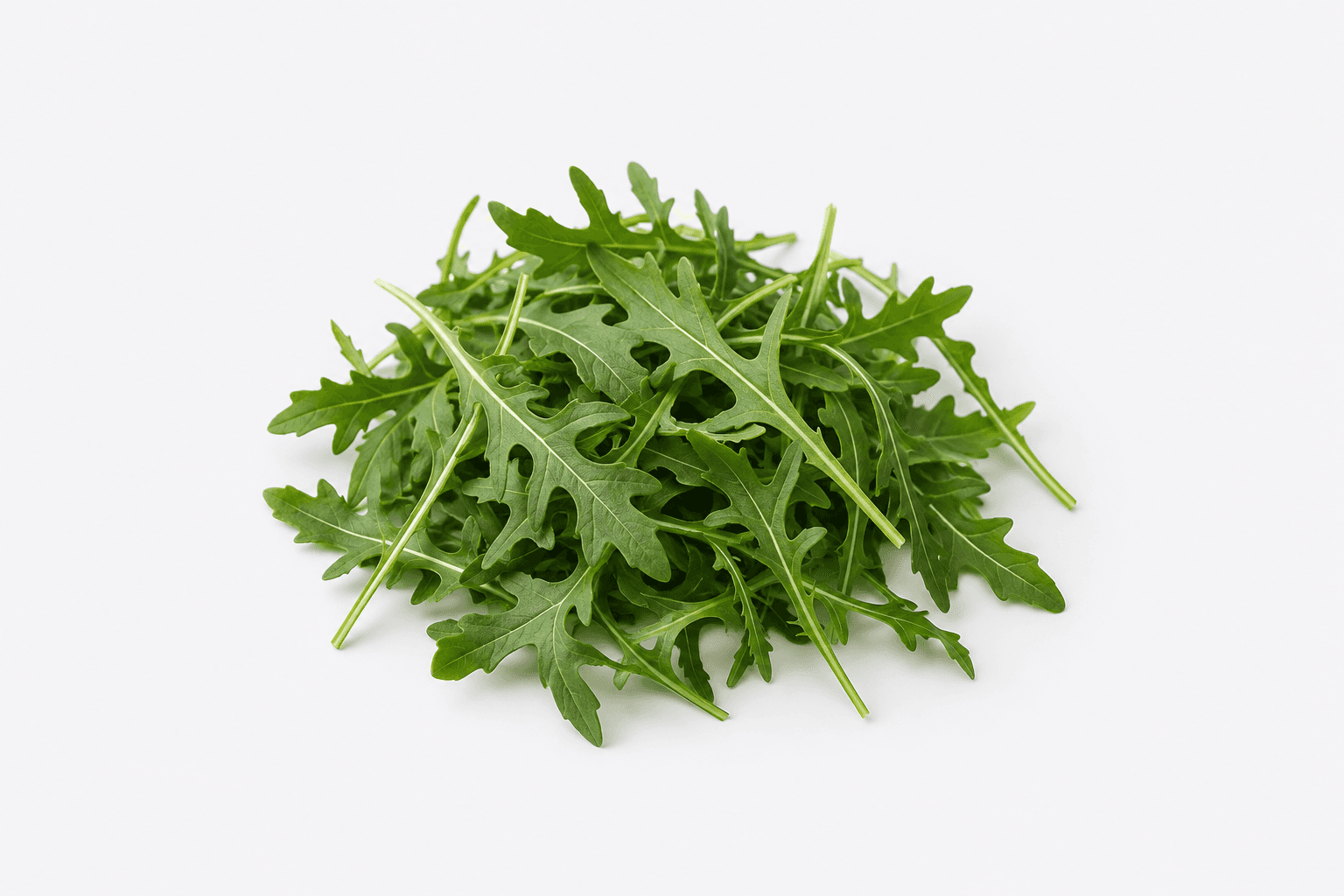
Arugula is a leafy vegetable in the mustard family, native to the Mediterranean; in British English it is called rocket. Being a relative of radish and mustard, it carries a sharp, peppery bite and a bitter edge, which come from the glucosinolates typical of the family. Young leaves are mild, and the pepperiness grows stronger as the plant matures. It is normally eaten raw in salads, or scattered over pizza and pasta at the end so it only just wilts.
Scientific name Eruca vesicaria
Leafy greens are said to lower blood pressure through their nitrate. There really is evidence — but the numbers deserve to be read as they are.
A 2025 GRADE-assessed dose-response meta-analysis in Nutrition Journal pooled 75 randomised trials in 1,823 people. The results are reported per millimole.
- Medium-term systolic −0.48 mmHg (95% CI −0.71 to −0.25)
- Diastolic −0.12 mmHg (95% CI −0.21 to −0.03)
That is 0.48 mmHg per millimole. To reach a meaningful size you need several millimoles.
And here the trail runs out. This site cannot tell you how many millimoles are in a plate of arugula. The USDA record has no nitrate entry, and the nitrate in leafy greens varies several-fold with soil nitrogen, light and harvest timing. The same cultivar differs sharply between a winter glasshouse and a summer field.
So this page does not say "a plate of arugula lowers your pressure by X mmHg." That would be a calculation without a source.
What can be stated with certainty is the composition — calcium 160 mg, vitamin K 109 µg, folate 97 µg, beta-carotene 1,420 µg.
Key benefits
- Moderate evidence
Medium-term systolic −0.48 mmHg per mmol of nitrate — 75 trials, 1,823 people
[1]2025, Nutrition Journal. PubMed, Scopus and Web of Science were searched to February 2024, pooling 75 randomised controlled trials in 1,823 people in a GRADE-assessed dose-response meta-analysis, pre-registered on PROSPERO (CRD42024535335).
First, the check that the nitrate actually got in. For each millimole of administered nitrate, plasma nitrate rose +32.7 µmol/L acutely (95% CI 26.1 to 39.4) and +19.6 µmol/L chronically (95% CI 9.95 to 29.3). What was eaten showed up in the blood.
The blood pressure results, all per millimole:
- Systolic, acute −0.28 mmHg (95% CI −0.40 to −0.17)
- Systolic, short-term −0.24 mmHg (95% CI −0.40 to −0.07)
- Systolic, medium-term −0.48 mmHg (95% CI −0.71 to −0.25)
- Diastolic −0.12 mmHg (95% CI −0.21 to −0.03)
Vascular measures showed a linear dose-response too: medium-term pulse wave velocity −0.07 m/s, medium-term flow-mediated dilation +0.30%, medium-term augmentation index −0.57%.
How should these numbers be read?
First, the per-millimole unit is the crux. A blood pressure tablet typically lowers systolic by around 10 mmHg. Reaching that would take more than 20 mmol of nitrate. Beetroot juice trials commonly use 5–8 mmol.
Second, the dose cannot be converted into food. Arugula's nitrate content is not in the USDA record and varies several-fold with growing conditions. The moment you write "100 g of arugula = N mmol", you have written a number with no source.
Third, the authors close carefully: future high-quality, population-specific studies with optimised dosages are needed to strengthen the certainty of the evidence.
Fourth, these are surrogate markers. Blood pressure and vascular function improved; no study here looked at heart attacks or death.
So why grade it moderate? Seventy-five trials and 1,823 people is a substantial body, the dose-response was linear, and the intermediate marker — plasma concentration — moved in the same direction. It is a pre-registered, GRADE-assessed meta-analysis. The effect size is small; the quality of the data is not.
- Nutrition data
160 mg of calcium — and unlike spinach, oxalate is not in the way
100 g of raw arugula holds 160 mg of calcium. That is high for a leafy green, and more than the 113 mg in 100 g of milk.
But judging leafy green calcium by the number alone gets it wrong. Spinach holds 99 mg per 100 g, yet its absorption is around 5% — very low. Oxalate binds the calcium into a form that cannot be absorbed.
Arugula is a brassica. It sits in the same family as kale, broccoli and cabbage, and vegetables in this family are low in oxalate. So the same milligrams are absorbed far better than spinach's. Kale's calcium absorption has been measured above 50%, and arugula belongs to that category.
This is the distinction that matters when choosing a "high-calcium vegetable" — look not at the content but at content × absorption.
The rest of the composition:
- 25 kcal, protein 2.58 g, fibre 1.6 g
- Folate 97 µg — 24% of the requirement
- Magnesium 47 mg, potassium 369 mg
- Vitamin C 15 mg, iron 1.46 mg
The 97 µg of folate stands out, high even among leafy greens. Folate is heat-sensitive and falls with cooking — and arugula is usually eaten raw, which works in its favour.
The 1.46 mg of iron is non-haem and poorly absorbed. Vitamin C raises the uptake, and arugula brings 15 mg of its own before you add the lemon juice or tomatoes that usually go in the salad.
- Nutrition data
109 µg of vitamin K and 1,420 µg of beta-carotene — eat it with oil
Per 100 g of raw arugula:
- Vitamin K 109 µg — close to the adequate intake (120 µg for men, 90 µg for women)
- Beta-carotene 1,420 µg, vitamin A 119 µg
Both are fat-soluble. Eaten without fat, absorption drops sharply. That is why a salad dressed with olive oil is the right form for this leaf — it is not only about taste.
The 1,420 µg of beta-carotene is common to deep green leaves. The chlorophyll hides it, but it is in the same leaf.
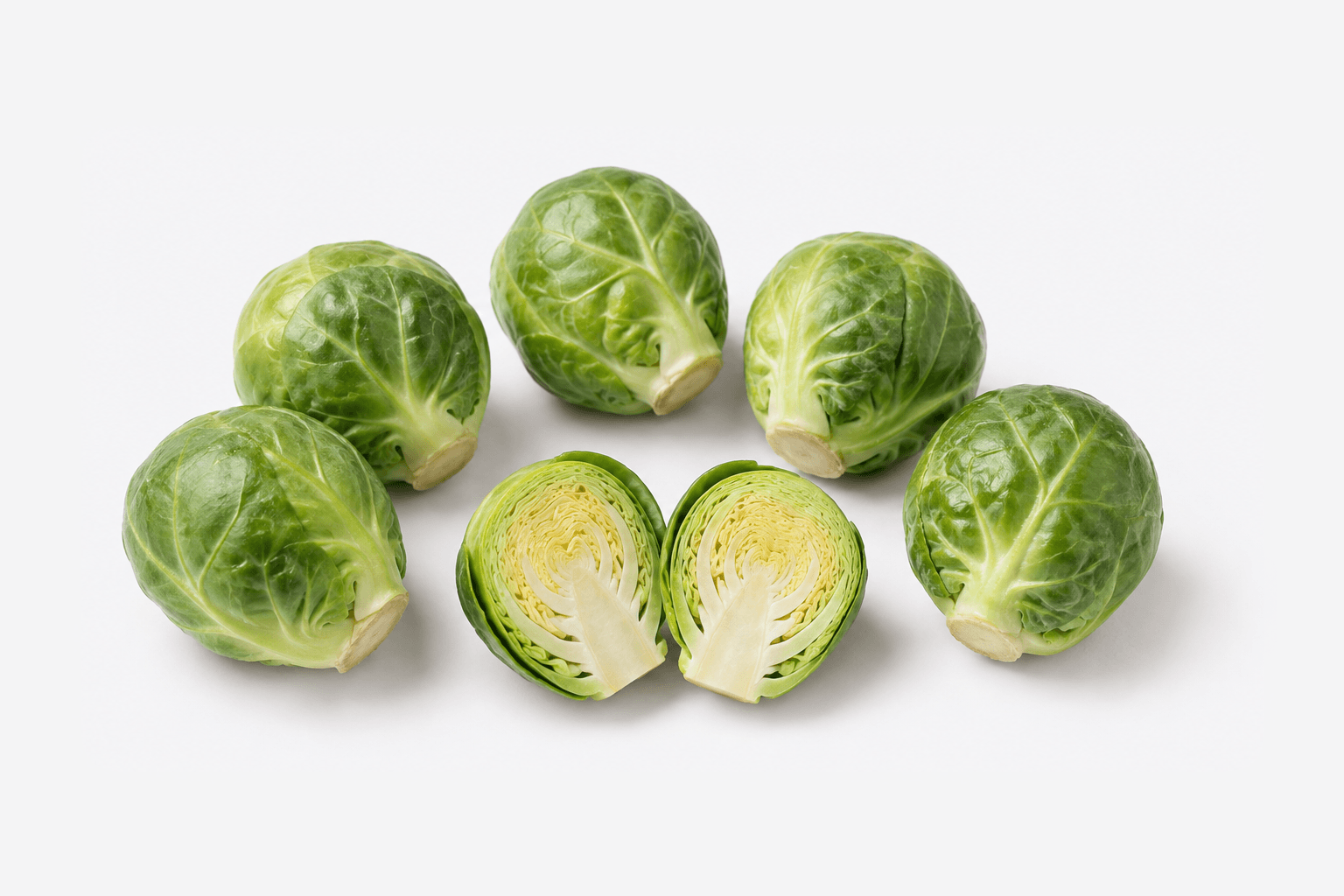
The 109 µg of vitamin K is a caution for anyone on warfarin. Not as much as Brussels sprouts (177 µg) or kale, but not trivial. This does not mean stop eating it; it means keep the amount steady.
Arugula's pepperiness and bitterness are glucosinolates, the compounds shared across brassicas — the same family as Brussels sprouts. Baby leaves are mild and mature leaves are sharp. Once it starts to flower, the bitterness climbs.
It does not take heat. Cooked, the aroma nearly vanishes and the leaves collapse. That is why it goes onto pasta or pizza after the heat is off.
Store it wrapped in damp kitchen paper in a sealed box and it keeps about four days. Standing it in water makes it go limp.
How to eat it well
- Eat it with olive oil. Vitamin K and beta-carotene are fat-soluble, and the absorption differs greatly.
- Add it off the heat. Cooking drives off the aroma and collapses the leaves.
- Baby leaves are milder. The larger and more deeply toothed the leaf, the sharper and more bitter.
- Dress it at the last moment. Acid and salt wilt it within minutes.
- Lemon juice or tomatoes alongside raise the iron absorption.
- Store it in damp kitchen paper in a sealed box. Do not stand it in water.
- If the bitterness is strong, pair it with cheese or nuts. Fat softens bitterness.
- If you are eating it for blood pressure, remember there is no way to know how many millimoles a plate holds.
How to read the grades
Each benefit carries a label showing how far research on people supports it. Grades differ between items even within the same ingredient.
- Nutrition data
- A fact verifiable from food composition databases or health authorities. This is a different kind of statement from a clinical effect.
- Strong evidence
- Consistently confirmed across randomised controlled trials or meta-analyses.
- Moderate evidence
- Human studies exist, but effect sizes are small or results are mixed.
- Early research
- Cell or animal work, or small preliminary studies.
- Not established
- Commonly claimed, but not confirmed in studies on people.
What to watch out for
- The blood pressure result above is −0.48 mmHg per millimole of nitrate. That is small, and how many millimoles a plate of arugula holds cannot be calculated, because the USDA has no figure.
- Nitrate in leafy greens varies several-fold with growing conditions. No single number applies.
- The authors themselves concluded that high-quality, population-specific studies are needed.
- If you take warfarin, account for the 109 µg of vitamin K, keep your intake steady, and speak with your clinician.
- With thyroid disease, brassica goitrogens can interfere with iodine use. Evidence that ordinary amounts matter is weak.
- It is eaten raw, so washing matters. Rinse thoroughly under running water.
- If you take blood pressure medication, discuss nitrate supplements with your clinician. They are not the same as food.
- Nitrate's effect on preventing cardiovascular events is not established.
Nutrition
Per 100 g of raw arugula. The leaves are light, so 100 g fills a large bowl; a side salad is usually 40–50 g. The USDA record carries no nitrate figure.
- Calories
- 25 kcal1%
- Protein
- 2.58 g5%
- Fiber
- 1.6 g6%
- Vitamin K
- 109 µg91%
- Calcium
- 160 mg12%
- Folate
- 97 µg24%
- Beta-carotene
- 1420 µg
- Vitamin A
- 119 µg13%
- Magnesium
- 47 mg11%
- Potassium
- 369 mg8%
- Vitamin C
- 15 mg17%
- Iron
- 1.46 mg8%
Percentages are of the US FDA Daily Value for adults and children 4 and over. National reference intakes differ by sex and age.
Calculate this alongside other ingredients →
Key nutrients
Dishes with this ingredient
Sources
The databases and health authorities this article's nutrition figures and health statements draw on.
- 1Plasma nitrate, dietary nitrate, blood pressure, and vascular health biomarkers: a GRADE-assessed systematic review and dose-response meta-analysis of randomized controlled trialsMeta-analysisNorouzzadeh M, et al. Nutrition Journal 2025PMID 40128734
- 2USDA FoodData CentralFood composition database
- 3NIH Office of Dietary SupplementsHealth authority
- 4European Food Safety Authority (EFSA)Health authority
- 5PubMedResearch literature