Contents
What it is
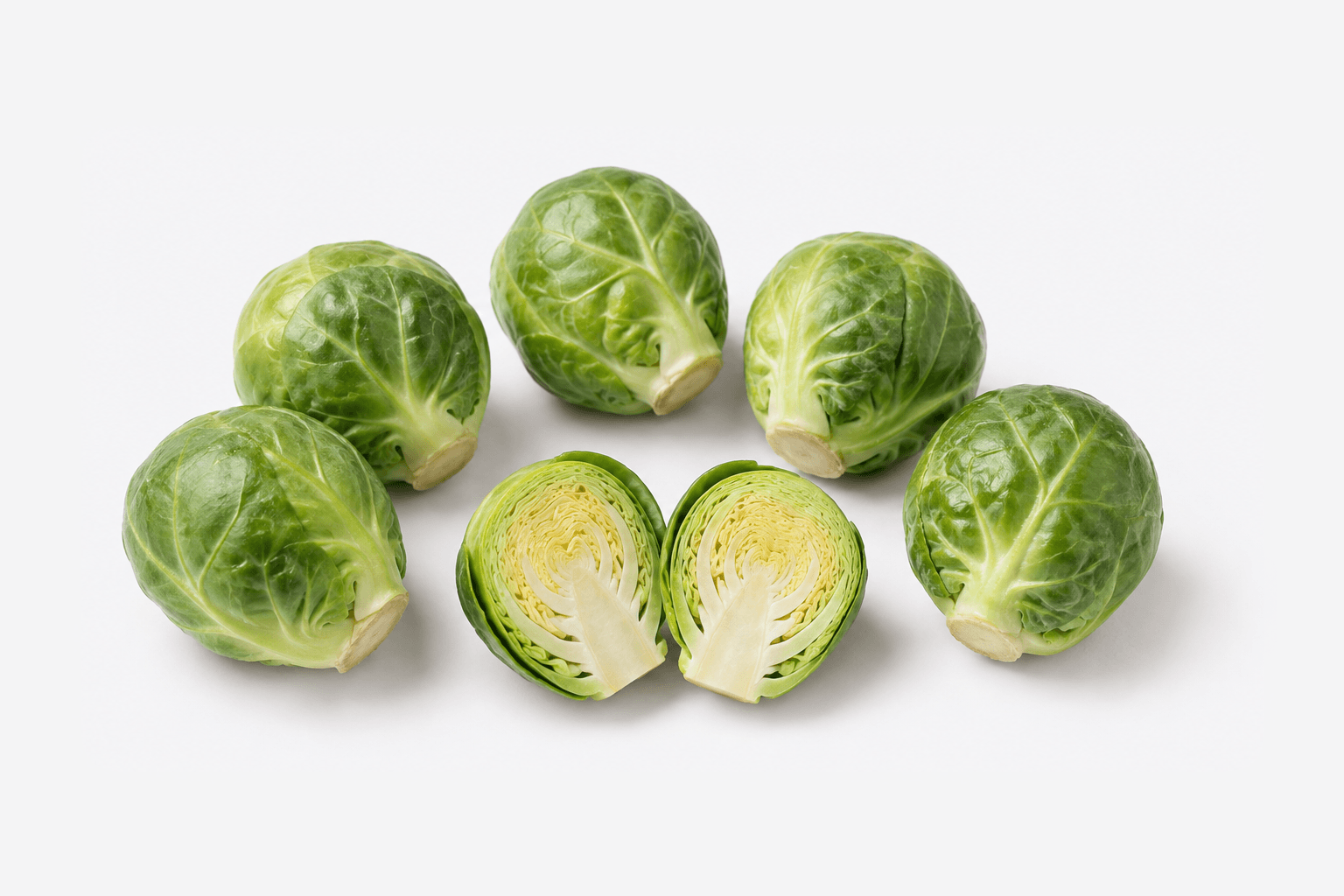
Brussels sprouts are a variety of the same species as cabbage, grown for the small buds that stud the stalk. Each one looks like a miniature cabbage, but dozens grow from a single stem rather than one head from one plant. They were developed around Brussels, which is where the name comes from. They carry some bitterness, and a frost sweetens them. Boiling them whole for a long time brings out a sulphurous smell, so halving them and searing the cut face is the better route: less bitter, nuttier.
Scientific name Brassica oleracea var. gemmifera
The first number to know about Brussels sprouts is 177 µg of vitamin K. That is in 100 g — about five sprouts — and it exceeds the adult adequate intake (120 µg for men).
For most people that is good news. If you take warfarin, it is the opposite. Vitamin K directly offsets warfarin, so a sudden increase or a sudden stop will move your INR. Read the cautions on this page first.
The second number is 85 mg of vitamin C, more than an orange's 53 mg, and 94% of the requirement in 100 g.
What about clinical evidence? There is essentially no randomised trial of Brussels sprouts alone. What exists is a dose-response meta-analysis of fruit and vegetables generally, within which cruciferous vegetables tracked inversely with cardiovascular disease, mortality and cancer. Brussels sprouts are cruciferous — but this is observational, and not the effect of this one vegetable.
Key benefits
- Moderate evidence
Cruciferous vegetables tracked with lower cardiovascular disease and mortality — observational
[1]2017, International Journal of Epidemiology. A dose-response meta-analysis pooling 95 prospective studies across 142 publications.
The overall result. For every additional 200 g a day of fruit and vegetables, the relative risks observed were:
- Coronary heart disease 0.92
- Stroke 0.84
- Cardiovascular disease 0.92
- All-cause mortality 0.90
The part broken out by type is what concerns Brussels sprouts. Green leafy and cruciferous vegetables showed inverse associations with cardiovascular disease and total mortality, and cruciferous and yellow-green vegetables showed inverse associations with total cancer risk. Brussels sprouts are cruciferous.
Risk reduction was observed up to 800 g a day (600 g for cancer).
Three things have to be stated clearly.
First, this pools observational studies, so it is not causation. People who eat more vegetables tend to smoke less, exercise more and earn more. Statistical adjustment reduces but cannot remove that.
Second, it is not "because it is a Brussels sprout". What this analysis examined is the cruciferous category. Broccoli, cabbage, kale and cauliflower sit in it too, and nothing here separates out the sprout's own share.
Third, that makes the reading simple — not "eat Brussels sprouts" but "eat more vegetables", which is also the easier thing to act on.
Hence the moderate grade. The body of data is large, but it is observational and does not single out this vegetable.
- Nutrition data
177 µg of vitamin K and 85 mg of vitamin C — more than an orange
Per 100 g of raw Brussels sprouts (about five):
- 43 kcal, protein 3.38 g, fat 0.3 g
- Of 8.95 g of carbohydrate, 3.8 g is fibre, sugar 2.2 g
- Vitamin K 177 µg — above the adult adequate intake (120 µg for men, 90 µg for women)
- Vitamin C 85 mg — 94% of the 90 mg requirement
- Folate 61 µg, potassium 389 mg, calcium 42 mg
- Vitamin A 38 µg, manganese 0.337 mg
The 85 mg of vitamin C is the surprising figure. An orange holds 53 mg; a lemon, 53 mg. Five Brussels sprouts carry more vitamin C than an orange. Cruciferous vegetables are generally high in it, and sprouts sit near the top.
But vitamin C is sensitive to water and heat. Boiling leaches a good share of it away. Steaming, roasting or a short stir-fry over high heat loses less.
Vitamin K, by contrast, holds up to heat. It is fat-soluble, so cooking does not cut it much, and eating it with oil raises absorption.
At 43 kcal with 3.38 g of protein, the protein share is high for a vegetable, and there is 3.8 g of fibre besides.
Frozen loses little. They are blanched and frozen soon after harvest, which can beat fresh sprouts that have spent days in transit.
- Nutrition data
The bitterness is glucosinolates — and the varieties have changed
There is a reason Brussels sprouts are remembered as a bad vegetable, and that reason has largely gone away.
The bitterness comes from glucosinolates, the sulphur-containing compounds common to cruciferous vegetables. When the tissue is damaged they meet an enzyme, myrosinase, and convert to isothiocyanates. That is where the bitterness and the characteristic sulphurous smell come from.
In the 1990s breeders found low-glucosinolate varieties. Dutch researchers went through old seed banks for less bitter lines and crossed them, and those crosses are what is sold today. The Brussels sprout on sale now is not the one from thirty years ago.
Cooking was the other half of the problem. Long boiling breaks the sulphur compounds down, worsening the smell and dulling the colour. Halved, oiled and roasted at 200°C for 20–25 minutes, the edges caramelise and turn sweet. It is hard to believe it is the same vegetable.
What about the health effects of glucosinolates? There is a great deal of research on isothiocyanates such as sulforaphane inducing detoxification enzymes. But there is still no randomised evidence that this changes outcomes such as cancer or death in people. The cruciferous finding in the meta-analysis above is observational too.
How bitter they taste varies by person. Variants of the TAS2R38 gene set sensitivity to particular bitter compounds. Someone who especially dislikes Brussels sprouts may not be fussy — they may genuinely be tasting more bitterness.
How to eat it well
- Halve them and roast cut side down. 200°C for 20–25 minutes, until the edges brown.
- Do not boil them. The vitamin C leaches out and the sulphur smell worsens. Steam, roast or stir-fry briefly over high heat.
- Vitamin K is fat-soluble. A little olive oil raises absorption.
- Trim the wilted outer leaves and a slice off the base. No need to cut a cross in the stem — halving does the job.
- Smaller ones are usually sweeter. Large sprouts tend to be more bitter.
- Frost makes them sweeter. Cold converts starch to sugar. The season is late autumn and winter.
- Frozen is fine. Blanched and frozen at harvest, they lose little.
- Do not blanch before roasting — the water left behind stops them browning.
How to read the grades
Each benefit carries a label showing how far research on people supports it. Grades differ between items even within the same ingredient.
- Nutrition data
- A fact verifiable from food composition databases or health authorities. This is a different kind of statement from a clinical effect.
- Strong evidence
- Consistently confirmed across randomised controlled trials or meta-analyses.
- Moderate evidence
- Human studies exist, but effect sizes are small or results are mixed.
- Early research
- Cell or animal work, or small preliminary studies.
- Not established
- Commonly claimed, but not confirmed in studies on people.
What to watch out for
- Take particular care if you are on warfarin. 100 g holds 177 µg of vitamin K. This does not mean stop eating them; it means keep your intake steady. Sudden increases or decreases move your INR. Talk to your clinician before changing your diet.
- The meta-analysis above is observational, and examined the cruciferous category rather than Brussels sprouts alone.
- With thyroid disease, cruciferous goitrogens can interfere with iodine use. The evidence that ordinary intakes matter is weak, and cooking reduces them substantially.
- With IBS, Brussels sprouts are high-FODMAP and cause gas and bloating.
- Gas is common because of the fibre and sulphur compounds. If you are not used to them, start small.
- Boiling cuts the vitamin C sharply. The 85 mg above is for raw.
- The anticancer effects of glucosinolates are not established in randomised human trials.
Nutrition
Per 100 g of raw Brussels sprouts. One sprout is about 20 g, so 100 g is roughly five. A side portion is commonly around 150 g.
- Calories
- 43 kcal2%
- Protein
- 3.38 g7%
- Carbohydrates
- 8.95 g3%
- Fiber
- 3.8 g14%
- Sugars
- 2.2 g
- Vitamin K
- 177 µg148%
- Vitamin C
- 85 mg94%
- Folate
- 61 µg15%
- Potassium
- 389 mg8%
- Vitamin A
- 38 µg4%
- Calcium
- 42 mg3%
- Manganese
- 0.337 mg15%
Percentages are of the US FDA Daily Value for adults and children 4 and over. National reference intakes differ by sex and age.
Calculate this alongside other ingredients →
Key nutrients
Dishes with this ingredient
Sources
The databases and health authorities this article's nutrition figures and health statements draw on.
- 1Fruit and vegetable intake and the risk of cardiovascular disease, total cancer and all-cause mortality-a systematic review and dose-response meta-analysis of prospective studiesMeta-analysisAune D, et al. Int J Epidemiol 2017PMID 28338764
- 2USDA FoodData CentralFood composition database
- 3NIH Office of Dietary SupplementsHealth authority
- 4European Food Safety Authority (EFSA)Health authority
- 5PubMedResearch literature