Contents
What it is
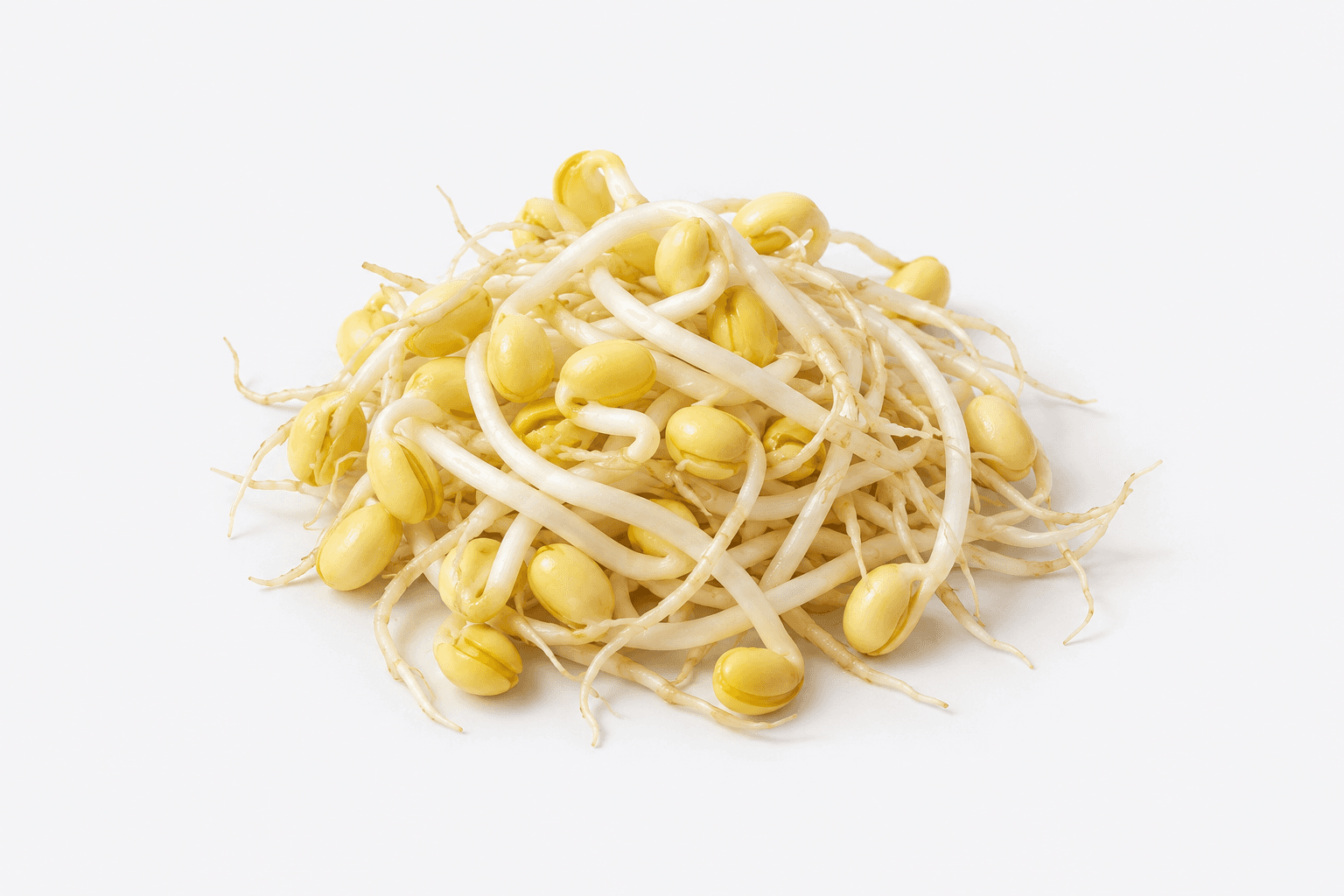
Soybean sprouts are soybeans germinated in the dark with nothing but water. They come from a different bean than mung bean sprouts and are thicker, with a larger head. Grown without light they stay pale yellow, and the defining fact about them is that vitamin C appears during germination where the dry bean had none — part of why they mattered when winter vegetables were scarce. The cooking lore about not lifting the lid partway relates to volatile compounds released while they heat, which are behind the raw, beany smell of the heads.
Scientific name Glycine max
Soybean sprout soup, seasoned sprouts, sprout rice. It is the cheapest and most common vegetable on the Korean table.
The composition is unusual. Soybean sprouts are a vegetable carrying 13.1 g of protein, because they start as soybeans. 172 µg of folate is 43% of the requirement, and the 15.3 mg of vitamin C was not in the bean at all — sprouting created it.
But one phrase follows soybean sprouts everywhere — "good for a hangover", "the aspartic acid breaks down alcohol".
This site could not find the evidence for it.
No randomised trial in people was identified in which feeding soybean sprouts changed hangover symptoms, blood alcohol or blood acetaldehyde. That sprouts contain aspartic acid and that aspartic acid reduces a person's hangover are claims at different levels. That is treated separately below.
None of which means the soup is useless. Only that the reason it helps may not be the one usually given.
Key benefits
- Nutrition data
Vitamin C that was not in the bean appears — what sprouting does
Per 100 g of raw sprouted soybeans:
- 122 kcal, protein 13.1 g, fat 6.7 g
- Of 9.57 g of carbohydrate, 1.1 g is fibre
- Folate 172 µg — 43% of the requirement
- Vitamin C 15.3 mg — 17% of the requirement
- Potassium 484 mg, magnesium 72 mg, iron 2.1 mg
- Thiamin 0.34 mg, copper 0.427 mg, zinc 1.17 mg
13.1 g of protein is extraordinary for a vegetable — nothing like spinach (2.9 g) or napa cabbage (1.2 g). Soybean sprouts sit in the vegetable aisle but start as soybeans.
The 15.3 mg of vitamin C is the interesting part. Dried soybeans hold essentially none. Sprouting made it. That is the historical reason sprouts served as a winter source of vitamin C — in the season when vegetables were scarce, they could be grown with nothing but water and darkness.
The 172 µg of folate is also boosted by sprouting.
122 kcal is high for a vegetable, because of the 6.7 g of fat carried over from the bean. In actual cooking water is added, so a bowl of sprout soup does not carry 122 kcal.
A limit of the table should be stated here.
USDA's "sprouted soybeans, raw" is closer to freshly germinated beans. Korean kongnamul is grown five to seven days, with long stems. As it grows, stored compounds move into the stem and water content rises, so the same 100 g can be composed differently. This site does not print numbers without a source, so the USDA values stand — with the note that they are not an exact match.
Head and stem differ.
- The head (cotyledon) — where the protein and fat concentrate, and where the beany taste comes from
- The stem (hypocotyl) — watery and crisp
- The root — tough, and usually trimmed off
Soybean sprouts and mung bean sprouts are different foods. These are soybeans; mung bean sprouts are mung beans. Mung sprouts are thinner and softer and cook faster, and the protein is far higher in soybean sprouts.
- Not established
"Aspartic acid cures a hangover" — no evidence was found
This entry sorts through a claim whose evidence was not found.
In Korea soybean sprouts are almost synonymous with hangover cures, and the reason always offered is aspartic acid. "It helps break down alcohol", "it clears acetaldehyde faster", the explanation goes.
Here is what this site did and did not confirm.
Confirmed — aspartic acid is an amino acid present in soybean sprouts and many other foods, and it is known that amino acid composition shifts during sprouting.
Not confirmed — any randomised controlled trial in which feeding people soybean sprouts (or aspartic acid) changed hangover symptoms, blood alcohol or blood acetaldehyde. If such a trial existed this page would read differently; it does not.
Several points follow.
First, aspartic acid is not unique to soybean sprouts. It is present broadly across protein-containing foods — meat, eggs, asparagus and more. Claims that sprouts contain particularly much are sometimes made, but even if true, that is not evidence of an effect.
Second, alcohol is metabolised by enzymes, not by amino acids. Alcohol dehydrogenase (ADH) and aldehyde dehydrogenase (ALDH2) handle it in sequence, and the speed is largely set by genotype. That is why some people flush after one drink and others do not. Evidence that food meaningfully changes the activity of these enzymes is thin.
Third, so why does the soup feel like it helps? There are more plausible explanations.
- Water — alcohol is a diuretic and causes dehydration. Broth replaces fluid
- Sodium — replacing electrolytes lost through sweat and urine
- Warmth and volume — an easy form to eat when your stomach is unsettled
- Food itself — restoring blood sugar after a long gap without eating
Those explanations belong to "hot broth", not to soybean sprouts. Dried pollack soup, seaweed soup and cabbage soup do the same job.
Fourth, the only reliable way to sober up is time. No food dramatically raises the liver's rate of metabolism.
The honest conclusion: sprout soup is not a bad choice the morning after — you need fluid, electrolytes and warm food. But no evidence was confirmed that the reason is aspartic acid.
- Nutrition data
The rule about not lifting the lid — beany smell and the practicalities
This entry is about cooking.
When boiling soybean sprouts, a rule circulates: keep the lid on from start to finish, or leave it off entirely — but never in between. Lifting it midway is said to bring out the beany smell.
There is a plausible explanation. Soybeans contain lipoxygenase, an enzyme that, when cells break and meet oxygen, degrades fats into the compounds responsible for that beany odour. Heat inactivates it.
- Lid on throughout — the temperature rises fast and the enzyme is inactivated early
- Lid off throughout — the volatile compounds that form escape
- Lifting it midway — oxygen reaches enzyme that is not yet inactivated, and the resulting smell is then trapped back in
Whether that explanation has been tested in cooking experiments, this site could not confirm. The mechanism is coherent, but it may be a scientific gloss applied to a kitchen habit. At minimum it does no harm and is widely followed.
The rest of the practicalities.
Do not remove the heads. Protein and fat concentrate in the cotyledon. People pull them off to avoid the beany taste, and in doing so discard a large share of the nutrition.
The roots are a matter of taste. They are trimmed because they are tough, not for nutritional reasons.
Do not overboil. Vitamin C is heat-sensitive and water-soluble. Three or four minutes is enough, and the texture is best then too.
Seasoned sprouts keep more vitamin C than soup. In soup it leaches into the broth — though drinking the broth recovers it.
Store them submerged in water in the fridge. Change the water once a day and they keep three or four days. Left dry they soften and brown quickly.
Discard browned sprouts, especially if the water has turned slimy.
One caution — do not eat them raw. Soybeans contain trypsin inhibitors and lectins that require heat. Sprouting reduces them but does not remove them.
How to eat it well
- Keep the heads on. The protein and fat are there.
- Three or four minutes is enough. Longer costs vitamin C and the crisp texture.
- Lid on throughout or off throughout — pick one.
- Always cook them. Raw sprouts are unsuitable because of trypsin inhibitors.
- Seasoned sprouts retain more vitamin C. In soup, drinking the broth recovers it.
- Store submerged in water in the fridge, changing it daily. Three to four days.
- If you eat them for a hangover, what helps is fluid, electrolytes and warmth, not a particular amino acid.
- Do not confuse them with mung bean sprouts, which are far lower in protein.
How to read the grades
Each benefit carries a label showing how far research on people supports it. Grades differ between items even within the same ingredient.
- Nutrition data
- A fact verifiable from food composition databases or health authorities. This is a different kind of statement from a clinical effect.
- Strong evidence
- Consistently confirmed across randomised controlled trials or meta-analyses.
- Moderate evidence
- Human studies exist, but effect sizes are small or results are mixed.
- Early research
- Cell or animal work, or small preliminary studies.
- Not established
- Commonly claimed, but not confirmed in studies on people.
What to watch out for
- This site could not confirm evidence for a hangover benefit. No randomised trial in people was found in which soybean sprouts changed a hangover measure.
- Do not eat them raw. Soybean trypsin inhibitors and lectins require heat.
- The table is USDA's "freshly sprouted soybeans" and may not match Korean kongnamul exactly.
- With gout, pulses do contain purines — though the link between pulses and gout attacks is less consistent than for meat and seafood.
- With thyroid disease, soy goitrogens can affect iodine use. Cooking reduces them.
- Avoid them with a soy allergy.
- If you restrict potassium for kidney disease, 100 g holds 484 mg.
- Throw out spoiled sprouts. If they have browned or the water is slimy, do not eat them.
Nutrition
Per 100 g of raw sprouted soybeans. The USDA entry is for freshly sprouted beans, while Korean kongnamul is grown longer with long stems, so treat the figures as indicative rather than exact. A side dish uses around 100 g.
- Calories
- 122 kcal6%
- Protein
- 13.1 g26%
- Fat
- 6.7 g9%
- Carbohydrates
- 9.57 g3%
- Fiber
- 1.1 g4%
- Folate
- 172 µg43%
- Vitamin C
- 15.3 mg17%
- Potassium
- 484 mg10%
- Vitamin B1
- 0.34 mg28%
- Magnesium
- 72 mg17%
- Copper
- 0.427 mg47%
- Iron
- 2.1 mg12%
Percentages are of the US FDA Daily Value for adults and children 4 and over. National reference intakes differ by sex and age.
Calculate this alongside other ingredients →
Key nutrients
Dishes with this ingredient
Sources
The databases and health authorities this article's nutrition figures and health statements draw on.