Contents
What it is
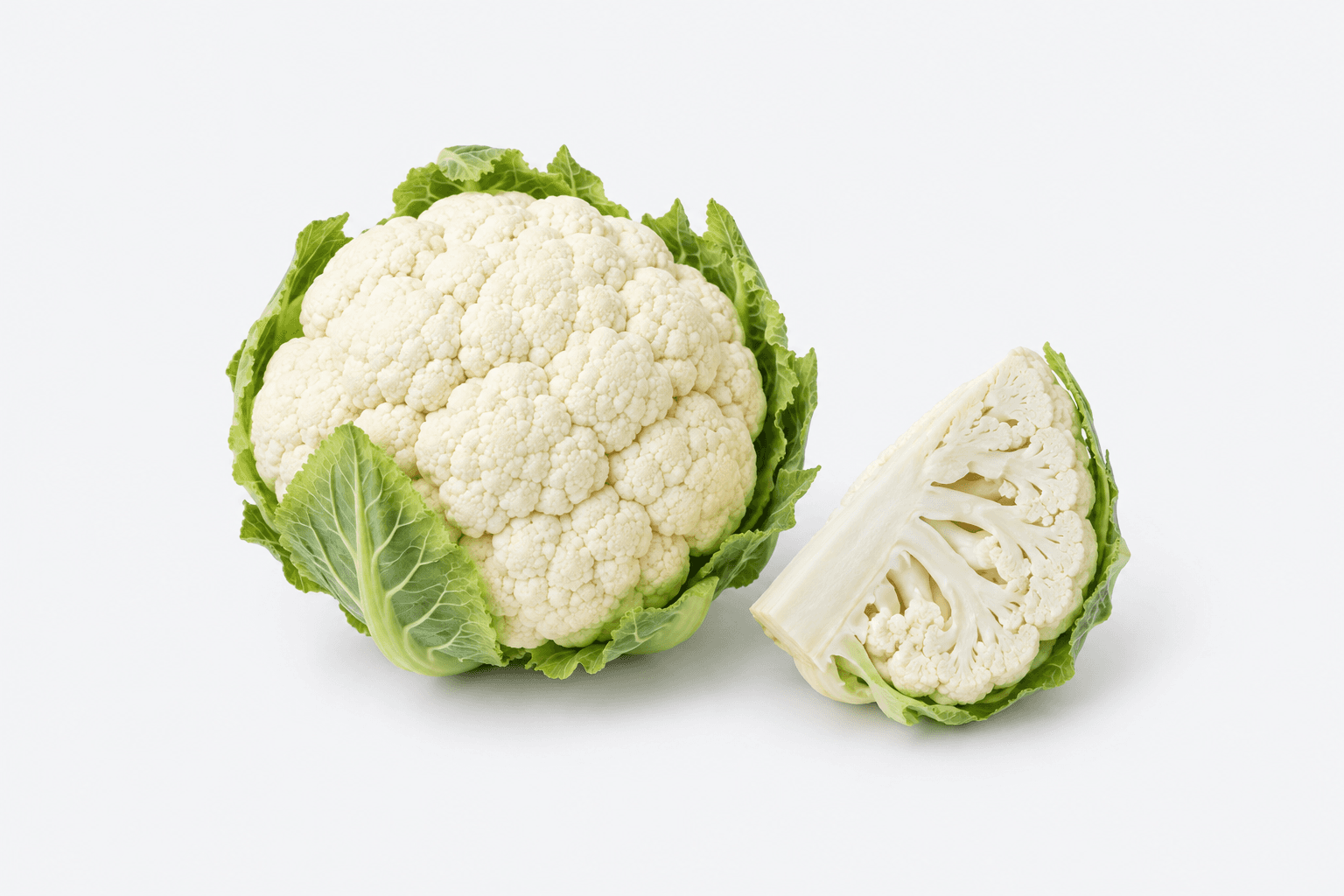
Cauliflower is another variety of the cabbage species, grown for the white head of flower tissue that stops short of actually flowering. Its closest relation is broccoli, but where broccoli is a cluster of green buds, cauliflower is a denser mass arrested at an earlier stage. It is grown with the leaves tied over the head to block sunlight, so no chlorophyll forms and it stays white. The flavour is mild and slightly starchy, which is why it is chopped fine as a rice substitute or mashed like potato.
Scientific name Brassica oleracea var. botrytis
Cauliflower's recent prominence has little to do with any standout nutrient. It comes from how its numbers sit against rice.
| Cauliflower, 100 g | White rice, cooked, 100 g | |
|---|---|---|
| Energy | 25 kcal | about 130 kcal |
| Carbohydrate | 4.97 g | about 28 g |
| Fibre | 2.0 g | about 0.3 g |
A fivefold difference. That contrast is why "cauliflower rice" spread.
But one thing should be stated plainly — cauliflower is not a nutritional substitute for rice. The point is to cut the carbohydrate rice delivers, not to deliver the same thing.
On nutrients, the vitamin C is what stands out. 100 g holds 48.2 mg, 54% of the requirement and close to an orange's 53 mg. It may seem odd that a white vegetable is high in vitamin C, but it is the norm across brassicas.
The clinical evidence comes from the cruciferous category. There is no randomised trial of cauliflower alone.
Key benefits
- Moderate evidence
Cruciferous vegetables tracked with lower cardiovascular disease, mortality and cancer — observational
[1]2017, International Journal of Epidemiology. A dose-response meta-analysis pooling 95 prospective studies across 142 publications.
The overall result, for every additional 200 g a day of fruit and vegetables:
- Coronary heart disease 0.92
- Stroke 0.84
- Cardiovascular disease 0.92
- All-cause mortality 0.90
In the analysis by type, cruciferous vegetables showed inverse associations with cardiovascular disease and total mortality, and cruciferous and yellow-green vegetables with total cancer risk. Cauliflower is cruciferous — the same category as broccoli, cabbage, kale and Brussels sprouts.
Risk reduction was observed up to 800 g a day (600 g for cancer).
Three things to state plainly.
First, it is observational. People who eat more vegetables smoke less and exercise more. Statistical adjustment cannot remove that entirely.
Second, it does not single out cauliflower. What was examined is the cruciferous category, and nothing here separates this vegetable's own share.
Third, the actionable sentence is therefore simple — not "eat cauliflower" but "eat more vegetables".
A note on glucosinolates. There is a great deal of research on these brassica compounds inducing detoxification enzymes, but there is still no randomised evidence that this changes outcomes such as cancer or death in people.
- Nutrition data
48.2 mg of vitamin C and 57 µg of folate — both fall sharply on boiling
Per 100 g of raw cauliflower:
- 25 kcal, protein 1.92 g, fat 0.28 g
- Of 4.97 g of carbohydrate, 2.0 g is fibre, sugar 1.91 g
- Vitamin C 48.2 mg — 54% of the 90 mg requirement
- Folate 57 µg — 14% of the requirement
- Choline 44.3 mg
- Potassium 299 mg, vitamin K 15.5 µg, vitamin B6 0.184 mg
The 48.2 mg of vitamin C is this vegetable's strength, close to an orange's 53 mg and about the same as a lemon. Being white has nothing to do with it.
But both it and the folate fall sharply on boiling. Vitamin C dissolves in water and degrades with heat; folate does the same. Boiling sends nearly half of it down the drain.
So the cooking method matters.
- Steaming — no contact with water, low loss
- Roasting — no water, low loss, and it turns sweet
- Stir-frying — fine if brief
- Boiling — the biggest loss. Less so if you drink the liquid
Choline at 44.3 mg is high for a vegetable. It is a nutrient mostly obtained from eggs and meat.
It is white because it grows covered by its own leaves. Without light it makes no chlorophyll — and its beta-carotene is close to zero, which is where it parts company with broccoli (361 µg), its fellow brassica.
Purple, orange and green varieties exist. Purple carries anthocyanins and orange carries beta-carotene, so their composition differs.
- Nutrition data
What to know before using it instead of rice
Cauliflower rice is a weight tool, not a replacement for rice. That distinction matters.
In numbers: a bowl of rice (210 g) is about 273 kcal and 59 g of carbohydrate. Filling the same volume with cauliflower gives roughly 50 kcal and 10 g.
So when does it fit?
- When cutting carbohydrate is the goal — yes
- When you want fullness for fewer calories — yes; the 2.0 g of fibre makes the bulk
- When you need the energy rice provides — no. If you are very active or still growing, the calories fall short
There is a texture problem too. Cauliflower is 92% water, so it weeps and goes soggy in a pan. Chop it, dry-fry it first to drive off moisture, then add the oil and the rest.
It can cause gas. Raffinose and glucosinolates are responsible. Someone unused to it who suddenly eats a bowlful will bloat. Start with half and blend it with rice.
With IBS, cauliflower is high-FODMAP. Using it instead of rice may make symptoms worse rather than better.
Frozen is convenient and loses little, being blanched and frozen at harvest. But thawing releases a lot of water, so cook it from frozen.
How to eat it well
- Steam or roast it. Boiling sends the vitamin C and folate into the water.
- Roast at 200°C for 25 minutes and the edges brown and sweeten. Use olive oil.
- To use it as rice, dry-fry it first to drive off the moisture, or it turns soggy.
- Start by blending it half and half. Switching entirely all at once brings gas.
- Cut the florets to an even size or they cook unevenly.
- The stem is edible. Just peel the tough outer layer.
- Cook frozen from frozen. Thawing releases a lot of water.
- Purple and orange varieties differ in composition — anthocyanins and beta-carotene respectively.
How to read the grades
Each benefit carries a label showing how far research on people supports it. Grades differ between items even within the same ingredient.
- Nutrition data
- A fact verifiable from food composition databases or health authorities. This is a different kind of statement from a clinical effect.
- Strong evidence
- Consistently confirmed across randomised controlled trials or meta-analyses.
- Moderate evidence
- Human studies exist, but effect sizes are small or results are mixed.
- Early research
- Cell or animal work, or small preliminary studies.
- Not established
- Commonly claimed, but not confirmed in studies on people.
What to watch out for
- The meta-analysis above is observational and examined the cruciferous category rather than cauliflower specifically.
- The anticancer effects of glucosinolates are not established in randomised human trials.
- With IBS, cauliflower is high-FODMAP. Using it instead of rice may worsen symptoms.
- Gas and bloating are common. If you are not used to it, start small.
- With thyroid disease, brassica goitrogens can interfere with iodine use; cooking reduces them substantially.
- If you take warfarin, the 15.5 µg of vitamin K is modest, but keep your intake steady.
- The 48.2 mg of vitamin C is for raw. Boiling cuts it sharply.
- Replacing rice entirely can leave you short of energy. Take care if you are very active.
Nutrition
Per 100 g of raw cauliflower. A medium head is about 600 g, and a side portion is commonly around 150 g.
- Calories
- 25 kcal1%
- Protein
- 1.92 g4%
- Carbohydrates
- 4.97 g2%
- Fiber
- 2.0 g7%
- Sugars
- 1.91 g
- Vitamin C
- 48.2 mg54%
- Folate
- 57 µg14%
- Choline
- 44.3 mg8%
- Potassium
- 299 mg6%
- Vitamin K
- 15.5 µg13%
- Vitamin B6
- 0.184 mg11%
- Calcium
- 22 mg2%
Percentages are of the US FDA Daily Value for adults and children 4 and over. National reference intakes differ by sex and age.
Calculate this alongside other ingredients →
Key nutrients
Dishes with this ingredient
Sources
The databases and health authorities this article's nutrition figures and health statements draw on.
- 1Fruit and vegetable intake and the risk of cardiovascular disease, total cancer and all-cause mortality-a systematic review and dose-response meta-analysis of prospective studiesMeta-analysisAune D, et al. Int J Epidemiol 2017PMID 28338764
- 2USDA FoodData CentralFood composition database
- 3NIH Office of Dietary SupplementsHealth authority
- 4European Food Safety Authority (EFSA)Health authority
- 5PubMedResearch literature