Contents
What it is
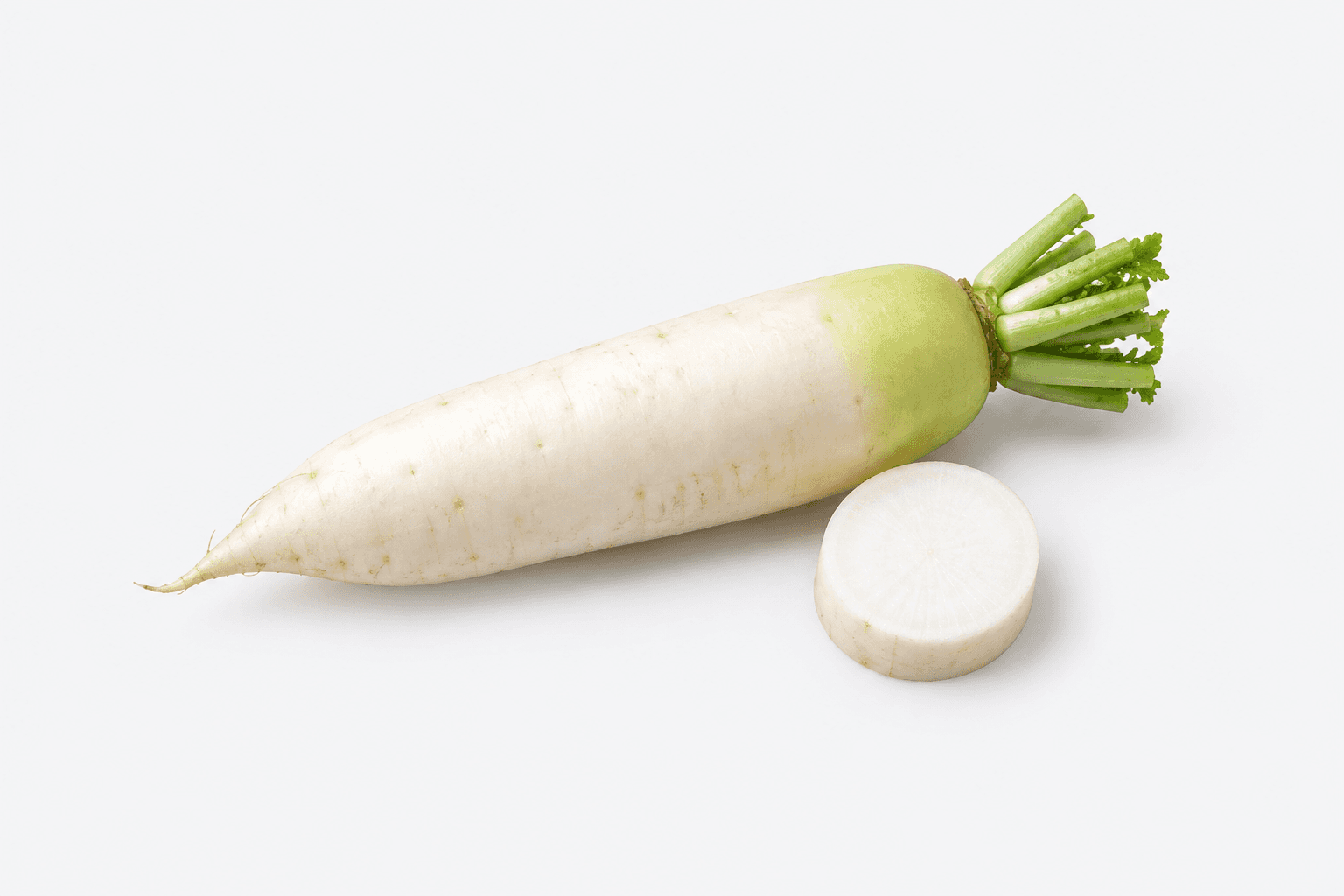
The radish is the root of a plant in the mustard family, a relative of napa cabbage, cabbage and mustard. Its heat comes from glucosinolates common to that family, released when broken cells let them meet an enzyme — which is why grating makes it hot and cooking takes the heat away and leaves sweetness behind. The Korean radish is thick and dense, sharper at the tail and sweeter at the crown. Autumn and winter are its season, when it is firmest and sweetest. The leaves are dried as siraegi and used too.
Scientific name Raphanus sativus
Daikon is one of the most-used vegetables on the Korean table — in soups, braises, fresh salads, kimchi and pickles, each in a different form.
The first thing the composition table shows is the energy. 18 kcal per 100 g. Close to cucumber (15 kcal) and below cabbage or cauliflower (25 kcal each). A 150 g chunk in a soup adds 27 kcal.
Vitamin C at 22 mg is high for a root vegetable — more than potato's 19.7 mg.
The clinical evidence comes from the cruciferous category. Daikon belongs with napa cabbage, cabbage, broccoli and cauliflower. No randomised trial of daikon alone was identified.
And there is an old claim — that radish aids digestion, that eating it with rice cake stops indigestion. It is true that radish contains enzymes such as amylase. But this site did not identify randomised evidence that this improves digestion in people. That is addressed separately below.
Key benefits
- Moderate evidence
Cruciferous vegetables tracked with lower cardiovascular disease, mortality and cancer — observational
[1]2017, International Journal of Epidemiology. A dose-response meta-analysis pooling 95 prospective studies across 142 publications.
The overall result, for every additional 200 g a day of fruit and vegetables:
- Coronary heart disease 0.92
- Stroke 0.84
- Cardiovascular disease 0.92
- All-cause mortality 0.90
In the analysis by type, cruciferous vegetables showed inverse associations with cardiovascular disease and total mortality, and cruciferous and yellow-green vegetables with total cancer risk. Daikon is cruciferous.
Risk reduction was observed up to 800 g a day (600 g for cancer).
Three things to be clear about.
First, it is observational. People who eat more vegetables tend to smoke less and exercise more, and statistical adjustment cannot remove that entirely.
Second, it does not single out daikon. What was examined is the cruciferous category.
Third, how daikon is eaten in Korea may differ from the premise of that analysis. Vegetable intake in those studies generally means fresh vegetables. Pickled daikon and radish kimchi are salted preparations, and the sodium comes with them. Counting fresh radish as a vegetable is not the same as counting pickled radish.
A note on glucosinolates. Radish's pungency comes from isothiocyanates formed when those compounds break down. There is much research on their inducing detoxification enzymes, but there is still no randomised evidence that this changes outcomes such as cancer or death in people.
- Nutrition data
22 mg of vitamin C in 18 kcal — and each part tastes different
Per 100 g of raw daikon:
- 18 kcal, protein 0.6 g, fat 0.1 g
- Of 4.1 g of carbohydrate, 1.6 g is fibre, sugar 2.5 g
- Vitamin C 22.0 mg — 24% of the requirement
- Potassium 227 mg, folate 28 µg
- Calcium 27 mg, magnesium 16 mg, copper 0.115 mg
- Sodium 21 mg
The 18 kcal defines this vegetable. It is over 94% water. Adding it generously to a soup barely moves the calories.
The 22 mg of vitamin C is heat-sensitive. Long simmering in soup loses much of it. More survives in uncooked forms — fresh salads and kimchi.
Different parts taste different, and this is a distinction cooks actually use.
- The top (near the leaves) — sweetest. Suits fresh salads.
- The middle — balanced. For soups and braises.
- The tail — the most pungent. The pungent compounds concentrate at the root tip.
The pungency is isothiocyanate, formed when grating or chewing breaks the cells and the glucosinolates meet their enzyme. Grated radish grows sharper for a while and then fades — the compound is volatile.
Winter daikon is sweeter. Cold converts starch to sugar. The season runs from late autumn through winter.
The leaves count separately. They hold far more calcium, iron and beta-carotene than the root, which is why they are dried and used as siraegi.
- Not established
The "aids digestion" claim — the enzyme is real, the evidence is another matter
This entry sorts through a claim that is not established.
"Eat radish with rice cake and you will not get indigestion" is a long-standing saying. The reason usually given is that radish contains amylase (diastase).
That fact is correct. Radish and many other vegetables contain starch-splitting enzymes.
Whether that improves human digestion is a separate question.
First, an enzyme is a protein. In the stomach, acid (pH 1.5–3.5) and pepsin break it down like any other protein. The same structure as bromelain on the pineapple page.
Second, the human pancreas already secretes plenty of amylase. There is no evidence a healthy person needs it from outside. Saliva contains amylase too.
Third, heat inactivates the enzyme. None survives in radish soup or a braise. The claim can only apply to raw or grated radish.
Fourth, this site did not identify randomised evidence in people. If there were a trial showing radish improved dyspepsia, this would be a different entry; there is not.
So why does it feel that way? Several explanations are available — radish's water and fibre can affect fullness and bowel movement, and its freshness alongside rich food may reduce the subjective sense of heaviness. But these are different mechanisms from the "digestive enzyme" story.
The honest conclusion: serving radish alongside your food is a good habit. There is simply no evidence that the reason is its digestive enzymes.
How to eat it well
- Use the parts differently. The top for fresh salads, the middle for soups and braises, the pungent tail for dishes that get cooked.
- To keep the vitamin C, do not cook it. More survives in fresh salads and kimchi.
- For soup, cut it into thin squares and sauté them first to bring out sweetness.
- Use grated radish immediately. The pungency is volatile and fades with time.
- Winter daikon is sweeter. Frost turns starch to sugar.
- Do not throw away the leaves. They hold far more calcium and beta-carotene than the root.
- Store it with the leaves cut off, wrapped in newspaper and stood upright somewhere cool. Left attached, the leaves draw moisture from the root.
- If you eat it for digestion, remember the enzymes do not survive cooking.
How to read the grades
Each benefit carries a label showing how far research on people supports it. Grades differ between items even within the same ingredient.
- Nutrition data
- A fact verifiable from food composition databases or health authorities. This is a different kind of statement from a clinical effect.
- Strong evidence
- Consistently confirmed across randomised controlled trials or meta-analyses.
- Moderate evidence
- Human studies exist, but effect sizes are small or results are mixed.
- Early research
- Cell or animal work, or small preliminary studies.
- Not established
- Commonly claimed, but not confirmed in studies on people.
What to watch out for
- The meta-analysis above is observational and examined the cruciferous category rather than daikon specifically.
- Pickled daikon and radish kimchi are salted preparations — nothing like fresh radish's 21 mg of sodium.
- No randomised evidence was identified that its enzymes improve digestion, and heat inactivates them anyway.
- With thyroid disease, brassica goitrogens can interfere with iodine use. Evidence that ordinary amounts matter is weak, and cooking reduces them.
- With IBS, radish is classed as moderate-to-high FODMAP. Symptoms may follow depending on the amount.
- If you restrict potassium for kidney disease, 100 g holds 227 mg.
- The anticancer effects of glucosinolates are not established in randomised human trials.
- The 22 mg of vitamin C is for raw. Boiling cuts it sharply.
Nutrition
Per 100 g of raw daikon radish. A medium root weighs 800 g to 1 kg, and a chunk for soup is about 150 g.
- Calories
- 18 kcal<1%
- Protein
- 0.6 g1%
- Carbohydrates
- 4.1 g1%
- Fiber
- 1.6 g6%
- Sugars
- 2.5 g
- Vitamin C
- 22.0 mg24%
- Potassium
- 227 mg5%
- Folate
- 28 µg7%
- Calcium
- 27 mg2%
- Magnesium
- 16 mg4%
- Copper
- 0.115 mg13%
- Sodium
- 21 mg<1%
Percentages are of the US FDA Daily Value for adults and children 4 and over. National reference intakes differ by sex and age.
Calculate this alongside other ingredients →
Key nutrients
Dishes with this ingredient
Sources
The databases and health authorities this article's nutrition figures and health statements draw on.
- 1Fruit and vegetable intake and the risk of cardiovascular disease, total cancer and all-cause mortality-a systematic review and dose-response meta-analysis of prospective studiesMeta-analysisAune D, et al. Int J Epidemiol 2017PMID 28338764
- 2USDA FoodData CentralFood composition database
- 3NIH Office of Dietary SupplementsHealth authority
- 4European Food Safety Authority (EFSA)Health authority
- 5PubMedResearch literature