Contents
What it is
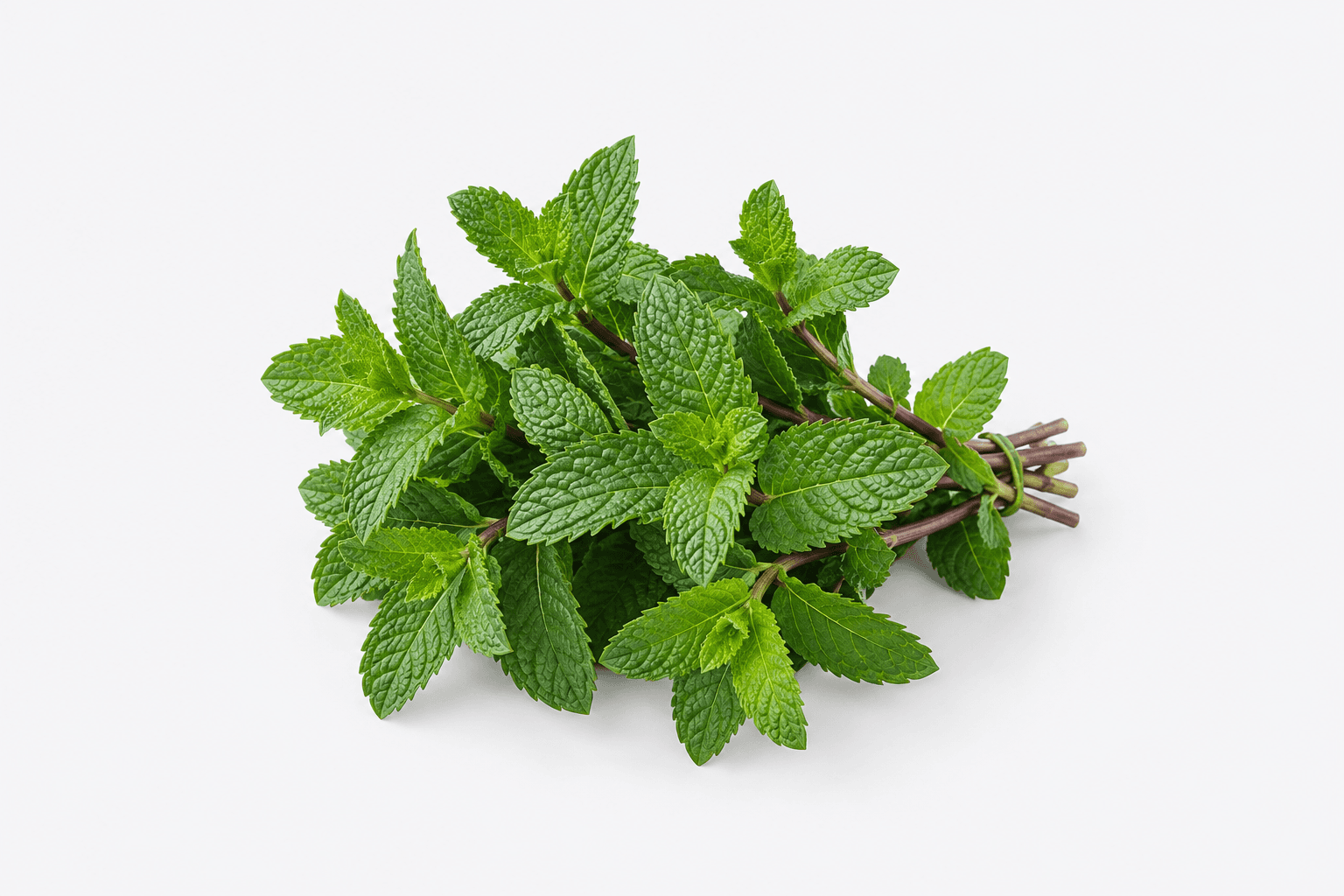
Peppermint is a mint in the mint family and, specifically, a hybrid of water mint and spearmint — that is what the × in its scientific name means. Being a hybrid it does not come true from seed and is propagated mostly from cuttings. The cooling sensation comes from menthol, which does not actually lower any temperature but stimulates the receptors that register cold. It holds far more menthol than spearmint, so the effect is much sharper. The leaves are steeped as tea, and the oil is also studied in capsule form.
Scientific name Mentha × piperita
There is evidence for peppermint. Three things have to be read together for it to be accurate.
A 2022 meta-analysis in Alimentary Pharmacology & Therapeutics pooled 10 randomised trials in 1,030 patients.
- Global IBS symptoms — relative risk of not improving 0.65 (95% CI 0.43–0.98), NNT 4
- Abdominal pain — relative risk of not improving 0.76 (95% CI 0.62–0.93), NNT 7
So far, good results. But the same paper continues.
First, adverse events were significantly more frequent — relative risk of any adverse event 1.57 (95% CI 1.04–2.37).
Second, the authors wrote in their conclusion that "quality of evidence was very low", and closed by saying adequately powered trials of peppermint oil as first-line treatment for IBS are needed.
Third, the confidence interval on that NNT of 4 runs from 2.5 to 71. It can be read as one in four people improving, or as one in seventy-one.
And the distinction that matters most — what the trials used was refined peppermint oil in enteric-coated capsules. Not peppermint tea.
Key benefits
- Early research
RR 0.65 for IBS symptoms — with adverse events at 1.57 and evidence quality "very low"
[1]2022, Alimentary Pharmacology & Therapeutics. Researchers from the Gemelli hospital in Rome, Beth Israel Deaconess in Boston, McMaster in Canada and Leeds in the UK updated their previous meta-analysis. The reason for the update matters: the abstract says it was done "particularly as recent studies have cast doubt on its role in the treatment of IBS".
The literature was searched to 2 April 2022, and 10 trials in 1,030 patients were pooled with a random-effects model.
Efficacy:
- Relative risk of global IBS symptoms not improving 0.65 (95% CI 0.43–0.98), NNT 4 (95% CI 2.5–71)
- Relative risk of abdominal pain not improving 0.76 (95% CI 0.62–0.93), NNT 7 (95% CI 4–24)
Safety:
- Relative risk of any adverse event 1.57 (95% CI 1.04–2.37) — significantly higher than placebo
The authors' conclusion, as written: peppermint oil was superior to placebo for the treatment of IBS, but adverse events were more frequent, and quality of evidence was very low.
Four ways to read this.
First, look at the confidence interval on the NNT. The NNT for global symptoms is 4, but the interval runs from 2.5 to 71. The point estimate says one in four people improves; the data cannot rule out one in seventy-one.
Second, the upper bound of that RR of 0.65 is 0.98 — close to 1.
Third, adverse events rose. The characteristic adverse event of peppermint oil is gastro-oesophageal reflux. It relaxes the lower oesophageal sphincter, which is exactly why the enteric coating exists: to get the capsule past the stomach and open it in the intestine.
Fourth, "very low quality of evidence" is the lowest grade in the GRADE system. It means the estimate may differ substantially from the true effect.
Hence this site grades it early. It is a meta-analysis with significant results, but the authors themselves assigned the lowest possible grade to the evidence.
- Not established
Tea and oil are not the same — the trials used capsules
This entry corrects a common misreading.
What those trials used was refined peppermint oil in enteric-coated capsules. A capsule typically holds 180–225 mg of oil, taken two or three times a day.
A cup of peppermint tea does not deliver that. Steeping 2 g of dried leaf extracts only a fraction of the essential oil, and what does come out is volatile, so a good share leaves as steam in hot water. That is the reason behind the tip of covering the cup.
The enteric coating is the crux. Menthol, peppermint oil's main component, relaxes smooth muscle. In the intestine that reduces spasm; in the stomach and oesophagus it causes reflux. The coating is a device for carrying the capsule past the stomach so it opens lower down. Tea has no such device.
Does that make peppermint tea useless? There is no basis for saying that either. The accurate statement is that the numbers in the meta-analysis above cannot be applied to tea. This site did not identify separate randomised evidence for tea.
The same goes for fresh leaves in cooking. A handful is about 5 g, and the essential oil in it is far below one capsule.
Take care if you have reflux oesophagitis. Whether as tea or oil, menthol relaxes the lower oesophageal sphincter. For someone with symptoms it can be an aggravating factor rather than a help.
- Nutrition data
The table is per 100 g, but you eat 2–5 g
Per 100 g of fresh peppermint leaves:
- 70 kcal, protein 3.75 g, fibre 8.0 g
- Calcium 243 mg, iron 5.08 mg, magnesium 80 mg
- Potassium 569 mg, manganese 1.18 mg
- Vitamin A 212 µg, folate 114 µg, vitamin C 31.8 mg
- Riboflavin 0.266 mg
On the numbers alone it looks excellent. 243 mg of calcium is more than twice milk's 113 mg, and 5.08 mg of iron beats beef.
But nobody eats 100 g. This is the correction always needed when reading a herb's composition table.
Converted to real amounts:
100 g A cup of tea (2 g) A handful in cooking (5 g) Calcium 243 mg 4.9 mg 12 mg Iron 5.08 mg 0.10 mg 0.25 mg Vitamin A 212 µg 4.2 µg 11 µg Folate 114 µg 2.3 µg 5.7 µg A cup of tea gives you 4.9 mg of calcium — 0.5% of a day's requirement.
And tea is an infusion, so not even all of the leaf's minerals make it into the water. The real figure is lower still.
This site prints the table not to invite you to expect nutrition from it, but to show in numbers why you should not. Peppermint is eaten for its aroma and for digestive symptoms, not for nutrients.
The aroma is menthol. It stimulates the cold receptor TRPM8 in the mouth, so it feels cold regardless of actual temperature — the exact mirror of capsaicin in chilli stimulating heat receptors.
How to eat it well
- Cover the cup when you brew it. The essential oil is volatile and escapes from an open cup.
- Slap fresh leaves once between your palms before adding them. The cells burst and release the aroma; chopping with a knife blackens them.
- Add it to food off the heat. Cooking drives the aroma away.
- Fresh smells better than dried, though dried keeps more easily.
- Discard the stems. They taste bitter.
- Store wrapped in damp kitchen paper in a sealed box. Standing it in water makes the leaves limp.
- If you are taking it for IBS, remember the trials used enteric capsules, not tea — and speak with your clinician.
- If you have reflux symptoms, peppermint is better avoided.
How to read the grades
Each benefit carries a label showing how far research on people supports it. Grades differ between items even within the same ingredient.
- Nutrition data
- A fact verifiable from food composition databases or health authorities. This is a different kind of statement from a clinical effect.
- Strong evidence
- Consistently confirmed across randomised controlled trials or meta-analyses.
- Moderate evidence
- Human studies exist, but effect sizes are small or results are mixed.
- Early research
- Cell or animal work, or small preliminary studies.
- Not established
- Commonly claimed, but not confirmed in studies on people.
What to watch out for
- The authors of the meta-analysis above graded the evidence "very low" — the lowest grade in the GRADE system.
- Adverse events were significantly more frequent than placebo (RR 1.57, 95% CI 1.04–2.37).
- The trials used refined oil in enteric capsules. These results do not transfer to tea or fresh leaves.
- Avoid it with reflux oesophagitis or hiatus hernia. Menthol relaxes the lower oesophageal sphincter and can worsen symptoms.
- With gallstones or biliary obstruction, discuss peppermint oil supplements with your clinician.
- Do not apply menthol products to the face or around the nose of infants. Laryngospasm has been reported.
- Peppermint oil supplements can affect the metabolism of some drugs. Check if you take medication.
- Do not mistake the 100 g figures for what you actually consume. A cup of tea is 2 g.
Nutrition
Per 100 g of fresh peppermint leaves. In practice a cup of tea uses 2–3 g and a handful in cooking is about 5 g, so you get 3–5% of these figures. What the trials below used was refined oil in enteric-coated capsules, not the leaf.
- Calories
- 70 kcal4%
- Protein
- 3.75 g8%
- Fiber
- 8.0 g29%
- Calcium
- 243 mg19%
- Iron
- 5.08 mg28%
- Magnesium
- 80 mg19%
- Potassium
- 569 mg12%
- Manganese
- 1.18 mg51%
- Vitamin A
- 212 µg24%
- Folate
- 114 µg28%
- Vitamin C
- 31.8 mg35%
- Vitamin B2
- 0.266 mg20%
Percentages are of the US FDA Daily Value for adults and children 4 and over. National reference intakes differ by sex and age.
Calculate this alongside other ingredients →
Key nutrients
Dishes with this ingredient
Sources
The databases and health authorities this article's nutrition figures and health statements draw on.
- 1Systematic review and meta-analysis: efficacy of peppermint oil in irritable bowel syndromeMeta-analysisIngrosso MR, et al. Alimentary Pharmacology & Therapeutics 2022PMID 35942669
- 2USDA FoodData CentralFood composition database
- 3NIH Office of Dietary SupplementsHealth authority
- 4European Food Safety Authority (EFSA)Health authority
- 5PubMedResearch literature