Contents
What it is
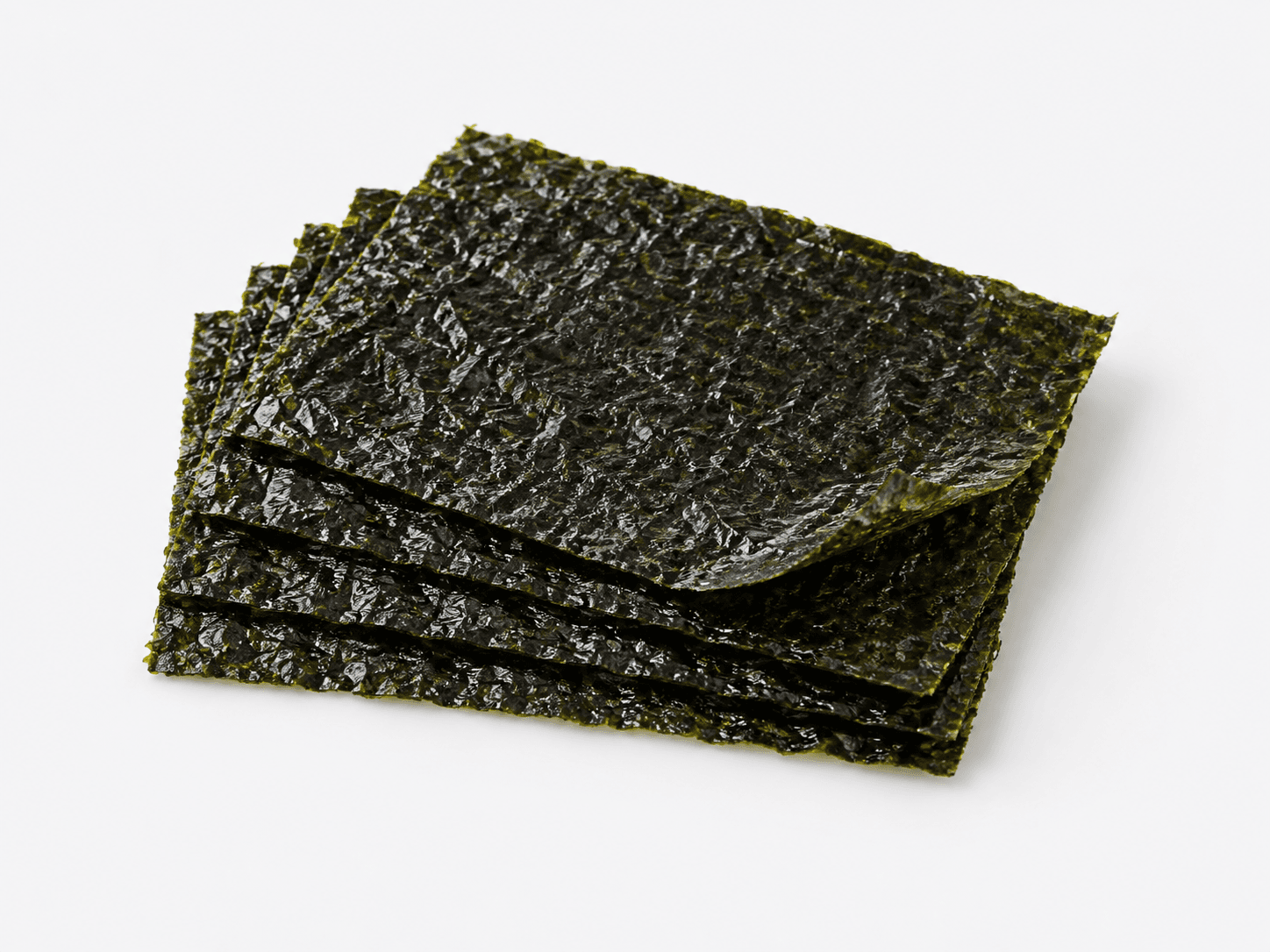
Gim is a red seaweed spread thin and dried into sheets. It looks like paper but grows as algae clinging to rock; the sheet form comes from a process much like making hanji paper — the weed is broken up in water, spread on a screen and dried. It is eaten in Korea, Japan and China. Dried and untoasted it is dark red and leathery; toasting turns it green and crisp, because heat breaks down the red pigment first. It takes up moisture fast, so it is kept sealed.
Scientific name Pyropia
One line has been repeated for years in plant-based nutrition: 'seaweed lists B12, but it is an analogue the body cannot use.' For many seaweeds that is true.
Laver was suspected to be an exception, and in 2024 someone tested it directly in people. The result went laver's way.
One more thing worth straightening out. Gim is a red alga; sea mustard and kelp are brown algae. Most of the iodine discussion concerns the brown ones, yet it gets applied to gim as though they were the same.
Key benefits
- Early research
It genuinely raised vitamin B12 levels in vegetarians
[1]Thirty vegetarians not using supplements were randomised into three groups for four weeks: no nori, 5 g a day (targeting 2.4 µg of B12), or 8 g a day (targeting 4 µg).
At 5 g a day alone, serum B12 rose 59 pmol/L above control (95 % CI 25–93, P = 0.0014), active holotranscobalamin rose 28.2 pmol/L, and homocysteine fell 3.7 µmol/L. The 8 g group did no better — the response had already plateaued at 5 g.
But this was 30 participants in an open-label trial with no blinding. Too small to settle the question. Still, it is enough to unsettle the idea that all seaweed B12 is useless. Five grams of dried nori is about two or three gimbap sheets.
- Nutrition data
It carries vitamin A, folate and riboflavin
Raw laver holds 260 µg RAE of vitamin A per 100 g, converted from the 3,120 µg of beta-carotene it contains. Folate is 146 µg and riboflavin 0.45 mg.
But do not forget that a sheet weighs 2–3 g. 100 g is more than thirty sheets. A sheet or two does not deliver these numbers. Gim earns its place not through absolute quantity but by carrying small amounts of things that are hard to get elsewhere.
- Nutrition data
The iodine worry belongs to sea mustard and kelp
[2][3]The survey of iodine intake in Koreans covered brown seaweed only — sea mustard and kelp. It found a daily average of 559 µg: 96 µg from sea mustard, 116 µg from kelp, and 348 µg from kelp broth alone.
Gim was not part of that survey. It is a red alga, a different group, and its iodine content is not the same. Transferring cautions about daily seaweed soup onto gim does not follow.
In a Korean study of thyroid cancer, higher gim intake actually came with lower risk (odds ratio 0.50, 95 % CI 0.30–0.83), while sea mustard and kelp showed no significant association. It is observational — do not read it as cause and effect.
How to eat it well
- For B12, choose plain gimbap sheets over seasoned gim. The trial used roasted nori; seasoned gim carries salt and oil in the same weight.
- If it goes soft, pass it briefly over a dry pan — no oil, low heat, a few seconds a side.
- Store sealed and cool. Gim absorbs moisture, and the aroma goes first. Keep the desiccant packet in.
- Pair the iron with vitamin C. Gim's iron is non-haem. Conveniently, gim also contains vitamin C.
- A sheet is 2–3 g. Two or three a day is realistic and costs nothing in energy.
How to read the grades
Each benefit carries a label showing how far research on people supports it. Grades differ between items even within the same ingredient.
- Nutrition data
- A fact verifiable from food composition databases or health authorities. This is a different kind of statement from a clinical effect.
- Strong evidence
- Consistently confirmed across randomised controlled trials or meta-analyses.
- Moderate evidence
- Human studies exist, but effect sizes are small or results are mixed.
- Early research
- Cell or animal work, or small preliminary studies.
- Not established
- Commonly claimed, but not confirmed in studies on people.
What to watch out for
- Seasoned gim adds salt and oil. Plain laver is low in sodium; seasoned is not. If you get through several packs a day, count it.
- If you are being treated for thyroid disease or are scheduled for a radioiodine study, discuss seaweed with your clinician. Gim has less iodine than sea mustard or kelp, but not zero.
- If you have a diagnosed B12 deficiency, do not try to fix it with gim. That trial looked at improving nutritional status in vegetarians, not at treating deficiency. Diagnosed deficiency is managed with injections or high-dose supplements.
- Seaweed allergy is rare but real.
- Fragments of shellfish or organisms growing on the seaweed can remain, so severe shellfish allergy warrants caution.
Nutrition
Per 100 g of raw laver. A single sheet of dried gim weighs about 2–3 g.
- Calories
- 35 kcal2%
- Protein
- 5.8 g12%
- Carbohydrates
- 5.1 g2%
- Vitamin A
- 260 µg29%
- Beta-carotene
- 3,120 µg
- Vitamin C
- 39 mg43%
- Vitamin E
- 1.0 mg7%
- Folate
- 146 µg36%
- Iron
- 1.8 mg10%
- Potassium
- 356 mg8%
- Vitamin B2
- 0.45 mg35%
Percentages are of the US FDA Daily Value for adults and children 4 and over. National reference intakes differ by sex and age.
Calculate this alongside other ingredients →
Key nutrients
Dishes with this ingredient
Sources
The databases and health authorities this article's nutrition figures and health statements draw on.
- 1Effect of roasted purple laver (nori) on vitamin B(12) nutritional status of vegetarians: a dose-response trialClinical trialHuang QN, et al. Eur J Nutr 2024PMID 39352476
- 2Iodine intake from brown seaweed and the related nutritional risk assessment in KoreansResearch literatureKwon SO, et al. Nutr Res Pract 2024PMID 38854470
- 3Seaweed and Iodine Intakes and SLC5A5 rs77277498 in Relation to Thyroid CancerResearch literatureHoang T, et al. Endocrinol Metab (Seoul) 2022PMID 35607818
- 4USDA FoodData CentralFood composition database
- 5MFDS Food Composition Database · 식품안전나라Food composition database
- 6NIH Office of Dietary SupplementsHealth authority
- 7PubMedResearch literature